Writing

Genre Fixation: Upmarket Fiction

In several posts, I have raged against the literary fiction v. genre fiction situation in the publishing world. One is held in high regard yet is often boring, the other is derided as trite or too commercial. As a writer who finds herself stuck in the middle of these two extremes and utterly frustrated by the hundreds of descriptors for genre and style, I never felt my work fit in any one category.

This week I discovered a new genre, upmarket fiction. This is the definition from editor Robb Grindstaff, “From an audience perspective, upmarket means fiction that will appeal to readers who are educated, highly read, and prefer books with substantive quality writing and stronger stories/themes. Upmarket describes commercial fiction that bumps up against literary fiction, or literary fiction that holds a wider appeal, or a work straddles the two genres.” The Book Genre Dictionary defines it as “Books in the upmarket fiction genre are made up of stories that merge the commercial and literary genres. The books appeal to well-read, sophisticated readers who want a high quality and complexity of writing, but that also have strong characters and plot. Upmarket genre books are often book club titles and inspire not only enjoyment of the story in a reader, but thought and discussion as well. The books consist of many layers of meaning and emotion, making them more complex.”

I must admit that I saw the definition and went, YES! This is what I have been looking for when describing my work. I’m not all genre and I’m not all literary, I’m somewhere in between. It’s always disappointing when readers see steampunk or historical fantasy and assume it will be action-packed. Sorry, readers, mine is not. There is action, but I find myself more focused on my characters. What are they going through? How are their lives affected by the events of the story? How are they changing through each story/trauma? I like to think of my characters are humans rather than archetypes or unchanging figures, which you sometimes see in suspense or action series where the main character goes on adventures through dozens of books. They stay in character for the entire series, but they do so at the expense of growth.

At its heart, I think this is what upmarket fiction is. It’s a book with genre fiction aesthetics (such as being set in a fantasy world, alternate history, or dystopia), but rather than focusing on the action only, the author pays more attention to the characters and plot than how much action drives it. The downside to upmarket is it sounds a bit… snobby. The main issue is where the definitions suggest only highly educated people will like upmarket, but I think what they really mean is people who want more than just 300 pages of action. Upmarket readers want a deeper connection to the plot and characters. They value complexity in not only the characters’ psyches but the plot. They want a book that makes them think.

I also tend to be a reader of upmarket fiction. I get frustrated with literary fiction when it’s a hundred pages longer than it ought to be and tends to ramble. With genre fiction, I get frustrated when the characters don’t change or don’t react appropriately to the horrors they are dealing with. A monster just tore his best friend to shreds, yet he decides to make out with his girl friend and only mourn his loss for two sentences. I need more substance but not the point of literary fiction where it once again becomes insubstantial.

Some upmarket books would be: The Golem and the Jinni, Water for Elephants, Jonathan Strange & Mr Norrell, and The Left Hand of Darkness.


If you would like news about new releases, promos, and previews of future projects, please sign-up for my newsletter.

newsletter button

Writing

Success and the Awkward Authoress

For a type-A personality, success is a tricky thing to navigate and define. I thrive off getting good grades and being told that I’m at the top of the class. In writing, I’m definitely not at the top of the class. I’m not even in the middle. I’m at the bottom of the totem pole, trying to pull my way up. It’s been quite a while since I haven’t been at the top or a competitor, and it’s disconcerting to know that you’re a nobody.

I know I’m a newbie to the world of self-publishing. It’s been less than a year since I published my first book, and I’ve not only had sales every month but I’ve gotten a few loyal readers who love my books and characters. There is no reason for me to complain, but part of me wonders if I’m succeeding or failing. In this industry, I can’t rely on grades to tell me whether or not I’m doing well. You can’t rely on sales rankings because while you made a sale, you may not have added a reader. You can’t even rely on reviews because you aren’t tailoring the story to the reader as you would an assignment for a professor. Some readers will love it, others will be ambivalent, and a few will hate it. People won’t get it, and you’ll be frustrated that they didn’t see your vision. You can’t go and say anything to explain your point of view, all you can do it hope someone else gets it. It’s frustrating. It makes you question if you’re doing as well as you hoped or thought you were.

The key is to define what success is to you. It’s so much easier said than done, but when you figure out what success is to you, you can determine whether or not you’re actually failing or simply lacking confidence. Do you want to sell a lot of books each year or do you want to gain a larger readership? Do you want consistently high ratings on your books or do you want to grow with each book?

As I’ve written more and gotten deeper into the publishing process, I have found that what I care about are: gaining new readers and improving the quality of my writing with each book. Unfortunately, you need sales to get readers, but I’d rather have ten very loyal readers than a hundred ambivalent ones. In terms of quality, I know my first book is not my best work, and I’m okay with that. I’ve grown since I published it a little over a year ago, and I should have. With each successive book, I should get better. I should improve and grow and experiment. That’s what art and writing are about. The good thing is I know book two is even better than book one, so I guess in that area, I’m successful.

In this area, I find myself battling logic and emotion. Logically, I know that most writers aren’t successful in multiple areas (readership, sales, improvement, notoriety, etc.) until they have at least five books out and do a lot of marketing and connecting. Emotionally, I’m upset that I don’t feel that I’m doing as well as I should. I also realize that no matter how many sales, readers, or 5 star reviews I had, I would still probably feel insecure. This state of mind always worsens when I’m feeling stuck in my current writing project, and guess where I am currently– floundering in planning my next chapter. In order to not fall into this trap (or at least not as often), writers need to define what success is to them and work towards those goals.

What do you define as success?


If you would like news about new releases, promos, and previews of future projects, please sign-up for my newsletter.

newsletter button

Writing

10 Bookish Confessions

To prove that I am a human being and to hopefully connect with my readers, I occasionally like to do “about me” posts. This time, I thought I would write ten book-related confessions about myself. Seems fitting for a blog about writing and books… and writing books.

  1. My favorite classic is Jane Eyre. I read it in 2013, and I was in love with Jane and Rochester (especially Rochester). Since then, I think I’ve read bits and pieces of it about four times. There’s something about a man whose ugly-handsome, scandalous, and willing to dress as a woman just to troll his date(s).
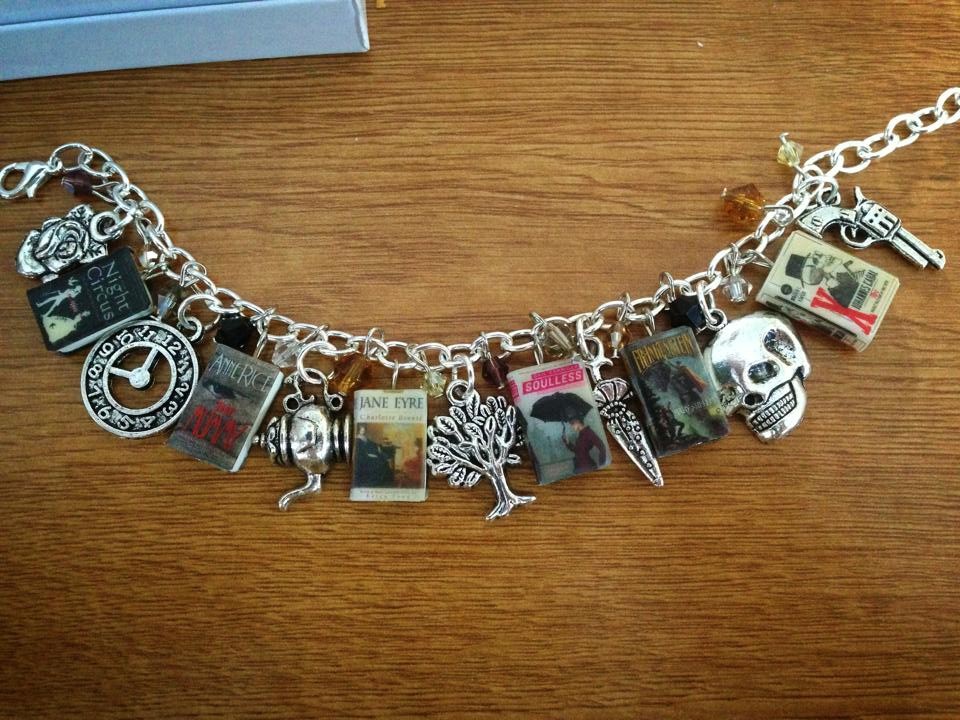
  2. I have a bracelet of some of my favorite novels. Yes, I’m a lit nerd, so much so that I commissioned an artist on Etsy to make a charm bracelet for me of my favorite books. The books in the pic are The Night Circus, The Mummy by Anne Rice, Jane Eyre, Souless, Frankenstein, and Johannes Cabal: Necromancer.bracelet
  3. My pets names have a literary theme. My dog’s name is Edgar, after Edgar Allan Poe. My cat’s name is Sherlock (Holmes), even though he’s more like a pudgy, blundering Watson, and my other cat, who passed when he was a kitten, was named Erik after the Phantom of the Opera.
  4. My favorite type of writing is that which is sensual and well-written. I love great plots and I love characters that grow, but what really draws me into a work is being immersed in it body and soul. I want to see it, I want to hear it, I want to experience every emotion that character is feeling. If the sentences aren’t good or the writing is flat, it immediately drops to three stars in my mind.
  5. My preferred format of book is paperback. I’m warming up to ebooks, but a paperback is still my favorite way to read a book. I like to hold it, display it, let others borrow it, and show it off, and with ebooks, I can’t do that. I tend to not read hardcovers because they’re cumbersome to lug around. My bag already is cripplingly heavy, and a two pound book doesn’t help. Also, I just find their bulk harder to hold. That and the ever shifting and sliding book sleeve.
  6. I’m a book-finisher. I can probably count one hand the books I’ve put away permanently because they were so bad. No matter how god-awful the book is, I feel the need to finish it. It may be cutting off my nose to spite my face, but there’s a part of me that still hopes the book will get better. Plus, no one can tell me that I missed the good part. No, my review stands because I read and finished the book.
  7. I will read erotica or romance, but I hate naked people on book covers. It’s a pet peeve of mine. I know sex sells, but not to me. I hate half-naked men and women equally. I don’t want to see your giant man-pecks or your pert derriere. An understated cover that is closer to sensual or intriguing than arousing is more my style. I tend to avoid books like that. This is also why I am on the look out for a better version of Teleny. I am embarrassed by the cover (not only half-naked but hideously drawn).
  8. Of my two books thus far, The Winter Garden is my favorite. I know we aren’t supposed to have favorite children, but I really, really love book two more than book one. There’s been so much personal and professional growth since I wrote The Earl of Brass, but I also just love the characters. Out of all of my characters, I think I connect the most with Immanuel. The Winter Garden is also a much darker story, and as a writer, I thoroughly enjoy writing twisted characters and delving into some rather complex emotions.
  9. I have a thing for fancy bookmarks yet rarely use them. I love fancy bookmarks. Ones with tassels, fabric ones, paper ones, metal ones, ones that are silly, ones that are artsy. It doesn’t matter, I want them. Oddly, I tend to use scraps of paper or folded post-its most often. Over the years, I’ve lost a lot of beautiful bookmarks, so now, I’m afraid I’ll lose them. Currently, I’m actually using adorable silicone seedling bookmarks my cousin got me.
  10. My favorite genres are: historical fiction, historical fantasy, and Gothic horror. When I say Gothic horror, I’m thinking like Dorian Gray or Anne Rice’s Vampire Chronicles. Horror with some upper class panache. If the book has a tie to the past and is able to submerge me in it from cover to cover, I’m sold.

Well, there you go. Ten bookish things about the Awkward Authoress.


If you would like monthly updates about research, book reviews, and interesting articles, please sign-up for my newsletter by clicking the button below.

newsletter button

Writing

7 Tips for Editing Your Manuscript

editing

I have a love-hate relationship with editing.

Being the type of person who is appalled and embarrassed to have others discover mistakes in my work, I use editing as a way to polish my work before I show it off to anyone.  I have one alpha reader who reads most of my work while it is in progress because she is the most familiar with my characters and can often judge if I have a scene or reaction makes sense, and of course she sees my work in its unedited glory.  She is also my best friend and a fellow writer, who isn’t afraid to say, “Uh, what were you thinking?”  No one else should see it that way.  To me, an unedited work is like being in your underwear.  You don’t necessarily want everyone to see you in that state. Continue reading “7 Tips for Editing Your Manuscript”

Writing

Finishing Book Two and What I Learned Along the Way

wg manuscriptIt’s done.  The Winter Garden is done.

Well, the story is finished.  While I was stuck on the third to last chapter (yes, I had finished the epilogue and part of the pen-ultimate chapter before I started that one), I decided to edit the first twenty-seven chapters.  Now, the editing is done as well and The Winter Garden (Ingenious Mechanical Devices #2) is off to my beta readers! Until they get back to me with their feedback, I will be taking a little hiatus from Emmeline, Immanuel, and Adam.  Every time I finish a novel, it’s a bit depressing.  I’m done with the characters (for now), the plot is finished, the bad guys have been dealt with, and now, I need to step back.  In my next post, I will discuss editing in more detail, but for now, I would like to impart what I have learned after publishing my first book and finishing my second. Continue reading “Finishing Book Two and What I Learned Along the Way”

Writing

Advertisement and the Awkward Authoress

Marketing has never been my strong suit.  I always worry about where the line is between good marketing and being absolutely obnoxious. Typically I air on the side of caution and not get on my box with a megaphone and shout about my book like a sideshow barker, but on Sunday and Monday, my book was on sale for 99 cents and I went to town advertising.  I convinced my boyfriend/in-house artist to create an ad banner for me along with a new banner for my Facebook and Twitter pages.  I also paid $15 to have the Ereader News Today advertise it in their email newsletter and website.  From Sunday morning to mid-day Monday, I was hustling.  On both of my pages, I posted the advertisement banner along with a little message saying to please share the picture and spread the word, and guess what, people did! Continue reading “Advertisement and the Awkward Authoress”

Personal Life · Writing

Spring Semester, Sales, and Stories

eob 99c promo

I have realized that when the semester begins again, I am horrible about updating my blog (I’m going to try to work on that this time).  It has been a crazy week but a good one.

This week was the beginning of the spring semester at my university.  At the beginning of each semester I am a bundle of nerves complete with tension headaches and the urge to vomit.  Last semester began with me coming home my second day there and crying at my kitchen table for feeling like an inadequate fraud after I didn’t know who Kerouac and Carver were.  Continue reading “Spring Semester, Sales, and Stories”

Personal Life

Migraines and Deadlines

As the saying goes, “Even the best laid plans go awry.”

Earlier in the week, I decided to set up the Kindle pre-order of The Winter Garden (IMD #2), and of course, I made a schedule for what I need to accomplish each day for the next two weeks.  Each day, I planned to edit about 5 chapters while finishing up the ending.  Luckily, I built in quite a bit of padding and I figure I will be able to get it done by March 31st (technically the 21st because that is when Amazon needs the final file), but I am sick. Continue reading “Migraines and Deadlines”

Writing

Series Introduction: The Ingenious Mechanical Devices

As I was trying to figure out what to write for my next blog post, I realized I never introduced the series The Earl of Brass and The Winter Garden are part of. The title of the series, The Ingenious Mechanical Devices, was taken from the name of a book by Al-Jazali called The Book of Knowledge of Ingenious Mechanical Devices.  The book was written in 1206 and describes over fifty automaton devices, such as mechanical clocks, pistons, programmable robots, automatic gates, and many other inventions.

imd book

While I was researching automaton devices for The Earl of Brass, I came across Al-Jazali and was immediately fascinated.  I don’t think many people realize how far back these robotic devices were being invented, I know I didn’t.  As someone who can barely put together an Ikea shelf, I am always fascinated by people who are able to create works of art that are not only beautiful but functional.  This book of automaton creatures and machines went perfectly with the aesthetic of steampunk as well as Eilian Sorrell’s love of Middle Eastern culture.  With each story in the series, there is a machine or creation that features in each book.  In The Earl of Brass, it is Eilian’s mechanical arm, and in The Winter Garden, there is an electric machine that can steal or deposit souls.  What the device will be in book three, I do not know yet. Continue reading “Series Introduction: The Ingenious Mechanical Devices”

Writing

Why Buy Indie?

Department stores are to traditionally published authors as independent bookstores are to indie authors.

We are the small businesses of the writing world.  Unlike authors who have published through traditional means, we are often the editors, marketers, formatters, and creative directors of our work.  Our publishing house consists of one person.  This means every success and failure falls on our shoulders, but it also means so does every cost.  Our resources are our own, and especially in the beginning when we do not have many books or readers (remember book two always sells book one), most of our expenses come out of our pockets.  We pay for the cover artists, the editors, the box of books we lug to conferences and author events.  It can be a hard road, especially when we don’t tend to get shelf space at your local Barnes and Noble or Waterstones.  Just remember that for less than a cup of coffee at Starbucks, you are buying something someone worked on numerous hours to perfect. Continue reading “Why Buy Indie?”