Writing

Why Buy Indie?

Department stores are to traditionally published authors as independent bookstores are to indie authors.

We are the small businesses of the writing world.  Unlike authors who have published through traditional means, we are often the editors, marketers, formatters, and creative directors of our work.  Our publishing house consists of one person.  This means every success and failure falls on our shoulders, but it also means so does every cost.  Our resources are our own, and especially in the beginning when we do not have many books or readers (remember book two always sells book one), most of our expenses come out of our pockets.  We pay for the cover artists, the editors, the box of books we lug to conferences and author events.  It can be a hard road, especially when we don’t tend to get shelf space at your local Barnes and Noble or Waterstones.  Just remember that for less than a cup of coffee at Starbucks, you are buying something someone worked on numerous hours to perfect. Continue reading “Why Buy Indie?”

Writing

Checking Those Boxes

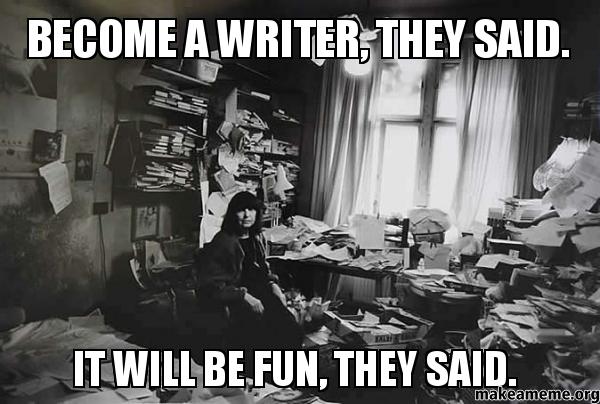
Become-a-writer

Often my posts mention my dealings with academia, and the stark contrasts between the “normal” world and the academic domain.  These differences have sparked an interest in figuring out the psychology of not only some professors but the world they are enmeshed in.  One of the things I have noticed during my time as a graduate student in an MFA program is the difference in publishing goals and how the professors treat their writing versus how most authors deal with their work and how they market it.

To be hired as a professor, one must publish at some point, and it seems for some that the only reason they have published anything is to able to put it on their resumes.  Maybe I’m naive and idealistic, but to write a novel or short stories to check off a box seems disingenuous.  If you have a passion for writing, why would you only write one book or a handful of short stories?  Most writers have a hard time stopping or getting other work done when the writing bug bites, so how can one instruct and inspire young writers when they haven’t really done it themselves?  Can you really consider yourself a writer or author when you only write to further your career goals?  It most definitely is not my motivation for writing, but I cannot say why others do it. Continue reading “Checking Those Boxes”

Personal Life

Getting to Know Each Other (Blog Hop)

This blog hop is designed to show our readers a more personal side. We list seven interesting facts to help cast light onto that tough writer’s persona we all like to project. But I am human and like everyone else I have dreams, hobbies, problems and goals. I see this as a way to share some of them with you, my readers.

The rules are that I share seven facts about myself, and links to at least fifteen blogs that I enjoy reading. I don’t think I follow that many blogs, and the ones I have are tagged by other authors already, so I will simply fill it out and forgo the tagging.

Seven Facts About Me:

1) I am in graduate school studying creative writing, but I began my undergraduate career as a biology major (added English in the beginning of my junior year).

2) If I could, I would be a hermit.  Honestly, I would rather stay shut up in my house 98% of the time with my books, tv, and dog than go anywhere.  If everything could be delivered to my house, I would never need to leave (apart from class). Continue reading “Getting to Know Each Other (Blog Hop)”

Writing

What is Your Novel’s Sex?

I’m not sure many people think about the gender of their book while they are writing it, but when I began The Earl of Brass as an undergraduate, it crossed my mind.  While reading other steampunk novels, I was rather surprised by how the books seemed to either be very masculine (G.D. Falksen’s Blood in the Skies) or very feminine (Gail Carriger’s Soulless).  I wanted to write a book that was androgynous, that had no defining gender for itself or its audience.

As part of my research for writing The Earl of Brass, I read through Sir Arthur Conan Doyle’s The Lost World as well as Charlotte Perkins Gilman’s Herland in order to better understand Victorian and Edwardian adventure novels. There again, I found the gender gap.  In Conan Doyle’s novel, the men leave their women at home and go on an adventure full of dinosaurs and savages, and while Gilman infused her work with feminist ideals, it was very much an us-versus-them mentality with a muddled ending where the women and men fall in love and go back to America. Continue reading “What is Your Novel’s Sex?”

Personal Life · Writing

You Are What You Read

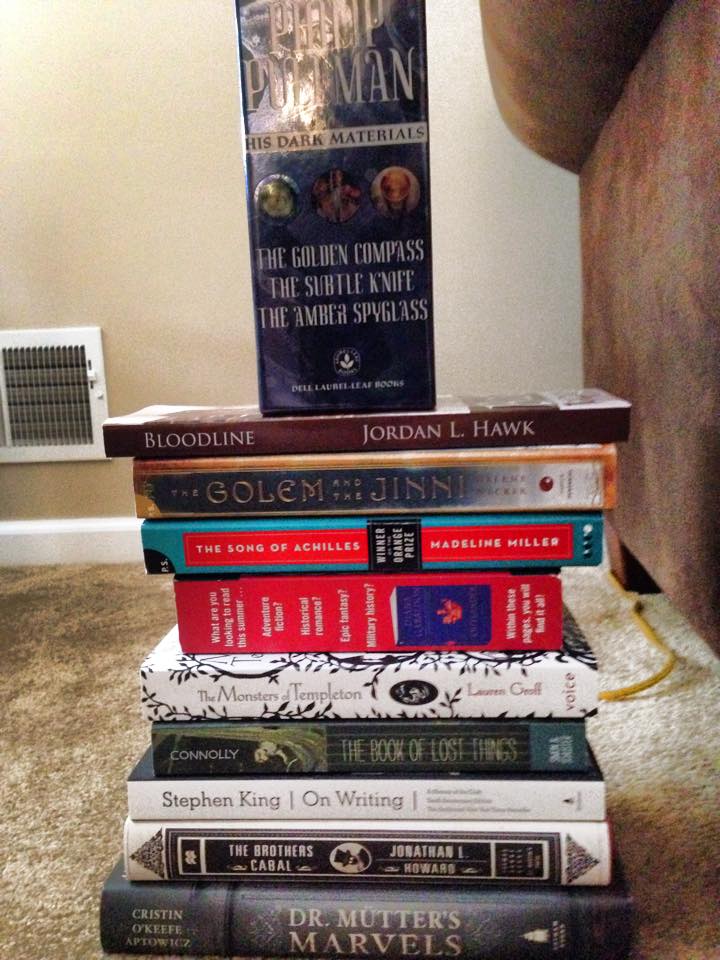
tbr pile oct 30What do your reading choices say about you?  Since beginning graduate school, I have been turning this question over in my mind as I listened to others in my classes mention who their favorite authors are.  Most of them are people I have never heard of or read but are rather famous in the contemporary lit world.  Typically, I hold my tongue and don’t mention what I read for fear of being ridiculed or looked down upon.  This led to a greater question: why do people read certain books?

Do people (especially those in academia) read for fun or do they read certain books because they feel it is expected of them?  As I continue my journey through the MFA in Creative Writing program, I find myself wondering what my professors read, especially when they are writers or poets as well.  What we read automatically becomes ingrained in our beings and eventually comes out in our writing. I can attest to the fact that when I read a book I love, I am inspired to write and often I will lean toward that genre or some theme found in that work.  If I read a book I had to drag myself through, it typically slows my writing to a crawl.  Oddly, while I didn’t love reading Virginia Woolf for the most part, her works had a huge influence in the way I deal with close narration and “head hopping” as others call it. Continue reading “You Are What You Read”

Writing

Character Preview: Immanuel Winter

im close up(Artist credit for this pic of Immanuel Winter goes to the lovely Fiammetta de Innocentis)

I put up a poll on my Facebook page asking the fans of my work what they would like to see next as a preview of The Winter Garden.  Only a few people answered (I’m not that popular and Facebook hides my posts), but it was unanimous that they wanted to see a character preview.  What I am going to reveal here will contain no spoilers and only contains information from before the events of The Winter Garden.  Down the line, I may release a few more of these along the way, but may I present to you, the leading man of The Winter Garden, Immanuel Winter.

Immanuel Winter was born February 2nd, 1870 in Berlin, Germany.  His family line can be traced back to the alchemists of Cologne, but during the time of the French Republic, his family migrated to Berlin.  This change of cities officially shifted their already changing identity from alchemists to scientists, but one remnant of their esoteric past remained in the form of a pendant: Continue reading “Character Preview: Immanuel Winter”

Personal Life

Chapter 23: In Which the Author has an Existencial Crisis

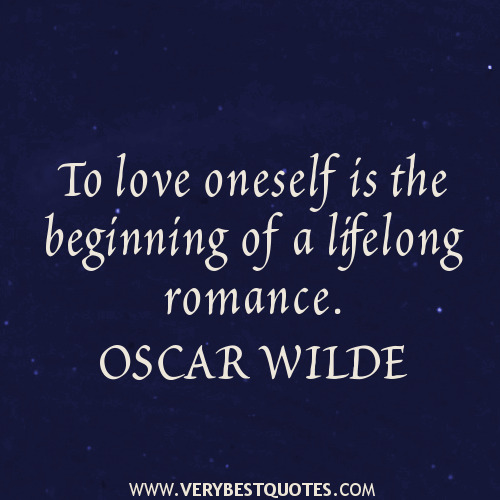
love-yourself-quotes-To-love-oneself-is-the-beginning-of-a-lifelong-romance..I am never sure how many people know I have anxiety.  I am a class A worrier, dweller, and moment-reliver.  Last week was my first full week of graduate classes, and midway through the week, I sat and cried when I got home.  Sometimes I wonder what has happened to me.  I wasn’t always such an emotional person, but honestly, sitting down and having a good cry is better than bottling up until you explode or internalizing your misery.

I am not like most of my family.  The idea of working in an office for the rest of my life is repellant even if I do not mind the place I currently work and enjoy the company of the people who work there.  I just want more than that.  For my entire life, school has been a factor that validated who I was.  I was a (mostly) diligent student who got good grades.  School has been there to give me a ruler to measure myself against and prove my worth, and this is probably what pulls me toward the world of academia. My family went through the motions of school and seemed to enjoy the social aspects more than anything they actually learned, but because I typically had few friends, my focus was on homework and my classes.  In my family, I was first one to go to college for four years and actually earn a degree, and I did it because I loved my classes for the most part and my professors.  I had a drive and my mentor nurtured that by giving me the confidence to write more and actually participate in literary conferences when most undergrads didn’t.  Toward the end of my time in college, I realized I wanted to be an English professor, but my family has not exactly been supportive of my endeavors. Continue reading “Chapter 23: In Which the Author has an Existencial Crisis”

Writing

The Winter Garden: Book Two of the Ingenious Mechanical Devices

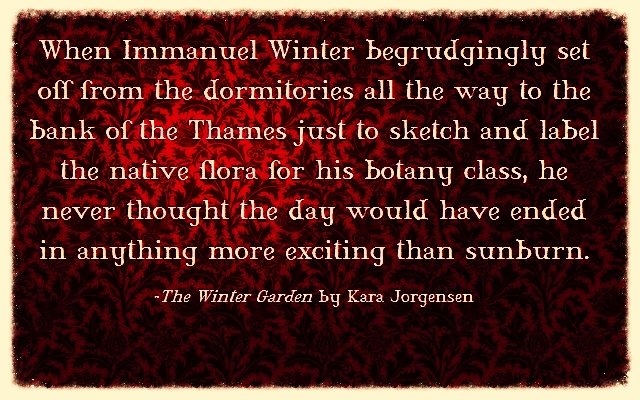
first line

The Winter Garden: Book Two of the Ingenious Mechanical Devices is only chapters away from completion (apart from editing), so I decided it was time to post the blurb and hopefully build up some hype.  Here is it:

Emmeline Jardine and Immanuel Winter are only months away from achieving their dreams, she will enter debutant society and he will receive a degree from Oxford, but a day at the Thames transforms their lives forever, intertwining their souls and putting them into the path of a predator.

Ripped from the comfort of the world they know, Emmeline and Immanuel are thrust into a struggle for their survival. Even though they escape, Immanuel is forever altered by his time in captivity. Gradually he begins to settle into a normal life as the coroner’s assistant until he comes face to face with the man who nearly destroyed him.

Unaware of what he is capable of, Emmeline is infatuated with the dashing madman and follows him deeper into a world of corrupt mediums. When a murderer masquerading as a monster begins to hunt beautiful Spiritualists, Immanuel knows the key to stopping him lies within the girl who shares his soul.

Continue reading “The Winter Garden: Book Two of the Ingenious Mechanical Devices”

Writing

Straddling the Genre Line

litvgenrThe phrases “genre fiction” and “literary fiction” strike fear into my heart.  There’s a constant tug and pull in the literary world between what is of the higher art and what is considered beneath the establishment.  What should be valued more? Entertainment and enjoyment or the more “artistic”, philosophical, cerebral side of literature. Being a graduate student studying creative writing, I cringe when people ask what I write.  I am already anticipating the raised eyebrows and disapproving looks when I say, “Well, it’s technically science fiction or historical fiction.”  Instantly, it is discounted as trope-laden, cliche genre fiction. Continue reading “Straddling the Genre Line”

Personal Life · Writing

The Long-Term Goals of a Young Writer

Today I am heading back to graduate school to begin another semester studying creative writing.  Every time I start school anew, I feel my anxiety level rise tremendously as I worry my professors will not like me or my work, and the best way I have found for me to combat this is to look at the larger picture.  This year I achieved one of my major life goals, to publish a novel, and for this year and the beginning of next year, I would like to publish the second book in the Ingenious Mechanical Devices series, The Winter Garden.  I’m 73,000 words into it, so I hope to be done in a month or two since my writing slows down exponentially once the semester starts.  Editing hopefully won’t take too long, so it is supposed to be out some time in March or so. Along with finishing book two, I plan on getting book three underway or working on my master’s thesis project (which is a novel also but not in the Ingenious Mechanical Devices series though it is still laced with fantasy). Maybe even both. I haven’t tried to tackle juggling two projects at once in a while, but hopefully, I’ll manage. Continue reading “The Long-Term Goals of a Young Writer”