Writing

AI Writers, Please Quit

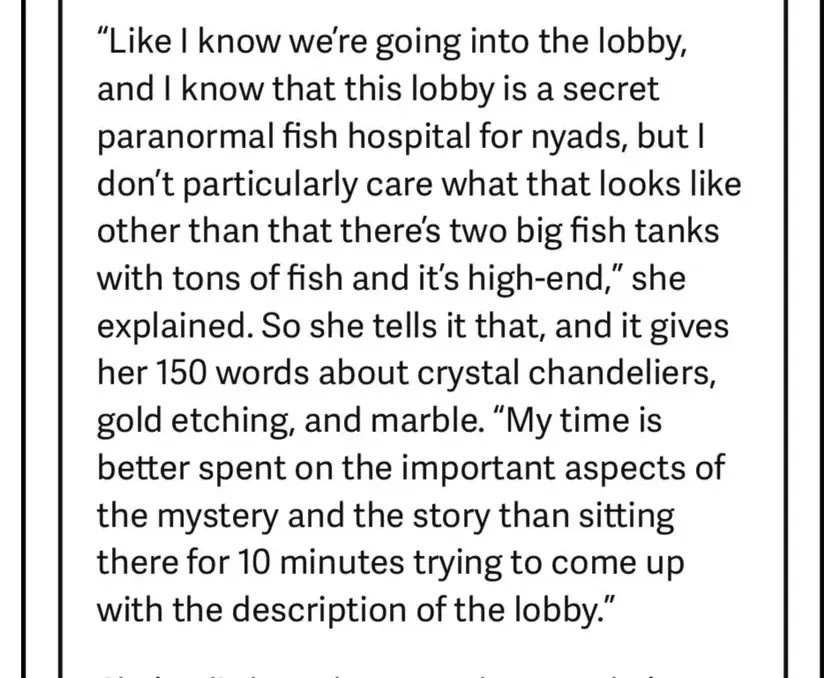
I came across this excerpt from a writer talking about using generative AI during her writing process, and all I have to say is, if you use generative AI to help you write your book, please quit writing.

That isn’t hyperbole or snark; I mean every word. Here’s the thing about writing, it isn’t glamorous, but people think being an author is. People who use AI to write some or all of their books want the aesthetic of being a writer. They want the fans or readers, they want the pretty covers, the money (lol), the minor amount of fame and prestige it bestows upon someone who has published, but ultimately, they don’t want to do the work to get there. And writing is work. It is incredibly unglamorous work. It’s long days staring at a screen, figuring things out, murmuring to yourself, getting stuck, and getting stuck, and getting stuck. It’s weeks of fiddling with descriptions or rewriting things that don’t quite make sense or need a bit more life breathed into them.

For the writers who use AI, they look at the work part and think about how to eliminate it. Who wants to deal with the ugly, un-fun bits of the process? Let the machine do the things I find hard or unenjoyable.

But once you outsource your process to the plagiarism slot machine, is it even yours? See, the thing about AI is that it doesn’t magically come up with new stuff for you. It’s essentially the predictive text feature on your phone, so it pulls up the most likely thing it can from a combination of words. Not the most correct or the most interesting, the most likely. Whatever description or idea it is spitting out is the lowest common denominator. It’s always going to give you a homogeneous, verbal statistical average. If you generate a bunch of statistical averages, your book is also going to be statistically average and have the same voice as other writers using AI. For some writers, at least the ones who use AI, that’s fine. As long as they can make a little more money or churn out work a little more quickly, who cares if the quality suffers? Their readers won’t even notice.

The fact that they think their readers are so indiscriminate that they won’t even notice their is statistically average is sad. Either they don’t value their readers and don’t think they’re intelligent or they have cultivated a following of people who will shell out for average slop and be happy about it. Personally, if an author I read did that, I would stop reading them, unfollow them, and never give them a dime because they don’t respect me as a reader, and I know a lot of other readers and writers who would do the same.

The thing about art is that the process is the important part. We make money off the final product, but we better our skills through the process and ultimately that is what gets us the best product. Going back to the original quote above, writing that off-handed description of the lobby in the paranormal fish hospital is part of the process. It is the process of getting better at writing descriptions; adding more depth, realism, and interest to your setting; adding theme or mood into your story through the use of setting. No description in your book should be pointless enough that you can hand it off to a computer to write. If it serves no purpose, don’t write it.

The fundamental issue with writers using AI is that they choose to outsource their creativity instead of bettering their craft. Learning your craft comes from doing mundane bits repeatedly or by dissecting what writers you like do and figuring out how to work it into your writing. It’s like playing a sport. Having a robot shoot baskets for you won’t make you better at basketball, only you doing lay-ups and practicing can do that. Writing, art, crafts, etc. are skills that can only be increased with practice. Every writer using AI has lost the plot in that regard. Outsourcing the mundane bits will ultimately make you a worse writer because the muscle you have for writing those bits will atrophy over time, and you will have to rely on it more and more. Same for using it for research, coming up with ideas, outlining, editing, etc. Those are skills you need to learn and strengthen through practice and getting feedback from other people. The machine cannot give you feedback as it does not have a brain that can analyze and be critical. It can only regurgitate what it thinks you want to hear. It’s also not a search engine, so any research it brings up is not necessarily accurate, just the thing that appears the most in relation to the terms you gave it. It’s a median machine.

At its core, authors utilizing AI leans heavily on the idea that talent for art or writing is either innate or store-bought with no between. Those who think they don’t have innate talent go for store-bought (the AI) when in reality the writers they think are innately good have just practiced for years and the store-bought isn’t talent, it’s basically a box of saw dust mislabeled as cake mix. Adding your characters’ names to it won’t make it any better, but people will still buy it if you put a shiny enough wrapper on it.

Writing

Writer Tips: The Beginning Pt. 1

This week I thought I would talk about writing the beginnings of books since I am working on the fourth Reanimator Mysteries book. Opening chapters are often the hardest to write and the thing we spend the most time fixing/fiddling with. Part of this is because we put so much emphasis on attracting readers and keeping them hooked from the beginning. They are the first impression of the book that our reader has, so we need to make sure we use that chapter to set expectations and capture the general mood of the piece to avoid disappointing readers later. As a side note before we start, I think first chapters/openings are often something to worry about in the second draft rather than the first. Things often become clearer once we’re farther along. Remember, don’t get hung up on the opening when you start. You can always fix it in a later draft if you realize there is a better place to start the story. That’s what editing is for.

The Pieces

I really like the way Sarra Cannon lays out the structure of a novel (you can check her out at Heartbreathings.com). Let’s take a look at her Act 1 outline to remind ourselves what we need in Act 1/our opening

  • An interesting image/hook

  • Introducing our characters

  • Introducing the setting

  • Introducing conflict/mystery

The Hook

When you open a book, we want to put something interesting at the very beginning to keep the reader intrigued or entertained. We want to create this opening image in a way that sneakily introduces the character and the setting. What we do not want to do is put too much information into the opening because our reader won’t remember it’s important later. The opening is meant to be a brief image that gets us intrigued before diving in, and your reader will remember more of the feel of the scene than the information you give or the words you say, which is why we want to nail the vibe but not info dump.

A prologue can be used instead of an opening scene in order to introduce a mystery- like showing someone getting murdered or a god dying, but we have to be careful with prologues because they can become info-dumpy rather than intriguing. Save info/specific world-building for when you have the world more established and the reader can appreciate it. You also want to be careful with starting with dialogue as the reader doesn’t know who these people are, the context of their relationship, etc. It may be better to save it for half a page in when the reader has been grounded by the mood or setting.

Introducing Our Characters

During your opening chapter, we should be introduced to at least one of the main characters. If you have multiple POV characters, obviously that will be spread over multiple chapters or we will only get them from one person’s POV (aka don’t split the chapter in two with different POVs). You want to ground your reader, so e should get the character’s “normal” before the conflict really kicks in. This is important because we need to establish where your character is before they change over the course of the book. You can do this by showing us the character’s world, which also helps to incorporate the setting, and showing them interacting with others while giving us their thoughts and feelings.

At the same time, there should still be a hint of something being amiss during the opening scenes. Some examples:

  • If the MC is a workaholic, show them missing a holiday due to a work trip.
  • If a character has a gambling problem, show them checking their bank account and seeing all of the micro transactions.
  • If a character is lonely, hint at it by having them be alone or mentally commenting on the silence.

Your reader will connect with your main character first and foremost, so spend time fleshing them out by giving them thoughts, feelings, ideas, opinions, clothes, rooms, things, etc. By the end of the opening, the reader should understand what this character is going through, where they live, who they are, etc. Once again, is is often something that is strengthened in the second draft once you understand them better. The bigger point is that at the beginning of the story, these characters are wounded and/or missing something that they need. We need a hint of that wound/issue early on because it will drive the internal and potentially the external conflicts.

Introducing the Setting

Apart from your character, you also need to establish the setting, mood, and genre of your story. I lump these together because you’re doing all of the above at the same time. As you are writing, keep in mind that not every genre cares as much about setting as others do. Small town romances require you to create a realistic town while fantasy and scifi require a much greater level of world-building, so you will need to do this proportionately to the genre you are working in. At the same time, even if setting isn’t as prominent, like in contemporary romance, it is still important to ground your reader in a place by describing what the character is experiencing from a sensory perspective.

In this opening chapter, you are giving us hints of the world, the foundation and first glimpses of it. Only give us lore if it’s absolutely necessary, as in, we need to know this right now or we will be totally confused. Even then, I suggest doing so with caution and consider in your next draft if it is necessary. In your opening, we should be moving through the world via your main character’s eyes. Only give us things they would see or know. They take lore for granted since they exist in this world, so your opening should reflect that. You can also hint at fantastical things without being overt, like showing us bits of magic by offhandedly mentioning someone stirring a cup with telekinesis or a magical animal talking with the main character. You don’t need to give the reader explanations. They can suspend a little disbelief early on.

Having your character physically move through a space is a really good way to pepper in that world-building naturally. That way we follow their eyes over doors and paintings where you can add in little bits of detail that characterize the setting. During this time, we still need to set up the mood as well, and this should be baked into the setting and thoughts of the characters. Keep in mind that your genre can dictate the mood based on reader expectations. While a paranormal romance can be silly or serious, subgenres of mysteries or romances have more distinct moods. A cozy mystery can’t be too heavy, and a noir detective story has to air on the side of dark. Your world-building, thoughts, feelings, sensory words will all imbue the world with a mood. You need to establish that mood during your opening paragraphs, so you don’t pull a bait and switch on your reader.

The Conflict

As mentioned in the character section, your reader should get a hint of what the internal conflict is early in your book. Chapter one or the prologue can’t be aimless, so by having the internal conflict rearing its head, we give the book a bit of direction. There can be hints of the external conflict, mentions of money troubles, a bad guy looming, newspaper headlines, etc., but the external conflict shouldn’t quite appear in the opening. That should be saved for the inciting incident, which is at the very end of act 1 and pushes the main character into the meat of the story. This is sometimes called the call to adventure. The main reason we don’t want to do this is that we want to build up the world and the characters before shoving them into the main part of the story in order to build up the stakes or what the character could lose if things don’t work out for them. Without that build-up, the story can feel very flimsy or your reader isn’t engaged because they haven’t connected to the main character yet. This doesn’t mean there can’t be a murder or something intriguing, it just means that the thing that really forces the character to move hasn’t happened yet. If we don’t establish the internal conflict, the stakes, and the characters, the story will feel rushed, and we don’t want that.


I hope this break down on the opening of your book helped you! I would consider the opening to be the first 10-15% of the story with the inciting incident happening at the 25% mark. Next week’s post will talk about potential pitfalls in the opening of your story and how to avoid them.

Monthly Review

March 2025 Wrap-Up Post

March has been the longest month, and while that isn’t a bad thing, it feels a bit surreal that so much has happened in thirty-one days. Before we get into the post, I’d like to point out that Kinship and Kindness is part of Trans SFF bundle on itchio where you can get 38 books by trans authors for $40. I also have The Reanimator’s Heart on sale for $0.99 and The Reanimator’s Soul for $2.99 at all major retailers and regions. There is also a TRH/TRS bundle on itchio that is slightly cheaper than at other retailers.

Before continue, let’s take a look at my goals for March:

  • Reread all of the Reanimator Mysteries books in preparation for book 4
  • Start outlining book 4
  • Write at least 10k words of book 4
  • Proof as much of the audiobook for The Reanimator’s Remains as I can
  • Deal with several doctor’s appointments this month (boo)
  • Have the Weeknight Writers event go well (March 15th)
  • Continue to bug my senators and house member
  • Read 8 books
  • Blog weekly
  • Send out my monthly newsletter
  • Maintain my sanity
  • Work diligently on my cross stitch project

Books

My goal was to read 8 books, and I read 10 books. The links below are affiliate links, so if you buy a book through them, I get a small commission.

  1. Make Room for Love by Darcy Liao- 4 stars, a trans woman fleeing an emotionally and financially abusive relationship with a cis man runs into a cis butch lesbian who offers to take her in. Together, they bond over unionizing and coming out of their shells. I have mixed feelings about the trans rep, but otherwise, I enjoyed the romance aspect.
  2. 10 Things That Never Happened by Alexis Hall- 5 stars, a manager fakes amnesia to keep his boss from firing his employees only to be taken care of by his boss. He sees a new side of him and slowly begins peeling back the layers with the help of his gremlin of a cat.
  3. EAT by Nagabe- 4 stars, it’s a bit f-ed up as most of Nagabe’s stand alone works are. It’s about a wolf who wants to be prey or be eaten.
  4. When the Earth was Green by Riley Black- 5 stars, a nonfiction work about the long history of plants on earth from before the dinosaurs to the recent past. It is written in a narrative style that is accessible while being incredibly interesting and rich with information.
  5. The Invisible Man & His Soon-to-be Wife (#5) by Iwatobineko- 4 stars, a super cute series about a blind woman who falls in love with an invisible man. In this volume, she goes to meet his parents while he meets her brother.
  6. The Knight and the Butcherbird by Alix E. Harrow- 5 stars, brutal and all at once wonderful, this novella packs a bunch in a dystopian land where cancer creates monsters and the line between human and monster is slimmer than one thinks.
  7. The River Has Roots by Amal El-Mohtar- 5 stars, a lyrical tale about two sisters who tend to trees growing near a magical river. It’s about magic wrapped in magic and how song unites people through history. I highly recommend the audiobook version.
  8. Murder by Memory by Olivia Waite- 4 stars, a detective suddenly wakes up in a new body and is forced to solve a murder on a space cruise ship where everyone aboard reincarnates into their own bodies. It is a really cool premise with a lot of potential for interesting future books.
  9. Flesh and Bone by Arden Powell- 4 stars, two cowboys are hunted by a werewolf while one is haunted by his past, and the only way to overcome the first is to face the latter.
  10. What Moves the Dead by T. Kingfisher- 4 stars, a very creepy version of the “Fall of the House of Usher,” featuring uncanny hares, a dilapidated house, a nonbinary soldier, and fungus. There’s a lot crammed into the novella, and I am looking forward to the second book in the series.

Admin/Behind-the-Scenes Stuff

  • Reread all of the Reanimator Mysteries books and side stories in preparation for writing book 4
  • Brainstormed and started toodling with book 4
  • Started proofing the audiobook for The Reanimator’s Remains (TRM #3)
  • Participated in a panel on trans characters for Weeknight Writers, which was a lot of fun
  • Was part of a Trans SFF bundle on Itch.io (see top of page for details)
  • Put The Reanimator’s Heart and The Reanimator’s Soul on sale (see top of page for details)
  • Set up a Bookbub ad for the end of March
  • Bugged my senators profusely about various political issues
  • Blogged weekly and send out my monthly newsletter
  • Kept up with my grading (*tired* yay)
  • Dealt with my and my partner’s medical appointments (we’re fine btw)
  • Finished putting together my day job’s literary magazine with my class
  • Changed the batteries in every alarm/detector in my house (this has nothing to do with writing but it was labor intensive and hanging over my head forever, so someone has to hear about it)
  • Had to get major repairs on my car… again
  • Released “An Unexpected Evening” (TRM #3.5) to my non-newsletter readers (here)
  • Started the Court of Crows stitch-a-long by FineFrogStitching

Blogs


Writing

There isn’t too much I can talk about with writing right now. I’m currently working on the beginning of the fourth Reanimator Mysteries book, but I don’t want to go too much into it at this point because things are very subject to change. The opening of a book is where things are the messiest and most subject to change when I’m writing. I have false starts quite often during this part of the process, so I’m keeping my lips zipped about the contents of the story until I hit the end of act 1 when things finally lock in for the most part. What I will say is that this book will involve Oliver stepping up, trips to the library, Gwen’s magnum opus, and Felipe confronting his past and future. I will have more for you all next month, including hopefully a mood board and a working blurb.


Hopes for April

  • Write 20,000 words for book 4
  • Continue to proof the audiobook for TRR as it comes in
  • Stay on grading as there is a lot this month
  • Finish Act 1 and 2 outlines for book 4
  • Continue to bug my senators and house rep
  • Participate in the Narratess Sale (4/5-4/7)
  • Maintain my sanity as best as I can
  • Send out my newsletter
  • Read 8 books
  • Blog weekly
Writing

Join Me on Weeknight Writers

On Saturday, March 15th from 1-3 pm EST, I will be participating in a virtual panel on writing trans characters! I am super excited to have been invited by Weeknight Writers to participate in this panel along with authors Felix Graves, Georgina Kiersten, Vaela Denarr and host Dianna Gunn and Jade Benjamin.

Trans stories are more important than ever. This two-hour panel will feature four trans authors sharing how they approach writing trans characters and what trans folks should keep in mind when writing their own stories. We’ll also touch on how cis writers can create trans characters without perpetuating stereotypes or causing harm and how everyone can support stories featuring trans characters.

This event is hosted by the Weeknight Writers Group, a social enterprise  dedicated to providing affordable and accessible support for authors. The first hour and a half will be devoted to questions from our Sustaining Members and the panel moderators. The final half hour will be devoted to live audience questions.

You can purchase a ticket on their website for $15 or you can join their newsletter in order to get half-off your ticket. I also believe that being a sustaining member of the Weeknight Writers will also get you access to the panel and others before/after it.

I hope I will see you there or that you will support this fantastic writers’ organization that continues to bolster marginalized writers.

Monthly Review

February 2025 Wrap-Up Post

Even though the US is a hot mess, I felt like February was far better than January. Maybe it’s seeing the push back, protests, and having judges rule in our favor that has heartened me. That or the spite inside of me has been kindled. That helps as well. Before we get going, let’s take a look at my goals for February:

  • Finish writing “AUE”
  • Edit “AUE”
  • Send it out to my newsletter peeps first (everyone else gets it a month later)
  • Reread The Reanimator Mysteries books 1-3
  • Start proofing the audiobook for The Reanimator’s Remains
  • Read 8 books
  • Blog weekly
  • Send out my monthly newsletter
  • Maintain my fragile sanity
  • Perpetually bug my congress people

Books

My goal was to read 8 books, and I read exactly 8. The links below are affiliate links, so I get a small kickback if you purchase the book through them.

  1. Two Friends in Marriage (#3) by Jackie Lau- 5 stars, a lovely queer MF romance featuring a demisexual FMC and a bisexual MMC. Watching these two go from friends to married to lovers was just so sweet and cute. There’s also a giant penguin plush in the story who helps to sort of bridge the gap through cute and loving gestures.
  2. A Study in Black Brew by Marie Howalt- 4 stars, a retelling of A Study in Scarlet (aka a Sherlock Holmes story) set in a world with multiple alien races, advanced tech, and of course, coffee/black brew. It comes out May 22nd.
  3. Husband Material (#2) by Alexis Hall- 4 stars, a mm story built upon the structure of Four Weddings and a Funeral. Lucien and Oliver are simultaneously at their worst and best in this book, and while I enjoyed this one, the ending kind of annoyed me.
  4. Textiles by Beverly Gordon- 4 stars, a coffee table-ish book about the history and cultural significance of textiles. This is less specific than Victoria Finlay’s Fabric, but it gives you a lot of rabbit holes to go down while doing future research. I believe it is out of print.
  5. The Single Life (#1) by Akiko Morishima- 4 stars, two women who were penpals as children and realized they were lesbians through their letters meet up as older women. This is not a romance, but it’s sort of a slice of life as two queer women figure out what they want from the future.
  6. The Single Life (#2) by Akiko Morishima- 4 stars, see volume 1’s review.
  7. The Single Life (#3) by Akiko Morishima- 4 stars, see volume 1’s review.
  8. Time Loops & Meet Cutes by Jackie Lau- 4 stars, I loved this book. It’s like 50 First Dates meets Ground Hog Day as a workaholic eats some dumplings and gets caught in a time loop where she befriends another time looper and desperately hopes the man she has fallen in love with her will eventually remember her or that they might have a future together. This book comes out May 6th, and I HIGHLY recommend grabbing it.

Admin/Behind-the-Scenes Stuff

  • Approved the first 15 minutes of the audiobook for The Reanimator’s Remains (TRM #3)
  • Wrote the rest of “An Unexpected Evening” (TRM #3.5)
  • Edited/Proofread/Formatted “An Unexpected Evening” (TRM #3.5)
  • Sent out “An Unexpected Evening” (TRM 3.5) to my newsletter subscribers
    • I also posted the link for it in the freebie section of my website
  • Started working on the Court of Crows Stitch-a-long from FineFrogStitching
  • Agreed to take part in the Weeknight Writers Writing Roundtable on writing trans characters taking place on March 15th
    • You can grab a ticket here or wait for the replay
  • Stayed on task/schedule with grading for my classes
  • Celebrated my partner’s birthday
  • Bugged my senators and congress person repeatedly about… everything. If you can, please reach out to them and try to push them to do the right thing (and praise them when they do- carrot and stick, my friends)

Blogs


Writing

At first, I was very upset that my brain utterly derailed from stress in January after *gestures to the White House*, but I think taking this extra month to work on “An Unexpected Evening” was worth it. The story is significantly better, clearer, and longer. Sometimes, taking extra time is dawdling or dealing with executive function issues, but other times, it really is part of the marinating process. This time it felt like those extra few weeks of marinating helped me to really nail what I was trying to say with Oliver and Felipe. It also made it clearer what I want to do with book 4 (more on that in the near future). I’m super excited for you all to read “An Unexpected Evening,” and I hope you will leave a review on Goodreads or Storygraph if you read it.


Hopes for March

  • Reread all of the Reanimator Mysteries books in preparation for book 4
  • Start outlining book 4
  • Write at least 10k words of book 4
  • Proof as much of the audiobook for The Reanimator’s Remains as I can
  • Deal with several doctor’s appointments this month (boo)
  • Have the Weeknight Writers event go well (March 15th)
  • Continue to bug my senators and house member
  • Read 8 books
  • Blog weekly
  • Send out my monthly newsletter
  • Maintain my sanity
  • Work diligently on my cross stitch project

Writing

8 Things New Authors Should Know

I’m the first to admit that I do not have the answers when it comes to writing or being an author. Hell, I’m still shocked they let me teach students, but after ten plus years of being an indie author, publishing ten books and a bunch of short stories, I have learned a thing or two. It’s funny because I posted a similar blog a year or two ago, but after teaching my novel writing class this past semester, I realized there are a few things I really think new authors should know.

  1. You have to be your biggest fan. I often see writers who come from a fanfic background get down about the lack of validation and encouragement when they come nonfanfic writers because your stories go out when they’re finished rather than as they work on them. You are probably never going to get that same validation on your work unless you post the draft live on your blog or on Patreon, so my suggestion is to become your biggest cheerleader. You need to love what you’re working on and light your fire for your characters. That isn’t to say there aren’t going to be hard days where you are frustrated or hating the process. You just have to be excited to see these characters go on their journey more than anyone else. Write for yourself first and foremost to keep that excitement alive.
  2. Take care of your body. My partner and I are both from artistic backgrounds, and the number one thing they always remind me of is to take care of my body. If you want to have a long and sustainable career as a writer, you need to take care of your hands and your back. Resist the urge to curl up like a shrimp while you type, make sure your wrists are in an ergonomic position to avoid carpel tunnel, stretch those fingies and wrists, and take breaks. I’ve been stressing this to my students lately because what you can do at 18 or 21 is infinitely harder at 34.
  3. Avoid burnout. Something we all need to know the warning signs of and try to prevent is burnout. Burnout is basically when you run your brain into the ground by overtaxing it and not giving yourself enough rest. It can also be caused by compounded stress. Sometimes, it is unavoidable due to bad things intersecting all at once, but if you can help it, be on the look out for suddenly feeling run down, actively avoiding your work, everything suddenly being far harder than it normally is. This can be due to other health issues, but if this feels more mental than physical (or is mental and turning physical), it may be burnout. Radical rest is the best medicine. Your deadlines and readers can wait for you to take care of yourself. Being burnout for a long prolonged period can lead to permanent damage, so please rest when you feel it coming on.
  4. Learn about taxes early. I know this is probably not as big of an issue outside the US, but please learn about how taxes work for independent creators in your state. I always thought taxes were very scary, but the IRS is not going to bust into your house like the Kool-Aid Man and arrest you. What you can figure out is what counts against your taxes (losses/things needed to create your products), how to do quarterly taxes (which will save your money in the long run if you make a decent amount per year), and what the threshold is for upgrading to an LLC or having a professional handle your taxes and advise you. I know it is stressful and varies from state to state, but figuring this stuff out took a lot off my plate. If you want to sell things on Etsy or from a storefront online, you should also figure out how to do sales tax and such as well.
  5. Learn that authors are not your competition. They are your coworkers. No reader exclusively reads one author and no one else, so there is no reason to treat other authors like the enemy. I know that often this comes from a place of jealousy, but treat the people who are doing better than you are inspiration or case studies. See what they are doing in terms of marketing or interactions and try to apply that to your work. Don’t copy people; learn from them. Other authors are your community, and they are often the ones who step up to help out newer authors. Fine supportive people. It may take a bit, but also don’t be afraid to leave groups that are catty or mean spirited. They aren’t your friends, and you can do better.
  6. Be true to yourself and your vision. This is sort of similar to point one, but it can be easy to get caught up in doing what everyone else is doing. Authors see people are making book boxes or Tiktoks or book trailers, and suddenly, you’re worried that these things are the key to success. No one thing is, and if doing Tiktoks isn’t something you want to do because you hate video, then don’t do it. It’s best to stay focused on what you want and how you want your writing life to look and focus on how to make that work rather than fling spaghetti and do everything while hoping something sticks. If you try to do everything, you will burn yourself out and get less done.
  7. Remember that not everything you see online is real. People lie. Shocking, I know, but yes, people on the internet lie about their success or pull a Wizard of Oz to make their success look grander than it really is. There are a lot of people online who are grifters who just want to sell you their course or get you to listen to their money-making podcast, so they tell you what you want to hear. They have the secret to make a million dollars or how to make four figures a month. Someone can make a million dollars over fifteen years and call themselves a million dollar author, or they might make $50k in a month, but what they don’t say is that they spent $30k in ads. You might also see authors who claim to have personal assistants when, in reality, it’s a chatbot or them under a different Facebook or email account pretending to be someone else. Trust me that it is more common than you would think, especially from people who try to act like authorities online.
  8. Don’t use AI. There are also a lot of people who will tell you AI can help you write faster or that it can help you with research. It can’t. AI is basically the mediocrity machine. It picks the most common dreck and smooshes it together on command, but it cannot think, it cannot create emotional depth, and it isn’t consistent. There are TONS of resources online that can teach you to become a better writer, but AI isn’t it. It isn’t a shortcut to success, but it is a shortcut to losing your career because most readers do not want to read AI written or aided stories, and yes, you can tell. From a creative writing teacher perspective, every bit of AI writing I have seen has been far worse quality than anything newbie writers in my classes have turned in. It’s soulless. If you can’t convince yourself to write and have to turn to AI in order to do it, you are in the wrong field and should leave to make room for those who do give a shit about craft and their readers.

Writing

Plot? Character? Both? Both. Pt. 2

Last week in part 1, we talked about how to build characters in a way that makes it easier to build the rest of the story structure around their growth and change. I highly recommend reading that before reading part 2 if you haven’t yet.

A caveat before we begin is that I am using my writing process as a scaffold for this. Everyone has a different writing process and there is no one way to write a novel. My hope is that you will adapt my advice to what works best for you by taking what works and leaving what doesn’t. Also, this post will have very minor spoilers for The Reanimator’s Heart as I use it to show how I construct the basis for my characters/plot.


A few key reminders before we start

  • your main characters must change from the beginning to the end of the story (this can be positive or negative growth, but there has to be change)
  • if you’re writing a romance or a character driven story with more than one protagonist, you’ll need to have more than one character change, so they will all need a journey tied to the plot
  • if you are planning to write more than one book with the same characters, you will need to have them change incrementally across multiple books, usually by shifting different traits in each book
  • the hierarchy of building a story goes character > plot > world-building > everything else

Let’s ruin their lives

The big difference between a character driven story and a plot driven story to me is that character driven stories focus on the change in the character first and make the plot work toward that. Plot driven stories have the characters serve the plot, meaning you could hypothetically swap out the characters without changing the major beats of the journey. In real life, we might be going through a midlife crisis without something in our external life making it worse, but because this is fiction, we can make things far more convenient than reality in our character driven story. Think of the external plot as a trigger for the inner journey of your characters. They are already feeling this way, but the external plot has kicked off a lot of feelings and made things more complicated for your character. I think a lot of writers tend to think of the internal journey and external plot as being separate, but if they are intrinsically intertwined, you can really heighten the character’s turmoil and strengthen both the character development and the plot at the same time.

I’m not going to go into a specific beat sheet or structure, so if you’re a plotter, feel free to use whatever plot structure works best for you. Personally, I like Sarra Cannon’s beat structure, which you can find in her HeartBreathings channel on Youtube.

Last week, I mentioned that we need to figure out what your character needs most to be a happier or better person (or feel free to ruin them; it’s your book) in order to figure out the internal journey. For Oliver and Felipe in my book The Reanimator’s Heart, they both need to work on their issues with isolation in order to be happy. Oliver needs to step out of his bubble while Felipe needs to let Oliver into his. How they deal with their isolation and interact with each other will be informed by the past and personality we crafted earlier. As a reminder, Oliver is autistic and a necromancer, which has contributed to his isolation and getting stuck in a rut after years of pining after Felipe who also works at the Paranormal Society. Meanwhile, Felipe is seen at the society as almost a demigod. He is a self-healer, a hero, someone who takes the worst cases and can survive the harshest conditions. This has set him above and apart from the other investigators who like and respect him but also low key fear him. This along with his daughter going off to college has caused him to pull away from most people because they expect him to constantly be that untouchable hero.

My question to myself while constructing a plot is how can I ruin my characters’ lives in a fun and inventive way? This is why we want their issues to be similar, so that we can ruin their lives efficiently while plotting. Ultimately, since this is romance, we want Oliver and Felipe to get together by overcoming their loneliness together. Now, let’s combine this with a worst case scenario for them personally. Oliver is a necromancer, and Felipe is a hero with nearly supernatural abilities. What if Felipe gets killed, and Oliver reanimates him? That’s pretty messy. Oliver is also a rule follower by nature and going against the laws of nature by keeping people alive long after death is definitely against the rules, so if he were to reanimate Felipe, that would cause him some angst. Felipe is–was–nearly immortal, so the whole being dead thing would also cause angst and an identity crisis.

Note how all of this is picking at wounds or character traits/history that was already there. As you’re writing and brainstorming, it’s fine to tweak the backstory to make this work more smoothly. This is also why I think you should give yourself some vagueness or breathing room with a character’s history; it allows you to tweak things to better serve the character-plot symbiosis while plotting.

Constructing the plot

Now that we’ve ruined their lives, we’re probably at the end of act one in terms of plot structure. This life ruining should kick us into the story proper, which means the plot should unfold logically from there. Keep in mind as you go from the kick off to the finale that your characters need to grow or change by the end of the story. In Oliver and Felipe’s case, it’s overcoming their isolation. Since it’s a romance, we can assume that means they get together as a couple in a happily ever after. There needs to be a logical progression from lonely to together that builds over the course of the story.

As I said, I’m not going to go into too much detail regarding plot structures, but the four acts of a story should go as follows:

  • act 1 (0-25%)- introduce the issues (and if it’s a romance, entangle them)
  • act 2 (25-50%)- we’re exploring the new world and showing how these issues are a problem
  • act 3 (50-75%)- at the beginning there’s some moment of recognition of the flaw and they spend the rest of the act trying to rationalize it or shy away from fixing it all while being more conscious of it
  • act 4 (75-100%)- things come to a head and the character(s) are forced to confront their issues and finally overcome them, usually while overcoming the external plot

As you brainstorm the plot and overall external conflict of your story, you need to think of a plot that will poke at the wounds your character already has while still being interesting. This way you are constantly touching the internal journey rather than weaving it back and forth into the story as a subplot. With Oliver and Felipe, I decided that a way to intertwine the inner journey and outer plot was to have Felipe die by being murdered. This forces the characters to go solve his murder (along with another murder I grafted onto the plot for cohesion after this initial brainstorming). By solving his murder, they are forced to spend a lot of time together, look for clues, get to know each other, and do things that tackle their loneliness issues while complicating their relationship. If he had died naturally as opposed to being murdered, the two plots of the story wouldn’t be linked together as tightly.

Throughout the story, but especially in acts 2 and 3, you have the perfect opportunity to use plot points to deepen or explore the internal journey while they do things for the external plot. These can be large plot points like when Oliver is nearly killed, which reveals the true depth of Felipe’s feelings and some clues for the external plot, or they can be quieter plot points, like where the characters discuss the case while having dinner and by sharing a meal, they’re also no longer isolating. You want the majority of the major plot points to do double duty in serving the internal journey while also moving the external plot forward. This is also why I suggest having the main characters in a romance have the same issue in a different flavor (like loneliness). If they have opposing issues or ones that very different, figuring out how to riff off the main plot while balancing both may be difficult or come off as disjointed.

As you are writing your story, I want you to make sure that you don’t lose sight of the most important part: the characters. They are the key to making a compelling story or series that sucks your readers in. It’s easy to get wrapped up in the fun and games of the plot, but if you’re writing a character driven story, they need to be front and center in your mind and on the page from the opening to “the end.”

Uncategorized · Writing

Plot? Character? Both? Both. Pt. 1

One of the most common arguments I remember hearing in my MFA program that I still online is whether genre fiction is character or plot focused. The answer is often both, especially if you write romance or something with a heavy emphasis on character development. A question I hear a lot when I’m teaching creative writing or with friends who want feedback on their books is how do I construct a plot that is character-centric but still fun and tightly structured? This week and next week’s blog posts will be about how to do create character driven novel that is heightened by an external plot.

A caveat before we begin is that I am using my writing process as a scaffold for this. Everyone has a different writing process and there is no one way to write a novel. My hope is that you will adapt my advice to what works best for you by taking what works and leaving what doesn’t. Also, this post will have very minor spoilers for The Reanimator’s Heart as I use it to show how I construct the basis for my characters/plot.


How to build a character

I think the biggest piece of prework for writing a character-centric story with a plot that enhances the characters is knowing the characters really well. In order to create the plot of your story, you need to know where the characters are at the beginning and end of the story, aka how they change over time. The plot will help to move them toward that goal, but first, you need to figure out where your characters are before the story starts.

I’m a gardener (a loose-ish plotter), so I like to spend a lot of time before I start truly writing getting to know who my characters are. I do this by brainstorming, ruminating, making notes about what I think their backstory is, their personality, what they look like, etc. Let’s use Oliver from The Reanimator’s Heart as an example. I really wanted to write a character who is autistic, so I knew that was going to factor into his personality and overall design because your neurotype influences how you act and behave. I was inspired by the show Pushing Daisies, which had a main character who could raise the dead in order to solve murders, so it made sense that Oliver would then be a necromancer. Autistic + necromancer = Oliver, so what does that mean in terms of character traits? I decided that I wanted him to be an autistic who isn’t very good at masking or hiding his traits, so he’s quiet, a bit weird, not socially adept, and if necromancers are stigmatized in this magical world because it’s a rather morbid power that can cause very bad things, it would make sense that he either self-isolates or is isolated within the Paranormal Society (the setting of the story). I asked myself, does he have family? I decided that I didn’t want him to have living family members (upping the isolation), but he does have a really good friend that he’s close to, Gwen, who also works at the society. What job would make sense for a necromancer at the Paranormal Society? Being a coroner or medical examiner would meaning he can talk to the dead with little oversight as people typically avoid dead bodies. I researched medical examiners, and you need to be a doctor to be one, so now, Oliver has a medical degree.

Ultimately, I decided Oliver is an autistic necromancer who tends to self-isolate due to his social difficulties and his necromancy being stigmatized. His backstory is that he is without living family, has a medical degree but for some reason is no longer practicing medicine, and works as the medical examiner for the society’s investigative wing. This is where we find him right when the story starts. If you’ve read The Reanimator’s Heart, you know how all of this plays into the story line.

For me, physical attributes always come second as I use them to highlight or heighten the character traits rather than the other way around. I wanted Oliver to look dead, so I made him very pale (he’s white) and gave him dark hair to make the contrast even starker. He’s tall because autistic looming can make people uncomfortable. I also wanted him to be accidentally scary to people who don’t know him (his looks might also intimidate people who might try to mess with Gwen/his best friend). His grey eyes fit the monochromatic theme and gave him a little enigmatic flare because why not. This is a romance after all.

PS- make sure to write all of this sort of brainstorming somewhere you can find it again. Do not trust yourself to remember because you won’t.

Now, if you’re writing a romance or a multi-POV book with more than one protagonist, you will need to do this for two characters, and for romance, you will need to figure out a way to make them highlight or contrast with each other. The Reanimator’s Heart is a romance, so Oliver needs a love interest/romantic partner. That’s where Felipe comes in. If Oliver is a necromancer who works as the medical examiner and isn’t very social, who might he run into often at the society? An investigator. That’s how Felipe ended up with his job. From there, I decided he is going to be one of the best investigators, the kind who go on the longest, toughest missions. I hadn’t initially decided what his power is, but I knew his background had to be in monster hunting and fighting. I had toyed the year before with the idea of a character being Zorro adjacent, but the story idea fizzled out for many reasons. Ultimately, Felipe ended up being born from that spark of inspiration, so he ended up being a heroic monster hunter known for his fighting prowess who also comes from a family of monster hunters in California. To make him a foil for Oliver, Felipe would have to be sort of his opposite, which would make him more outgoing, social, and well-liked by the people at the society. Felipe ended up becoming a charming, more extroverted, levelheaded monster hunter/investigator. His physical traits had to fit someone of Mexican-American descent since he is from California, and I decided it would make sense for him to be Latinx. Felipe became a short king because I wanted a little size difference with Oliver and because heroes are tall way too often.

Even if Felipe is a foil for Oliver, they have to have something in common, and since Oliver is isolated and lonely due to his autism and powers, it would make sense for Felipe to also be dealing with loneliness of a different flavor. In a romance, a good way to have the main characters interlock and play off each other is to have them struggling with the same internal problem in different ways and have them make up for what the other lacks.


Where did you come from? Where did you go?

Something I want you to pay attention to in regards to the construction of characters mentioned above is that they were not constructed by squishing together a bunch of character traits. I’ve seen a lot of blog posts or videos that suggest focusing on traits, but I think it makes more sense to take a holistic approach and work backwards and forwards to figure out how a character acts and why they act this way. The why is the important part. If you want your characters to come off as real people, you have to think of the psychology and cause and effect behind their traits. Our personalities aren’t made in a vacuum, and neither should your characters be built in a vacuum.

Our pasts and upbringings inform our identities, so I think it’s important to figure out how you want your character to be at the beginning of the story. Once you have that, you have to ask why they behave this way? Some of it will boil down to things like neurotype, gender (and the societal expectations of that or the subversions), sexuality, class, trauma, religion, disabilities, the culture they were raised in, etc. All of these things have an effect on how we behave or interact with our world, so your character’s personality also will be affected by the world building in your story. By starting with the current person and working backwards, you are more likely to have a cohesive character who is more than a hodgepodge of traits, and when you need to figure out how they’ll react in your story, you can look back at that history for the answer. I suggest being flexible or loose with this past history in case you need to tweak or change something as you write the story, but knowing the basics and overall journey of how the character got to this point is helpful.

Next week we’re going to talk about making the plot work with the character development in more detail, but before we get into that, we need to figure out how the characters need to grow from the beginning to the end of the story. Keep in mind that if this is going to be a series with the same characters in multiple books, you should only fix one trait or problem at a time. I tend to see most writing “rules” as guidelines, but if you want to have a character-centered story, the character has to change or grow throughout the story. Before you start working on the overall plot, you need to figure out how you want them to change. That journey will be the scaffold upon which the rest of the plot is built.

A good way to figure this out is to think about what your character needs most to be a happier or better person. For Oliver and Felipe, they both need to work on their issues with isolation in order to be happy. Oliver needs to step out of his bubble while Felipe needs to let Oliver into his. How they deal with their isolation and interact with each other will be informed by the past and personality we crafted earlier.

Stop by next week to see how we integrate their internal growth with the external plot!

Writing

My 2025 Goals

I’m not always a fan of yearly goals. Truthfully, I prefer to do 90 day/quarterly goals, but since it’s the beginning of the new year, I thought it would be good to post my overall goals for the year. I have divided the goals into writing, publishing, personal, and other goals. In a perfect world, I will be able to write two full books this year, but these goals will probably be aspirational, and that’s okay. Something I’ve been trying to be better about is not beating myself up when I don’t accomplish everything I set out to do. As long as I do my best at the time, it’s fine, and it will eventually get done. Without further ado, let’s take a look at my goals for 2025.


Writing Goals

  • Write, edit, and publish “An Unexpected Evening” (about 10k, started it at the end of 2024)
  • Write, edit, and publish The Reanimator Mysteries #4 (100k+ words)
  • At least start writing Ansley and Joe’s story (80k? words)
  • Write, edit, and publish an epilogue short story for book 4
  • Write consistently throughout the year
  • Try writing two books at once (maybe)
  • Have 10 2k writing days
  • Have 3 5k writing days

Publishing Goals

  • Publish the audiobook of The Reanimator’s Remains (TRM #3) with Jack R. R. Evans as the narrator
  • Publish/send out “An Unexpected Evening” (TRM #3.5) to newsletter subscribers
  • Publish 1-2 books
    • Definitely publish TRM #4
    • Potentially publish Joe and Ansley’s book, though that may be next year
  • Make more money than I did in 2024
  • Potentially get a new cover for Kinship and Kindness (this may get pushed back to next year if Joe and Ansley’s book ends up being worked on late in the year)

Personal Goals

  • Work on my office since I stalled out on this
    • Get rid of the old furniture
    • Paint the walls
    • Set up the new furniture
  • Get healthier
    • Make more veggie-heavy dishes
    • Continue to lift weights consistently
    • Work up to 10 lb weights when I’m ready
  • Maintain my mental health
    • Be social with my friends online and in-person
    • Play games and/or refill the well
    • Be cognizant of when I’m burning out and take steps to stop it

Other Goals

  • Read 100 books
  • Play/finish 3 video games (I will consider prolonged playing of an open-world game like Stardew as “finishing”)
  • Learn a new craft
  • Learn new cooking techniques/recipes
  • Blog weekly
  • Send my newsletter out monthly

More than anything, I hope 2025 is boring. I know we’re heading into turbulent times in the US and around the world, but I want everyone to reach out to those around them and find people to support them. Change starts with us, so I hope you all turn to the trans, disabled, and marginalized people in your lives and make decisions with their best interests in mind.

The Reanimator's Remains

The Reanimator’s Remains is in the Indie Ink Awards!

Voting for the indie ink awards is open! The Reanimator's Remains is nominated in: best friendship, best setting, disability rep, LGBT+ rep, mental health rep, ND rep
Vote at indiestorygeek.com/a/indie-ink-awards-2024

I am very excited to announce that The Reanimator’s Remains was nominated for quite a few categories in the Indie Ink Awards, and I still can’t believe it. Seriously, thank you to all the people who nominated it.

Last year, books 1 and 2 won in different categories, and it would be amazing if book 3 could do the same.

The voting is currently open, and I would be eternally grateful if you would vote for The Reanimator’s Remains, especially in the mental health, disability rep, and/or neurodivergent rep categories. The top 10 of each category go onto the judged finals.

Voting is open until the end of the year, and you can vote here. Just make sure to hit save at the bottom of the page after voting (all books in their categories are listed in alphabetical order by title)