Monthly Review

February 2022 Wrap-Up

So last month in January’s monthly wrap-up post, I made a few goals for myself, which I promptly forgot. Let’s go over what those goals for February were:

  • Read 8 books
  • Write 20k words with a stretch goal of 30k
  • Finish a syllabus for a future class
  • Finish a proposal for that same class
  • blog weekly and send out my monthly newsletter
  • crochet more because I haven’t since before Christmas

So let’s see how that went.


Reading

I set out to read 8 books in February since my goal for the year is 100, and I read 9.

  1. Leather and Lace (#1) by Magen Cubed (4 stars- monster hunter x vampire with a cute dog chase down monsters and accidentally fall in love)
  2. A Southern Gothic Summer Vacation and Other Stories by Magen Cubed (4 stars- see above)
  3. A Southern Gothic Holiday Special by Magen Cubed (4 stars- see above)
  4. A Bloody Little Valentine by Magen Cubed (4 stars- see above)
  5. Six Figure Author: Using Data to Sell Books by Chris Fox (3 stars- much more useful for people who are churning out books very fast and using Kindle Unlimited. For those that don’t, not very helpful)
  6. Newsletter Ninja 2 by Tammi Labrecque (4 stars- very helpful in regards to creating a reader magnet or cookie)
  7. We Free the Stars (#2) by Hafsah Faizal (4 stars- a lovely ending to an epic fantasy the duology)
  8. Rest in Pieces by Bess Lovejoy (4 stars- didn’t love it as much as Caitlin Doughty’s books on the same subject, little too sensationalized for my taste)
  9. The Son of Neptune by Rick Riordan (4 stars- greatly enjoyed RR’s books as always)

Admin/Behind the Scenes Author Stuff

  • Finished the syllabus for the class on monsters (basically went through what I had, changed some books, tinkered with dates)
  • Finished the course proposal for the class on monsters (justifying why this class should exist beyond Kara wants to teach it)
  • Finished another hypothetical syllabus for a literary magazine class that I put off for months
  • Listened to and approved the first 15 minute sample of the audiobook for Kinship and Kindness as read by Jack RR Evans
  • Updated the keywords for all my books on Amazon, though I may still tinker with this in the future as I’m not sure if I actually did a good job or not
  • Completed 3 out of 5 weeks of Sarra Canon’s Publish and Thrive course (it runs through mid-March)
  • Added the proper Amazon categories to all my books in the US ebook store (I still need to do this for CA, UK, and all the paperbacks *quietly weeps*)
  • blogged weekly
  • sent out my February newsletter, you can read it here
  • Permanently set The Earl of Brass (book 1) to free and The Gentleman Devil (book 2) to $0.99 (make sure to grab them if you like queer historical-fantasy with a hefty dose of magic and the gothic)

Blogs Posted

If there is anything you ever want me to write/talk about, leave it in the comments! I will never complain about suggestions.


Writing

So if you read last month’s wrap-up post, you know January was a STRUGGLE when it comes to writing. By the end of the month, I had only written about 3,000 words. Luckily February was much better, and I ended up writing 10,000 words. For a lot of people, that really isn’t much, but between starting a new story (which is were I struggle most) and grief shit and current events, writing has not been easy for me. Here are my weekly stats (not including blog post word counts):

  • Week 1- 1,130 words and missed 3 days of writing, 377 words/writing day
  • Week 2- 1,160 words and missed 2 days of writing, 232 words/writing day
  • Week 3- 2,700 words and missed 2 days of writing, 540 words/writing day
  • Week 4- 3,615 words and missed 1 day of writing, 602 words/writing day

This doesn’t include Monday’s/February 28th’s word count since it runs into the new week for me, but I have reached 20k words in this draft *cue the flaming Elmo gif* and I’m feeling good about it. I’m also very happy to see the days off decrease and the word counts increase. I just hope I can keep this going in March.


Hopes for March

  • Read 8 books (to reach 25 total by the end of the quarter)
  • Finish Sarra Canon’s Publish and Thrive course
  • Brainstorm a short story for my newsletter subscribers (click on the newsletter tab at the top of the screen to join)
  • Writing goals
    • Minimum goal 10k to reach 30k words (323 words/day)
    • “True” goal 15k to reach 35k words (484 words/day)
    • Stretch goal 20k to reach 40k words (645 words/day)
  • Blog weekly and send out a monthly newsletter
  • Craft/Crochet something

Well, I never got around to crocheting really anything in February, so I will at that to March’s list. I do want to get into my craft projects again. It’s just been hard when I have a lot of writing to catch up on. I’m also trying to be realistic with my writing goals, so as not to overwhelm myself or set myself up to fail. I’ll do a post about writing goals in the near future.

So let’s see how March goes. What are some of your goals this month?

Writing

Adding Texture to Your Story

This something I talk a lot about when I teach my fiction writing classes, especially when we get to world-building, but I think it might be important to discuss what I consider to be the difference between texture and description before we get too deep into this.

Photo by Pixabay on Pexels.com

Texture is description, but description is not always texture. That’s the very basic difference here. Texture goes beyond what something looks like to focus on what does it feel like.

Texture is a subset of description that ties back to the greater world-building and adds vibrancy and life to your story that basic description does not. It’s also a sustained effort throughout a scene or work. We create texture by utilizing sensory detail strategically, especially by evoking a sensory triad. A sensory triad is when you pull in three out of the five senses in short succession, so within a sentence or two. What this does if done well is to activate different parts of your reader’s brain by evoking multiple senses at once, which creates a more immersive sensory experience.

Now, you can’t just mention a smell, a texture, and something you hear without using descriptions or adjectives that are specific or it won’t be evocative enough to do much. In my classes, I refer to these specific, evocative words as gourmet words because they’re often a little fancier than your run of the mill adjectives. Some examples are things like: briny, scaly, herbaceous, plunk (onomatopoeia is incredibly evocative), marbled, peppery, honeyed, etc. These don’t necessarily need to be complex words, just evocative or specific. An example of a sensory triad being used to set a scene might be something like this:

When he first arrived at the hibachi place, James had enjoyed the soothing pluck of the zither music they piped over the speakers, but as more diners came in, he could barely think over the clatter of plates and the excited whoops from the party at the grill behind him where an onion tower roared into a tiny volcano. Rubbing his temples and squinting at the menu in the near dark, he decided not to order anything with onions; the sharp, charred smell from the other table was churning his stomach.

So I whipped up this little paragraph on the fly, but let’s take a look at the evocative bits. Hibachi is specific, and if you’ve ever been, there’s an immediate image, but if there’s not we have further description of the feel of being in the restaurant. First, we have the “soothing pluck of the zither.” Even if you’ve never heard a zither, we can assume it’s a string instrument. “Excited whoops” is a specific type of exclamation, the use of “roar” with a small onion inferno is another good noise verb. Then, we get to rubbing his temples, which is, to me, a sensory thing. It’s a self-soothing pressure. “Squinting…in the near dark” gives us the action of seeing/holding your face in a specific way and how dim the restaurant is. And finally, we add in the “sharp, charred smell” of onions churning his stomach. I’d also argue that churning works as a sensory detail because it’s very visceral, and most of us know exactly what they feels like.

Now, what you might notice is the lack of specific visuals. I could have spent time on the dark wood tables or the koi motif on the scrolls hanging from the walls. More than likely, I would have included that at some point in my description, but visuals are often the least interesting but most relied upon sense. Do we need to describe a setting? Absolutely, but when adding texture, you need to make sure that you are branching out beyond just decor. I specifically refer to it in my classes as texture because it is something you should feel, not just see. In order to establish an important setting, you have to get the sensory experiences going. The other visuals can be peppered in later or throughout the scene instead of clumping them all together. Readers are more likely to skim a paragraph delineating the decor than a sensory experience worked into action or thoughts.

The best way to create texture is to work with the idea of unity of effect. Now, this goes back to Edgar Allan Poe writing about short stories, but I’m going to co-opt the idea of unity of effect because writing a novel or longer work still requires that unity in order to create texture. This extends to a unified world in your story through cohesive world-building. This shouldn’t be mistaken for homogeneity because you can have a unified world made of many different parts. Take New York City for example. I can stand on a street and smell pizza, chicken wings, and truffle butter all from the same spot. What would hammer home the unity of New York’s texture would be things like brief mentions of taxi yellow, screens playing ads, the jostle of crowds, the smell of halal or hot dog carts. If you keep touching base with these sensory experiences, your reader remains in that moment and reconnects with descriptions you have mentioned earlier.

You don’t need to be super heavy-handed with this either. A solid sensory foundation can be reawakened by brief touches in later descriptions, or they can be complicated and even thwarted, depending on the scene. An example of this might be describing New York City at winter time when it’s super crowded, then stepping into St. Patrick’s Cathedral. The soaring space within the cathedral and the quiet of being inside a church immediately changes the tone. That sensory experience whiplash as you establish this opposing texture can be really powerful in creating interesting, visceral detail.

There are also some less obvious ways of adding texture that rely more heavily on world-building than on individual sensory descriptions, such as focusing on:

  1. Fabrics/materials- what fabrics are being used in this world. Is it silk? Barkcloth? Brocade? Denim? All of these fabrics have very different textures, histories, uses, and connotations. Integrating fabrics in clothing and building materials or decorative arts is a great way to add vibrancy, and it also speaks to the world-building. At the same time, be careful that you aren’t choosing these as window dressing and that they make sense within the world itself.
  2. Colors/pigments- I feel like I’m rehashing Victoria Finlay’s wonderful book topics, but the use of color can be a fantastic unifying force in regards to texture. We see this a lot in movies (looking at you, Wes Anderson), so think of it in a similar manner with your stories. You may also want to delve into the meanings of colors to your characters’ society, how they represent (or don’t represent) class, and even within decorations or buildings, how does paint or color create mood?
  3. Food- I love a good food description. If your writing a fantasy food or something you think readers may not be super familiar with, remember that you don’t have to spoon-feed them what it is. Give them the general feel of the food’s taste (spicy, peppery, sweet, etc.), a hint as to what it’s made of (a flaky crust, tender meat, creamy corn), and you’re good. Food is a great way to add a bit of color, smell, and texture into a scene and to ground your reader in sensory detail (and make them hungry).
  4. The weather- If the Regency and Victorian periods did one thing right, it was creating a mood with weather. Think about how the weather can add texture to your story through sensory detail. The beating sun warming a character’s back, the spray of ice stabbing their cheeks like needles, a warm spring breeze as they sway in a hammock. Combining the spring breeze with the drone of bees in the garden beside them and the gentle sway of the hammock as their food skims the grass is a great combination of detail.
  5. Gross things- I didn’t really know what to call this category, but gross things felt appropriate. Nothing is more viscerally evocative than something that is disgusting or unpleasant. The slimy grip of algae catching your foot in the water or the sulfurous punch of opening a tupperware that has been in the refrigerator too long is not something one forgets, which means it is very easy to evoke those senses.

The worst thing when creating texture is that you don’t always know what something specific smells or tastes or feels like. If it’s a fantasy setting, I would say do your best to imagine it and try to compare it to things your audience would recognize. If it’s a real world thing, then do your homework. When writing Kinship and Kindness, I googled, “What does the bayou smell like?” I had smelled swamps in NJ, we have plenty of marshes, and they’re quite pungent in summer or after a heavy rain, but it does vary. Luckily, we have the internet and most people are very willing to describe things for you. Actual in person research is best but not always feasible, so do your best with what you have and don’t be afraid to ask people if a description makes sense. Also, keep in mind that we all experience smells, tastes, and textures differently, so what smells wonderful to one person is offensive to another. That experience can often be fun to play with.

I hope this helps you integrate texture more into your work in the future. And always remember that after your first draft is a great place to go back and flesh out your settings/experiences.

Happy writing, peeps, and let me know what you think in the comments.

organization · Writing

How to Outline as a Pantser

I know the title looks like an oxymoron, but just bear with me for a moment.

Before I get into detail about what I do as a pantser, I want to talk about what I mean by a pantser, gardener, and plotter, which are terms I’m going to use throughout this post.

A pantser is someone who “flies by the seat of their pants” while they write. Meaning that they do no pre-writing or minimal pre-writing. Pantsers typically don’t use outlines, though they may have some idea of the direction of their stories when they start.

A plotter is someone who uses outlines, pre-writing, and various organizational methods to sort out the plot of their book before they start writing.

Gardeners, or plantsers as they are often known, fall somewhere between plotting and pansting, meaning that they may use some organizational techniques ahead of time but they may be scant or only used sometimes.

The problem a lot of pantsers and gardeners often run into is that they don’t like to outline because it sort of sucks the magic out of the creative process. Half the fun of writing is discovery, so when you get told everything in the outline, there’s no drive to discover. Then the next problem that arises is, if I have a beginning and end, how do I bridge those two pieces if I don’t have an outline?

What I would catch myself doing is constantly rereading what I had written in hopes that I would figure out how to get to the ending I imagined. As you can probably guess, I wasted A LOT of time rereading the same passages, and as the book got longer, I found myself skipping writing days to reread 100 pages, which then put me behind. A few times I tried to outline like a plotter when I got stuck and found myself staring into the void because I still didn’t know how to get to point B from where I was. I wasn’t a plotter and would probably never be, so this type of outlining didn’t work for me. Luckily I did find something that helped a lot: reverse outlining.

I highly doubt I am the first person to come up with reverse outlining, but I figured out this sort of retroactive outlining technique on my own after having reread the same draft every day for 3 days. What a reverse outline is, is writing out what happens in each chapter as you write them. So I make a bulleted list with Chapter # as a header, then put a bunch of bullets under it of the major things that happened. Sometimes I also include character descriptions, important objects or settings, etc. You can do this digitally on a Google/Word Doc or on Scrivener or you can make one by hand in a notebook or on index cards. Something I started to do as my story got longer is to color code the events. General main plot got one color, the romance arcs got a different color, subplots another. You could also do this if you shift point of view as well. That way, you see main points and how they work together at a glance. Here’s an example from my current project, THE REANIMATOR’S HEART:


Chapter One: Foolish Choices

  • Oliver Barlow introduction- he is the coroner at the Paranormal Society and is also a necromancer
  • He autopsies Mr. Hezekiah Henderson who was apparently killed by his own pet tigers (could talk to animals). He gets this info by reviving him briefly
  • His BFF Gwen comes in, she’s in the midst of an asthma attack. Oliver helps her, and she tells him that Felipe Galvan is looking for him. Oliver is flustered because he likes Felipe but begrudgingly agrees to go

This reverse outline can be as detailed or scant as you wish, but it should help to cut down on having to reread and reorient yourself constantly. For some chapters, these entries can be quite long, but it’s worth it. I tend to write these out after I’ve finished a chapter rather than after each writing session. This reverse outline should also help during the editing process as you can target where certain plot points/threads that need to be adjusted at a glance.

Something else you might consider after reverse outlining that helped me was micro-outlining. Half of the reason I use the reverse outline is because I’m not good at thinking too far in the future, but I often have scene ideas along the way with no means of connecting them. I tend to have a detailed reverse outline on a doc and another one of just major events written on index cards. Once I have the preexisting bits done, I make cards for future events I have in my head. As I work forward, the stepping stones to get to those events become clearer, so I start making notes (or note cards) for myself of what I need to do to get there. I think of this as micro outlining because it doesn’t take away from that discoverability aspect that I enjoy with being a pantser, but it keeps me moving forward more smoothly (as someone who forgets things, writing ideas down is key to actually using them later). It also helps me to figure out where to put things I want to include. If you’re someone who is very visual, I highly recommend using an index card based system for reverse outlining. It just makes it a lot easier to visualize what comes next. Plus, moving things around can sometimes jog ideas loose. If you are afraid of losing your index cards, Scrivener also has a digital index card feature.

If you’re a pantser or gardener who is constantly rereading your work or forgetting what you’ve done, I hope you’ll try using a reverse outline to mark out where you’ve been and figure out where you’re going.

Writing

Why Authors Need Other Hobbies

I can already hear some of you saying, “But, Kara, writing is my hobby! It’s my one passion, my true love,” etc.

And, yeah, same, but that’s also part of the problem. For those of us who would eventually like to write full-time or think of writing as more than a hobby, writing can become an all-consuming activity. We spend hours upon hours of our lives staring at the screen, working on plots or outlines, posting on social media about our work, and of course, editing said work. Often, we clock in more time with our writing than we do with our day jobs.

But what happens when the words stop flowing for a while or we write something that isn’t well received? In the past when this happened, I caught myself falling into a mental health spiral because so much of my self-worth is tied closely to my ability to write and my productivity in relation to my writing. Part of this is certainly tied to the capitalistic notion of hustle culture and productivity = self-worth. Author and writer also become part of our identity, and when that part isn’t being stoked, we lose our sense of who we are, our self-confidence, and that leads to a lot of the mental health slipping.

What I found helped me to feel less mentally chaotic when stress or life made writing difficult was learning to crochet.

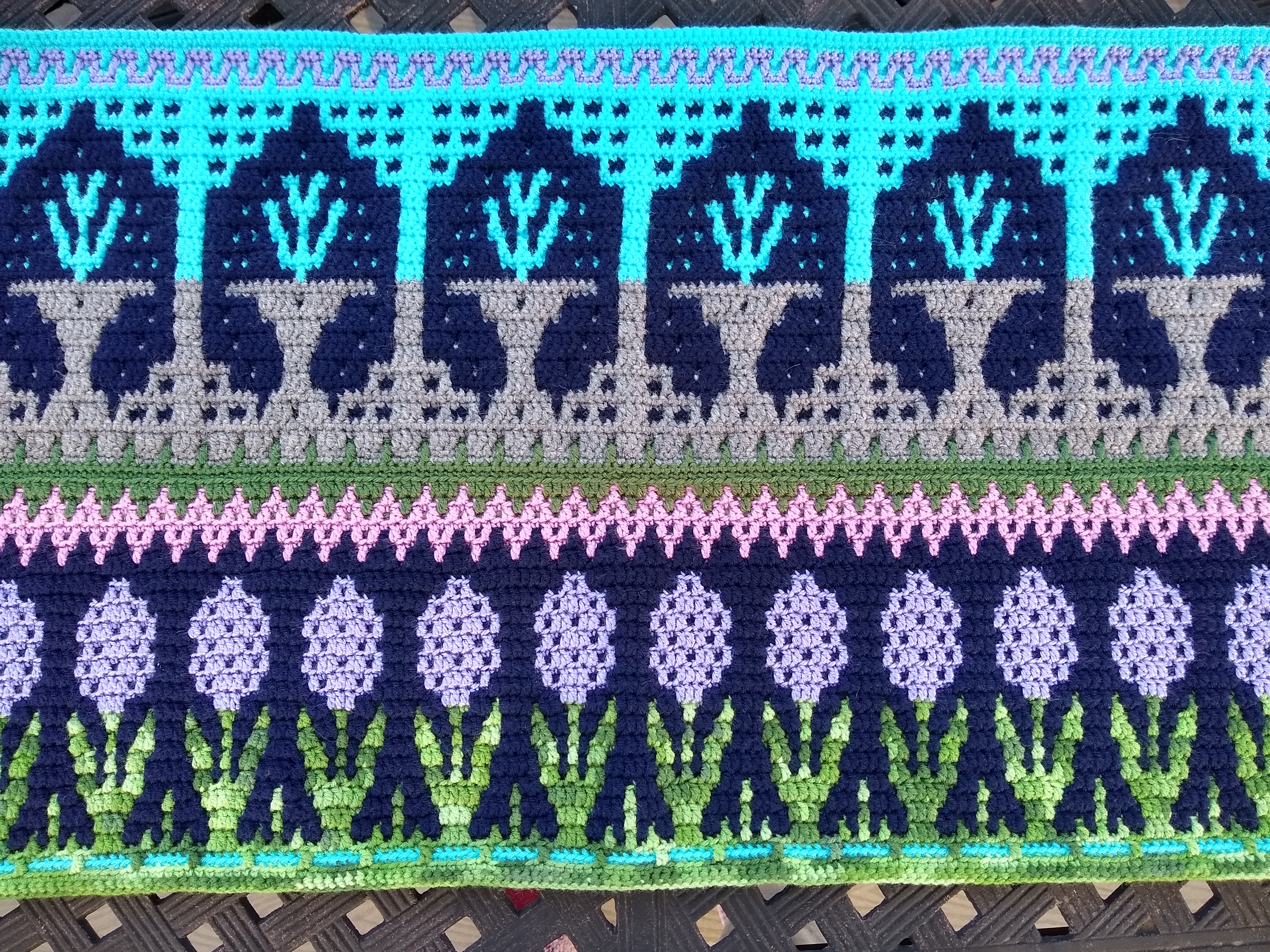
Parts 1 and 2 of the Letitia’s Garden CAL blanket I am working on for my mom. (Pattern by Rosina Plane on Ravelry)

What I love about crochet is that when I’m done with a project, there is an immediate pay off. I learn stitches, I follow a pattern, and I get a hat/scarf/blanket/produce bag/stuffed squid. Unlike writing where it takes months or years for a pay off, crocheting smaller projects can be done in an hour or two. It’s something I do to wind down if I’m feeling stressed by working on something simple or repetitive or to challenge myself by choosing something with an intricate pattern like the blanket in the picture. It helps keep me centered, especially when my writing isn’t going well.

Part of the reason this works is because I am a goal-oriented person who mentally gets off to ticking things off a to-do list, and a crochet pattern is basically a to-do list that ends in a product magically appearing. I can see the pay-off happening as I work the pattern, and that gives me the brain boost I need to counterbalance what’s going wrong with my writing. Does it help all the time? Absolutely not, and sometimes, I can’t bear the thought of picking up my crochet project and working on it.

But having a hobby that isn’t writing to give your brain that boost it needs to keep out of a downward spiral is really what is key here. If you’re athletic, maybe going to the gym and doing reps or having a pick-up game with your friends will do the trick. If you’re a crafter like me, maybe try crochet, needlepoint, knitting, plastic canvas, or even needle felting. Nothing like stabbing something a million times to get the frustration out. The good thing is, most of these hobbies don’t cost very much. You can get cheap yarn and a serviceable set of hooks/needles for $10 and there are tons of tutorials on YouTube, which is where I learned to crochet (I highly recommend HookedByRobin or JaydaInStitches).

If you are not crafty, then try video games. Much like crafts, quests give that bite size chunk pay off and seeing progression through a story or quest helps to refill the wells with serotonin. I greatly enjoy low stress games like Stardew Valley, Animal Crossing, and Ooblets, so if you aren’t a big gamer, those might be a good place to start to unwind.

The other thing I might suggest if you don’t feel like getting into a new hobby or playing a game is reading. I think most authors also tend to be readers, but I get frustrated when I hear authors say they don’t have time to read. You can probably make time for anything you truly want to do, even if it’s squeezing in a few minutes reading an ebook on your phone while in the bathroom. It still helps to refill those creative reservoirs.

Truthfully, I think doing something non-book related is the better option when you need to counterbalance writing angst. Doing something with your hands or playing video games, which helps to engage that hand-eye coordination and decision making anyway, are rife with pay-offs that might make you feel better if things are going wrong. Those small pay-offs that a hobby can bring add up and will ultimately lower your stress even if a pattern or project is frustrating in the moment. A side benefit is that I’ve often had plot epiphanies while my brain was busy chugging away a crochet project or plantings crops in Stardew Valley. It’s the repetitive, meditative nature of it that allows for your brain to run in the background and unpick the knots you’ve made.

If you’re feeling frustrated or stuck with your writing, I highly recommend trying a new hobby or picking up an old one.

organization · Writing

On Doing Things Wrong as an Author

Let me preface this by saying this is not a how-to on how to fix your screw ups. This is a post about things I screwed up that I didn’t realize were even a problem until I did them [repeatedly].

There is no right or wrong way to do most things as an author, especially in regards to writing. There will always be people who are really into your niche genre or dying for this very specific type of character you’re writing, but on the business end of things, there are, let’s say, less desirable ways of doing things. Things that don’t benefit you/the writer or the reader/your audience.

How I F-ed Up My Newsletter

I am incredibly guilty of doing those less desirable things because I’m either a) tired or burnout b) didn’t know better c) didn’t want to bother anyone. I bolded and italicized the last one because not wanting to bother anyone has been a lifelong mode of operation that I probably need therapy for, but we will not get into that. The problem with that mindset is that you treat everything you do as a chore for others. I only send emails to my newsletter occasionally because I don’t want to bother them. Or I don’t want to advertise my book because I don’t want to bother people. This means I am treating the books that I love and spent hours and hours of my life working on as something unworthy of attention, and in the long-run, I am setting myself up for failure because people don’t know I have books or think I’m only reaching out to sell them something, which is not a great look.

So what I’ve been working on is creating a monthly newsletter that will cover the following things:

Join my monthly newsletter for: sneak peeks, freebies/deals, book recommendations, life updates, pet pics, and book research
The background is grey with teal writing and there are 2 bats flying behind the words.

If you join my monthly newsletter, I’ll share things I’m working on, some cool research (and let me tell you, writing historically set books, there is a lot and it is weird), pics of my dogs, and books that I’ve read and loved and think you’ll love, too. When you sign-up, you’ll also get a free prequel short story, and over the next few months, I plan to send out another free short to subscribers. After the initial thank you emails, you will get monthly emails, which will be sent out at the end of every month.

I decided to change this to a beefier, monthly email because I was doing a disservice to my readers/subscribers by “not bothering them” except when I had book updates, and when I thought harder about that, it felt wrong to only send messages when I published. You could just follow me on Amazon or Bookbub if you wanted that kind of bare bones update.

How I F-ed Up my Back Matter

The next giant thing I screwed up is not keeping up with fixing my back matter. Back matter is the about the author, also by the author, newsletter/social media links, etc. that are found at the back of your book. Between changing laptops several times since 2014, switching writing programs, and just being overwhelmed at the prospect of going through like 10 Word docs, I put off updating all of these things for YEARS. This means that my first book had an “also by” list that only went up to like book four of the series. I facepalmed hard when I realized I hadn’t updated my back matter since 2017.

Something I would also recommend other authors doing is going back and formatting their docs, so the chapter headers are in a heading style and the body text is one uniform style. This makes it easier for the Kindle and eReader software to convert your book to something that makes sense. Guess who went back and properly formatted all 10 documents? And I was shocked to find that once I got going, it took significantly less time than I expected. I was able to do all of them over the course of a week and reuploaded the new files to my distributors. Amazon/KDP also has a new bit of free software called Kindle Create that is a lot like Vellum or, if you’ve used D2D, their autogenerated software, which will break your book into chapters and add pretty flourishes if you’re so inclined. Once again, very easy, highly recommend to make your books look spiffy.

If you’re an author, this is your sign to fix your back matter and formatting as it won’t take you nearly as long as you think once you finish the first book.

How I Forgot to Publish an Entire Box Set

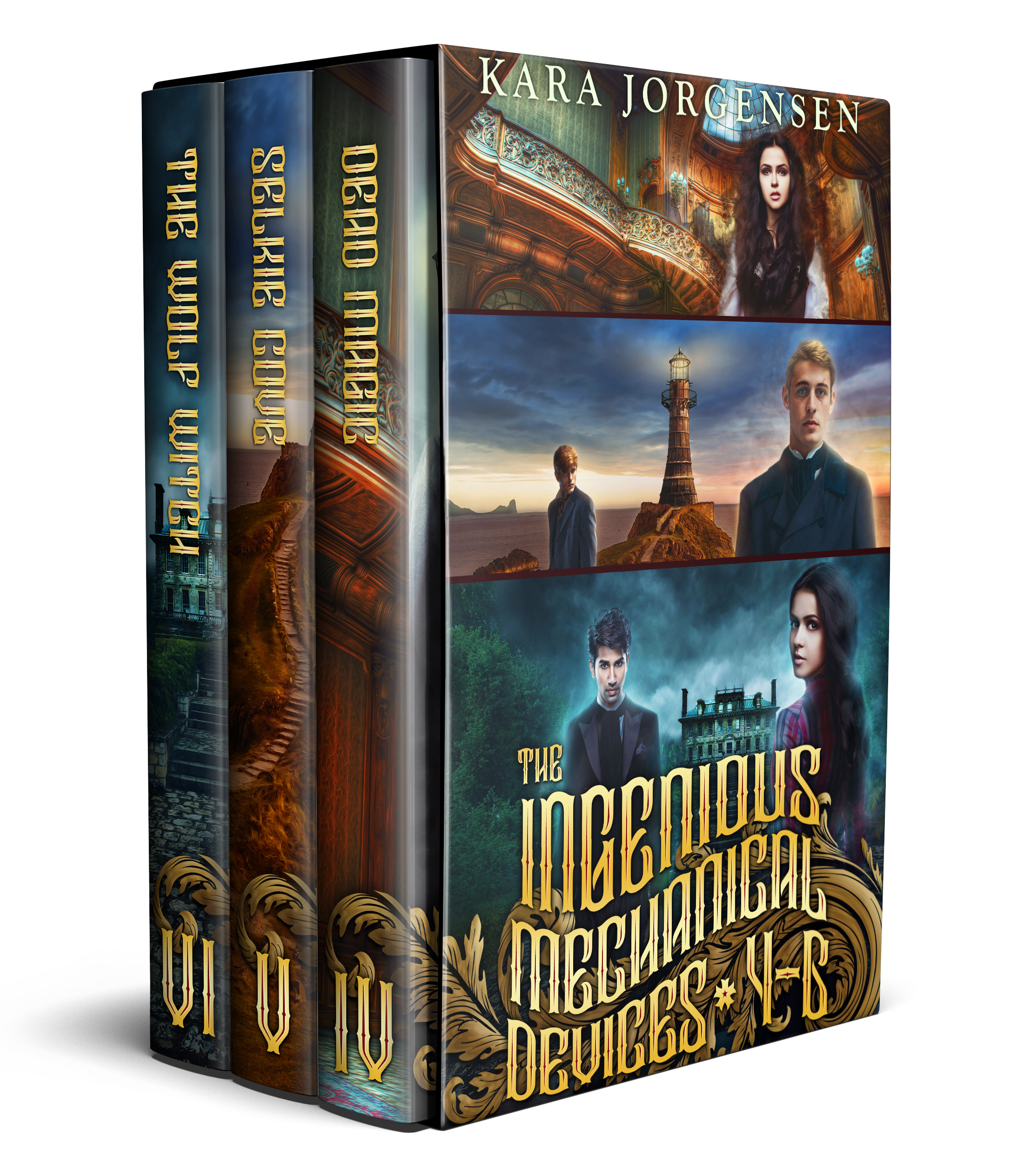
The last thing I did to get my work back into shape is to add a new box set for the Ingenious Mechanical Devices series. A while ago, I made a box set for books 1-3, which is 20% off the cost of buying the books individually, but I thought I’d wait until a year after book 6 came out before I made the next box set. Well, then I got overwhelmed with life and then enough time passed that I forgot. A couple weeks ago, I reached out to my cover designer (Lou Harper at Cover Affairs), made the file, and got it all listed, so if you’re interested in getting a box set of books 4-6 for 25% off buying the books individually, now you can. Both sets are available on all major retailers, BUT I had a little hiccup with Apple Books and Kobo. They have the set as a preorder that releases January 29th. I’ve reached out to fix it with no answer, but the 29th isn’t that far away, so if it doesn’t get fixed immediately, you will get your books by the end of the month.

TL;DR

If you’re an author, research best practices instead of assuming you’re being annoying because you could be in a totally different way than you though.

You may also want to join my monthly newsletter as it starts up in earnest this month.

If you’re an author, fix your back matter and formatting.

Check out my latest release, which is a box set of books 4-6 in the Ingenious Mechanical Devices series for 25% off the cost of the books individually.


Let me know in the comments what kinds of things you like to see in author newsletters!

organization · Personal Life

How I’m Getting My Sh*t Together

If you saw my post on “Life’s a Mess but There’s Hope,” you know that I have been having a rather rough time. Earlier in the year, due to life/emotional stress (or from a potential asymptomatic covid leftover), I was struggling with brain fog, checking OCD, and general anxiety. This combined with work stuff and writing malaise had wreaked havoc on my self-esteem and self-worth, so while I was mainlining YouTube videos, as one does when they feel shitty, I came across Sarra Cannon’s videos about her quarterly planning.

I already am a big proponent of using planners and have used a bullet journal every year since 2016, but when my downhill mental spiral started in earnest in 2020, I stopped setting concrete goals and my organization devolved from there to the bare minimum. So when I saw Sarra’s planning videos, I was excited, especially since she is a writer and entrepreneur, and it turns out her HB90 system is centered around exactly that. Before I go on, I’d like to say that I am in no way affiliated with Sarra’s classes. I just took the HB90 course and felt that I benefited from it.

What is the HB90 system?

The HB90 system was created by author Sarra Cannon (YouTube channel is Heart Breathings) as a way to help others stay organized and move toward the ideal life they want. Instead of focusing on a year at a time, she breaks things down by quarter. Some of you might shrug and say it sounds like every other planner, but there were certain aspects that greatly appealed to me.

The first one was that this system focused on quarterly goals instead of yearly goals. A problem I often faced was getting off track due to life and my yearly goals would rapidly spiral into why bother land. I wouldn’t be able to right that ship and would give up. By having quarterly goals, they are smaller chunks, and after each quarter/90 days, you do a review and figure out what worked, what didn’t work, and what you need to do. That way, if you know you were doing something self-sabotaging, you can sort of check yourself and figure out how to move forward. Also, you can decide if you want to continue a half-finished/unfinished goal or shelve it next quarter.

The other thing that appealed to me was the visualization/ideal life aspect. At the beginning of the course (and each quarter), you fill out questions regarding what you truly want your life to look like. The idea is that if you have a specific direction/vision, you know that your goals should aim you toward that vision and you can eliminate or minimize things that won’t move you toward that life. It wasn’t done in a “you should be rich in the future with a mansion and a convertible” or girlboss kind of way. She’s simply asking you to find an ideal in order to make sure your choices make sense. Something I struggle with is “spaghetti flinging,” so if I don’t know what I need to do, I will do all the things instead. This means, I do a lot of random stuff that doesn’t amount to much. This is meant to eliminate that because I can say, “Yes, this idea is great, but this isn’t what I’m focusing on right now.”

I don’t want to go over every aspect of this course (this is what taking the course is for), but something I appreciated was that Sarra Cannon is mindful of reality and different realities. She asks you to be realistic but also kind to yourself. Don’t set yourself up for failure by being like “New Year New Me!” while still having old you’s habits and abilities. You have to work on that gradually, and I was so relieved to hear her talk about if you have chronic health problems and budgeting your time based on how often you know those things take you out of commission. This really isn’t a hustle culture kind of thing, so that work til you drop and hustle harder wasn’t there. It was about knowing what you are currently capable of and potentially working toward different habits in the future or scheduling yourself better right now. As someone who has inflammation problems, migraines, and anxiety, I can’t live up to the ableist standard of hustle culture, so this took some of that pressure off me while I was working on my goals/schedule.

My Ideal Life

When I was asked to imagine my ideal life, I struggled a bit. Academia has been going through a weird time of upheaval, especially in the humanities where I work, and that has made my own life more complicated. What I decided to do for my ideal life was to create a vision board on Pinterest, and I quickly realized it would make no sense to anyone but me. What I want is a life lived creatively. I want a rich, fulfilling life that is focused on things that make me feel good: my partner, my dogs, going to museums, doing creative writing, doing more art. There’s certainly room in there for a full-time academic position if one should ever come available, but I don’t feel like I can bank on that due to the current climate at US universities. I would like to model my life a little on Vincent Price’s. He was an actor, obviously, but he also loved art and cooking, and I want a life that is filled with creativity in various forms (he also wrote a book about his dog, The Book of Joe). I already crochet, but I’d like to do more traditional art, maybe even pottery, and I’d eventually like to live off my writing (especially if teaching full-time is ever off the table). This means my overall goals should be pointing me toward being able to rely on my writing more and giving myself the space to treat my writing seriously.

My Goals for 2022 Quarter 1

Goals in the HB90 system are a little different from what we normally think of as goals. The HB90 system asks you to pick things for goals that are slightly out of your control. That way you can see whether the tasks you put under them worked or not. So I’m not posting ALL of my projects under these goals, but the idea is that you have an overarching goal, then projects under it (larger scale stuff that you would normally consider goals) and those projects get broken into tasks that can be accomplished between a few hours or a week’s time. So here are my goals for Q1:

  1. To work on publishing new books while reworking my back list to increase my monthly income to $X/$Y/$Z a month (numbers have been hidden because I felt awkward talking about how much I make off my books).
  2. To create an energized community surrounding my works and increase my social media followers by 10%/15%/20% (Focus on newsletter, blog, Instagram, Twitter).
  3. Continue to work on my teaching materials and to maintain my mental health by maintaining a decent work-life balance.

To accomplish these goals, I will be writing more (please see my 2022 Projects post for specifics), reading some books on marketing, taking another course to keep my author knowledge up to date, hopefully sending out more newsletters, fixing the back matter in my books, and working on some departmental stuff for one of the universities I work at.

The Kanban Board

The top level of my Kanban board for quarter 1, aka the to-do section. The other sections aren’t shown since they’re empty.

To keep this post from being 8 miles long, I will not go into minute detail about the Kanban board (you can check out one of Sarra’s videos for detail), but the Kanban board is part of the HB90 setup as well. It is originally a Japanese form of organization where you get a dry erase board/paper/digital board and divide it into three parts. It goes to-do, currently working on, done. The idea is that you put everything in the to-do part, and as you work on it, you move it down until it ends up in the done section. Sarra uses sticky notes, and because my tasks aren’t super granular this quarter, I decided to use dry erase magnets as they are less likely to fall off.

The things written on each magnet are tasks that I need to do this quarter. I’m sure I’m missing some, but that’s what the extra magnets are for. What I like about this technique is that it is very visual. I am a tactile, visual person who needs lists in front of my face in order to remember to do things. If I can see progress (aka things moving down the board), I think I will feel better about myself and maintaining my mental health with be easier. Something I have struggled with is feeling like I’m doing so much but not getting anywhere. Something I’m still gauging is how much will fit in 90 days, but that should come with practice and will vary based on what classes on I’m teaching and such.

Final Thoughts

I’m excited to have some sort of framework in which to organize my writing and indie author stuff because these last few years have been a shit show for me. Sarra Cannon’s videos and course has helped to reignite my focus and zest for being an indie author. I’m cautiously hopeful that this will get me back on track.

Let me know if you want to know anything else about the HB90 program or how I use planners in the future! I do plan to update you all on how this is going at the end of the quarter.

Monthly Review · Writing

2022 Projects

Photo by Lisa on Pexels.com

As I mentioned in my recent post, I want 2022 to be a year of getting my shit together. I’ll talk more about this in a future post, but I have been taking a course on the HB90 method, which is a way to keep yourself organized, plan future goals, and get your life in order. The course was made by a fellow writer, so I’m hopeful it’ll help me to get back on track. While I’m doing the behind the scenes work, I wanted to give you a little preview of what I am working on and hope to publish in the coming year.

Now, a little disclaimer that I cannot control many factors, so I don’t have full release dates yet. Assume longer projects will come out in the second half of 2022.


Photo by Mitja Juraja on Pexels.com

The Reanimator’s Heart

The Reanimator’s Heart is an off-shoot of the Paranormal Society Romances, so it still takes place in the same time period as Kinship and Kindness and many scenes are at the New York Paranormal Society. The reason I chose to create a spin-off is because this will be sort of equal parts paranormal mystery and M/M romance.

The Reanimator’s Heart is like Pushing Up Daisys meets Penny Dreadful. There are definitely some darker, scarier moments in this story, so if you like Jordan L. Hawk’s Widdershins or KJ Charles’ Magpie Lord stories, this is probably up your alley.

Oliver Barlow is the Paranormal Society’s resident coroner and necromancer. Oliver does his best to keep his powers hidden, but when he finds the man he’s had a crush on for years dead, he accidentally revives the charming Felipe Galvan. But Felipe refuses to go back to being dead until they find out who murdered him. Oliver and Felipe soon find themselves entangled with a murderous cabal that wants to bring something horrid from the great beyond.


Photo by Brandon Nickerson on Pexels.com

TROUSERS AND TROUBLE (Paranormal Society Romance #2)

Trousers and Trouble is the sequel/prequel to Kinship and Kindness. This story follows Bennett from when he leaves his uncle’s home, arrives in Brooklyn, and meets his best friends, Ruth and Rory. I know the series title says, “romance,” but let’s stretch this to mean platonic friendships and self-love. This is really a story of Bennett discovering who he is and a community where he is accepted for who he is (on several levels).

As with Kinship and Kindness, there will be magic, shifters, but this story has three transgender main characters. Ruth and Rory will eventually each have their own books in the series.

Between drag balls, performances at the Stratford Theater, and days spent at the Paranormal Society, Rory and Ruth are living their best, bachelor lives in Brooklyn. That is until a teenager on the run from his old life stumbles into their path.
While parenting had never been in the cards, Ruth and Rory know what they need to do, and they soon become Bennett’s fairy godmothers as they help him become the person he was always meant to be. But sometimes the past sinks in its teeth and refuses to let go. When Bennett’s family comes knocking, Ruth and Rory will stop at nothing to keep their new friend safe.


Future WIPS

  • A short story freebie for my newsletter that will probably be in the K&K world (join my newsletter in advance and you will get another free short story, “The Errant Earl”)
  • Tempests and Temptation (PSR #3)
  • Book 2 of the unnamed necromancer series
  • More books in the Ingenious Mechanical Devices series- not sure how many, but there will be at least 2 more

Well, I think I have kept you all long enough. Let me know in the comments which of these projects you are most looking forward to!

Uncategorized

The Box Set of Books 1-3 of the Ingenious Mechanical Devices is Now Available at All Major Retailers

For quite a few years, the box set of books 1-3 of the Ingenious Mechanical Devices series was only available on Amazon, but I have finally taken it wide, which means that you can now buy a copy on all major ebook retailers, such as Kobo, Nook, Scribd, Apple, and more.

The best part is that if you buy the box set, it costs 20% less than buying the three books individually.

The box set contains The Earl of Brass (#1), The Gentleman Devil (#2), and The Earl and the Artificer (#3).

If you click the button below, it will take you to your favorite retailer. If you have never visited Books2Read before, it will ask you to pick a retailer and will remember for future clicks.

The Wolf Witch · Writing

The Wolf Witch is Out Today!

banner books to 6

The sixth book in the Ingenious Mechanical Device is out today! You can grab a paperback or ebook copy of THE WOLF WITCH on Amazon here.

Since returning to England from abroad, Emmeline Jardine has managed to get a place of her own, maintain a tenuous truce with her guardians, and celebrate her new found freedom by attending as many parties as she can manage. That is until a man claiming to be her father shows up.
Her father has a problem. Her half-brother, Wesley, has disappeared while investigating possible werewolf sightings, and he needs Emmeline’s help finding him. Emmeline reluctantly agrees only to find there are others interested in Wesley’s plight. When she receives a mysterious invitation to a country estate deep in the woods, Emmeline is shocked to find a familiar face there.
Nadir Talbot, Decadent, writer, and all around nuisance, infuriates her to no end, but Emmeline soon finds he is the only she can turn to as they are thrust into a world of werewolves, monsters, and secrets from her family’s past that threaten to bring the empire to its knees.

Emmeline has done a lot of growing since Dead Magic, so I hope you’ll enjoy reading her story and following her on her journey to discovering who she truly is.

If you pre-ordered a copy, it will be waiting for you on your Kindle, and if you enjoyed THE WOLF WITCH, I hope you will leave an honest review on Amazon or Goodreads. They help small time authors like me a lot in terms of visibility.

I hope you all enjoy THE WOLF WITCH, and I will have news soon on my next project, which involves characters mentioned in THE WOLF WITCH.

Personal Life · Writing

In Defense of Small Word Counts

Let me let you in on a little secret. I don’t write a lot of words per day.

My daily word counts vary from 350 to 700 on a good day, but I almost never break 1,000 words unless I’m at the very end the book because the resolution is often easy for me to write since all the major strings have been tied.

On social media, it’s common for people to post their word counts after a writing sprint or just as a daily thing they do to hold themselves accountable. When I see people post that they wrote 4,000 words in a few hours, I feel sick. That’s more than I write in a week sometimes, most times. Seeing giant word counts is something that bothers me on and off. When my writing is flowing well, I don’t really care. When I’m struggling, all I see are other people’s numbers and I begin to feel inadequate.

When I’m writing consistently, it’s easy say to myself, “Why do you care? You’ve published 5 books. It isn’t like your words don’t add up to a full book.” And my books aren’t exactly tiny. Most are over 90,000 words. So what if it takes me 6-9 months to write it? I’d like to blame capitalism for that. Everything we do is measured in productivity and inevitably we tie our self-worth to the outcomes of our labor. How many words per day is merely a metric by which I measure my self-worth when things aren’t going well.

Someone might say, “Ditch the word count. Just write.” I tried that last year when my mental health was rather shitty, and it did the opposite of help because without something to push me, I wrote nothing for a few months. When writing is a form of self-care, you understand how this can cause a downward spiral. My small daily word count goal of 350 words is like saying I’m going to meditate for 15 minutes every day. It’s something I have to push myself to do because my brain, when it’s feeling low, resists doing it even though it’s good for me. A small, doable goal gives me the push I need to get it done.

Once I hit my 350, I can stop and go to bed. Most of the time I keep going. Days I don’t write because I just don’t have mental or physical spoons to do so, I make up for it the next day. I have a word count tracker that I use to chart my progress and hold myself accountable. Days I don’t write, I don’t put a zero in. Some may think it’s cheating, but zeroes made it harder to write when I was down. Now I just fill in 350 and make up for it the next day by writing 700 words or as I tell myself 2 350s.

We do what we must to trick ourselves into taking our medicine.

For years, I’ve dreaded things like NaNoWriMo where you write 50,000 words in a month or 1,667 words a day. Before I made friends with other writers, I thought you had to be a pro to accomplish such a massive daily word count or be on speed. It never seemed possible. Then I made friends with writers who seemed to do it without a lot of trouble and my confidence cracked. I couldn’t do it. I tried to do NaNo and gave up within the first week. Despite all the hype and support of other writers, I stared at that word count like it was Mt. Everest. Only the strongest and best could do it, and I couldn’t.

What I failed to notice is how many writers do NaNo and don’t publish or shop the book after. Plenty of books grow out of NaNo, but most don’t or they need to be heavily revised. That’s far from my usual process. Until last year, I had never had to totally rewrite a book. My books need editing, but most of it is fact-checking, copy edits, and cleaning up/beefing up descriptions. What I start, I finish, even if it takes the better part of a year.

I guess the point of all this is that you have to do what works for you. If writing a lot and then editing a lot is what comes naturally, then do it. If you write a little at a time, that’s fine too. There’s no one way to write even if there are plenty of books that try to teach you how to boost your productivity. At some point, you have to come to terms with what your process is and embrace it as best you can.