Writing

No, You Shouldn’t Use AI, Even on the Small Stuff

If you’ve followed me on social media for longer than a few days, you know I hate AI. I am morally opposed on every level to AI because it not only destroys the environment but is a tool of fascism. As much as I would like to word vomit about that, instead, I would like to speak about why writers shouldn’t use AI, even for seemingly minor details as so many AI-using authors claim to do.

Here’s the thing, there are no truly minor details or unimportant parts of a book as everything needs to further the characterization and mood of the story.

I can already feel some writers rolling their eyes at that. Feel free to do so at your own peril. Writers who are willing to hand over parts of their project to AI to “free up their time” to do other things should instead look at their relationship to hustle culture and why they have chosen quantity over quality. Hustle culture is rife in the writing world with many author groups pushing a churn and burn mentality where authors need to publish every 3 months or be lost to irrelevancy. If you go onto Amazon’s top 100 category boards for books on writing, you’ll find books about writing more or writing faster. While those can be useful, writing more isn’t the same as writing good or better books. The hustle side of the writing world stresses that readers don’t care about the books themselves. They’ll read anything as long as it checks off a few boxes for them, and that once you have hooked them, readers will come back every 90 days to choke down whatever book you throw at them.

I despise this mentality. For one, it is patronizing to readers. Readers won’t stick around if your book sucks or if the quality goes down over time. We’ve seen this with readers noticing an author with a massive backlist has turned to AI, and they abandon them when the writing becomes nonsensical or the quality change becomes noticeably bad. I don’t like when authors treat their readers like shit or take advantage of them by assuming they will always be there no matter how they treat them or how crappy their books are. If you’re a writer, I believe you should write for yourself first, but anything you sell to readers should be the best it could possibly be for them since they’re the ones supporting you monetarily.

What I hate even more about the hustle culture mentality is the way corporate speak has made its way into creative fields. Creativity can and should make you money. Artists should be paid fairly for their work and be able to make a stable living off of it. At the same time, I don’t think creativity should be treated like a business in the way that corporations expect exponential growth at all times. It is unsustainable. We cannot write more books every single year and increase our yearly word counts exponentially. It is impossible and will quickly lead to burn out and quality loss. In order to meet these unsustainable quotas, authors turn to AI because others have convinced them that if they outsource the tedious parts of writing to the machine, they will free up time to write more of the things they enjoy or just write faster. The problem is that those tedious parts aren’t useless; everything in your book should serve a purpose.

What many of these “write more in less time” gurus purposely ignore is writing as a craft. There is almost no discussion of how to make your writing better, only how to do it faster. If they did care about craft, none of them would be suggesting using AI. As someone who teaches young writers how to better their work, every piece of writing I have seen from AI is far worse and emptier than anything brand new writers in my classes have come up with. AI writing is confusing, devoid of charm or character, and just flat-out bad. 0/10 do not recommend using it because it will take way more time to edit than just writing something yourself. A study with people who code showed that while they thought they were taking less time using AI, they were actually taking longer because they had to review it, fix it, etc (source). This is on top of the environmental harm, the fact that it is a tool of fascism, and a plagiarism machine.

The thing that a lot of writers using AI for the “boring parts” don’t seem to understand is that the minor details are incredibly important to your story. One of my most hated posts online is the whole, “Only English teachers care that the drapes are blue. They’re just blue. The author just gave it a random color. It isn’t that deep.” Sure, that can be true occasionally, but 99% of your descriptions and details should be purposeful. When you are creating a world, even if a story takes place in the real world, you are building a microcosm specific to your characters and the story you are telling. Therefore, there is an added level of cohesion and purpose in those details that might not appear in our material reality. When you are setting the scene, you need to think about how you want the reader to feel while interacting with this part of the world, how the structure fits the function of this setting, and how the point of view character effects the way the world is interpreted or experienced. For example, a character with a phobia of dentists is going to view, experience, and describe a dental office differently than someone who doesn’t think getting their teeth cleaned is a traumatic experience. If you just let AI fill in the description of the dental office, you are losing that context. Even if the character isn’t scared of it, they will still notice details other characters won’t, and while you’re writing your story, that should be something you focus on.

The other place I’ve heard people using AI for “busy work” in books is dialogue. This really makes no sense to me because dialogue is one of the best ways to insert characterization, motivation, and movement into a story. Even if you feed a chat bot relevant information about your character, it isn’t going to understand the context of your work and anything about the character below a surface level. Any dialogue it spits out will be generic, boring, and probably ill-fitting for the moment. This is one of those situations where editing extensively will be necessary and will probably take longer than just writing it yourself.

But what if I’m stuck? Why can’t I just use AI to fill in the gap for me?

Because that’s cheating! It’s cheating yourself out of using your brain to puzzle out what should go next. It’s like saying, “I find this exercise hard, so I’m going to use a motor to move the dumbbell for me.” It isn’t going to help you, and at some point, your writing muscles are going to shrink and atrophy until you can’t write anything without constantly circling back to AI. Using AI long-term causes cognitive problems (source). If you continually use it to help write your books, you will become more dependent on it and eventually get worse at writing. The best way to combat this is to face the things that challenge you head-on. Why are you stuck on this dialogue? Why do you struggle with description? Do you not know when you need to add it, or do you simply need some resources to help you name things?

There are a ton of writing resources online made by authors for authors, many of which are free. Instead of using AI, slow down and invest time and effort into getting better at your craft. I know hustle culture says write more, write faster, publish quicker, but the best way to get ahead as a writer is to take time for yourself and do things to be a better writer. Sometimes, that looks like taking a break to read good books, watch shows that stoke that creative fire, do other crafts to refill your well. Other times, it’s dissecting how other authors write well and figuring out how to do that in your own way. Writing takes work, and work means effort on your part. Using AI to write the things that you struggle with or find boring means that you are cheating yourself out of the opportunity to learn, grow, and become a better writer. Before you run to ChatGPT for help when you get stuck, look up a resource on Google that can help you with this particular thing. If you are struggling, others have too, and there’s a 90% chance that someone has made something to help you figure it out on your own.

Writing

8 Things New Authors Should Know

I’m the first to admit that I do not have the answers when it comes to writing or being an author. Hell, I’m still shocked they let me teach students, but after ten plus years of being an indie author, publishing ten books and a bunch of short stories, I have learned a thing or two. It’s funny because I posted a similar blog a year or two ago, but after teaching my novel writing class this past semester, I realized there are a few things I really think new authors should know.

  1. You have to be your biggest fan. I often see writers who come from a fanfic background get down about the lack of validation and encouragement when they come nonfanfic writers because your stories go out when they’re finished rather than as they work on them. You are probably never going to get that same validation on your work unless you post the draft live on your blog or on Patreon, so my suggestion is to become your biggest cheerleader. You need to love what you’re working on and light your fire for your characters. That isn’t to say there aren’t going to be hard days where you are frustrated or hating the process. You just have to be excited to see these characters go on their journey more than anyone else. Write for yourself first and foremost to keep that excitement alive.
  2. Take care of your body. My partner and I are both from artistic backgrounds, and the number one thing they always remind me of is to take care of my body. If you want to have a long and sustainable career as a writer, you need to take care of your hands and your back. Resist the urge to curl up like a shrimp while you type, make sure your wrists are in an ergonomic position to avoid carpel tunnel, stretch those fingies and wrists, and take breaks. I’ve been stressing this to my students lately because what you can do at 18 or 21 is infinitely harder at 34.
  3. Avoid burnout. Something we all need to know the warning signs of and try to prevent is burnout. Burnout is basically when you run your brain into the ground by overtaxing it and not giving yourself enough rest. It can also be caused by compounded stress. Sometimes, it is unavoidable due to bad things intersecting all at once, but if you can help it, be on the look out for suddenly feeling run down, actively avoiding your work, everything suddenly being far harder than it normally is. This can be due to other health issues, but if this feels more mental than physical (or is mental and turning physical), it may be burnout. Radical rest is the best medicine. Your deadlines and readers can wait for you to take care of yourself. Being burnout for a long prolonged period can lead to permanent damage, so please rest when you feel it coming on.
  4. Learn about taxes early. I know this is probably not as big of an issue outside the US, but please learn about how taxes work for independent creators in your state. I always thought taxes were very scary, but the IRS is not going to bust into your house like the Kool-Aid Man and arrest you. What you can figure out is what counts against your taxes (losses/things needed to create your products), how to do quarterly taxes (which will save your money in the long run if you make a decent amount per year), and what the threshold is for upgrading to an LLC or having a professional handle your taxes and advise you. I know it is stressful and varies from state to state, but figuring this stuff out took a lot off my plate. If you want to sell things on Etsy or from a storefront online, you should also figure out how to do sales tax and such as well.
  5. Learn that authors are not your competition. They are your coworkers. No reader exclusively reads one author and no one else, so there is no reason to treat other authors like the enemy. I know that often this comes from a place of jealousy, but treat the people who are doing better than you are inspiration or case studies. See what they are doing in terms of marketing or interactions and try to apply that to your work. Don’t copy people; learn from them. Other authors are your community, and they are often the ones who step up to help out newer authors. Fine supportive people. It may take a bit, but also don’t be afraid to leave groups that are catty or mean spirited. They aren’t your friends, and you can do better.
  6. Be true to yourself and your vision. This is sort of similar to point one, but it can be easy to get caught up in doing what everyone else is doing. Authors see people are making book boxes or Tiktoks or book trailers, and suddenly, you’re worried that these things are the key to success. No one thing is, and if doing Tiktoks isn’t something you want to do because you hate video, then don’t do it. It’s best to stay focused on what you want and how you want your writing life to look and focus on how to make that work rather than fling spaghetti and do everything while hoping something sticks. If you try to do everything, you will burn yourself out and get less done.
  7. Remember that not everything you see online is real. People lie. Shocking, I know, but yes, people on the internet lie about their success or pull a Wizard of Oz to make their success look grander than it really is. There are a lot of people online who are grifters who just want to sell you their course or get you to listen to their money-making podcast, so they tell you what you want to hear. They have the secret to make a million dollars or how to make four figures a month. Someone can make a million dollars over fifteen years and call themselves a million dollar author, or they might make $50k in a month, but what they don’t say is that they spent $30k in ads. You might also see authors who claim to have personal assistants when, in reality, it’s a chatbot or them under a different Facebook or email account pretending to be someone else. Trust me that it is more common than you would think, especially from people who try to act like authorities online.
  8. Don’t use AI. There are also a lot of people who will tell you AI can help you write faster or that it can help you with research. It can’t. AI is basically the mediocrity machine. It picks the most common dreck and smooshes it together on command, but it cannot think, it cannot create emotional depth, and it isn’t consistent. There are TONS of resources online that can teach you to become a better writer, but AI isn’t it. It isn’t a shortcut to success, but it is a shortcut to losing your career because most readers do not want to read AI written or aided stories, and yes, you can tell. From a creative writing teacher perspective, every bit of AI writing I have seen has been far worse quality than anything newbie writers in my classes have turned in. It’s soulless. If you can’t convince yourself to write and have to turn to AI in order to do it, you are in the wrong field and should leave to make room for those who do give a shit about craft and their readers.

Writing

Plot? Character? Both? Both. Pt. 2

Last week in part 1, we talked about how to build characters in a way that makes it easier to build the rest of the story structure around their growth and change. I highly recommend reading that before reading part 2 if you haven’t yet.

A caveat before we begin is that I am using my writing process as a scaffold for this. Everyone has a different writing process and there is no one way to write a novel. My hope is that you will adapt my advice to what works best for you by taking what works and leaving what doesn’t. Also, this post will have very minor spoilers for The Reanimator’s Heart as I use it to show how I construct the basis for my characters/plot.


A few key reminders before we start

  • your main characters must change from the beginning to the end of the story (this can be positive or negative growth, but there has to be change)
  • if you’re writing a romance or a character driven story with more than one protagonist, you’ll need to have more than one character change, so they will all need a journey tied to the plot
  • if you are planning to write more than one book with the same characters, you will need to have them change incrementally across multiple books, usually by shifting different traits in each book
  • the hierarchy of building a story goes character > plot > world-building > everything else

Let’s ruin their lives

The big difference between a character driven story and a plot driven story to me is that character driven stories focus on the change in the character first and make the plot work toward that. Plot driven stories have the characters serve the plot, meaning you could hypothetically swap out the characters without changing the major beats of the journey. In real life, we might be going through a midlife crisis without something in our external life making it worse, but because this is fiction, we can make things far more convenient than reality in our character driven story. Think of the external plot as a trigger for the inner journey of your characters. They are already feeling this way, but the external plot has kicked off a lot of feelings and made things more complicated for your character. I think a lot of writers tend to think of the internal journey and external plot as being separate, but if they are intrinsically intertwined, you can really heighten the character’s turmoil and strengthen both the character development and the plot at the same time.

I’m not going to go into a specific beat sheet or structure, so if you’re a plotter, feel free to use whatever plot structure works best for you. Personally, I like Sarra Cannon’s beat structure, which you can find in her HeartBreathings channel on Youtube.

Last week, I mentioned that we need to figure out what your character needs most to be a happier or better person (or feel free to ruin them; it’s your book) in order to figure out the internal journey. For Oliver and Felipe in my book The Reanimator’s Heart, they both need to work on their issues with isolation in order to be happy. Oliver needs to step out of his bubble while Felipe needs to let Oliver into his. How they deal with their isolation and interact with each other will be informed by the past and personality we crafted earlier. As a reminder, Oliver is autistic and a necromancer, which has contributed to his isolation and getting stuck in a rut after years of pining after Felipe who also works at the Paranormal Society. Meanwhile, Felipe is seen at the society as almost a demigod. He is a self-healer, a hero, someone who takes the worst cases and can survive the harshest conditions. This has set him above and apart from the other investigators who like and respect him but also low key fear him. This along with his daughter going off to college has caused him to pull away from most people because they expect him to constantly be that untouchable hero.

My question to myself while constructing a plot is how can I ruin my characters’ lives in a fun and inventive way? This is why we want their issues to be similar, so that we can ruin their lives efficiently while plotting. Ultimately, since this is romance, we want Oliver and Felipe to get together by overcoming their loneliness together. Now, let’s combine this with a worst case scenario for them personally. Oliver is a necromancer, and Felipe is a hero with nearly supernatural abilities. What if Felipe gets killed, and Oliver reanimates him? That’s pretty messy. Oliver is also a rule follower by nature and going against the laws of nature by keeping people alive long after death is definitely against the rules, so if he were to reanimate Felipe, that would cause him some angst. Felipe is–was–nearly immortal, so the whole being dead thing would also cause angst and an identity crisis.

Note how all of this is picking at wounds or character traits/history that was already there. As you’re writing and brainstorming, it’s fine to tweak the backstory to make this work more smoothly. This is also why I think you should give yourself some vagueness or breathing room with a character’s history; it allows you to tweak things to better serve the character-plot symbiosis while plotting.

Constructing the plot

Now that we’ve ruined their lives, we’re probably at the end of act one in terms of plot structure. This life ruining should kick us into the story proper, which means the plot should unfold logically from there. Keep in mind as you go from the kick off to the finale that your characters need to grow or change by the end of the story. In Oliver and Felipe’s case, it’s overcoming their isolation. Since it’s a romance, we can assume that means they get together as a couple in a happily ever after. There needs to be a logical progression from lonely to together that builds over the course of the story.

As I said, I’m not going to go into too much detail regarding plot structures, but the four acts of a story should go as follows:

  • act 1 (0-25%)- introduce the issues (and if it’s a romance, entangle them)
  • act 2 (25-50%)- we’re exploring the new world and showing how these issues are a problem
  • act 3 (50-75%)- at the beginning there’s some moment of recognition of the flaw and they spend the rest of the act trying to rationalize it or shy away from fixing it all while being more conscious of it
  • act 4 (75-100%)- things come to a head and the character(s) are forced to confront their issues and finally overcome them, usually while overcoming the external plot

As you brainstorm the plot and overall external conflict of your story, you need to think of a plot that will poke at the wounds your character already has while still being interesting. This way you are constantly touching the internal journey rather than weaving it back and forth into the story as a subplot. With Oliver and Felipe, I decided that a way to intertwine the inner journey and outer plot was to have Felipe die by being murdered. This forces the characters to go solve his murder (along with another murder I grafted onto the plot for cohesion after this initial brainstorming). By solving his murder, they are forced to spend a lot of time together, look for clues, get to know each other, and do things that tackle their loneliness issues while complicating their relationship. If he had died naturally as opposed to being murdered, the two plots of the story wouldn’t be linked together as tightly.

Throughout the story, but especially in acts 2 and 3, you have the perfect opportunity to use plot points to deepen or explore the internal journey while they do things for the external plot. These can be large plot points like when Oliver is nearly killed, which reveals the true depth of Felipe’s feelings and some clues for the external plot, or they can be quieter plot points, like where the characters discuss the case while having dinner and by sharing a meal, they’re also no longer isolating. You want the majority of the major plot points to do double duty in serving the internal journey while also moving the external plot forward. This is also why I suggest having the main characters in a romance have the same issue in a different flavor (like loneliness). If they have opposing issues or ones that very different, figuring out how to riff off the main plot while balancing both may be difficult or come off as disjointed.

As you are writing your story, I want you to make sure that you don’t lose sight of the most important part: the characters. They are the key to making a compelling story or series that sucks your readers in. It’s easy to get wrapped up in the fun and games of the plot, but if you’re writing a character driven story, they need to be front and center in your mind and on the page from the opening to “the end.”

Writing

Why My Books Aren’t in KU

Because someone on the internet will willfully misinterpret this, this isn’t bashing authors who use Kindle Unlimited, but with everything, it is a business decision. I’m writing this post because I feel bad for my friends who have gone all in on Amazon and feel like their world has been upended. It especially sucks because having been publishing since 2014, this has happened before.

Full disclosure: once upon a time, I had my books enrolled in Kindle Unlimited. I’ve been publishing since 2014, so I think my books were in KU from 2014 to 2018 or 2019 (I honestly cannot remember). There were times I made really good money off KU, like more money than I make now because I paired KU with a Bookbub ad and my profits/exposure exploded.

I still took my books out, and the reason being is that I have been through the KU song and dance before. This rollercoaster of profit and loss is nothing new to authors who have been around a while and why you don’t see many authors have been around a while on Kindle Unlimited. KU had a different payout system for a while, then they changed that, and our royalties tanked, then more people started indie publishing and enrolling in KU, and profits tanked again. Lather, rinse, repeat for different yet very similar reasons.

At some point, I got sick of it. I liked the perk of easily being able to run a sale, but ultimately, it wasn’t worth it. I had friends who told me they wanted to read my books, but they didn’t use a Kindle. Looking at other indie or hybrid authors I looked up to, I noticed most of them had their books at stores besides Amazon. That sort of solidified my decision to go wide with my books and pull them out of Kindle Unlimited. It makes me sad that a lot of the indies I knew back in 2014 have disappeared or don’t talk much about publishing because I think a lot of newer authors could have expected this to happen and been prepared for it.

I’m not going to lie, removing my books from KU was an ordeal, and I think they do that on purpose. My books had been published at different times, so I had to pull them out individually and wait until the next one was about to clock out of its 90 day KU cycle. I’m not going to lie, laziness almost got me there. I was frustrated and ready to just let them rot in KU, but eventually I got my shit together and removed all my books. They still remained on Amazon, but I looked into Draft2Digital, and it seemed easy enough to get my books on there.

To all the authors who were not around back in the day, you’re very lucky not to have to deal with Smashwords’s “meatgrinder,” which also stalled my publication process. Now though, it is so easy to post your work to D2D and use their formatting tools to make your ebook look attractive. I, then, took that file from D2D and uploaded it to Google Play in order to have even more reach. If you’ve never published your books wide before, there are tons of resources online, especially on Youtube that can walk you through the process of uploading your books onto other platforms.

At this point, besides fear of lost royalties, I can’t understand why anyone would stay in Kindle Unlimited. I understand that I am looking at this from someone who has watched KU for a long time and been burned before, but between the shittier payouts, people getting their accounts banned because some asshole put their books on pirating cites, and Amazon bots taking people out for no reason, it seems like a terrible decision to keep your eggs in one basket. For those who hang on hoping to ride out the storm, it may happen. KU is publishing chutes and ladders, but at some point, you may feel like you’re still not making money on KU and that money could be made elsewhere.

What I like about having my books on many platforms is that I get readers from all over the world (especially on Google Play, which seems to reach everywhere but China), I get to have my books in library systems, and readers who don’t use a Kindle, can still access my books. The worst part about going wide is that you do need to revamp your marketing a little bit and actually advertise that you’re wide now. You will probably have a few slow months until people realize your books are there, and there will always be platforms where your book does better than others. Series do really well on Google Play, but outside of Amazon, most of my books sell best on Apple Books.

I have to admit that I roll my eyes when people act like having their books on Kindle Unlimited is some moral good because they’re “accessible” and cheap. Having your books in library systems is less sexy than KU, but your book is equally accessible and even cheaper. It isn’t like KU is available in all countries (same with libraries, to be fair). Still, I like the fact that I can make my books as available as I possible can make them without relying solely on Amazon. At the end of the day, this is a business decision that I made for myself and my book. I don’t like leaving money on the table, and after almost ten years of being an indie author, you will see history repeat itself and watch others not heed the warnings from established authors because some hustle-master on Youtube or Tiktok said it was a great way to make money. With what’s going on, you need to ask yourself if it’s worth it to be at Amazon’s mercy. There are other options, but you need to do your due diligence and decide what’s right for you, but please, don’t think KU is the only way to make money because I can promise you that it isn’t.

Writing

Why I’m [Still] an Indie Author

For most of my life, I’ve wanted to be a writer, and I have been. If you put pen to paper (or fingers to keyboard) and words flow out into story or poetry or screenplay form, you’re a writer. I never had dreams of being a traditionally published writer, at least not in the sense of doing book tours. I just wanted to be able to hold my book in my hands and know other people are reading it. Not long ago, I showed one of my friends my proof copy of The Reanimator’s Heart, and they said something along the lines of “It’s a shame no traditional publisher has snapped you up yet.”

It sort of took me aback because I haven’t had the desire to be traditionally published in a long time. I haven’t even tried because, frankly, I don’t want to. There’s a multitude of reasons as to why I haven’t tried to be traditionally published after self-publishing seven, almost eight books. I think a lot of people see self-publishing as a sort of last resort or desperation route, but for a lot of us, this is the way we have purposely chosen to go and will continue to go. If you’re curious as to why I have decided to forgo the traditional route, here are some reasons:

  1. Traditional publishing is imploding/turning into a monopoly. If you follow book Twitter or have read business news, you might have seen how the big 5 has become the big 4 and is inching toward the big 3. This is terrible for competition, editors, diversity, agents, and of course, authors. The whole trial regarding the merger has further soured my feelings toward publishing as the administrators are acting like they have no idea how the industry works, which could be them playing dumb or actual ignorance on their part. Neither of which fills me with hope. On top of this, smaller publishers or imprints get gobbled up or shut down in order to funnel money into the larger publishers.
  2. Advances are getting smaller and more spread out. Is the money in traditional publishing worth it? If I was able to not work between books, yeah. At this point, most writers are making less than money than they did ten years ago in terms of advances. They tend to be smaller and have gone from being in three parts to five parts, which means you get less money over a longer period of time. Unfortunately, bills do not wait for your five part advance. At this point, my monthly growing income from my books is more reliable, and in the future, the hope is that my monthly income will be enough to live off. The sad fact is that traditional publishing is also becoming less livable.
  3. Publishing with a small press can be a good way to screw yourself over. The biggest issue is they tend to implode. We saw this happen a lot during the mid 2010s with queer romance publishers. They started to fold, stopped paying authors, ghosted them, and then wouldn’t give them their rights back. I saw this happen to multiple people. The other issue is that some smaller presses don’t do a very good job. Someone I know published with a university press and the book cover was horrible. I am not a stellar graphic artist, and I could have done better. They looked like they were made in paint by someone who gave zero shits. I cannot imagine they did any marketing for these books, yet they still collected this author’s royalties and did them no favors by giving them an unmarketable product with a genre-ambivalent cover. Being set up for failure by someone else in order to be recognized as “traditionally published” by the establishment feels pointless.
  4. My book lives and dies by my choices if I self-publish. The big takeaway here is my choices. I pick the cover, I make the blurb, I market the book, etc. I don’t have to worry about someone else picking a hideously ugly cover or doing no marketing for my book. If the market changes, I can buy a new cover for my book, I can alter the blurb at a moment’s notice, and I can set up ads for my books whenever I want. I don’t have to have my marketing blessed by authorities, and best of all, I can rant about whatever I’m working on because I don’t have an NDA stopping me. Do traditional publishers have a longer reach in terms of marketing? Sometimes, but with new authors who aren’t being promoted as they next big thing, not really. Publishers are getting cheaper and cheaper with marketing and small presses don’t do a whole lot in that regard.
  5. The immediacy of self-publishing and lack of gatekeeping. I can literally finish proofing my book and slap it online as soon as I’m done. I don’t have to wait 1-2 years for it to trickle through the system and that’s after potentially waiting years for an agent to think I’m worthy of their time. Everything in self-publishing is on my schedule, and if I need to take longer due to unforeseen circumstances, I can. Part of why I initially started self-publishing was to avoid the gatekeeping in traditional publishing. Back in 2014, publishers were trying to straight-wash queer media, and while that’s less common in 2022, we definitely still see certain marginalized stories get pushed to the sidelines or not get marketing. If I want to write a trans character or an autistic characters, no one can tell me the character makes the book unmarketable.

I could go on about more minute reasons, but these are probably the top five reasons as to why I’ve decided to continue self-publishing and not really look at traditional publishing. It just isn’t worth the time and energy investment when I can do a lot of the same things myself and reap the benefits without having to pay a middle man. Plus, self-publishing is a viable option in terms of being able to live off your writing. Nothing is a guarantee, but it’s something to work toward, especially after seeing other self-published authors find success.

Writing

Indie Book Covers on a Budget

A few weeks ago, I talked about the process of having a professional cover artist create my covers. For me, this is the biggest expense I have when publishing my books, but covers matter and I know I’m not particularly gifted when it comes to cover creation, hence why I’m willing to save up and pay. My first covers were done by my partner who has a degree in art, but eventually, I felt I needed to update them to stay competitive. A lot of authors starting out don’t have that sort of budget, so today, I wanted to talk about ways to do this on a budget.

$200 or less

If you have a small budget for your book cover, I might suggest checking someplace like Fiverr to see if there are any good budget cover artists out there, but sometimes it’s hard to figure out what’s a scam and what’s legit or how much the added fees will be once you get your cover made. There are also plenty of new cover designers who have fairly low pricing since they’re just starting out. Once again, the problem is that you are taking a chance that it may not be what you hoped or expected.

Something that can be very useful to new authors is premade covers. A lot of cover artists make “for fun” covers or extra covers that they sell on their websites as is. You basically plug in your title and author name, and it’s ready to go. Most of these are $150 or less with the vast majority on premade cover websites under $100. These covers are typically ebook only, and it will cost extra should you want the cover to be altered into a paperback cover (which is why I made the budget in this section this high). If you write cozy mystery, YA, SFF, and romance, you typically have a lot to choose from. There are plenty of websites that sell these, but one I particularly like is The Cover Collection. They seem to have a nice mix, and the cozy mystery covers are graphic and gorgeous.

The downside to a premade is that it may not be exactly right for your book and you can’t change it. The other issue arises if your book is part of a series. You can’t brand the books perfectly if different people made the covers, which means you may end up with disparate styles between books in the same series. Some people try to buy covers together at the same time or buy a premade and reinvest their book 1 money on a cover for book 2 that is made to match. You might also consider rebranding in the future when you have more money and just using the premade as a temporary cover.

No Budget

This always has me sort of tense up because I have seen some BAD do-it-yourself covers. I would suggest that if you aren’t halfway decent at Photoshop/CSP/other art or editing software, don’t try this yourself. Your cover is something people are going to see first online, and if it looks like a hot mess, they aren’t going to buy your book because they will [wrongly] assume the inside looks like a hot mess. If you have no budget, I might suggest bartering with a friend who has better graphic design skills than you. Please do not read this as go pester your artist friend. Most of them don’t make a whole lot of money either, so unless you’re willing to do something decently large for them (clean their gutters, watch their kids for a week, edit their manuscript, etc.), do not be upset if they say no. A simple but clean cover is far better than something that looks like someone did a bad job in Paint. Know yourself.

If you are going to forge ahead doing it yourself, I do have a few suggestions.

1) Look at covers within your genre on Amazon and other distributors. See what is often represented on those covers, the colors used, the styles of fonts, etc. Even if your cover isn’t perfect, you can at least sort of blend in. You don’t want to stand out in a bad way. It might also give you direction on what stock photos to look for, which leads me to point 2.

2) Look for stock photos. You cannot grab any old picture off Google and use in a book cover. Someone owns the rights to it, but using Shutter Stock or Pexels will give you tons of photos and vector art that is royalty free, meaning anyone can use it. You may need to alter them with editing software, but the photos are there for you to work with.

3) If you decide to go the Penguin Classics route and use an old painting, make sure you can use that painting on a cover. There’s a small issue with copyright when it comes to works of art. Museums and galleries have the rights to the images for many of them, so you may not be able to slap that picture on a book cover. A lot of museums, galleries, etc. do have websites where you can browse their pictures and see which ones are for commercial use. It’s a pain in the butt, but I’d rather not deal with copyright issues.

4) Show your finished product to other people to get their opinions before putting it on your ebook. Think of this like getting a tattoo. You want someone else to look at their artist’s portfolio with you in case they notice the flaws while you are enamored with the art. Your book cover will be out for everyone to see, so it’s better to catch a weird line or unreadable font now before it’s all over the internet. Be willing to take feedback from people because they will be your customers. The Courtney Project on Youtube has a great playlist of book cover critiques, which may be helpful in showing you what you should look for when making a book cover.

Final Thoughts

Your book cover is an investment in your brand and in your book. If I was going to spend money on one thing, it would be the book cover, BUT I am pretty sound with grammar and editing. If you aren’t great with those things, then, your money is better spent on editing.

At the same time, premade covers can be a great way to get a cool looking cover without breaking the bank. If you have no budget and want to make your own cover, I would definitely be realistic regarding your art/editing skills and make sure to follow the genre conventions for books within your genre in order to make something that will appeal to readers of your genre. Once you finish it, make sure to get feedback from others as you may not readily see the flaws in your cover design.

Writing

The Indie Author Cover Design Process

With my recent cover reveal for The Reanimator’s Heart, I have had a few people reach out to ask me about the cover design process, and I thought this might be easier than trying to string together several Twitter posts.

So far, I have worked with two different cover designers, both of whom I love (Cover Affairs and Crowglass Design), but they each have different processes. Before I get into this, I want to be upfront that I don’t think either process is better or worse than the other. They are just what works best for the artist. Also, I will not be showing the mock-ups and such that I’m going to talk about here. It’s like showing someone your first draft, and without permission from my designers, it would be very rude.

The General Process

  1. Go online and find a cover designer– sounds simple, but you have to keep in mind that you should find someone who jives with your genre, does good work, is within your budget, and can work with you during the time period needed for your book. This can take time, so I suggest doing your research ahead of your book being ready for publication. I found Cover Affairs by looking at books within my genre whose covers I liked. I asked the author who designed their cover (and/or checked inside the book for the cover designer info) and reached out to the cover designer. Sometimes you run into the problem of your cover designer being very popular and having openings 6 months out. You may have to wait to put your book out, or you might opt to find someone else to do your cover. This is why I seriously suggest reaching out months before you’re ready.
  2. Book your cover designer and settle on a deadline– Contact the cover artist, find out their lead times, settle on when you want to schedule it, and then go back to working on your book.
  3. Your cover designer will send you a form to fill out- Both cover designers I’ve worked with have sent me a Google Form to fill out, and the questions were fairly standard between both, so I will summarize the gist of it. Name, email, book title/subtitle/series (#), genre and subgenres, time period of the book, settings or specific imagery or objects that are important in the story, other covers you like or other book covers in your series, stock photos you might use for characters or elements you might want to include in the cover, general vibe of the book, back of cover blurb for the book, anything you do not want at all on the cover. Basically, your cover designer is trying to feel out what you want and the overall feel of what they’re going to create. This is also where you should probably tell your cover designer if you want an ebook, paperback, audiobook, hardcover version, etc. Tell them upfront, so they can find what they need (and so you can get an accurate bill/idea of cost). You can always add a paperback or audiobook cover later, but you will probably pay more as most cover artists would prefer to do everything in one shot.
    1. For my one cover designer, she worked off the Google Form and that’s it. For my other cover designer, he wanted to read the book to get the feel for the work. *Cue panicking as I wasn’t done and wasn’t expecting him to ask for it* Now, I know. It worked out though as he was fine with me sending chunks of it as he was working on the cover along with my Pinterest board and music playlist for the book.
  4. First draft mock up– this will probably be rough, so don’t panic. Your cover artist can do this several ways. They might send sketches, stock photos for your approval (Lou at Cover Affairs and I usually send stock photos back and forth until we find someone who works), or even rough cover concepts that are a patchwork of styles or ideas. You should send your cover designer feedback. Don’t just say it looks great to be nice if you don’t like the idea or it doesn’t jive with your book. At the same time, do not be a pain in the ass and shoot things down without looking for stock or giving direction. Sometimes you cannot find exactly what you want, and you need to compromise and pivot to a new idea. It can also be your wording in your Google Form that is throwing off your cover designer, and you may need to explain further what you mean. If you absolutely feel like you and your cover designer are not figuring things out, this may be the point to call it quits and find someone else. You might lose your deposit, but it’s better than paying in full for a cover you don’t like or that doesn’t fit your book.
    1. Things to keep in mind with the first draft mock-up: does it fit your genre? Does it fit the vibe of your story? Does it make sense? I air on the side of your cover should be unique and pretty but still fit the general conventions of your genre. I do not like the naked people romance covers, but they do sell. If you’re trying to be very commercial, I’d say follow the trend to a T. If you’re in a looser, more niche genre, you generally have more wiggle room for what can/will be successful online. Look at your genre’s Amazon top 100 section to see what styles are popular. Your cover should make sense among those other books. Standing out like a sore thumb isn’t great because people might assume your book is a different/wrong genre and skip it.
  5. Second draft/real draft– you have locked in a design with your cover artist, so now it is time to sit back and see what they come up with. At this point, major changes should be done. You and your cover artist might have some back and forth conversations about minute details like font, flourishes, weapon/item options, dress color, etc. But the design should not undergo major changes at this point. Once your cover designer comes back with the second draft cover mock-up, you should be happy with it. You picked the first draft idea, you approved the smaller details, and generally when this is done, you should be looking at a nearly completed book cover. Don’t hesitate to ask for small changes, most cover designers are more than willing to tweak, but we are past big picture issues.
  6. Optional paperback cover– if you have a paperback cover, your cover designer will generally make the ebook, then extend out to make the paperback. Once the main design is locked in, they will then work on the back half. Please send them the most updated back blurb because if you are like me, you have messed with it substantially since they first started working on it and now what they have in their Google Form is outdated. Also, they will probably want a guestimate of the size your paperback will be in pages and inches (6×9 or 5×8), so they can format the spine and covers correctly. When you get closer to releasing your paperback, generally you reach out and tell them the exact page count, so they can tweak the cover perfectly to fit the size.
  7. Optional audiobook cover– your cover designer will make an abbreviated or truncated version of your front cover for the audiobook since it’s square instead of rectangular.
  8. Optional hard cover– I have not done this, but if you decide to you, you will need to tell them if it’s an Amazon hard cover (no flaps/wrap) or an Ingram hard cover (has flaps/wrap), and you will have to decide what goes inside the wrap part versus the back.
  9. Sizing problems– this happens without fail no matter how fantastic your cover designer is because the printing/ebook companies are a pain. Files are too large, the cover doesn’t fit right, something isn’t bright/is too bright. Reach out to your cover designer and tell them the specific error. Mine reply quickly, and the crisis is averted without issue.
  10. Set up your preorders, buy your author copy, profit (maybe)- remember that your book cover is what is going to help sell your book. It should be something you love and are proud of, and this is where the vast majority of my budget goes. Put your best foot forward, and lure in readers with your cover for preorders.
organization · Writing

What I’d Do Differently as a New Author

Hindsight is always 20/20 as they say, and there are plenty of mistakes I made early in my career that I would not suggest new authors repeat. We also must consider that I published my first book back in 2014 when there really wasn’t a whole lot about indie publishing online and nothing as organized as we have now. Since 2014, I’ve published 7 books, 2 boxed sets, and 2 short stories, and have learned quite a bit about what not to do. My hope is that some brand new authors or authors early in their indie author careers will learn from my mistakes.

For simplicity’s sake, I have decided to number these:

  1. Start a newsletter before I published– A lot of authors resist having a newsletter because it’s more work or they don’t know what to say, but just keeping a very basic release update newsletter will help you down the line. Building a newsletter can be a slow-go, so having people involved from the beginning and funneling them to your newsletter in case your social media goes bust is a fantastic idea. I know this from personal experience after having my FB and IG hacked, locked, and eventually deleted. Any social media account can disappear at any moment, but a newsletter list can be downloaded regularly just in case.
  2. Know what constitutes a good audiobook narrator before producing one– This goes for any part of the publishing process you don’t understand. Ask others who do like that thing and see if they think it sounds good. I don’t think my first audiobook narrator was necessarily the best because I didn’t listen to audiobooks and didn’t understand what people like in an audiobook narrator. My narrator was more suited to nonfiction than fiction. I’ve since learned.
  3. Ask people involved in a program, promo, etc. about their honest experiences- sometimes a program sounds fantastic on paper when in reality it has a a lot of problems or limitations. For instance, Kindle Unlimited sounds like a great idea (exclusivity as a trade off for voracious readers). If you’re in the right genre, it can be great, but if you aren’t in a genre where people read voraciously, you may not gain the same traction and your exclusivity may not be the pay off you think it is. There’s also the trade-off of losing traction or not gaining it as fast when you go wide because you don’t have the same preorders and release push that you would if you published your books there for the first time.
  4. Invest in good covers that fit the genre from the start– I was lucky enough that my partner is an artist, and he was able to make me a halfway decent cover for my first few books. While this was great for my budget, they were not the best in terms of marketing since they didn’t fit the genre at all. If I was doing it over again, I would definitely invest in a professional cover that fit the genre conventions (aka look at Amazon best seller listings and comp titles ahead of time instead of making something I liked).
  5. Not publish a large series as a first project/publication– When I first wrote The Earl of Brass, I had no idea how long the series would be, especially since I started branching off into other couples. I don’t think I ever anticipated it being 6+ books long. The problem is that people need to read book 1 to read the rest of the series, and by the time you hit book 6, you’re writing is A LOT better and readers are still judging your series based on book 1’s writing. I definitely wouldn’t suggest going beyond a trilogy for your first/early major project because you will improve a lot and the difference will be stark from the beginning to the end of the series.
  6. If you were in an MFA program, you may need to do some re/de-programming– I graduated from an MFA program where some professors were very supportive of me writing genre fiction because, to them, good writing was good writing, but there were others who were vocal about how they thought it was garbage and that literary fiction was the pinnacle of art. Despite writing and publishing genre fiction out of spite during my time in grad school, I definitely picked up some bad habits and self-loathing. If look back at old blog posts from 2015/2016, I definitely got hung up on “upmarket” fiction and speculative fiction, which are nice ways that lit fic authors/publishers relabel what should be genre fiction. I came out of grad school ready to start fights over genre fiction’s merits only to find most people were totally cool with it and loved it. The difference was stark, so I wasted a lot of time trying to make my writing (as a product) sound good to lit fic people when they were not my audience at all. I think no matter the program, there will always be bad habits or bad thoughts you will need to un-learn as you grow.
  7. Learn that other writers are your coworkers, not your competitors– What I mean by that is, don’t treat other writers like people you have to one-up or beat. It just sets you up to feel like shit and to potentially treat others like shit. Early in my career, I felt jealousy keenly when other writers who started around the same time I did got traditional publishing deals or appears at cons or had opportunities I couldn’t get. When I started to have some success and felt people do the same to me (being bitter and suddenly treating me differently) as I did to others who got ahead of me, it was a wake up call to knock off the behavior. It was ugly and unnecessary, and I shouldn’t have had to feel it turned back on me to stop. It’s perfectly normal to feel pangs of jealousy, but you have to remind yourself that they may be ahead in their career overall, they may have different connections, or what they have looks good but wouldn’t be good for you. You have to feel that jealousy but still be happy for them. Trust me, you don’t want to be that person who alienates their writing friends when they get a whiff of success.
  8. Have a plan before publishing– This one seems like it should be obvious, but oh, dear reader, it is not. As someone who struggles to plan things because I have zero chill, I have launched books early or with little preamble because I was so excited for other people to read it. That was not a solid business plan. If you’re just publishing as a hobby, that’s fine, but if you’re trying to grow your readership and make some money off of it, publishing on a schedule or launching a series x amount of months apart is a much smarter idea than releasing a book because you cannot contain yourself. A lot of indie authors now have made videos and resources about creating a pre-launch plan and how to best utilize the push from pre-orders and pre-marketing. I wish there was more of that when I was a baby indie back in 2014. It would have been a major help to me.

There are plenty of other f-ups I have made along the way, but these are the ones that I think have had the biggest impact, whether I realized it or not at the time. I hope these help you if you’re a newbie or just starting on your indie publishing journey.

If you’re already an indie author, what are some things you would tell new indies to do differently? Drop your suggestions in the comments.

organization · Writing

On Doing Things Wrong as an Author

Let me preface this by saying this is not a how-to on how to fix your screw ups. This is a post about things I screwed up that I didn’t realize were even a problem until I did them [repeatedly].

There is no right or wrong way to do most things as an author, especially in regards to writing. There will always be people who are really into your niche genre or dying for this very specific type of character you’re writing, but on the business end of things, there are, let’s say, less desirable ways of doing things. Things that don’t benefit you/the writer or the reader/your audience.

How I F-ed Up My Newsletter

I am incredibly guilty of doing those less desirable things because I’m either a) tired or burnout b) didn’t know better c) didn’t want to bother anyone. I bolded and italicized the last one because not wanting to bother anyone has been a lifelong mode of operation that I probably need therapy for, but we will not get into that. The problem with that mindset is that you treat everything you do as a chore for others. I only send emails to my newsletter occasionally because I don’t want to bother them. Or I don’t want to advertise my book because I don’t want to bother people. This means I am treating the books that I love and spent hours and hours of my life working on as something unworthy of attention, and in the long-run, I am setting myself up for failure because people don’t know I have books or think I’m only reaching out to sell them something, which is not a great look.

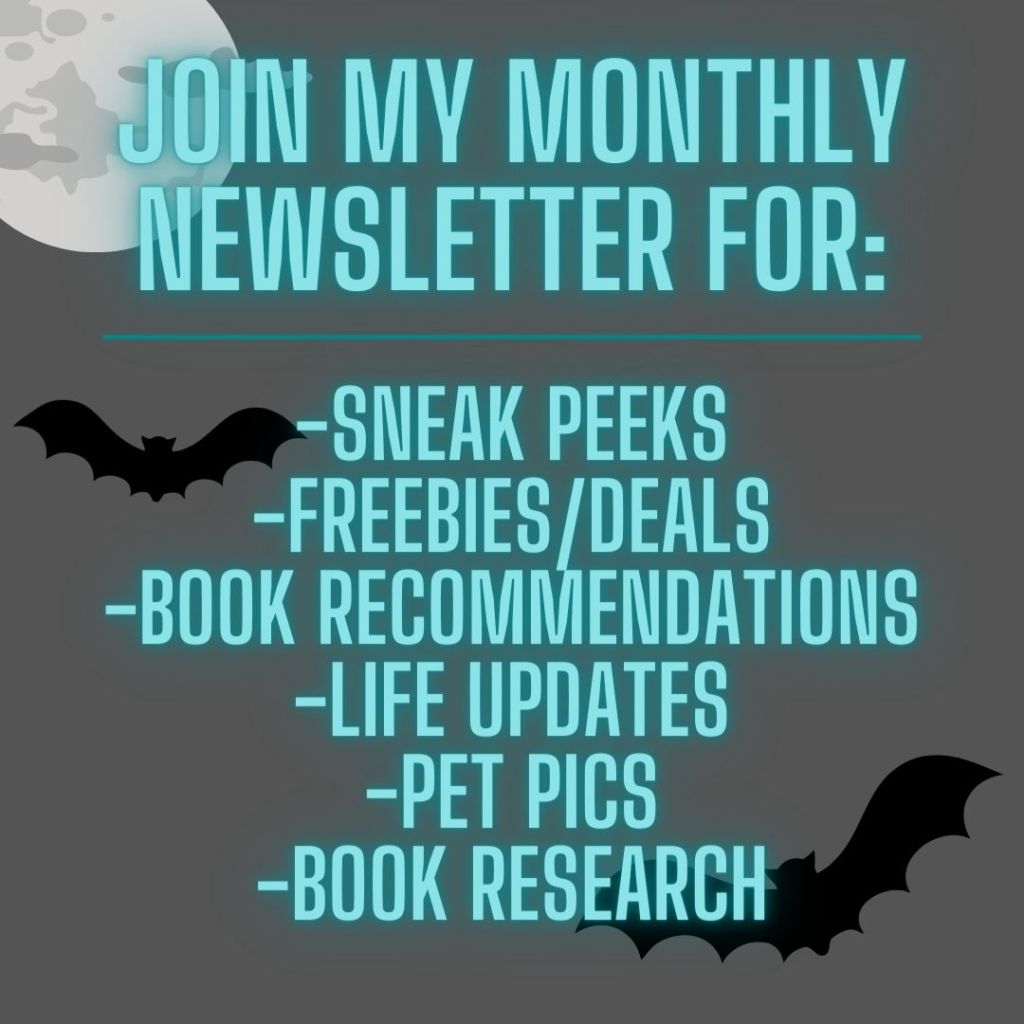
So what I’ve been working on is creating a monthly newsletter that will cover the following things:

Join my monthly newsletter for: sneak peeks, freebies/deals, book recommendations, life updates, pet pics, and book research
The background is grey with teal writing and there are 2 bats flying behind the words.

If you join my monthly newsletter, I’ll share things I’m working on, some cool research (and let me tell you, writing historically set books, there is a lot and it is weird), pics of my dogs, and books that I’ve read and loved and think you’ll love, too. When you sign-up, you’ll also get a free prequel short story, and over the next few months, I plan to send out another free short to subscribers. After the initial thank you emails, you will get monthly emails, which will be sent out at the end of every month.

I decided to change this to a beefier, monthly email because I was doing a disservice to my readers/subscribers by “not bothering them” except when I had book updates, and when I thought harder about that, it felt wrong to only send messages when I published. You could just follow me on Amazon or Bookbub if you wanted that kind of bare bones update.

How I F-ed Up my Back Matter

The next giant thing I screwed up is not keeping up with fixing my back matter. Back matter is the about the author, also by the author, newsletter/social media links, etc. that are found at the back of your book. Between changing laptops several times since 2014, switching writing programs, and just being overwhelmed at the prospect of going through like 10 Word docs, I put off updating all of these things for YEARS. This means that my first book had an “also by” list that only went up to like book four of the series. I facepalmed hard when I realized I hadn’t updated my back matter since 2017.

Something I would also recommend other authors doing is going back and formatting their docs, so the chapter headers are in a heading style and the body text is one uniform style. This makes it easier for the Kindle and eReader software to convert your book to something that makes sense. Guess who went back and properly formatted all 10 documents? And I was shocked to find that once I got going, it took significantly less time than I expected. I was able to do all of them over the course of a week and reuploaded the new files to my distributors. Amazon/KDP also has a new bit of free software called Kindle Create that is a lot like Vellum or, if you’ve used D2D, their autogenerated software, which will break your book into chapters and add pretty flourishes if you’re so inclined. Once again, very easy, highly recommend to make your books look spiffy.

If you’re an author, this is your sign to fix your back matter and formatting as it won’t take you nearly as long as you think once you finish the first book.

How I Forgot to Publish an Entire Box Set

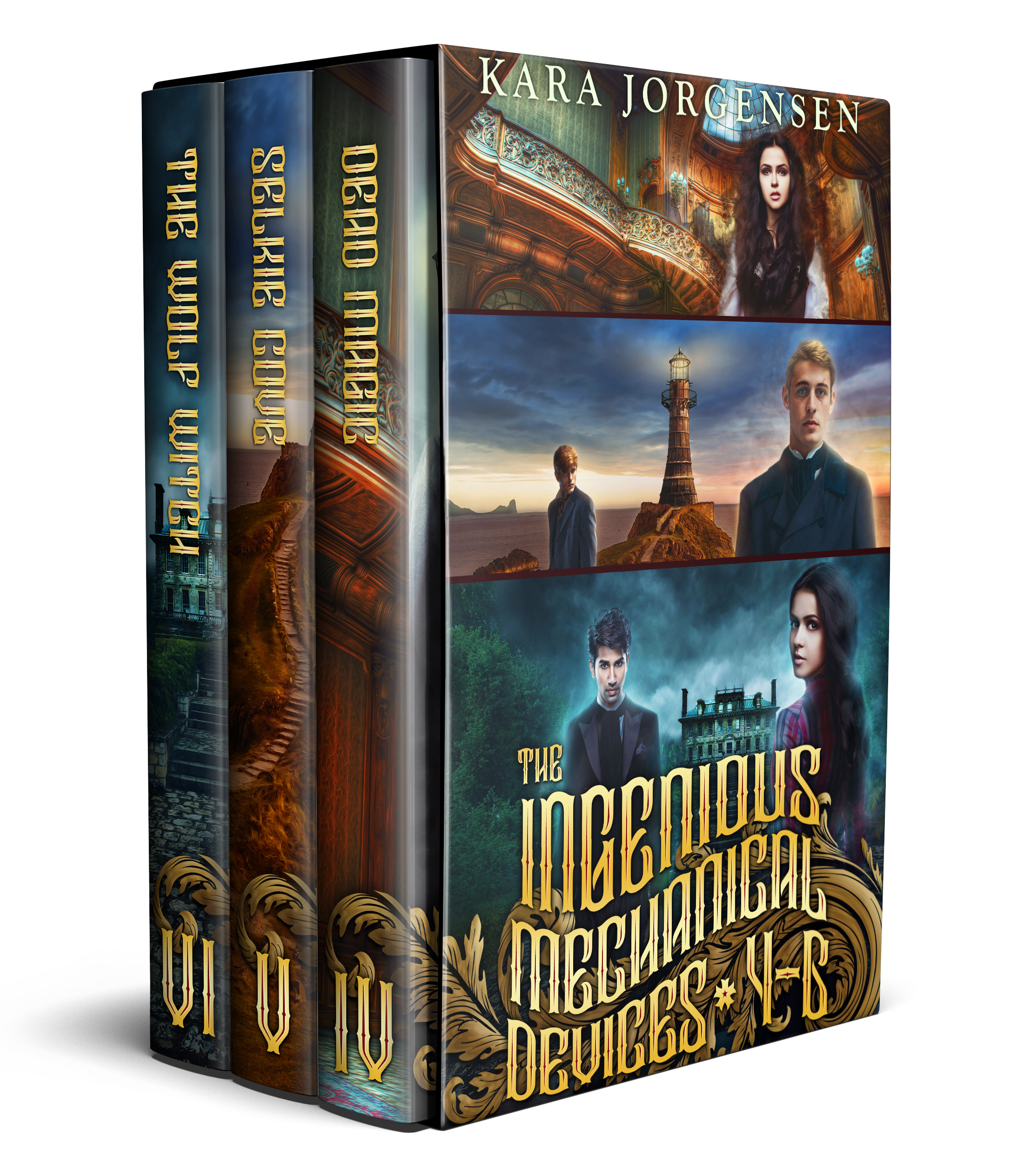
The last thing I did to get my work back into shape is to add a new box set for the Ingenious Mechanical Devices series. A while ago, I made a box set for books 1-3, which is 20% off the cost of buying the books individually, but I thought I’d wait until a year after book 6 came out before I made the next box set. Well, then I got overwhelmed with life and then enough time passed that I forgot. A couple weeks ago, I reached out to my cover designer (Lou Harper at Cover Affairs), made the file, and got it all listed, so if you’re interested in getting a box set of books 4-6 for 25% off buying the books individually, now you can. Both sets are available on all major retailers, BUT I had a little hiccup with Apple Books and Kobo. They have the set as a preorder that releases January 29th. I’ve reached out to fix it with no answer, but the 29th isn’t that far away, so if it doesn’t get fixed immediately, you will get your books by the end of the month.

TL;DR

If you’re an author, research best practices instead of assuming you’re being annoying because you could be in a totally different way than you though.

You may also want to join my monthly newsletter as it starts up in earnest this month.

If you’re an author, fix your back matter and formatting.

Check out my latest release, which is a box set of books 4-6 in the Ingenious Mechanical Devices series for 25% off the cost of the books individually.


Let me know in the comments what kinds of things you like to see in author newsletters!

dead magic · Writing

Chapter Five of Dead Magic

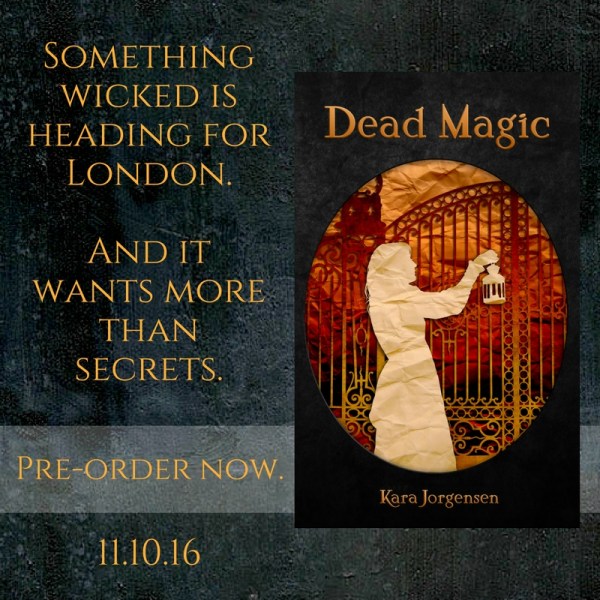
dm-preorder

Since Dead Magic will be coming out in a little less than a month, I thought I would share the first few chapters here to whet your appetite for its release on November 10th. Over the next few weeks, I’ll be releasing a few more of the opening chapters. I hope you enjoy!
If you missed it, here are chapter one, chapter two, chapter three, and chapter four.

Chapter Five

Empty

Adam Fenice paused at the stove, listening as the grandfather clock in the hall struck six. A small grin crossed his lips. Immanuel would be home any minute, and Adam hoped to god he had a good day at work. They had only been living together eight days, but it was beginning to feel as if he had always been there. He had expected it to be harder to integrate their dissonant lives under one roof, especially when he had spent his life fighting to be seen as a separate person from George and Hadley and their businesses. With Hadley married and gone, Adam suddenly found himself alone, staring at gaps in shelves and empty rooms where she had once been. A quiet fell over the house that couldn’t be silenced. Something was missing, something he couldn’t fill alone.
When Immanuel appeared at the train station with only one trunk, Adam feared there would still be an emptiness, but soon science books appeared where ones on mechanics had once been and a sweet, soft voice singing in German chased away the morning silence. Suddenly it was as if he had always been there. No longer did his parents’ marriage bed feel too large or the house too empty for a bachelor. Hadley’s old room was stocked with Immanuel’s somber wardrobe and soon her old workroom would smell like bleaching bones and varnish. What Adam loved most was seeing two dressing gowns hanging in their room and the shallow indent in the pillow where Immanuel’s head had been.
With a groan, the front door opened. Glancing around the doorway, Adam could only catch a glimpse of Immanuel’s blonde hair and the swing of his leather satchel as he pulled it over his head. Adam turned his attention back to the stew and waited. Quiet footsteps padded into the kitchen, and within seconds, Immanuel’s hands were snaked around his stomach and his head was nestled against his shoulder. Adam drew in a long breath, inhaling the familiar soapy scent of Immanuel’s skin. His lips brushed Adam’s neck and cheek before returning to his shoulder.
“Have a good day at work?”
“Better than I expected,” Immanuel purred, giving Adam a squeeze. “I got you invited to the museum’s gala.”
“Oh really? And how did you manage that?”
“I threw your sister and brother-in-law’s names around. Once they realized we were all related and we shared a flat,” he paused as Adam turned toward him with a questioning henna brow, “they wanted to extend an invitation to the Countess’s brother, lest he feel slighted.”
“I’m sure you were put out that you had to invite me. I’m but a lowly money-counter.”
A grin spread across Immanuel’s lips as Adam wrapped his arms around his. “Well, I see you every day, so why would I want to spend an entire night with you drinking champagne and waltzing?”
Adam turned, catching Immanuel’s hands and pulling him closer until their hips were flush and their gazes met. Keeping their joined hands up, he tightened his grip around Immanuel’s back and took the first step of a sweeping waltz. Immanuel stumbled after him, half a beat behind as he was twirled backwards.
“Waltzes aren’t your strong suit anyway,” Adam replied with a toothy grin, his pencil mustache curling in agreement.
“Thankfully, I would rather not be asked to join when I can’t dance with my partner.”
Slowing to a stop, Adam turned, his blue eyes softened with thought. Immanuel’s grip tightened as he pulled him in for a kiss. Adam sighed, his eyes closing at the gentle push of Immanuel’s tongue against his lips. Arching back, he wrapped his arms around the taller man’s neck and his hand sliding into the curls of his hair. A chill washed over him at the skimming of fingertips over his spine. Immanuel’s hand dipped under his jacket and made its way toward the top of his trousers.
“We should wait until after dinner,” Adam whispered, licking his lips and resting his forehead against Immanuel’s.
Adam wanted to say more. He wanted to bang his fist on the table and cry that it wasn’t fair. That none of this was fair. At Hadley’s wedding, he and Immanuel had sat at the same table for hours, watching other couples dance with arms and eyes locked. He caught their knowing smiles when bodies brushed while he and Immanuel had to pretend they barely knew each other. Staring into his glass, he had wished he could take Immanuel by the hand and dance alongside the other couples, but as he tightened his grip on the stem of his glass, a gentle hand squeezed his arm. When he lifted his eyes, he had expected to find Immanuel giving him a reproachful look. Instead, he found Hadley staring down at him, her eyes heavy with guilt. Did she regret inviting them both to the wedding when she saw the misery etched into her brother’s features? That night when they returned to the house on Baker Street, anger had deteriorated into melancholy. Stripped of their finery, they had lain in each other’s arms until daybreak, a tangle of limbs and lips making up for lost time. Would they always be making up for those impossible moments?

***

Immanuel looked up from his empty bowl at Adam. He had been abnormally quiet during dinner. Swallowing hard, he said, “I’m working with Peregrine Nichols this week, helping out with the exhibits.”
“Who?” Adam asked, snapping back to reality as he grabbed his bowl and stacked it on top of Immanuel’s.
“Peregrine Nichols. I’m certain I told you about him. He’s the one who reminds me of an imp. He’s always smiling and prattling. If he wasn’t charming, it would be maddening. It might still be when we work together. You might like him, though. I’m sure you will meet him at the gala.”
“Why are you working with him? I thought he worked with insects or something.”
As Adam put the dishes in the sink, Immanuel took up the hissing tea kettle and poured them each a cup. “Plants, but he’s behind on his work. With the gala coming up, it’s all hands on deck, and having a hand in the preparations really isn’t a bad thing for me. It will look like I have initiative.”
“I guess so. Though, it might be better if you stayed out of it and kept to your work.”
Immanuel frowned. “I know, but I can’t stand to look at another seal or walrus. Somehow my reputation as the seal expert has followed me here. I don’t want to smell like— like rotting blubber.”
Adam froze at the way Immanuel spat the word blubber. When he looked up, Immanuel’s face remained impassive as he doctored their tea and refilled the kettle, but he knew the old wounds were still raw. It was during a visit to Oxford that he heard of Immanuel’s nickname for the first time. The name Blubber had originated from his preparation of pinniped skeleton’s for the university’s museum and the malice threading through it came from the nightmares that followed his captivity and abuse at Lord Rose’s hands. Even now he wouldn’t speak of it except in the vaguest terms, but his university roommates couldn’t forgive him for crying out for mercy in his sleep.
“Immanuel, I can do that. Just sit down and enjoy your tea.”
“I will in a minute,” he replied with a weak smile.
Immanuel looked over his shoulder and spotted a vase sitting in the center of the kitchen table overflowing with fern fronds, forget-me-notes, and periwinkle traveler’s joy. Adam had given them to him when he arrived, but now their edges were curled and turning brown while their heads dolefully flopped over the side. Immanuel set down his tea and took up the vase. As he made for the sink, he turned, expecting to find Adam behind him but found nothing. He went to take a step forward and was knocked off kilter by something hitting his chest. Heat seared through his veins, snaking through his core until it hit his heart and shot through his body one beat at a time. Swallowing hard, he leaned against the counter, busying himself with the flowers to keep Adam from seeing the fear in his eyes. This time it wasn’t death gripping his heart. It was something that wanted in. He took a shuddering breath and closed his eyes, hoping the stutter in his heart would stop.
“Immanuel? Immanuel, are you all right?”
Immanuel jerked back as water overflowed from the crystal vase and ran over his sleeves. The creeping heat abated at the water’s touch until it only lingered as a tight ball lodged near his heart. Releasing a pained breath, he swallowed hard and carried the flowers back to the table without a word. As he raised his gaze to the dying flowers, a gasp escaped his lips. Before his eyes, the flowers’ heads uncurled and the bits of brown he had seen a moment earlier eating away at the edges of the petals disappeared. Across the table, Adam absently poked at a sugar cube bobbing in his cup, unaware of his partner’s sudden urge to pitch the plants out the backdoor. Immanuel averted his gaze, but when he looked back, the blues and purples of the forget-me-nots were more vibrant than the day he arrived.
Something was wrong with him. Something was very wrong.
“I— I think I’m going to lie down for a little while.”
Adam’s arm wrapped around his shoulders, pressing Immanuel’s back into his chest. “You look flushed. Are you feeling all right?”
“I’m fine,” he snapped but caught himself. “I’m just tired.”
“Well, I will come up with you.”
Immanuel crossed his arms. “I can get up the stairs by myself. I’m not feeble anymore.”
“I think you misunderstood me.” Adam slowly raised his gaze to Immanuel’s, locking eyes as he held his arms. “I want to come up with you.”
Immanuel’s mouth formed a soundless O, and before he could think about what Adam said, they were checking the locks on the doors and covering the windows. Darting up the stairs, Immanuel slipped off his jacket and tie and tossed them into his undisturbed bedroom as he passed. He waited at the threshold of Adam’s door, watching his companion carefully close the curtains to ensure no one could see inside. It had become a nightly ritual that Adam had begun months before Immanuel moved in to avoid suspicion from their neighbors. When the room was dark, Adam took his hand and led him to the bed. His hand slid under Immanuel’s shirt and ran along the flesh of his back. Even after a week together, Immanuel still hesitated, expecting someone to be just beyond the door. It seemed too good to be true to have such freedom.
“Mr. Winter,” Adam whispered into Immanuel’s skin as he planted a trail of hot, moist kisses down his neck, “I have been waiting for this all day.”
But why? Immanuel suppressed the question that would only elicit a strange look from Adam and an equally awkward reply.
Before Immanuel could stop him, Adam’s fingers were flying over the buttons of his waistcoat and shirt. He resisted the urge to stiffen and cover his deformed chest with his arms, and instead he followed Adam’s lead. Beneath his bright dandy’s clothes, Adam was as solid and strong as Immanuel felt frail. Adam pushed Immanuel against the bedpost, catching his mouth. His pencil mustache prickled Immanuel’s lip as the redhead’s tongue plunged and grazed against his. The breath caught in Immanuel’s throat. Closing his eyes, he let his companion explore his mouth and his ever-changing body. Adam’s hands worked along his sides before sliding over the firm flesh of his buttock, eliciting a soft groan from his companion. Heat crept up Immanuel’s form, tensing every muscle in his abdomen and sending his heart out of rhythm. Immanuel blindingly unbuckled Adam’s belt and felt his fine wool trousers slip down his legs. Reaching for his own, Immanuel kicked them off and pulled Adam toward the mattress.
The bed sighed under their weight as Adam climbed on top of him. His eyes drank in Immanuel’s form while his hands rested on his ribs. Adam caressed the dents where his ribs hadn’t properly knit together. Immanuel swallowed hard at the thought of being prone and unable to hide from Adam’s mental dissection. He hoped it was too dark for Adam to see him, but his mind was silenced by a shiver rippling from his scalp to his curled toes. Immanuel raised his eyes to meet Adam’s gaze. A wordless conversation passed between them, and Adam’s lips curled into a knowing grin. Immanuel stiffened, his hips twitching, as Adam nipped at his collarbones and ran his tongue along his sternum and down the scant trail of hair leading to his flannel drawers. His fingers twisted into Adam’s henna hair as a gasp escaped his lips at the rush of air and the goosebumps rising on the tops of his thighs as his drawers were pulled away.
“I want to make you feel better,” Adam murmured, his voice husky and his breath hot against his stomach.
Immanuel closed his eyes, fisting the sheets as Adam drew him in. He needed him. He needed this. He needed to be reminded that even after all that happened, there was still love in the world. More than anything, he needed Adam to make him forget.

***

Adam stirred. Something nagged at his sleep-drunk mind, but when he finally cracked open one eye, he found the bedroom dark and the street outside the window quiet. The bed shifted beneath him, followed by another quick jolt. Turning his head, he found Immanuel still beside him with the covers drawn up to his chin and his body curled into a ball. As he watched him, Immanuel’s body trembled and a muffled squeak escaped his lips. Before he could stop himself, he released a series of soft sobs. A pale hand shot from beneath the blanket and pulled his pillow down. Hugging it close, he hid his face, reducing his cries to twitches and faint hiccups. Fear sucked the air from Adam’s lungs as he watched Immanuel, keeping his eyes nearly closed in case he turned over.
The covers slid off Immanuel’s back, revealing a cluster of shiny circular scars inscribed into his shoulder blade. Adam swallowed hard. He had never heard Immanuel’s nocturnal cries. He knew about them from Immanuel’s stories from Oxford, but as he listened to each pained sob and choked half-word, his stomach knotted. The idea that someone had used this against his partner sent rage climbing up his throat. But what could he say to make it better? Offering words of comfort wasn’t his strong suit. He didn’t even know why he was crying, so how could he help him? Maybe it would be best to close his eyes and pretend that he had never heard him.
Immanuel buried his face in the pillow as another hiccup escaped his lips. Adam resisted the urge to scratch at his wrist. Inching closer, Adam slipped his arm beneath Immanuel’s side and rested his forehead against his neck. His partner stiffened in his grasp and drew in a crackling, drowning breath. He hesitated before slowly turning over to meet Adam’s gaze. In the scant moonlight, Adam could make out Immanuel’s glossy, red eyes. Immanuel blinked to squeeze away the burning ache behind his lids, but as he opened his mouth to apologize, Adam pressed his lips to his. Immanuel’s body quavered beneath his grasp as he held him close. Heat radiated from his thin form, soaking the sheets and catching his hair in a sheen of cold sweat. As they parted, Adam caught his partner’s bichrome gaze. Silent phrases passed between them, revealing months of pain and longing. There wasn’t anything left to say.
Wrapping his arms around him, Adam pulled him closer until Immanuel’s clammy forehead rested against his collarbone. Immanuel latched onto him, concealing his face and holding onto him as if he feared he would be set adrift. There was still nothing Adam could think of to comfort him, but hands and eyes could articulate what lips could not. As he rubbed Immanuel’s back and gently hushed him, Adam watched him chew on his lip. There was something he wanted to say, something threatening to bubble out. What if he wanted to talk about Lord Rose or the terrible place where he was held captive? Adam wanted to move on. They were together now and life was good. That was what mattered.
Finally, Immanuel drew in a deep breath and met Adam’s gaze. “I— I think something’s wrong with me, Adam. I really do. Something has to be.”
Adam wiped away the moisture clinging to the dark circles under his companion’s eyes. “Why would you think that? You may have a bad eye, but like I told you months ago, spectacles might help.”
Immanuel shook his head and shut his eyes, pressing them against Adam’s chest. “No, that’s not it.”
“Are you in pain?” Adam asked, his voice tightening. “We could stop by James and Eliza’s tomorrow. I’m sure he wouldn’t mind taking a look at you.”
“It isn’t physical. Maybe it is, but sometimes—” The words hung in Immanuel’s throat as he inhaled Adam’s familiar lavender cologne in hopes it would steady him. “Sometimes I see things.”
Immanuel hesitated. Should he talk about the cat skeleton hidden in his drawer? That he knew the cat had once been a beloved pet and because of that, he didn’t know what to do with it. How could he explain to Adam that when he touched something dead, he saw what happened right before it died and that’s why he couldn’t handle raw meat? It was embarrassing. It was more than embarrassing; it made him question his sanity, which was already precarious at best. What would he think if Adam told him he watched a vase of plants revitalize before his very eyes? He would think he was losing his grip on reality, and perhaps he was.
“They’re just nightmares, Immanuel,” Adam whispered, pressing his lips to Immanuel’s forehead, “and nothing more.”
“Just—” A loose laugh escaped his lips. Immanuel shook his head. He had it all wrong. “They’re not…”
“I know you still think you see Lord Rose, but it’s just your mind playing tricks on you. You can’t give into it. We know he’s dead and can’t hurt you now. If you keep telling yourself that, then all of this will stop.”
It had all been said so sweetly, so innocently, and with such a gentle kiss on his brow that Immanuel didn’t dare say a word.
His eyes burned with tears as he whispered, “Right. You’re right. Good night, Adam.”
Rolling onto his side, he felt Adam’s arms wrap around his bare torso and the hot flesh of his stomach press against his back. As Adam settled into slow, steady breaths, Immanuel’s eyes trailed to the narrow space between the curtains. Moonlight streamed into the room, illuminating the pile of clothes strewn across the floor. Biting back the urge to snatch them off the rug and fold them, Immanuel stared at the winking stars. Adam didn’t mean it that way, he reminded himself. How could he know that putting his kidnapper and abuser out of his mind was hard on a good day and nearly impossible on a bad one? No amount of love or good fortune would dispel the damage Lord Rose had done. His ribs still ached on humid days from where they had been broken and the cigarette burns on his back seared anew the moment his mind lapsed into daydreams. But how could Adam know the pain the past still caused?
Immanuel drew in a wet breath and squeezed his eyes shut. Against his will, a tear bubbled out and slid down his cheek. Pressing his face into the pillow, he tried to push away the disappointment and fear pooling in his sockets. Adam had been there since the beginning. He had seen his body shattered, a hollow skeleton of its former incarnation, and he had watched him carve out a new form meant to resemble what he had lost, yet he still didn’t understand.
For months Immanuel had counted down the days until he left Oxford and could finally be able to live without a mask, yet it wasn’t to be. How could he tell Adam about the strange sensations and the visions if it meant losing the one anchor of stability he had? He sniffed and shifted until Adam’s loose grip fell away.
Even with everything he could have wanted, there was no way to forget.


If you enjoyed what you read, you can pre-order Dead Magic here and have it delivered to your Kindle on November 10th. Paperbacks will also be available closer to the release date.

Stay tuned for more chapters and previews to come.