Monthly Review

April 2025 Wrap-Up Post

April felt like the longest month ever for me. I think it was mostly due to being kept busy by grading nonstop (April is the November of the spring semester), and I, for one, am exhausted. I’m really looking forward to break starting in May, so with that, let’s remember what my goals were for April.

  • Write 20,000 words for book 4
  • Continue to proof the audiobook for TRR as it comes in
  • Stay on grading as there is a lot this month
  • Finish Act 1 and 2 outlines for book 4
  • Continue to bug my senators and house rep
  • Participate in the Narratess Sale (4/5-4/7)
  • Maintain my sanity as best as I can
  • Send out my newsletter
  • Read 8 books
  • Blog weekly

Books

My goal was to read 8 books, and I read 10 this month.

  1. What Feasts at Night (#2) by T. Kingfisher- 4 stars, I love a nonbinary protagonist, and we get that along with a nightmarish monster who is sucking the life out of people. As always with T. Kingfisher, it is very atmospheric and creepy.
  2. The Wolf and the Woodsman by Ava Reid- 4 stars, a fantasy story that pulls together pagan Eastern European, Jewish, and Christian folklore. We have a wolf girl who reluctantly falls for a woodsman/prince who needs to save his kingdom from fanaticism.
  3. Turning the Tables by Andrew P. Haley- 4 stars, book research, but I think it’s interesting for anyone who is into culinary history or how the rise of the middle class in the late 1800s led to the formation of restaurant culture.
  4. The Invisible Library by Genevieve Cogman- 3 stars, a steampunk adventure featuring librarians from a timeless library, book dragons, and tons of nods to classics.
  5. A Gentle Madness by Nicholas A. Basbanes- 4 stars, if you’re a book lover or a collector, this book is for you. Basbanes delves into rare book collecting, bibliomania, and the people who have made some of the greatest collections in history.
  6. Book Curses by Eleanor Baker- 4 stars, this was book research for The Reanimator’s Fate. It’s a very short book that could be a webpage, but it’s fun to have.
  7. Don’t Sleep with the Dead (#2) by Nghi Vo- 5 stars, the loose sequel to The Chosen and the Beautiful set 20 years later during WWII where Nick starts hearing Gatsby long after his death. I absolutely love the demons and world this is set in and how the characters are handled.
  8. Into the Dark (#3) by Jordan L. Hawk- 4 stars, a ghost hunting story featuring lots of queer characters where they go to investigate the asylum the medium’s grandmother was sent to. This is definitely 95% ghost hunting with like 5% romance with an established couple, just as an FYI if you’ve read Jordan’s other series.
  9. The Case Study of Vanitas (#11) by Jun Mochizuki- 4 stars, it was nice to see all the characters back together again as we begin a new story arc. I look forward to seeing where the new story line goes.
  10. Ornithography (#2) by Jessica Roux- 4 stars, this is a book about the symbolism of birds. It would probably be nicer as a coffee table book than an ebook, but it was interesting.

Admin/Behind-the-Scenes Stuff

  • Fixed the outline for the beginning of The Reanimator’s Fate
  • Restarted writing The Reanimator’s Fate
  • Participated in several sales/bundles
  • Did more research for The Reanimator’s Fate
  • Proofed more of the audiobook for The Reanimator’s Remains
  • Blogged weekly
  • Send out my newsletter
  • Finished teaching for the semester (thank god)
  • Finished the literary magazine for my class
  • Graded a shit ton of papers
  • Paid quarterly and yearly taxes (no one cares but it’s stressful, so it counts, lol)

Blog


Writing

The writing section for this month is a little odd for me. At first, things were going well until I realized I started in the wrong place and had to scrap what I wrote. Ultimately, the idea I had wasn’t going to work, and restarting it was for the best. This sucks since my word count went back to zero, and I spent two weeks figuring out how to fix it and make sure it didn’t happen again. Writing the final book in a series is hard because I want to do the characters justice, and I really want to make my audience happy. It’s really easy to get into your own head and give yourself performance anxiety or choice paralysis. I’m going to try very hard to stay true to myself, to my characters, and to the vision I have for this final book. In the near future, I will talk more about some specifics in the books and reveal the blurb, so stay tuned for that!


Hopes for May

  • Write 20,000 words of TRF
  • Write the working blurb for TRF
  • Maintain my mental health
  • Keep working out consistently
  • Continue proofing the audiobook of TRR
  • Finish grading portfolios
  • Send out my May newsletter
  • Read 8 books
  • Blog weekly

Writing

Writer Tips: The Beginning Pt. 2

In last week’s blog post, we talked about how the opening of a book needed to include a hook, establish the main character, establish the setting, and establish the conflict. In this week’s blog, we’re going to talk about the potential pitfalls when writing the beginning of a book, how to avoid them, and how to make them work.

Keep in mind that these pitfalls aren’t absolute rules; they are merely things to look at more closely while writing and editing the beginning of your book because they can often be weak, boring, or cause other issues. My hope is that these will make you reexamine ideas for the beginnings of your works and figure out innovative ways to make them exciting, interesting, and smooth.


Starting With Characters Waking Up

The problem: this is usually not an interesting place to start the story. While you do need to establish the “before” for your main characters early in the story, you don’t necessarily want to start with them waking up and getting ready because it might not be when anything interesting is happening. You can incorporate what the character looks like without having them look in the mirror or put on clothes. It often comes off as clunky or that the writer is just warming up. Another sign of a new writer is writing every single time the characters wake up or go to sleep. Time skips are your friend in regards to flow, and 9/10 starting with the character waking up is warm up rather than the right place to start.

How to make it work: have the character wake up for an interesting reason. Olivia Waite’s Murder by Memory has the main character waking up in a brand new body that isn’t hers during a blackout on the space ship she’s on. This sets the scene, introduces some conflict, and punches up the excitement from the first sentence. You could also have an explosion wake them up or something crash. Those would be interesting things that would get your reader engaged immediately. If there’s something very odd about the character, having them get ready could be a way to show this. For example, in Metamorphosis, the main character wakes up and only while getting ready do we realize he has turned into a bug. If you were writing from the perspective of a spy getting ready for a job or an assassin suiting up, those would be interesting getting ready montages, especially if they start normally and quickly become more weird or unexpected.

Starting With A Dream Or Flashback

The problem: these can be incredibly disorienting to your reader. We have no context, no idea what’s going on, who is who, where we are, etc. A lot of newer writers like to start with dreams because they’re a way to add mystery or create a cool image, but readers often get annoyed when they’re suddenly dumped out of the dream and nothing they just read is real. Flashbacks are usually less disorienting than dreams, but they can often be a place where writers info dump or give the reader too much info too soon. It can also be info the reader doesn’t even need, and the story can start somewhere else or the info can be worked in elsewhere.

How to make it work: I think it helps to make it clear at some point that the character realizes it’s a dream to make it less jarring for the reader, so they don’t feel cheated. I still caution against using a dream sequence to start unless the dreams will happen repeatedly throughout the story. Much like a flashback, you still need to make sure that you aren’t using a dream to info dump because your reader won’t remember all the details you cram into there. With flashbacks, the big question is, do your readers need to know this right now? If the flashback is of something that has caused the story, that’s fine. An example of this working is showing an accident that happened months before the story starts, and then the next chapter is the character getting out of the hospital. This works because the accident will be the catalyst for whatever turmoil the character is going through, but we don’t have to sit through months of recovery. Basically, the flashback works because it is the reason for the story. If the flashback isn’t serving a major purpose, skip it.

Starting With Info Dumping

The problem: your readers aren’t going to remember 90% of what you are telling them in the opening chapter, so info dumping is wasted in the opening. Your reader has no idea what’s going on, who is who, where they are, what the conflict is, etc., so it’s very hard for them to figure out what they need to pay attention to and remember. We also see this in fantasy or scifi stories where the writer tries to give the reader an intense amount of world-building right at the beginning. Again, your reader isn’t going to remember 90% of this. They have context for the lore, so they aren’t going to remember most of it, and it’s sort of a waste.

How to make it work: save the world-building and background info for moments where it is needed or can be naturally introduced. Your readers don’t need to know everything all at once, so pepper it in. The best way to do this in the beginning is to show the world through the character’s eyes. If they are always in this world, they won’t be introduced to things they live with every day. Just introduce things naturally. For example, you can have a character open the door to their daughter’s room to wake her up, and we will know it’s their daughter’s room because if they’re appearing to be in a caregiver role and you described the room as a child’s, readers will assume that is their child. If you have a character in a steampunk world get into a vehicle called a steamer, readers will assume it’s like a car. You can always briefly describe the outside of it in passing rather than being like, “I got into my vehicle, a steamer, which I take to work.” That was very pointed, but you get the idea. A better way would be to say, “I pushed past the persistent, gap-toothed newsboy on the corner and cranked my steamer to life. In the quiet of the steamer, I let my head rest against the wheel before pulling away from the curb and heading toward Independence Square where the royal zeppelins hovered in the distance.” We can cram a lot of world-building into a few sentences without being too pointed.

Starting by Introducing a Ton of Characters

The problem: your reader won’t remember everyone you introduce at the beginning. As I mentioned several times so far, your reader won’t remember most of what you tell them at the beginning because they have no context and therefore no way to know what is important yet. If you introduce too many people at once who are important, your readers will struggle to keep them all straight. This is also a problem later in the book in something like a party scene where readers get a whole new crop of characters all at once, but even three or four characters in rapid succession might be hard for readers to contextualize in the opening chapter. A lot of writing advice tells you that you need to hit the ground running, so writers will try to toss everything in at once. Hitting the ground running with action is far better than doing so by muddying the waters.

How to make it work: introduce two important characters at once at most. It’s one thing to mention a character with a minimal amount of context, but it’s another to give a full description early on. You want to make sure that your main character(s) are getting the greatest amount of description and fleshing out early on to make it clear that they are the main characters. With side characters, give enough context early on to figure out their relation to the main character rather than giving us their entire history or a long description. It’s far better to give us their description and backstory in dribs and drabs to make things less confusing. An example of introducing a bunch of characters early on without bogging it down might go something like, “Stephen took a steadying breath before pushing out of the tent. Leroy, Cassandra, Mikail, and the other knights were sitting around the campfire waiting for him, but when he drew closer, Mikail’s light eyes ran over his rumbled grey hair and the bloodied bandage wrapped around his shoulder.” Note how we establish the main character, Stephen, by staying in his head/following him out. We pepper in the names of a few side characters and give the context that they are all knights. From this description, we might also surmise that Mikail is closer to Stephen or of high importance than the others within the narrative.


While these aren’t all the pitfalls you might encounter while writing the opening of your book, I hope these examples were helpful for you in figuring out how to strengthen your story.

Writing

Writer Tips: The Beginning Pt. 1

This week I thought I would talk about writing the beginnings of books since I am working on the fourth Reanimator Mysteries book. Opening chapters are often the hardest to write and the thing we spend the most time fixing/fiddling with. Part of this is because we put so much emphasis on attracting readers and keeping them hooked from the beginning. They are the first impression of the book that our reader has, so we need to make sure we use that chapter to set expectations and capture the general mood of the piece to avoid disappointing readers later. As a side note before we start, I think first chapters/openings are often something to worry about in the second draft rather than the first. Things often become clearer once we’re farther along. Remember, don’t get hung up on the opening when you start. You can always fix it in a later draft if you realize there is a better place to start the story. That’s what editing is for.

The Pieces

I really like the way Sarra Cannon lays out the structure of a novel (you can check her out at Heartbreathings.com). Let’s take a look at her Act 1 outline to remind ourselves what we need in Act 1/our opening

  • An interesting image/hook

  • Introducing our characters

  • Introducing the setting

  • Introducing conflict/mystery

The Hook

When you open a book, we want to put something interesting at the very beginning to keep the reader intrigued or entertained. We want to create this opening image in a way that sneakily introduces the character and the setting. What we do not want to do is put too much information into the opening because our reader won’t remember it’s important later. The opening is meant to be a brief image that gets us intrigued before diving in, and your reader will remember more of the feel of the scene than the information you give or the words you say, which is why we want to nail the vibe but not info dump.

A prologue can be used instead of an opening scene in order to introduce a mystery- like showing someone getting murdered or a god dying, but we have to be careful with prologues because they can become info-dumpy rather than intriguing. Save info/specific world-building for when you have the world more established and the reader can appreciate it. You also want to be careful with starting with dialogue as the reader doesn’t know who these people are, the context of their relationship, etc. It may be better to save it for half a page in when the reader has been grounded by the mood or setting.

Introducing Our Characters

During your opening chapter, we should be introduced to at least one of the main characters. If you have multiple POV characters, obviously that will be spread over multiple chapters or we will only get them from one person’s POV (aka don’t split the chapter in two with different POVs). You want to ground your reader, so e should get the character’s “normal” before the conflict really kicks in. This is important because we need to establish where your character is before they change over the course of the book. You can do this by showing us the character’s world, which also helps to incorporate the setting, and showing them interacting with others while giving us their thoughts and feelings.

At the same time, there should still be a hint of something being amiss during the opening scenes. Some examples:

  • If the MC is a workaholic, show them missing a holiday due to a work trip.
  • If a character has a gambling problem, show them checking their bank account and seeing all of the micro transactions.
  • If a character is lonely, hint at it by having them be alone or mentally commenting on the silence.

Your reader will connect with your main character first and foremost, so spend time fleshing them out by giving them thoughts, feelings, ideas, opinions, clothes, rooms, things, etc. By the end of the opening, the reader should understand what this character is going through, where they live, who they are, etc. Once again, is is often something that is strengthened in the second draft once you understand them better. The bigger point is that at the beginning of the story, these characters are wounded and/or missing something that they need. We need a hint of that wound/issue early on because it will drive the internal and potentially the external conflicts.

Introducing the Setting

Apart from your character, you also need to establish the setting, mood, and genre of your story. I lump these together because you’re doing all of the above at the same time. As you are writing, keep in mind that not every genre cares as much about setting as others do. Small town romances require you to create a realistic town while fantasy and scifi require a much greater level of world-building, so you will need to do this proportionately to the genre you are working in. At the same time, even if setting isn’t as prominent, like in contemporary romance, it is still important to ground your reader in a place by describing what the character is experiencing from a sensory perspective.

In this opening chapter, you are giving us hints of the world, the foundation and first glimpses of it. Only give us lore if it’s absolutely necessary, as in, we need to know this right now or we will be totally confused. Even then, I suggest doing so with caution and consider in your next draft if it is necessary. In your opening, we should be moving through the world via your main character’s eyes. Only give us things they would see or know. They take lore for granted since they exist in this world, so your opening should reflect that. You can also hint at fantastical things without being overt, like showing us bits of magic by offhandedly mentioning someone stirring a cup with telekinesis or a magical animal talking with the main character. You don’t need to give the reader explanations. They can suspend a little disbelief early on.

Having your character physically move through a space is a really good way to pepper in that world-building naturally. That way we follow their eyes over doors and paintings where you can add in little bits of detail that characterize the setting. During this time, we still need to set up the mood as well, and this should be baked into the setting and thoughts of the characters. Keep in mind that your genre can dictate the mood based on reader expectations. While a paranormal romance can be silly or serious, subgenres of mysteries or romances have more distinct moods. A cozy mystery can’t be too heavy, and a noir detective story has to air on the side of dark. Your world-building, thoughts, feelings, sensory words will all imbue the world with a mood. You need to establish that mood during your opening paragraphs, so you don’t pull a bait and switch on your reader.

The Conflict

As mentioned in the character section, your reader should get a hint of what the internal conflict is early in your book. Chapter one or the prologue can’t be aimless, so by having the internal conflict rearing its head, we give the book a bit of direction. There can be hints of the external conflict, mentions of money troubles, a bad guy looming, newspaper headlines, etc., but the external conflict shouldn’t quite appear in the opening. That should be saved for the inciting incident, which is at the very end of act 1 and pushes the main character into the meat of the story. This is sometimes called the call to adventure. The main reason we don’t want to do this is that we want to build up the world and the characters before shoving them into the main part of the story in order to build up the stakes or what the character could lose if things don’t work out for them. Without that build-up, the story can feel very flimsy or your reader isn’t engaged because they haven’t connected to the main character yet. This doesn’t mean there can’t be a murder or something intriguing, it just means that the thing that really forces the character to move hasn’t happened yet. If we don’t establish the internal conflict, the stakes, and the characters, the story will feel rushed, and we don’t want that.


I hope this break down on the opening of your book helped you! I would consider the opening to be the first 10-15% of the story with the inciting incident happening at the 25% mark. Next week’s post will talk about potential pitfalls in the opening of your story and how to avoid them.

Uncategorized

Acceptance, Not Awareness

Every year I look forward to April with equal parts anticipation and dread because it is Autism Acceptance Month. Note that I did not say Autism Awareness Month. As an autistic author who has written a series with an autistic protagonist, I love being able to promote my work and have people read a story from the perspective of an autistic character. Seeing other autistic authors promote their work and being able to connect with them means a lot to me. Within the community, it’s a great time to share resources, connect with others, celebrate our unique weirdness, but outside the community is another story.

In 2025, everyone should know what autism is. We are past the point of awareness, and with the awareness of neurotypical or allistic folks comes ableism and eugenics. If you don’t know Autism Speaks is an organization that calls for an end to autism, which most autistic people take issue with for obvious reasons. They promote ABA (conversion therapy for autistic people that most autistics oppose), they talk over autistic people in favor of promoting allistic caregivers/parents, and they discuss autism in terms of deficits or geniuses, which is problematic. The worst part is that they are one of the loudest voices during April. They are the ones promoting blue light bulbs and puzzle pieces.

The awareness that Autism Speaks and other parent-centric organizations bring is often riddled with eugenics and deficit-centered language. We are talked about only in how our existence is a burden to others or how our neurotype disturbs those around us. Bringing awareness to our neurotype in this way is like only talking about an amputee in terms of what they can’t do without their arm or leg. It is important to discuss the difficulties disabled people face in their daily lives, but we shouldn’t only discuss the far ends of the spectrum: how burdensome we are and inspiration porn.

This is where Autism Acceptance Month comes in. The idea of acceptance is that we accept all of that person, struggles, good days, bad days, things we’re good at, our humor, our communication styles, and the things that make us different from neurotypicals. Accepting autistic people pushes back against the narrative that organizations like Autism Speaks promotes that we are burdens or problems that need to be solved. If we are accepted as just a different neurotype, then we are equal with allistic people, and in turn, they should also be willing to bridge the gap to aid in meeting our needs rather than the onus falling on autistic people. Things like ABA therapy are basically obsolete because their whole premise is to make autistic people appear to be neurotypical while forcing autistics to disregard their needs in favor of what allistic people want them to do. If autistic people are on equal footing with allistics and are accepted, there is no reason to essentially dog train an autistic child into not stimming or ignoring that the lights of hurting their eyes. We can simply let them do their thing as long as they aren’t hurting themselves or dim the lights a little.

If we acknowledge that a lot of what allistic society dislikes about autistic people is that they are “weird” or doing something that they feel they cannot do in polite society, like be direct, wiggle, not disregard their sensory needs; society as a whole will be better for it.

Everyone deserves to have their needs met and to communicate in ways that get to the heart of the matter even if it makes others uncomfortable. Society as a whole needs to take a hard look and ask itself why does directness bother you? Why does stimming make you so uncomfortable? Why it is a bad thing that someone needs dimmer lights, headphones, or comfortable clothes in order to function? Why does having “childish” interests or a weird special interest have to be a bad thing? Overall, why do you even care?

So much of the pushback stems from people who are uncomfortable that someone else is saying, “No, I need this or want this, and I’m going to do it” rather than demurring and conforming. Our society is so obsessed with conforming that the reason autistics stick out so much is that we are terrible at it, but the better question is why are you all doing it in the first place? If something doesn’t jive with your in terms of fashion, food, office politics, etc., why do you force yourself to do it instead of questioning how we got here and what the point is?

Our society is riddled with systemic issues, and peeling away the notion that we have to conform to whatever is the norm is the first step in freeing ourselves from these systems. Stepping back can show you the cracks and the deep fissures that cause others so much pain, not just for autistics but anyone who isn’t the white male cis het majority. Acceptance of our differences instead of the awareness of our differences is far more freeing and can ultimately lead us down a much better road.

The Reanimator's Heart · the reanimator's soul

Book Sale Time!

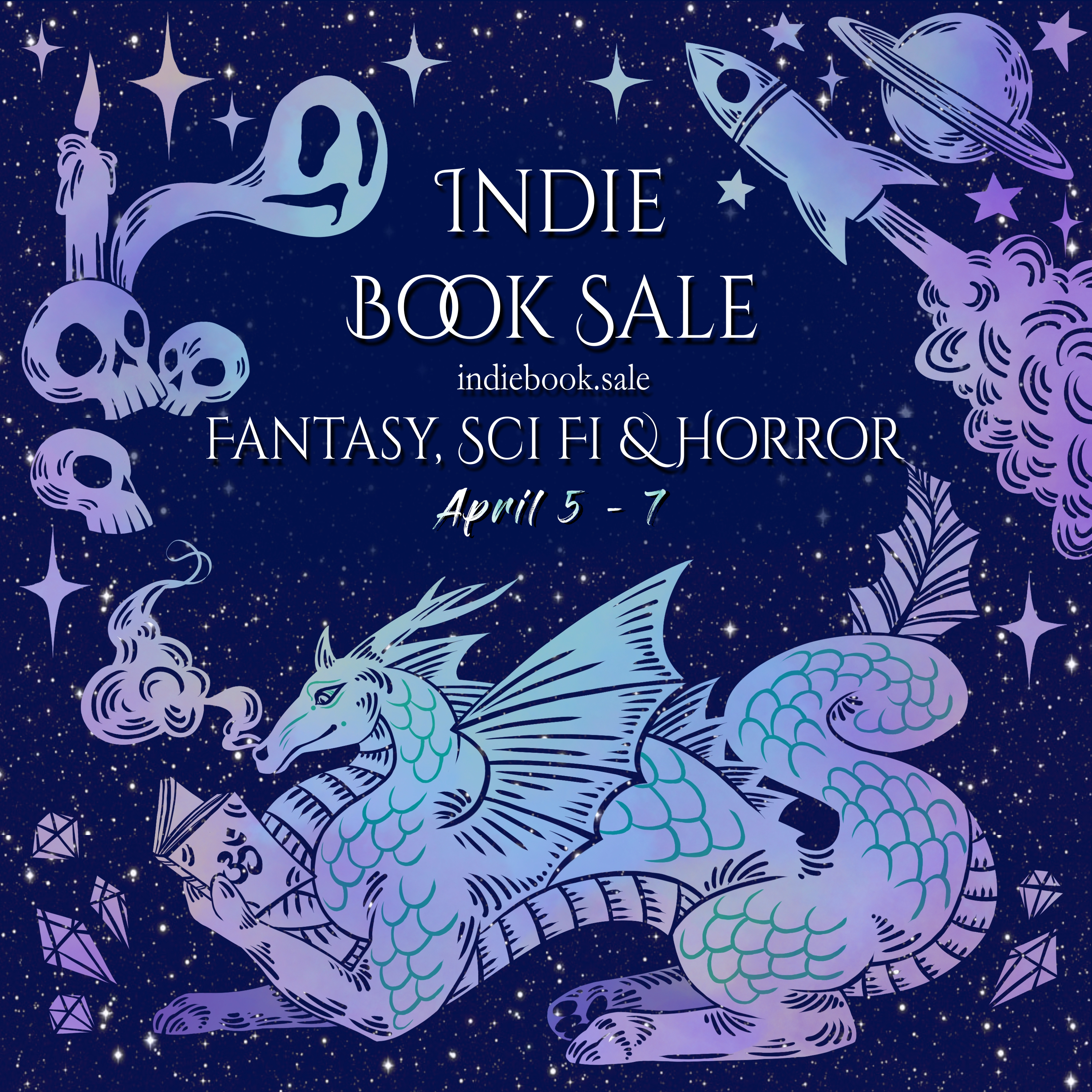
a dark blue background with purple-ish drawings of ghosts, skulls, a rocket, planets, gems, and a dragon reading a book. It says Indie book sale indiebook.sale fantasy, scifi, and horror April 5th to April 7th

This week’s blog is a day and a half early, but it’s because it is time once again for the Narratess Sale! This is a massive sale of indie authors writing scifi, fantasy, or horror, many of whom are queer and/or marginalized authors. You can find tons of good books for under $2 each (some are even free). Lots of my friends have their books for cheap, so make sure to take a look between April 5th and April 7th!


I have included The Reanimator’s Heart (TRM #1) in the sale for $0.99, but The Reanimator’s Soul (TRM #2) is also on sale for $1.99. You can grab them at all major retailers, including Kobo, B&N, Apple Books, Amazon, and you can get them slightly cheaper at Itch.io

If you like queer, paranormal historical romances featuring an autistic necromancer and his undead lover solving crimes in 1890s NYC, this series is for you. It’s also perfect for fans of Pushing Daisies and Sleepy Hollow.

Monthly Review

March 2025 Wrap-Up Post

March has been the longest month, and while that isn’t a bad thing, it feels a bit surreal that so much has happened in thirty-one days. Before we get into the post, I’d like to point out that Kinship and Kindness is part of Trans SFF bundle on itchio where you can get 38 books by trans authors for $40. I also have The Reanimator’s Heart on sale for $0.99 and The Reanimator’s Soul for $2.99 at all major retailers and regions. There is also a TRH/TRS bundle on itchio that is slightly cheaper than at other retailers.

Before continue, let’s take a look at my goals for March:

  • Reread all of the Reanimator Mysteries books in preparation for book 4
  • Start outlining book 4
  • Write at least 10k words of book 4
  • Proof as much of the audiobook for The Reanimator’s Remains as I can
  • Deal with several doctor’s appointments this month (boo)
  • Have the Weeknight Writers event go well (March 15th)
  • Continue to bug my senators and house member
  • Read 8 books
  • Blog weekly
  • Send out my monthly newsletter
  • Maintain my sanity
  • Work diligently on my cross stitch project

Books

My goal was to read 8 books, and I read 10 books. The links below are affiliate links, so if you buy a book through them, I get a small commission.

  1. Make Room for Love by Darcy Liao- 4 stars, a trans woman fleeing an emotionally and financially abusive relationship with a cis man runs into a cis butch lesbian who offers to take her in. Together, they bond over unionizing and coming out of their shells. I have mixed feelings about the trans rep, but otherwise, I enjoyed the romance aspect.
  2. 10 Things That Never Happened by Alexis Hall- 5 stars, a manager fakes amnesia to keep his boss from firing his employees only to be taken care of by his boss. He sees a new side of him and slowly begins peeling back the layers with the help of his gremlin of a cat.
  3. EAT by Nagabe- 4 stars, it’s a bit f-ed up as most of Nagabe’s stand alone works are. It’s about a wolf who wants to be prey or be eaten.
  4. When the Earth was Green by Riley Black- 5 stars, a nonfiction work about the long history of plants on earth from before the dinosaurs to the recent past. It is written in a narrative style that is accessible while being incredibly interesting and rich with information.
  5. The Invisible Man & His Soon-to-be Wife (#5) by Iwatobineko- 4 stars, a super cute series about a blind woman who falls in love with an invisible man. In this volume, she goes to meet his parents while he meets her brother.
  6. The Knight and the Butcherbird by Alix E. Harrow- 5 stars, brutal and all at once wonderful, this novella packs a bunch in a dystopian land where cancer creates monsters and the line between human and monster is slimmer than one thinks.
  7. The River Has Roots by Amal El-Mohtar- 5 stars, a lyrical tale about two sisters who tend to trees growing near a magical river. It’s about magic wrapped in magic and how song unites people through history. I highly recommend the audiobook version.
  8. Murder by Memory by Olivia Waite- 4 stars, a detective suddenly wakes up in a new body and is forced to solve a murder on a space cruise ship where everyone aboard reincarnates into their own bodies. It is a really cool premise with a lot of potential for interesting future books.
  9. Flesh and Bone by Arden Powell- 4 stars, two cowboys are hunted by a werewolf while one is haunted by his past, and the only way to overcome the first is to face the latter.
  10. What Moves the Dead by T. Kingfisher- 4 stars, a very creepy version of the “Fall of the House of Usher,” featuring uncanny hares, a dilapidated house, a nonbinary soldier, and fungus. There’s a lot crammed into the novella, and I am looking forward to the second book in the series.

Admin/Behind-the-Scenes Stuff

  • Reread all of the Reanimator Mysteries books and side stories in preparation for writing book 4
  • Brainstormed and started toodling with book 4
  • Started proofing the audiobook for The Reanimator’s Remains (TRM #3)
  • Participated in a panel on trans characters for Weeknight Writers, which was a lot of fun
  • Was part of a Trans SFF bundle on Itch.io (see top of page for details)
  • Put The Reanimator’s Heart and The Reanimator’s Soul on sale (see top of page for details)
  • Set up a Bookbub ad for the end of March
  • Bugged my senators profusely about various political issues
  • Blogged weekly and send out my monthly newsletter
  • Kept up with my grading (*tired* yay)
  • Dealt with my and my partner’s medical appointments (we’re fine btw)
  • Finished putting together my day job’s literary magazine with my class
  • Changed the batteries in every alarm/detector in my house (this has nothing to do with writing but it was labor intensive and hanging over my head forever, so someone has to hear about it)
  • Had to get major repairs on my car… again
  • Released “An Unexpected Evening” (TRM #3.5) to my non-newsletter readers (here)
  • Started the Court of Crows stitch-a-long by FineFrogStitching

Blogs


Writing

There isn’t too much I can talk about with writing right now. I’m currently working on the beginning of the fourth Reanimator Mysteries book, but I don’t want to go too much into it at this point because things are very subject to change. The opening of a book is where things are the messiest and most subject to change when I’m writing. I have false starts quite often during this part of the process, so I’m keeping my lips zipped about the contents of the story until I hit the end of act 1 when things finally lock in for the most part. What I will say is that this book will involve Oliver stepping up, trips to the library, Gwen’s magnum opus, and Felipe confronting his past and future. I will have more for you all next month, including hopefully a mood board and a working blurb.


Hopes for April

  • Write 20,000 words for book 4
  • Continue to proof the audiobook for TRR as it comes in
  • Stay on grading as there is a lot this month
  • Finish Act 1 and 2 outlines for book 4
  • Continue to bug my senators and house rep
  • Participate in the Narratess Sale (4/5-4/7)
  • Maintain my sanity as best as I can
  • Send out my newsletter
  • Read 8 books
  • Blog weekly
organization · Project Shop My Shelves

Project Shop My Shelves

As I was perusing my bookshelves the other day, I realized that I have a problem: I buy too many books. Well, not exactly. Over the past few years, I have reined in my book shopping habit, but what I didn’t account for is that I never truly get ahead of what I have on my shelves, so the books stack up. I have books on my shelves that I have been “dying to read” since 2016 when I was in grad school. That is, uh, not great. The funny thing is that I made a To-Be-Read section in my bullet journal where I list out all the books I own, books I want to read, forthcoming books from authors I love, and that spread has gotten progressively longer year after year.

This year I decided that I want to do something about it, and I’m going to call this Project Shop My Shelves. My goal with shopping my shelves is to actually read the books I already own and read double the amount I buy. Yes, I will be curtailing my book buying. With the buying, I have had a few reservations about this. I want to support my fellow indie authors, especially during this politically horrible time, and I want to buy trad pub books from marginalized creators because if they don’t have a good launch, they’re less likely to get future publishing deals. The book buying ban will be mostly focused on white cis het authors because, frankly, they can wait for me to buy their books. In order to get ahead of my buying, I want to make it a habit to read at least double the amount of books I buy, so if I buy 3 new books, I need to read at least 6 books. I’m not sure how I’m going to count advanced reader copies (ARCs) yet, but I don’t get them that often, so they may be an exception to this rule as I’m doing promo work my reading them.

In order to make a dent in my rather embarrassing TBR pile, I think I’m going to try to read the books that have been there the longest. Maybe not all at once, but I would like to make a point to move them to the done pile if possible. There are some that have been there since at least 2016. I have removed books that I think I am no longer the audience for and donated them to a local book drive, so my hope is that I will still enjoy the ones that remain, even if I’m nine years older. If I find I don’t really jive with a series or book I bought back then, I will move it to the donate pile and make a note of it. In the same vein, I want to be realistic about my enjoyment of certain authors. Sometimes, we buy things because we think we should like them, and we really don’t. I have a few authors where I like a specific series, but I think once I finish that, I won’t be invested in their work anymore and that’s okay.

Going forward, I also want to be mindful about the medium in which I buy an author’s books. There are some authors that I enjoy much more in audiobook than I do in ebook or paperback (like J. R. R. Tolkien). As much as I like having the physical copy of their books, if I’m not using it to teach a class, it doesn’t make sense to have it if I don’t read it in that form. At this point, I have a tendency to buy duplicate copies, one in ebook/paperback and one in audiobook, and I want to not do that if possible.

I’m hoping to post about this project once a quarter and track my progress as I try to cull my tbr pile to a more manageable level. If I can’t read more or read faster, I can at least read with more purpose, and that’s what I plan to do. Project Shop My Shelves starts in April, so I hope you will join me in knocking down your tbr pile and reading what you have.

Once again, here are the main parts of Project Shop My Shelves:

  • Don’t buy new books unless they are from marginalized authors (indie or trad)
  • A 2:1 ratio of old books to newly bought books every month (or more if possible)
  • Read through the older books to finally get them off the TBR pile
  • Be realistic about my enjoyment of an author and what medium I prefer to read them
  • Post quarterly about my progress with this project
The Reanimator's Remains · Writing

“An Unexpected Evening” (TRM #3.5) is Out!

If you’re part of my newsletter, you have already received your copy of “An Unexpected Evening,” but I also wanted to release it officially to my non-newsletter readers.

You can grab your copy through the freebies section on my website or through this link. “An Unexpected Evening” (TRM #3.5) is a 16,000 word novella that takes place a few weeks after the events of The Reanimator’s Remains (TRM #3), so I would highly recommend reading that book (and the ones before it) first.

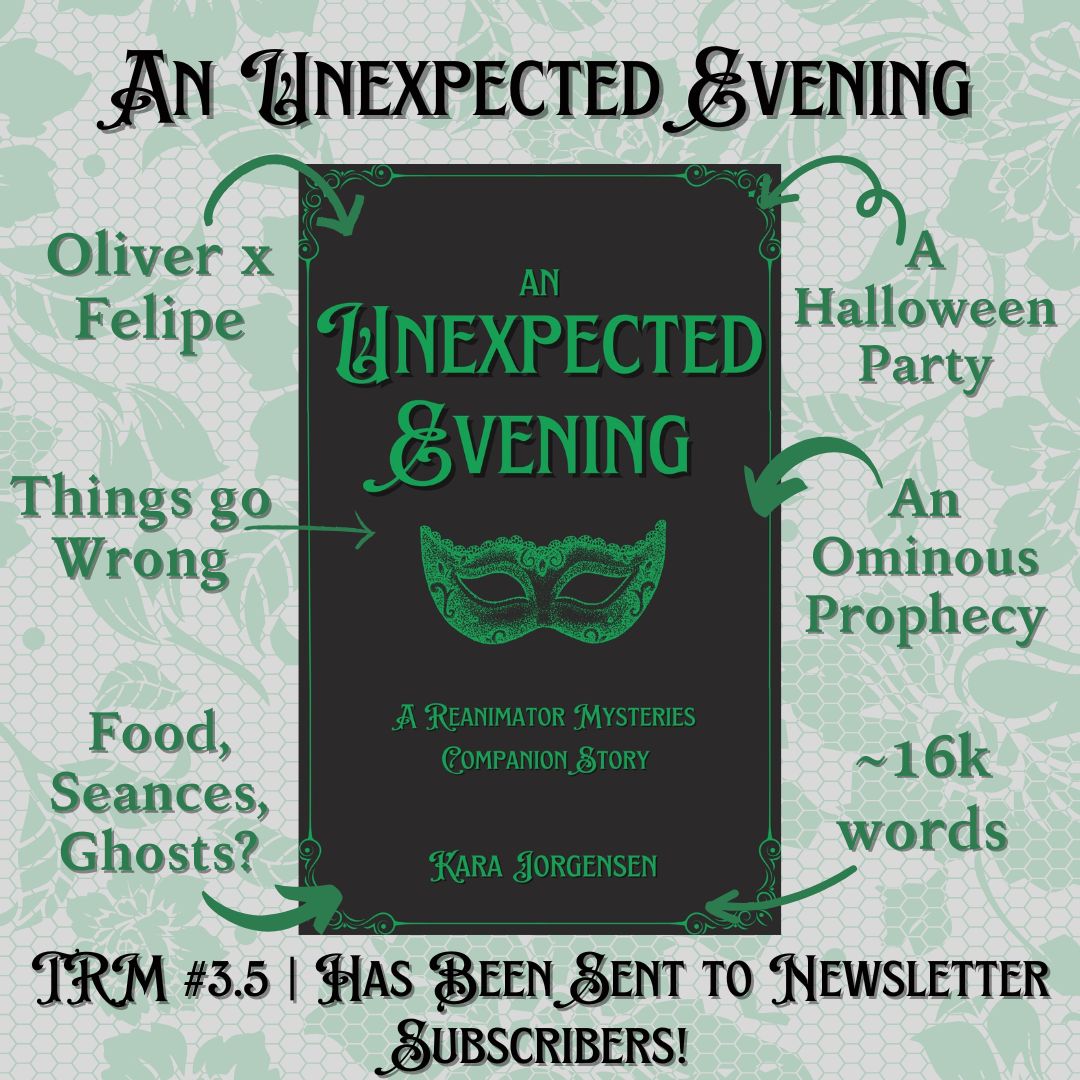
The cover of "An Unexpected Evening" is in the center (black with green text and a masquerade mask). An Unexpected Question TRM #3.5. Oliver and Felipe, Things go wrong, food, seances, ghosts? a halloween party, an ominous prophecy, 16k words

The Paranormal Society’s All Hallows’ Eve party is the highlight of the magical social season, and after years of going alone and ducking out after an hour, Oliver is hellbent on having a good time with Felipe this year, even if it kills him.

While Felipe is more than willing to wear a costume and dance the night away to make Oliver happy, an ominous prophecy from a sybil only hours before the festivities puts him on his guard. Unfortunately, the sybil’s warning isn’t Felipe’s only concern if the feelings coming across the tether are any indication.

Will Oliver and Felipe make it through the masquerade in one piece or will the prophetess’s warning be their undoing?


CW: discussions of past sexual trauma, sexual content, and panic attack


If you would like to grab your copy of “An Unexpected Evening,” you can do so by clicking the button below. You can also pop over to my freebies page on my website to grab the other 2 in-between stories for the Reanimator Mysteries series.

Writing

Join Me on Weeknight Writers

On Saturday, March 15th from 1-3 pm EST, I will be participating in a virtual panel on writing trans characters! I am super excited to have been invited by Weeknight Writers to participate in this panel along with authors Felix Graves, Georgina Kiersten, Vaela Denarr and host Dianna Gunn and Jade Benjamin.

Trans stories are more important than ever. This two-hour panel will feature four trans authors sharing how they approach writing trans characters and what trans folks should keep in mind when writing their own stories. We’ll also touch on how cis writers can create trans characters without perpetuating stereotypes or causing harm and how everyone can support stories featuring trans characters.

This event is hosted by the Weeknight Writers Group, a social enterprise  dedicated to providing affordable and accessible support for authors. The first hour and a half will be devoted to questions from our Sustaining Members and the panel moderators. The final half hour will be devoted to live audience questions.

You can purchase a ticket on their website for $15 or you can join their newsletter in order to get half-off your ticket. I also believe that being a sustaining member of the Weeknight Writers will also get you access to the panel and others before/after it.

I hope I will see you there or that you will support this fantastic writers’ organization that continues to bolster marginalized writers.

Monthly Review

February 2025 Wrap-Up Post

Even though the US is a hot mess, I felt like February was far better than January. Maybe it’s seeing the push back, protests, and having judges rule in our favor that has heartened me. That or the spite inside of me has been kindled. That helps as well. Before we get going, let’s take a look at my goals for February:

  • Finish writing “AUE”
  • Edit “AUE”
  • Send it out to my newsletter peeps first (everyone else gets it a month later)
  • Reread The Reanimator Mysteries books 1-3
  • Start proofing the audiobook for The Reanimator’s Remains
  • Read 8 books
  • Blog weekly
  • Send out my monthly newsletter
  • Maintain my fragile sanity
  • Perpetually bug my congress people

Books

My goal was to read 8 books, and I read exactly 8. The links below are affiliate links, so I get a small kickback if you purchase the book through them.

  1. Two Friends in Marriage (#3) by Jackie Lau- 5 stars, a lovely queer MF romance featuring a demisexual FMC and a bisexual MMC. Watching these two go from friends to married to lovers was just so sweet and cute. There’s also a giant penguin plush in the story who helps to sort of bridge the gap through cute and loving gestures.
  2. A Study in Black Brew by Marie Howalt- 4 stars, a retelling of A Study in Scarlet (aka a Sherlock Holmes story) set in a world with multiple alien races, advanced tech, and of course, coffee/black brew. It comes out May 22nd.
  3. Husband Material (#2) by Alexis Hall- 4 stars, a mm story built upon the structure of Four Weddings and a Funeral. Lucien and Oliver are simultaneously at their worst and best in this book, and while I enjoyed this one, the ending kind of annoyed me.
  4. Textiles by Beverly Gordon- 4 stars, a coffee table-ish book about the history and cultural significance of textiles. This is less specific than Victoria Finlay’s Fabric, but it gives you a lot of rabbit holes to go down while doing future research. I believe it is out of print.
  5. The Single Life (#1) by Akiko Morishima- 4 stars, two women who were penpals as children and realized they were lesbians through their letters meet up as older women. This is not a romance, but it’s sort of a slice of life as two queer women figure out what they want from the future.
  6. The Single Life (#2) by Akiko Morishima- 4 stars, see volume 1’s review.
  7. The Single Life (#3) by Akiko Morishima- 4 stars, see volume 1’s review.
  8. Time Loops & Meet Cutes by Jackie Lau- 4 stars, I loved this book. It’s like 50 First Dates meets Ground Hog Day as a workaholic eats some dumplings and gets caught in a time loop where she befriends another time looper and desperately hopes the man she has fallen in love with her will eventually remember her or that they might have a future together. This book comes out May 6th, and I HIGHLY recommend grabbing it.

Admin/Behind-the-Scenes Stuff

  • Approved the first 15 minutes of the audiobook for The Reanimator’s Remains (TRM #3)
  • Wrote the rest of “An Unexpected Evening” (TRM #3.5)
  • Edited/Proofread/Formatted “An Unexpected Evening” (TRM #3.5)
  • Sent out “An Unexpected Evening” (TRM 3.5) to my newsletter subscribers
    • I also posted the link for it in the freebie section of my website
  • Started working on the Court of Crows Stitch-a-long from FineFrogStitching
  • Agreed to take part in the Weeknight Writers Writing Roundtable on writing trans characters taking place on March 15th
    • You can grab a ticket here or wait for the replay
  • Stayed on task/schedule with grading for my classes
  • Celebrated my partner’s birthday
  • Bugged my senators and congress person repeatedly about… everything. If you can, please reach out to them and try to push them to do the right thing (and praise them when they do- carrot and stick, my friends)

Blogs


Writing

At first, I was very upset that my brain utterly derailed from stress in January after *gestures to the White House*, but I think taking this extra month to work on “An Unexpected Evening” was worth it. The story is significantly better, clearer, and longer. Sometimes, taking extra time is dawdling or dealing with executive function issues, but other times, it really is part of the marinating process. This time it felt like those extra few weeks of marinating helped me to really nail what I was trying to say with Oliver and Felipe. It also made it clearer what I want to do with book 4 (more on that in the near future). I’m super excited for you all to read “An Unexpected Evening,” and I hope you will leave a review on Goodreads or Storygraph if you read it.


Hopes for March

  • Reread all of the Reanimator Mysteries books in preparation for book 4
  • Start outlining book 4
  • Write at least 10k words of book 4
  • Proof as much of the audiobook for The Reanimator’s Remains as I can
  • Deal with several doctor’s appointments this month (boo)
  • Have the Weeknight Writers event go well (March 15th)
  • Continue to bug my senators and house member
  • Read 8 books
  • Blog weekly
  • Send out my monthly newsletter
  • Maintain my sanity
  • Work diligently on my cross stitch project