Writing

Why I Will Never Be a “Brand”

I’ve been thinking about brands, online personalities, and sincerity a lot lately. Without harping on past posts, let’s summarize the reason for this rumination as recent-past online trauma (if you know, you know).

Something you hear a lot as a new author is figuring out your “brand.” What’s your author brand? Build your author brand in 5 easy steps! Build your brand!

What building your brand should be is targeting your product to your ideal reader. Note: I said product. Your book is a product; you are not a product. I do have an author brand. I call it being a romantic goremonger. I write books with some gory, highly descriptive gross bits (usually medical in nature or having to do with a cadaver) while balancing that with lots of emotional intimacy between the two main characters. My ideal reader also enjoys historicals and is probably queer (or enjoys queer books) since those are basically all that I write. If you like Anne Rice, KJ Charles, Jordan L. Hawk, Cat Sebastian, Allie Therin, and Arden Powell, you’ll probably like my books.

What I don’t like and have come to actively distrust is creatives who treat their social media as an extension of their brand. There’s a big difference between throwing your audience a bone by posting a smutty snippet or sharing some cool research from your latest project and treating everything you post like it’s a direct reflection on you. When the latter happens, often people start posting less about things they actually care about and more about things that will reflect well on them as a brand. It’s the same reason corporations only post rainbow stuff in June or Black history infographics in February. It’s not that they care about any of these groups or want to foster equity of any sort. It’s that if they don’t, it’ll reflect poorly on their public image.

Years ago, I saw this mostly when authors completely refused to post anything “political” on their pages by abstaining from every mentioning a problem a person of color might face or that LGBT people exist. This was mostly due to the fear that people wouldn’t want to buy from them due to their lack of a stance (or conservative stance) on an issue. Unfortunately, we’re also starting to see it happen in the other direction where people make token posts about Palestine or trans rights because they feel they have to, not because they actually give a shit about either group. The idea is once again a preservation of their audience rather than a sincere post about something they care about. I’m totally fine with someone saying, “Hey, I’m not going to post about X because I don’t know enough about it.” I’d rather someone step back and educate themselves than make a knee-jerk post because they feel they have to. You should be supporting people of color, queer people, disabled people, etc. because you want to, not because you feel social pressure to do so. The social pressure on social media can absolutely drive this sort of insincerity, and I hate it immensely. The worst part is how many people seem very happy to tick off the boxes that make someone acceptable before supporting them when in reality it’s all for show and they don’t actually care.

Kara, how do you tell if someone cares? Well, at a glance, you really can’t.

This is the internet where everything is online for all to see, yet nothing is truly real. I think the only way you can truly judge is by looking at patterns of behavior. Do they continue support after X month is over? Do they seem to genuinely care about this topic/group? Do they retweet people who aren’t themselves posting about X thing? At the same time, some people only use their social media accounts for updates about their own stuff, so you have to take that into consideration. At a time where many people want a black and white litmus test for goodness or good rep, I’m here to remind you that nothing is that straightforward.

Going off of this, I will say the one rule of thumb that hasn’t proven me wrong yet is anyone who gets online and touts themself as an authority on anything is probably full of shit. Anyone who acts like they are the most queer, the most trans, the most Latinx, the most whatever because it makes them an absolute, unquestionable authority is probably pulling a Wizard of Oz act and hoping you can’t look behind the curtain to see who they really are. Authority should always be questioned, no matter if it’s in the community or outside of it. I feel like most people who know anything about something know that there is still a lot left to learn, and they are open to criticism or open to new information or outside perspectives. If someone’s online brand is that they are trying to cultivate a following that looks only to them or sees them as the ultimate authority on a marginalization or topic (like publishing), I would be very cautious as those people are usually grifters.

Has the idea of an author brand gone too far? I do kind of think so. The problem truly begins once a person gets a large enough following online. It seems around 3k-5k followers on most platforms is enough for fans/followers to start treating them less as a person and more of some random avatar that they can say whatever they want to as if they don’t have feelings. It’s weird, but I’ve seen it many times where people will suddenly say things to a person with a larger account that they would never say to someone they’re friends with who has 500 followers. The size of the account means the intimacy disappears and with it the humanity of the person holding the account. When we do that, we reduce a real person to only their posts, which makes it easier for grifters to turn themselves into an authority or “brand” that posts only to appease rather than sharing things they actually care about. Ultimately, it’s a problem that lies with the fans/followers as much as the creators. People don’t magically attain a different status when they reach a certain number of followers, and they are never going to appease everyone. Expecting them to do so will only lead to heartbreak, so keep your expectations in moderation and check yourself for parasocial relationships.

The Reanimator's Remains · Writing

An Excerpt From The Reanimator’s Remains (TRM #3) Part 2

Last week, I posted the first half of the prologue for The Reanimator’s Remains (TRM #3), which you can read here. You can preorder The Reanimator’s Remains at all major retailers in ebook form. The paperbacks will be available in October, closer to the October 29th release date. Without further ado, here is part 2.


The hairs rose on her arms as she passed from the normal forest and into the other realm. When Joanna looked back, the path to the Allen’s was gone, and in its place stood a thick carpet of ancient trees and moss. Here, there was no smoldering house or in-laws to hunt her, and she didn’t know if that comforted or terrified her. The Lady of the Dysterwood did not like humans to intrude upon her domain, and those who did so uninvited rarely lived long enough to regret it. Joanna’s heart beat loudly in her ears as she tried to remember the direction she had come from, but everything seemed wrong. The trees felt different from the ones growing the Pine Barrens. The pitch pines and black oaks around her rose to monstrous heights, leaving only smudges of sunless, red sky. They seemed older, as if their roots ran far deeper than humankind, and they had tasted the marrow of the earth. The Dysterwood felt untouchable. No human would dare take an ax or fire to it, lest they be destroyed.

All around her the woods teemed with life. Moss, flowers, and scrubby brush grew so thickly on the forest floor that she didn’t dare move or disturb them. It should have been a peaceful place, but beneath its bows, Joanna felt a litany of unseen eyes watching her. Every tree and leaf housed the Lady’s retinue. Birds she had never heard before squawked high in the canopy while the insects and creatures on the ground clicked and hummed as if oblivious to her presence. Hesitantly stepping deeper into the forest, Joanna froze at the gentle patter of blood from beneath her petticoat.

More! the Dysterwood howled as the ground closed around her boot and yanked her to her knees. Intruder!

Joanna bit back a cry as she landed hard, her palms stinging with scratches. Blood wept from the cuts, and in an instant, all eyes were upon her. The creatures buzzed to the surface, and the trees hissed in anticipation of the Lady’s verdict. Before it could come, Joanna drew in a deep breath and ripped her foot from the muck.

Lifting her chin, she stared into the waiting forest and held up her hand to show the ring her husband’s family had passed down for generations before he slipped it to her. “Take me to the Lady. I would like to make a bargain.”

For a moment, the entire Dysterwood went still until, with a dull rumble, the forest floor roiled and parted. Wet, petrified boards and bleached, half-rotted bones rose through the moss, cutting a path between the trees like the spine of some ancient slumbering beast. Squaring her shoulders, Joanna stepped onto the first tread.

The Lady would see her.

***

Time flowed oddly in the Dysterwood. Joanna walked for what felt like minutes, and darkness descended thickly over the forest. Owls hooted and screeched in the pine trees, diving down on unseen prey. A flash of red or a flicker of motion would catch Joanna’s eye, but she didn’t dare step off the path or let her attention linger for too long. Keep to the path and no harm will come to you, Stephen had said to her, but she wasn’t one of them, at least not by blood. She had the Lady’s attention, but she didn’t doubt she would feed her to some creature for her entertainment if given the chance. As she passed through a thick copse, the sky brightened to the bruised red of sunset. The trees thinned, giving way to pockets of mountain laurel, bushes studded with white bearberries and fragrant, pink swamp azalea. Bees droned nearby, though Joanna couldn’t see them through the thickets of flowers.

Stepping onto the next plaque of bone, rusty red water pooled around the soles of her boots. Joanna drew in a ragged breath. The endless forest should have been a paradise, but beneath the cloying aroma of flowers was the earthy smell of rotting earth and peat. If she strayed from the path to pick a flower or follow an animal’s child-like cry, the hungry ground would swallow her up and drag her down. The bog yearned for more flesh, more iron, more, though she didn’t dare stop following the path of decay, even as her calves and core ached and the blood ran from her body in earnest. What other choice did she have? The Lady might toy with her and let her wander aimlessly through the forest for all eternity, but Joanna wouldn’t lay down between the pitcher plants and sundew and let the Dysterwood consume her until she finished her pilgrimage. Her thoughts flickered to Mercy and the baby, but she quickly banished them from her mind. In her domain, the Lady might know her thoughts, and she wouldn’t give her any more tricks to use against her. She had given Mercy and the baby the best head start she could. That would have to be enough.

When Joanna raised her gaze, she suddenly stood in the center of an empty glade, and the trees that had surrounded her only a moment ago now stood a furlong behind her. She shivered, despite the summer heat, at the wrongness of the clearing. Still water pooled on either side of her, leaving a strip of grass only wide enough to accommodate the treads of bone and wood. With every step, her feet sunk deeper into bog and the pounding of her heart grew louder in her ears. Her powers hummed a steady dirge as she crossed the narrow turf. Joanna told herself not to look, but she needed to know. Beneath the bog’s still waters, a man’s face stared back at her. He was pale and still as death, a ragged wound marring his neck. While his clothes were from decades before her time, the outline of his features reminded her of Stephen. She half-expected him to open his sightless eyes or rise to grab her, but he never moved. Bracing herself, she looked into the pool on her right, expecting to find another body. Instead, a woman’s reflection hovered beside her own.

“Do you like my collection?”

Joanna gasped and turned to face the Lady of the Dysterwood. Nothing Stephen had told her could have prepared her for that moment. The Lady felt limitless, too old, too much, magic made flesh, made shadow, a glimpse of something other that was beyond comprehension. Then, she pulled back and solidified into something approximately human. A shadow of a smile twisted the Lady’s lips as she watched Joanna’s breath hitch and her eyes widen with terror. She was beautiful in an uncanny way that Joanna feared hid sharp teeth or claws. Her copper hair had been woven into intricate knots and braids, while her heart-shaped face remained unmarred by age, she appeared far older than Joanna’s twenty-five years. Her clothes were a mockery of the sumptuous, crinoline-fluffed gowns wealthy women wore. The fabric of her dress was so deeply red it hurt Joanna’s eyes to look at, and the embroidery decorating the edges shifted patterns from flowers to hunting scenes to figures of death, and where there should have been a chatelaine or purse at her belt, a heavy gilt knife hung. Instead of a simple necklace or ribbon around her neck, she wore a heavy, golden, dragon-headed torc. When the Lady looked down at her, her pale eyes bore through her, weighing on Joanna’s heart like lead.

“You took something that belonged to me,” the Lady said, her voice as deep and cold as her domain. “Do you know what I do to thieves?”

Joanna’s throat tightened like a garrot as the Lady stepped closer. If Stephen’s family dealt with her for centuries, she could do the same. Her feet were numb in the cold water and her head swam with blood loss, but Joanna straightened her spine and met the creature’s gaze.

“I am not a thief. Stephen made his own choices. I took nothing he didn’t freely give.”

The Lady’s eyes narrowed, and the trees around the glen rustled with an unseen gust. “My patience wears thin, little thief, and your hunters draw near. All it would take is but a thought to bring them here. Tell me why you have intruded into my domain.”

“I would like to make a bargain.”

A chiming laugh escaped her lips. “And why should I bargain with you?”

“Because I have this,” Joanna said, holding up the signet ring.

“That ring buys you entry, not cooperation, child. Besides, what do you think you could possibly give me that I don’t already have?”

Rusty water lapped against Joanna’s calves as the Lady turned away. Joanna’s powers hummed in time with her hammering pulse. Something was down there, a hair’s breadth from her skin, waiting for the Lady’s signal to strike. Her mind raced. She had to say something. She couldn’t be bested by a capricious demon’s disinterest after all they had done. “Me. You can have me and all that comes with that in exchange for a new bargain.”


If you enjoyed this excerpt, I hope you will preorder The Reanimator’s Remains at your favorite retailer or add it to your TBR on Goodreads. If you haven’t read books 1 or 2, you can grab them in ebook, paperback, or audiobook. Keep your eyes peeled for the cover reveal in July!

The Reanimator's Remains · Writing

An Excerpt From The Reanimator’s Remains (TRM #3) Part 1

I’ve recently realized that I am sorely behind in doing promos for The Reanimator’s Remains (TRM #3). Well, technically, I have been, but only in my newsletter and on social media. The cover reveal for book 3 will hopefully be next month, but in the meantime, I hope you will enjoy this excerpt from the prologue of The Reanimator’s Remains, which comes out October 29th at all major retailers. You can preorder it now in ebook. Paperbacks will be available closer to release day.


Prologue

The Bargain

Clutching the baby to her chest, Joanna silently slid open the window and ran. Her breath rasped loudly in her ears, but it did little to block out the voices yelling out behind her in the house. Quick as a shade, she slipped between two buildings and sprinted for the cover of the churchyard. The old cemetery held its breath as the sun crept toward the horizon, though not a single soul gave her away as she picked between the crooked headstones and disappeared behind the old, abandoned church. The moment her back hit the blistered, whitewashed wood, a wave of pain ripped through her core. Clasping a clammy hand to her stomach, Joanna released a tremulous breath. She shouldn’t be running yet. If she was any of the mothers she tended to, she would have told them to get back in bed and rest as much as they can, but if she stopped moving, everything she and Stephen did would have been for naught.

Joanna bit her lip against the bitter burn of tears. Her husband was well and truly dead now, her mother beyond her reach, and the people she once thought might become her family hunted her. All she had left was the swaddled baby in her arms, and she wasn’t going to let anyone stand in the way of his safety. Peeling back the quilt just enough to see her baby boy’s face, she watched him puff out a sleepy breath. How he had managed to sleep through the chaos of their escape, she didn’t know, but she silently thanked the Lord for small miracles and sleepy newborns. If Joanna had her way, he would never know about any of this. He would grow up to live a normal, peaceful life.

He will grow up without you.

Her head snapped up at the rustle of leaves. Across the sea of graves, the forest beckoned in a hissing whisper. No breeze reached her in the old church’s shadow, yet the tallest black oaks stretched and swayed as if searching for her. The Dysterwood had thousands of eyes, thousands of roiling, susurrus servants eager to tell their master of the goings on of mortals. Joanna pulled the blanket close enough to obscure the baby’s face and tightened her grip. The wood didn’t know him yet, and it never would.

Peering around the edge of the church, Joanna confirmed no one had followed her to the graveyard before making a break for the cluster of mausoleums. All around her the ground hummed with the slumbering dead. If she paid attention, she could tell who they were and roughly how long they had been gone, but she didn’t have time to talk to them now. Her heart clenched as she passed the clustered rows of tiny headstones, some with nothing more than a surname and single date. If she had done nothing else during her time in Aldorhaven, she had tried her best to keep their number from growing. Hiding behind the second grandest mausoleum in the cemetery, Joanna bit back a whimper of pain at another yanking cramp. As if sensing her discomfort, the baby stirred. She patted his back and whispered sweet nothings into his ear until he quieted. Can he sense the dead too? she wondered.

Part of her had hoped he might have an easier life and grow up to be a plantmancer like his father, but she knew from the second she saw him that he took after her. Shutting her eyes, she inhaled the milky scent of his skin, and for a moment, she could pretend she had merely taken him for a walk to settle him and that one day she might stroll with him hand-in-hand through the graveyard and explain how their powers could be used to do good, no matter what anyone said. She pictured him grown with dark hair like hers and his father’s gentle, warm smile. He would be kind and smart and helpful. Her mother would make sure of it, even if she couldn’t.

Joanna flinched at the sudden shatter of glass followed by a cry of fire. Smoke rose over the far side of the hill as Stephen’s final trick destroyed their home and bought her precious time, yet she didn’t dare look back. The house and furniture the fire consumed were only things, things that could trace back to her life before Aldorhaven, she reminded herself, ignoring the lingering pain beneath her heart. From her high perch behind the tomb, Joanna could see the Allen’s cottage at the edge of town. She watched as the tall, stalwart figure of Jacob Allen ran out of his house and mounted his horse a moment after the fire bells sounded. Just as she hoped.

Gathering the remainder of her strength, Joanna sprinted past the empty tombs of the town’s founding family, away from the cavernous mouth of the Dysterwood, and through a loose bar in the ironwork fence. Half-sliding down the hill, she made for the shelter of the trees leading to the Allen’s home. In the normal thickets of the Pine Barrens surrounding the edge of the town, the creatures of the Dysterwood held no sway, though Joanna knew the eyes of the forest still trailed her as she reached the field behind the house. The knot in her chest loosened upon seeing Mercy’s chestnut Morgan standing in the field beyond. The horse’s ears stood erect and his eyes wide as he listened to the distant clang of bells.

The moment he spotted Joanna, the brown stallion ambled over from the pasture, eager to check her pockets for treats. For the first time all day, a genuine smile crossed Joanna’s lips as she patted Rasmus’s nose and rubbed the white streak between his eyes. The horse butted his head against her neck, and she hugged him tightly with one arm, wishing this didn’t have to be goodbye. Pulling back, Rasmus snorted and nosed the bundle in her arms curiously.

“Gentle,” she coaxed as she carefully pulled back the blanket to reveal the baby. The horse looked puzzled as he sniffed him, but when the infant briefly opened his eyes to stare up at the gentle beast, Rasmus lipped and snorted on him for good measure. Joanna laughed, but the sound was cut short by voices and smoke carrying on the wind. “Where’s Mercy, boy?”

“Over here. I’ll be right with you, Joanna.”

Joanna turned, her heart lurching at the sixteen year old’s sudden appearance at the barn’s entrance. No matter how many times she did that, Joanna never grew accustomed to it. Mercy’s dark blonde hair clung to her face in the summer heat as she set the pitchfork against the wall and wiped her hands against her well-worn trousers. Swallowing hard, Joanna tried to commit Mercy Allen to memory. She was only a few inches taller than Joanna, yet she was stalwart and strong in a way she could never be. She moved through the world with purpose, when she let people see her, but the more days she spent in Aldorhaven with her father, the more patches of her that became threadbare under his gaze. If she didn’t get out soon, whatever life Mercy yearned for when she donned her brother’s hand-me-downs and galloped full speed past the house and into the pine barrens would be gone. As Mercy quickly washed her hands and face at the pump, Joanna readjusting her grip on the baby and confirmed she hadn’t lost her purse or knife in her haste. No, Mercy and her son would have the chance to have a life they could never know here.

“Sorry for keeping you waiting. My father left to deal with some crisis in town. Did you hear the—” Mercy’s brown eyes brightened with excitement as soon as they landed on the bundle in Joanna’s arms. “You had the baby!”

“Sssh!”

“Sorry,” she said softer with a wince. Gently shouldering Rasmus out of the way, Mercy peered down at the baby as he yawned and hunkered further into the quilt. “Oh, Joanna, I’m so happy for you. What’s their name?”

“He doesn’t have one.”

“Why not?” Mercy asked, gently stroking his dark hair with two fingers.

“Because I can’t know it.” Mercy’s head shot up, but Joanna held her gaze and nodded toward the woods. When Mercy opened her mouth to speak, Joanna cut her off. “Stephen’s dead. For real this time.”

“We knew it was coming, but still, I’m so sorry, Joanna. Did he get to see—?”

“Yes, he did, but now, they know,” Joanna said, the words tumbling together as she spoke. There was so much to explain and so little time. “Within moments of Stephen dying, they showed up, just like he said they would. I don’t think they fully understand what Stephen and I did yet, but when they do, they’ll come for the baby. You’re the only person who knows he’s alive, besides me and Stephen, and I need you to take him far away from here. I have money for you.” Pulling the heavy purse from her pocket, she shoved it into Mercy’s hands. “There’s enough there that you should be able to pay for the ferry, board Rasmus, and buy anything you need to start a new life, the one you’ve always wanted. My mother will understand and help you. She will let you stay with her until you’re on your feet, but you must take him and ride to the Camden as fast as you can. If you leave now, you can make it to the last ferry to Philadelphia and be at my mother’s not long after nightfall. There’s a note for her in the purse that explains everything. Her address is on it.”

Opening the pouch, Mercy choked. “Joanna, this is a small fortune. I can’t take this. How will you—?” Her eyes widened in understanding. “No. You can’t do that. He… he’ll need his mother.”

“I have to. Once they realize what we’ve done, they will be out for blood. Mine or his. That’s why I can’t name him. If they get it out of me, they can find him.”

“Then, come with me,” Mercy pleaded. “We can all fit on Rasmus.”

“I will only slow you down, and you’ll need all the speed you can get.”

“But I don’t know how to hold a baby. What if I drop him?”

“Mercy, I’ve seen you ride with a basket of eggs. I’ll make sure he’s strapped tight to you, but you need to go soon if you have any hope of escaping.” Glancing at the smoke-streaked sky, Joanna calculated the meager time she had left and turned back to Mercy. “I’ve never had a sibling, but of all the people in this world, you are the closest I have ever had. I would never ask this of you unless I had no other choice, but you are the only one who can escape the wood’s notice. It will be hunting me after what I’ve done, but it hasn’t sunk its teeth into the baby yet. You both can be free.”

When Mercy’s features tightened with fear, Joanna pressed her hand to her cheek and whispered, “If you love me, you will leave this place and live well. That is my greatest hope: for my boys to live well.”

“Are you sure there’s no other way?” Mercy croaked. When Joanna nodded, Mercy sighed and hung her head. “I’ll get my things.”

“Please be quick.”

Grabbing her saddle bags from the barn, Mercy disappeared into the house. As the door shut behind her, a wave of exhaustion passed over Joanna. She leaned against the side of the house out of sight, letting the baby’s full weight rest against her chest. The fear that had propelled her from the mob had finally been spent. Her arms shook with fatigue and blood dripped down her leg and clung to her petticoats while cupboards opened and shut inside the house. With every second she waited for Mercy, the baby seemed heavier and the rippling pain in her core grew stronger. Joanna screwed her eyes tight and released a steadying breath. She only needed to hang on a little longer. Soon, it would be over, and it would all be worth it.

The wind blew down the bank and through the trees, bringing with it the acrid tang of smoke and the sound of Stephen’s sister yelling her name. Tightening her grip on her son, Joanna peered around the corner of the barn, but thankfully, no one was there. Daphne’s only allegiance was to her family, and no bond of motherhood or feigned friendship would stop her from dragging her back. The door to the cottage whined as Mercy stepped outside. Before she could call for her, Joanna emerged from the shadows. In her brother’s clothes with the too long trouser legs rolled beneath her boots and a derby squashed over her hair, Mercy could easily pass for a boy in the evening light. Giving Joanna a stalwart nod, she strapped her bags to the saddle and prepared Rasmus for their ride. The horse looked nervously toward the Dysterwood, but Mercy whispered to him and stroked his neck until he quieted. Stepping back from him, Mercy held Joanna’s gaze but neither moved nor spoke.

Joanna twisted her fingers into the quilt and swallowed against the knot in her throat. She knew the time would come to let him go, but it still felt too soon. Everything she and Stephen had done had been for this moment when they could send him somewhere far away, where he would never know of Aldorhaven or the fate that would have awaited him if he had stayed. He had the chance for a life his father never did, and she needed to let him go. Pulling back the quilt, Joanna tried to memorize his face as she had Mercy’s. He was so new. He had no name or features she could pin down as coming from her or Stephen, but he had his life. And it would always be his own. Joanna kissed his forehead and readjusted the blanket around him until he was swaddled tight. Beckoning Mercy closer, she pulled the shawl from her shoulders and threaded it around Mercy’s middle under her coat. She carefully tied the bundled blanket into it and stepped away before she could change her mind.

Embers blew on the wind as Mercy gingerly swung into the saddle and turned Rasmus toward the road. “You can still come, Joanna.”

“You know I can’t.” At the hesitance in her eyes, Joanna called, “Mercy, after you get settled, promise me you won’t look for me. Forget I or this place ever existed.”

“I promise I won’t look, but I’ll never forget.”

Joanna stood rooted at the gate as Mercy gave her one final, long look before spurring her horse to a trot. She tried to keep her gaze trained on Mercy’s back as Rasmus picked up speed down the road, but her eyes kept sliding off as if they weren’t there. When she could no longer find them beyond the distant clack of hooves, the pain in her heart lessened a fraction. If she couldn’t see them, then hopefully, the wood couldn’t either. Godspeed, Mercy. Tears burned the backs of Joanna’s eyes, but she quickly blinked them away and headed back to the road. At the top of Cemetery Hill, a lone figure appeared between the tombs. Joanna’s heart lurched in her throat as Stephen’s father stepped from the shadows. Before he could see her and call out to the others, Joanna took a deep breath and plunged into the Dysterwood.


If you enjoyed this excerpt, I hope you will preorder The Reanimator’s Remains at your favorite retailer or add it to your TBR on Goodreads. If you haven’t read books 1 or 2, you can grab them in ebook, paperback, or audiobook. Stay tuned for the second half of the prologue next week.

Writing

Kara’s Current & Future Writing Plans

As we head toward the end of the second quarter of 2024, I find myself starting to plan. Truthfully, I should be planning for the third quarter, but instead, I find myself thinking about all the writing projects I would like to work on and when I’m hopefully getting to them. To preface, none of what I’m going to talk about is set in stone. All dates and ideas are subject to change, especially due to work, extra projects, etc.

2024 Books

The Reanimator’s Remains (TRM #3)– Book 3 of the Reanimator Mysteries will be out October 29th, 2024. I’m hoping to have it drafted and done by the end of the summer for the late fall release. You can preorder it here.

TRM #3.5 short story– I still have no idea what this will be about, though I’m thinking it will be set during the Paranormal Society’s All Hallows Eve party. Depending on how long it ends up being, it will be released at the end of 2024 or beginning of 2025.

2025 Books

The Reanimator’s ________ (TRM #4)– As of right now, I think book 4 will be the last book in the Reanimator Mysteries series. I have ideas for it and hope you all will love how the series wraps up, and don’t worry, we will definitely revisit our favorites in future books. This will be my big project for 2025, and I expect it to come out in October as usual.

TRM #4.5– I’m not 100% sure if there will be a final short story, but I’m going to assume I will write some sort of epilogue for Oliver and Felipe. This story will come out after book 4.

Timeline Unknown

When I say “timeline unknown,” what I really mean is, “I haven’t committed to a due date, and I can’t be behind if I don’t know when they’re due.” Basically, these projects are marinating and will for sure be worked on, but they are not as high of a priority as the Reanimatory Mysteries books are at the moment. Also, due to job stuff, energy levels, etc., it’s hard for me to write more than one book a year, though I would love to work up to finishing two a year without sacrificing quality or my sanity.

Joe and Ansley’s Book– I’m 99% sure this will be novel length, so it will probably take months to write. I don’t want to shoehorn it in between Reanimator books like an afterthought, but it is coming! I have ideas for them, and I really want to write more within this universe as well.

A book starring Teresa Galvan– This one is a huge maybe. I have a sparkly idea, but I’m not sure it makes sense yet. Teresa is growing up in a time of immense change and possibility, so writing a story set during the Belle Époque from an artist’s perspective would be a lot of fun. Once again, still working out the bugs.

More Reanimator Side Stories– I have some ideas bouncing around for an Oliver and Gwen prequel short story, potentially a short story about the head inspector and Gale, and several others. Eventually, I would like to put together a collected volume of Reanimator Mysteries related short stories.

Trousers and Trouble– I am so sorry to my readers who have been waiting years for this book. Between burnout, covid, life stuff, etc., it was really hard to write a book about trans joy. Once again, after the Reanimator books are done, I will revisit this book, and this series to write books for other characters mentioned in this one and Kinship and Kindness.

Dinosaur Duology– So I think it’s a duology. In my head, that’s the structure of it, before and after a giant event, but that is subject to change. There are also some other things I would like to explore within the same time period, so I don’t know what the structure of this series will be or if there will be an off-shoot book. I have no idea, but it’s marinating.

Scandinavian flavored epic fantasy– the series that will be cooking the longest because I don’t know if I am smart and/or talented enough to pull it off yet. I have lots of sparkly ideas and aesthetics, but those do not make a book, unfortunately.

For now, these are the works I have on the docket and the backburner. I hope you will stay tuned as I talk more about my current and future projects!

the reanimator's soul · Writing

The Reanimator’s Soul Audiobook is Available Now!

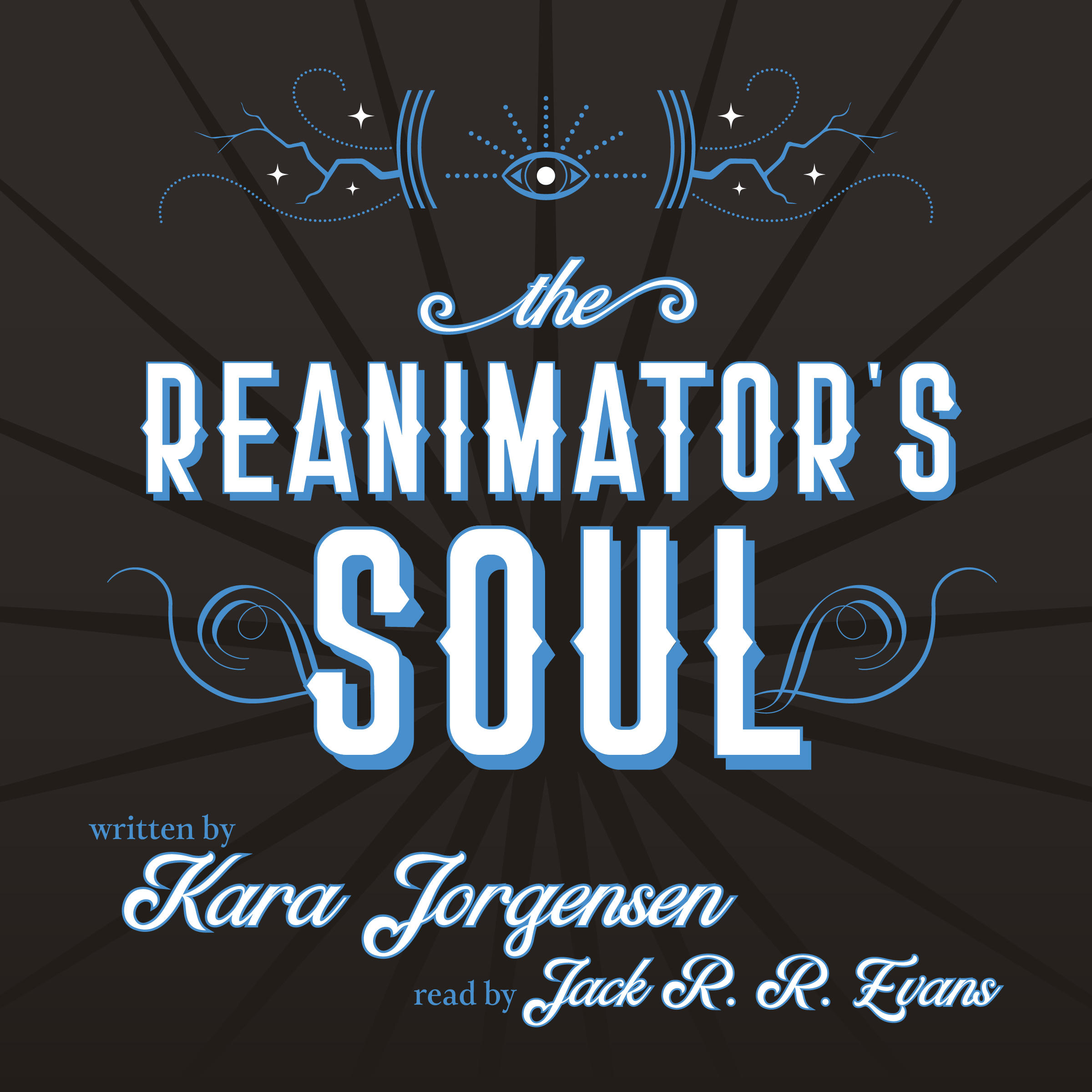
the audiobook cover for The Reanimator's Soul written by Kara Jorgensen, read by Jack R. R. Evans

I am so excited to announce that The Reanimator’s Soul is now out in audiobook! It’s still trickling out to a few other retailers, but it’s now out at most major retailers and library systems.

Jack R. R. Evans, who narrated The Reanimator’s Heart and Kinship and Kindness, has returned to narrate The Reanimator’s Soul, and they have done an amazing job. I always rave about Jack’s work, but the way they did Ansley and Joe had me grinning from ear to ear.

You can grab the audiobook of The Reanimator’s Soul at

Amazon

Audible

Barnes & Noble/Nook

Kobo (on Kobo Plus as well)

Apple

Chirp

Spotify

Google Play

And many more including Libby, which many libraries in the US use. It will also be available in other library systems and Libro.fm, but it takes a few weeks to appear.

The Reanimator's Heart · Writing

The Narratess Indie Sale!

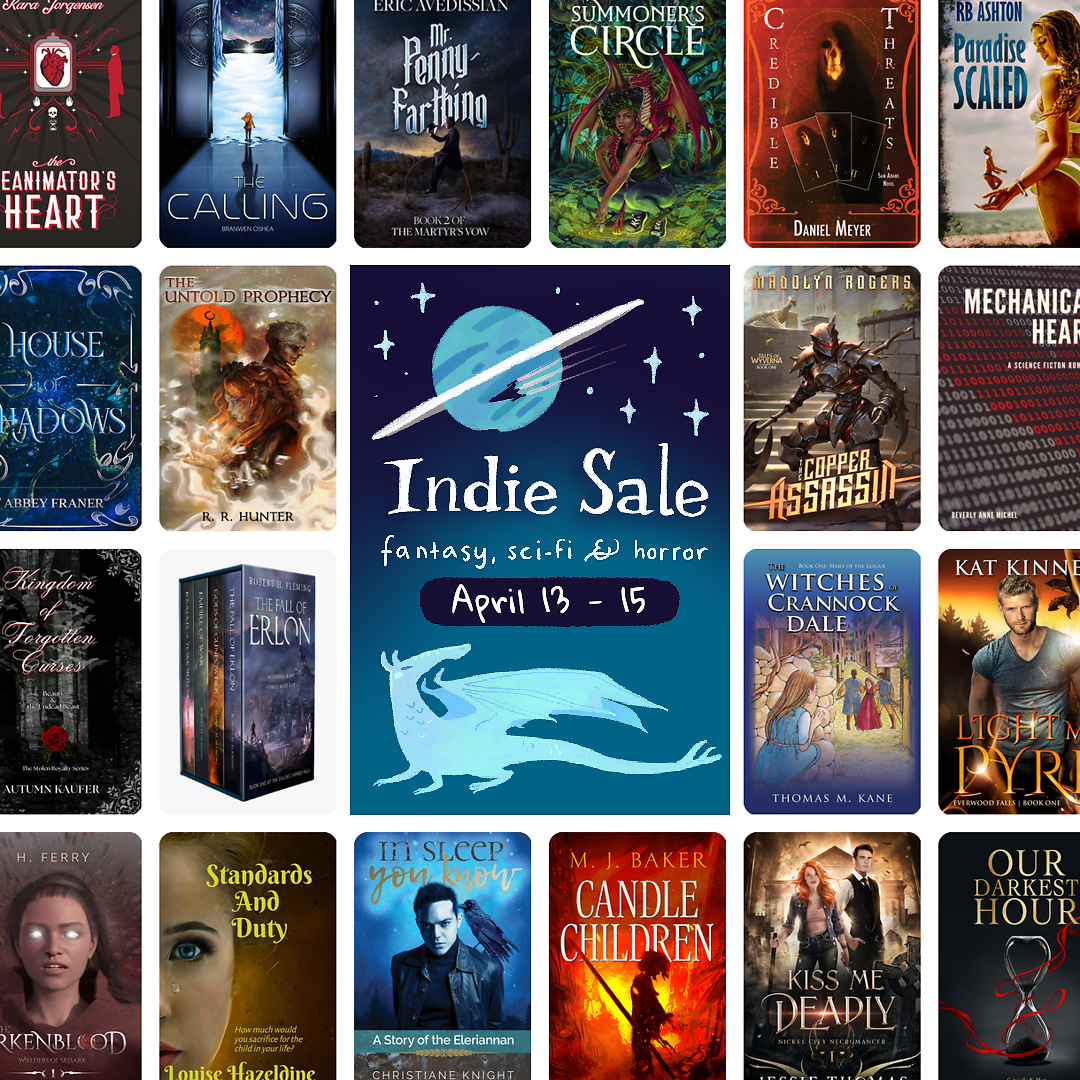
a grid of book covers. in the center is a dragon and a planet, and around them it says, Indie Sale fantasy, scifi, and horror. April 13-15th

We will be back to our regularly scheduled blogging next week, but I wanted to let you all know that there is one day left in the Narratess Indie Sale, so if you are looking to beef up your to-be-read pile for Indie April, swing over to the Narratess Sale to check out over 200 indie books that are free to $1.99.

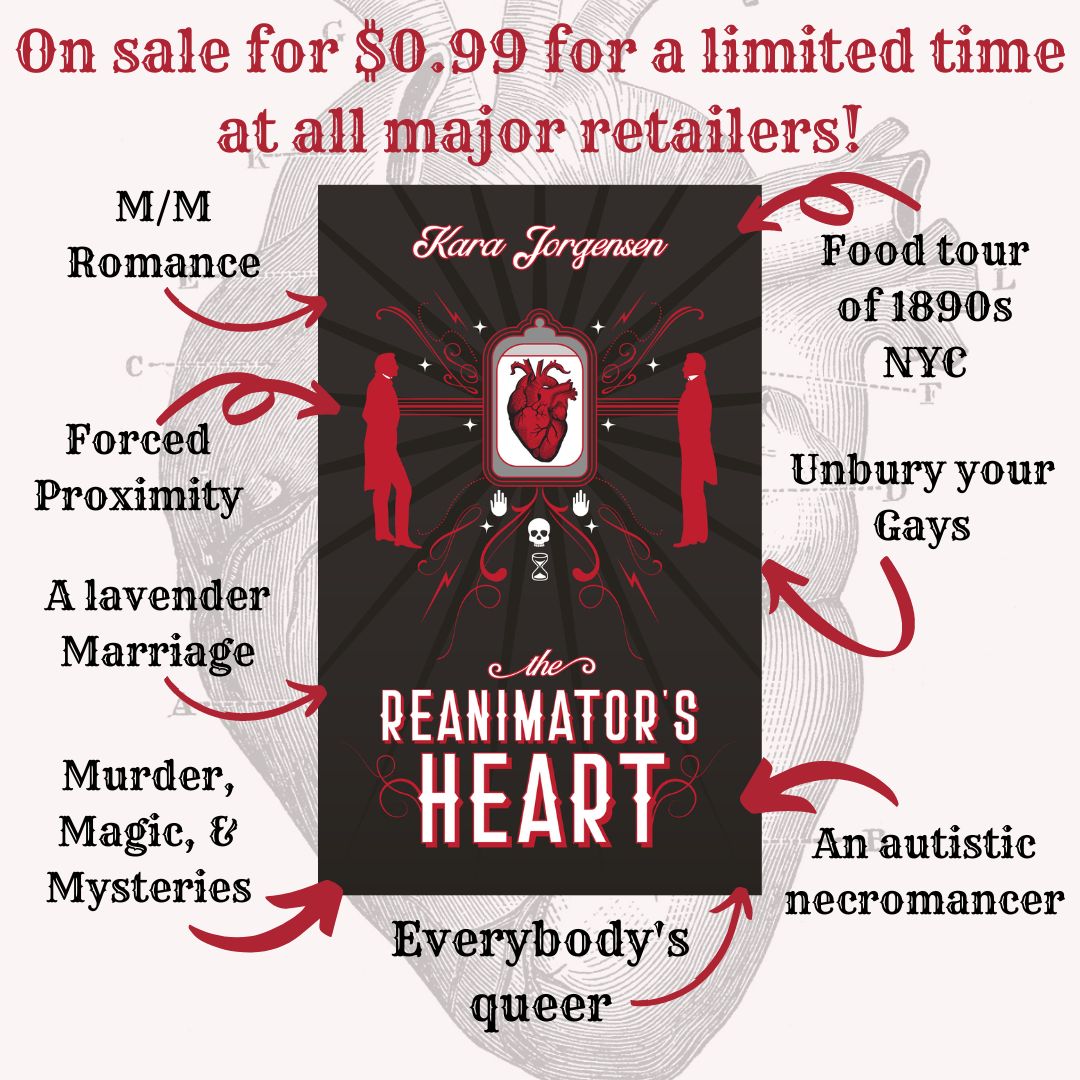
The Reanimator's Heart by Kara Jorgensen is on sale for $0.99 for a limited time at all major retailers. mm romance, food tour of 1890s NYC, unbury your gays, forced proximity, a lavender marriage, an autistic necromancer, everybody's queer, murder, magic and mysteries

The Reanimator’s Heart is also part of the sale and is $0.99 at all major retailers and in most regions, so if you’ve been looking to get your hands on it, now is the perfect time to start the series, especially ahead of book 3‘s release in October.

Writing

The New Book Blues

I have a confession: I hate starting a new book.

This probably sounds weird from someone who loves writing, their characters, stories, etc., but the actual starting part is the absolute worst for me. I’m not one of those writers who gets an idea and immediately dives headfirst to bang out 10,000 words in a few days before hitting the wall when they get to the middle. No matter how hard the spirit of inspiration strikes, I never get that sort of burst at the beginning of a story. The beginning is always the slowest part of the writing process for me. I’m constantly having false starts, stalling, reworking or clarifying things. The beginning of a book is about feeling things out and trying to get the shape of it in my mind before I get too far. My process is probably closest to a sculptor using a piece of a marble. They have to inspect the veins and natural curves and weaknesses of the rock before they get too far, lest they ruin it.

I’ve said it previously in other posts about my writing process, but I hate mess. I’m not the kind of person who can speed-run through a draft and deal with the problems later. If I have a super messy draft, there’s a 90% chance I will just chuck it in the bin and move on instead of dealing with it. Because I am mess averse, I tend to be a slower writer but a quick editor. My writing has been gone over so many times by the time I reach the editing stage that the draft is fairly clean. At the same time, I don’t have hyper-productive days with astronomical word counts because that would mean cleaning up a lot of mess later. Occasionally, I do have these days, but they’re often toward the very end of the story when I know exactly where I’m going and what needs to happen.

The beginning of a book is like standing at an eight-way intersection. I have too many choices and I haven’t puzzled out where they all lead yet, so I get decision paralysis. Some people will say just pick something and deal with the consequences. Yeah, no, I’d rather take a few hours or days to figure out what won’t work before charging down a certain path and making a mess for myself. I’m a careful writer, and the fact that the slow start is part of my process is something I need to remind myself each time I start a new project.

I often scare myself when I start a project because I am so slow at first. There’s a little, panicked voice inside of me that’s like, “At the rate you’re going, it’ll take two years to finish this book!” and then, I freak out more and freeze up. This time, I’m trying to remind myself that the speed at which I write exponentially goes up the further along I am in the book. The first five to ten thousand words are the slowest because my brain is still grappling with all the setup and moving pieces that need to be nailed down early on. This is part of the process, even if I don’t like how it feels, and at some point, I need to make peace with that.

The beginning of a book is like a road with nearly limitless paths, and the further I get into that draft, the more side streets are closed to me. The path becomes clearer, and the chance of getting lose diminishes. For now, I will keep going, albeit slowly, and try not to get lost.

The Reanimator's Remains · Writing

Introducing The Reanimator’s Remains

This week’s blog post is a sort of title reveal/blurb reveal/preorder reveal for book three of the Reanimator Mysteries series.

The title of book three is The Reanimator’s Remains! Book three will be out October 29th, 2024, and you can preorder it in ebook form now at most major retailers. Paperbacks will come closer to release day.

The cover reveal will be later this summer, but for now, you can read the blurb below.


An autistic necromancer, his undead love, and a town built on secrets

When the dead start rising and wreaking havoc in the small town of Aldorhaven, no one at the Paranormal Society wants to take the case; no one but Oliver Barlow. While he knows little of his parents’ lives, he knows he was born in Aldorhaven. Perhaps there, he might finally find out what happened to them or if he has any family left.

The last thing Felipe Galvan wants to do is go to a strange town in the middle of the woods, but for Oliver, he’ll go. From the moment they arrive, Felipe is haunted by memories better left buried and reminded that one misstep is all it would take for him to lose control and become the monster he was always meant to be.

But it isn’t merely the dead plaguing Aldorhaven, something far worse lurks in the woods and in Oliver’s blood. Together, Oliver and Felipe must untangle the magic hidden in the town’s past and destroy it before it can claim Oliver’s life.


What can you expect from The Reanimator’s Remains?

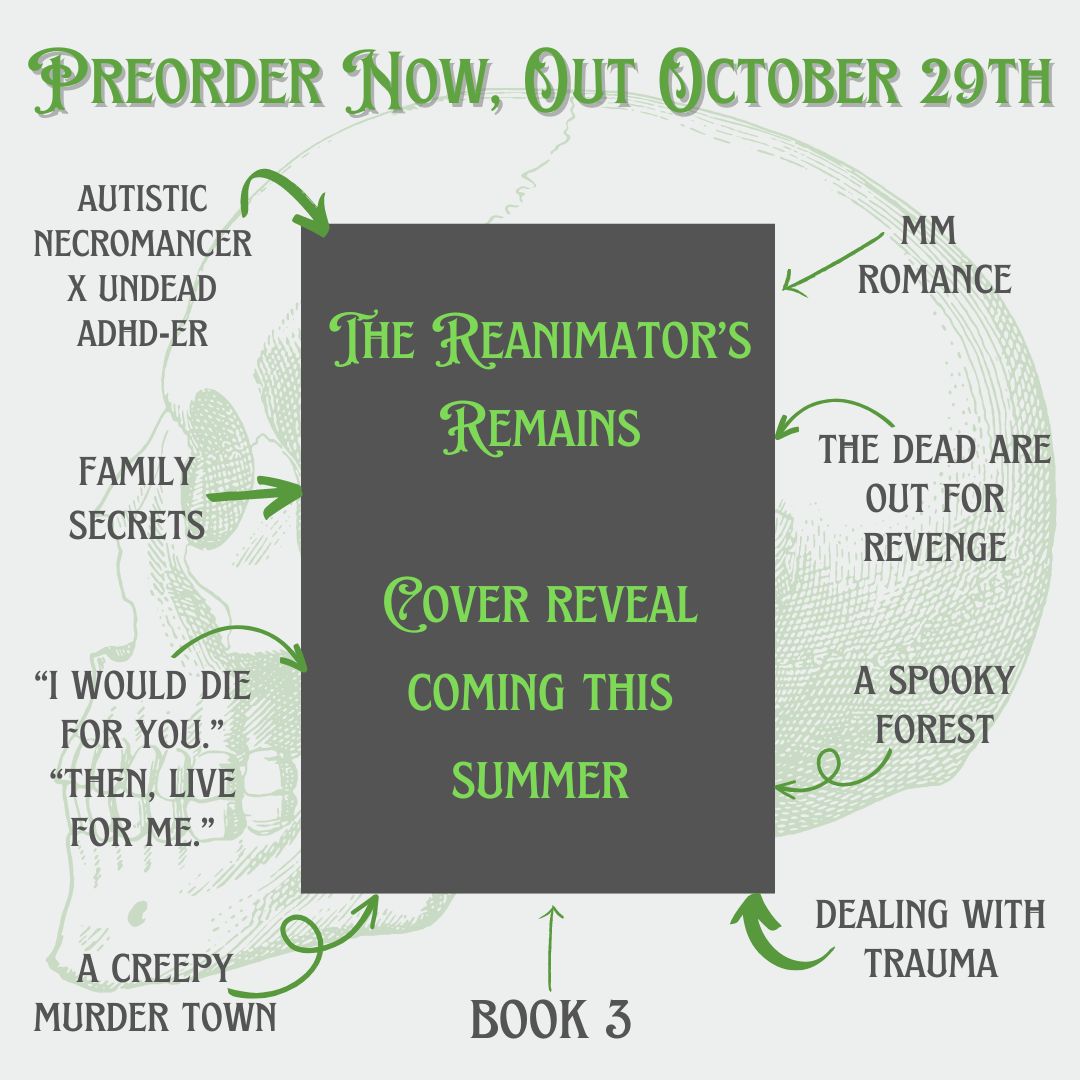
The Reanimator's Remains by Kara Jorgensen, cover reveal coming this summer. Preorder now, out October 29th.
autistic necromancer x undead adhd-er, mm romance, family secrets, the dead are out for revenge, "I would die for you" "Then, live for me.", a spooky forest, a creepy murder town, dealing with trauma, book 3.

I will definitely talk more about The Reanimator’s Remains (TRM #3) as I work on it, but at its core, it’s a story about fighting fate and expectations and breaking cycles. I hope you all will enjoy reading it as much as I’m enjoying writing it. You can preorder The Reanimator’s Remains at most major retailers, and if you haven’t read The Reanimator’s Heart or The Reanimator’s Soul, you still have time to do so before book three comes out in late October. You can also add it on Goodreads.

Writing

Research & the Discovery Writer

Something I greatly enjoy is learning about other writers’ processes for coming up with ideas and actually writing their books. What fascinates me most are writers who can seemingly research everything they need before starting a book. Every time I think about it, I laugh. That is certainly not my process.

The problem is that I am a discovery writer who plans their books out only a little at a time. For people who are more consistent outliners and planners, researching in advance might come far easier since they, generally, know what’s going to come up in their stories. I have no idea beyond broad strokes of what’s going to come up. For example, when I was working on “An Unexpected Question,” I knew I needed to research Coney Island, the amusement parks there, and 1890s men’s bathing suits since I knew the characters were going to Coney Island for vacation. What I didn’t realize was I would also need to research restaurants that were there in 1897, the ocean life around Coney Island, whether horseshoe crabs would be on the beach in August, street food in the 1890s, bathing machines, and a bunch of other minor stuff I hadn’t anticipated.

This is typical of what happens when I start writing a story. I have some very general idea of things that I need to research either because I know I will need the info or because I need to nail down what I think I want to do and have to eliminate things. While working on each of the Reanimator Mysteries books, I’ve read up on various occult things or aspects of medical cannibalism in order to decide the direction I wanted the books to go. Research is not strictly clarifying what I need to know but closing paths the story will eventually take.

The true issue is that I enjoy doing research. Someone once asked me, “How do you know when you’re done researching for a book?” My answer: you aren’t until the book is done because something will always come up that needs to be double checked, especially in historical fiction. As someone who is an eternal student and hoards special interests like a dragon hoards treasure, I’m okay with that because research is one of my favorite parts of writing, so I will do it the second I have an excuse to do so. I have gone down ridiculous rabbit holes over minor details that ultimately added up to one or two sentences.

The thing is, it’s probably only going to be a sentence or two, but some of the best ideas I’ve ever gotten came from doing random research. Knowing these minor details, especially in a historical context, helps to enrich a story and create greater depth than if I did all the research upfront. Even if the majority of readers have no idea, I know and some astute readers will pick up on it. It’s like throwing in Easter eggs, and it brings me joy.

This past week I decided to write a scene that involved a horse. I did not anticipate writing a horse scene and have actively avoided having horses in my stories by moving up the timeline for steam powered cars. The problem with horses is that it is very easy to screw them up. Horse enthusiasts will happily tell you that you royally screwed up a scene involving a horse, and I did not want to get an F in horse rep from the horse people. So what did I do? I did a deep-dive on horses in the 1860s for a 3 page scene because I was not getting it wrong. Then, I ran the idea past several people who confirmed I did not royally f up the horse in my book. If you’re a writer, horse people and historical gun people will happily tell that you messed up, and from my experience, the horse people are more than happy to help you get it right.

Some of you might be intimidated by having to do research for a book, but the time and effort it takes is worth it when you can put out a book that feels well constructed and thorough. It’s basically world-building, just world-building based in deep research or the past rather than constructed in your imagination. If you thinking about doing research for a book, I highly recommend not just looking at what you definitely need to know but things you may not use, and of course, read widely by getting works from scholars who are of marginalized backgrounds and/or research about people of those backgrounds. In regards to historical research, there are chunks of history that aren’t taught in schools, and it’s important to remember that when constructing your own books/worlds, so do you homework.

Writing

Social Media and the Devaluation of the Arts: Part 2

Last week in part 1, I discussed how video-based social media has screwed over artists and the artistic process. While you don’t necessarily have to read part 1 to understand part 2, I will be building upon those arguments today.


Scrolling through Tiktok, a woman making miniatures flashes across my screen. With a pair of long tweezers, she places a dozen tiny books onto a bookcase, one after the other. The cuts are evident, but I know that even someone with a deft hand and lots of practice picking up tiny things would struggle to put these itty bitty books on a shelf and have them look artfully arranged. I wonder how much time has gone into creating this video. Was this a time lapse or a rehearsed arrangement of books? Have the other books been glued down to avoid accidentally dumping or upsetting what’s already been placed down in this diorama of a library? But I’ll never know. The moment the last book hits the shelf, the camera pulls back to reveal a quaint, cozy library done in 1:12 scale. It zooms in on a few details before looping back to the beginning.

There’s something about miniatures that I love, though I don’t make them myself. It’s a replication of real life but on an inhuman scale. It’s a very human thing to build houses for ghosts. To decorate them to honor some unseen presence. We relish the work and time we put in making something the hypothetical inhabitant would like. Dollhouses pick up where our temples or homemade altars left off, and it’s comforting to know humans never truly change.

I follow a bunch of people who make miniatures on Instagram and Youtube. Miniaturists often make their own pieces for their dioramas or buy them from independent creators who specialize in a very specific niche like making tiny, lifelike vegetables or weaving itty bitty carpets on a bracelet loom. Under a video of someone rolling out and painting a clay cabbage, a commenter asks how much they cost. I wince at the responses to the creator’s honest answer. “FOR A CLAY CABBAGE?? I COULD MAKE THAT FOR $3!” says the questioner, and others quickly chime in to tell the craftsperson what a rip-off their price is.

The Price of the Aesthetic

If you’re an artist of any type, I’m sure you’ve heard someone complaining about the price of your work, whether it’s a $5 ebook or a $300 full color art commission. People don’t understand the amount of work that goes into making something. It isn’t just the cost of the materials or even the time it takes to make it. You’re paying for skill. It’s the same reason you can make yourself a cheeseburger and fries at home, but you pay $15 for the same thing at a restaurant. The chef knows what they’re doing, and you’re paying for their expertise. Yes, you could make that clay cabbage at home for $3, but do you have the experience to know what clay works best or how thin to roll it without tearing it or how to paint things in a way that makes them seem lifelike? In the amount of time, effort, and material you used to figure it out, you’ve probably spent more than you would have if you bought it from a professional.

When I commission artwork of my characters from my favorite artists, I do so because I know they can do a better job than I ever could. I’m paying for their skill, and usually, I’m underpaying for that skill. Most artists I know do not charge what their work is worth, and even then, they still get told they’re overcharging or trying to rip people off. No matter how little a creative charges, it will always be too much for someone. With the way social media algorithms demand artists to perform in videos, I wonder how much worse this will get.

As someone who crafts and writes, I know the time a project takes, the toll repeated motions can have on the body, the costs of materials, and the amount of energy it takes to learn a skill and hone it over years, but what about those who don’t? I think back to that Tiktok video of the woman placing tiny books on a shelf. I wonder how many people watching the video understand how much work goes into making each of those miniature books. Yes, they look uniform and nearly perfect, despite there being several dozen of them, but that is due to hours of labor and years of skill. They don’t look perfect because it’s easy. They look perfect because the artist knows what they’re doing. And now that work is been distilled into thirty seconds of “content” on Tiktok, being watched by people who may have no interest in miniatures or how they’re made or anything this artist is doing beyond consuming shifting pixels on a screen. The ratio of people who know what they’re looking at to the people who don’t is getting worse the further the video goes outside its target audience, and the more that happens, the more the demeaning comments flow in.

The shift to splashy thirty seconds or less videos is doing a disservice to the arts. A very common format on Tiktok is someone making something with half second sharp cuts between steps in the process. Thread the needle, needle into fabric, row, row, row, row, progress shot, tada. It forces the artist to condense their work and process into what I like to call the aesthetic of productivity. It flattens the creative process to the bare bones of each step, making it almost prescriptive when the art of creating the piece is not meant to be a tutorial. This format doesn’t leave room for contemplation or mistakes or reevaluation, just forward progress, a march to the finish before it’s onto the next Instagram worthy piece. It’s slight of hand that hides the work in favor of the sparkly product, but when we hide the work, we hide the skill, the meaning, the way we’re truly supposed to experience art.

Bob Ross wasn’t a cool artist because he made a shit ton of paintings; it was because he made the act of painting accessible and enjoyable. He took his skill and time and taught others how to make art and be fulfilled by the process of adding happy trees and embracing mistakes. What we’re seeing now is antithesis to this. It’s all product and capitalist consumption, no process or joy or fulfillment. When we take out the most fulfilling parts of creating and what allows us to express ourselves, we not only devalue what makes us human but the skill that artists have cultivated through years of practice and work.

Who Let the Tech Bros in?

I won’t get into my long winded rant about how the devaluation of the humanities lies squarely with white supremacy and its besties, capitalism and fascism, but for now, trust me when I say that the greater accessibility of higher education, online tutorials for nearly anything, and the ease of sharing marginalized voices via social media coinciding with a massive devaluation of the arts and humanities isn’t a coincidence. And as if smelling the blood in the water, tech bros have caught wind of the devaluation of the artistic process and sought to capitalize on it.

First, it was NFTs plaguing the art community, and now, it’s AI generated “art.” “Art” because art requires a certain level of humanity that a computer can never emulate. “Art” because it’s a plagiarist, and plagiarists don’t deserve credit for their work. And most importantly, “art” because it isn’t art; it’s an approximation of what the unskilled, uncaring, and uninterested think art should be. The worst part is, we’ve helped them get there with each high production value, no substance video.

For years, we have been devaluing the humanities. It started again in earnest more recently with the championing of STEM fields above all else and was compounded by the mass denigration of people who majored in the humanities (despite the fact that their skills make them more employable, even outside their respective fields). This has all been further heightened by the well-established misogynistic feelings in regards to needle crafts, clothing design, and artisanal products. Many of the crafts or types of art we see on Tiktok or Instagram were considered “women’s work” and were taken for granted or not seen as serious art for centuries, and now, that the queerness of many masc traditional artists is more obvious, there wasn’t enough “traditional masculinity” left to uphold the arts against the patriarchy. Techno grifters quickly realized they could cash in on those who wouldn’t dare debase themselves by dabbling in the arts and being vulnerable enough to be bad at something.

AI tech bros, whether they know it or not, are selling hyper-capitalist, patriarchal art. It requires no skill, no talent no practice, just stealing the hard work of legions of unseen (and probably marginalized) people. You can’t get more capitalist than that. At the core of it is instant gratification and accolades with none of the process or emotion that goes into actual art. And where do they show off these new masterpieces? Social media. Because as long as we’re quickly scrolling and haphazardly liking, we won’t notice the woman in the painting has seven fingers or that the pattern on her dress makes zero sense or that the piece has no emotional impact or intention. All that truly matters is that the tech bros have colonized a space that was inhabited largely by marginalized groups and filled it with easily consumable trash.


If the process no longer matters and the product barely matters beyond how many follows, likes, and retweets we garner, it’s no wonder that AI “art” has proliferated like a fungus. AI “art” is the culmination of the devaluation of art on social media because all that matters is pulling as much “content” and money from a piece as possible. Unfortunately, I don’t know what the solution is besides legislation cracking down on AI due to copyright issues, but there needs to be major push back from artists and art appreciators alike against the shiny-fication of the arts and the way it flattens the process and the meaning of the pieces themselves. Only by pushing back against the hyper-capitalist algorithms and trends can we truly move toward something more equitable and sustainable for artists.

If you want to help your artist friends, show off their art, like their quieter posts, and support things like UBI and other social safety nets that allow artists to more comfortably flourish. It isn’t too late to turn the tide.