Writing

8 Things New Authors Should Know

I’m the first to admit that I do not have the answers when it comes to writing or being an author. Hell, I’m still shocked they let me teach students, but after ten plus years of being an indie author, publishing ten books and a bunch of short stories, I have learned a thing or two. It’s funny because I posted a similar blog a year or two ago, but after teaching my novel writing class this past semester, I realized there are a few things I really think new authors should know.

  1. You have to be your biggest fan. I often see writers who come from a fanfic background get down about the lack of validation and encouragement when they come nonfanfic writers because your stories go out when they’re finished rather than as they work on them. You are probably never going to get that same validation on your work unless you post the draft live on your blog or on Patreon, so my suggestion is to become your biggest cheerleader. You need to love what you’re working on and light your fire for your characters. That isn’t to say there aren’t going to be hard days where you are frustrated or hating the process. You just have to be excited to see these characters go on their journey more than anyone else. Write for yourself first and foremost to keep that excitement alive.
  2. Take care of your body. My partner and I are both from artistic backgrounds, and the number one thing they always remind me of is to take care of my body. If you want to have a long and sustainable career as a writer, you need to take care of your hands and your back. Resist the urge to curl up like a shrimp while you type, make sure your wrists are in an ergonomic position to avoid carpel tunnel, stretch those fingies and wrists, and take breaks. I’ve been stressing this to my students lately because what you can do at 18 or 21 is infinitely harder at 34.
  3. Avoid burnout. Something we all need to know the warning signs of and try to prevent is burnout. Burnout is basically when you run your brain into the ground by overtaxing it and not giving yourself enough rest. It can also be caused by compounded stress. Sometimes, it is unavoidable due to bad things intersecting all at once, but if you can help it, be on the look out for suddenly feeling run down, actively avoiding your work, everything suddenly being far harder than it normally is. This can be due to other health issues, but if this feels more mental than physical (or is mental and turning physical), it may be burnout. Radical rest is the best medicine. Your deadlines and readers can wait for you to take care of yourself. Being burnout for a long prolonged period can lead to permanent damage, so please rest when you feel it coming on.
  4. Learn about taxes early. I know this is probably not as big of an issue outside the US, but please learn about how taxes work for independent creators in your state. I always thought taxes were very scary, but the IRS is not going to bust into your house like the Kool-Aid Man and arrest you. What you can figure out is what counts against your taxes (losses/things needed to create your products), how to do quarterly taxes (which will save your money in the long run if you make a decent amount per year), and what the threshold is for upgrading to an LLC or having a professional handle your taxes and advise you. I know it is stressful and varies from state to state, but figuring this stuff out took a lot off my plate. If you want to sell things on Etsy or from a storefront online, you should also figure out how to do sales tax and such as well.
  5. Learn that authors are not your competition. They are your coworkers. No reader exclusively reads one author and no one else, so there is no reason to treat other authors like the enemy. I know that often this comes from a place of jealousy, but treat the people who are doing better than you are inspiration or case studies. See what they are doing in terms of marketing or interactions and try to apply that to your work. Don’t copy people; learn from them. Other authors are your community, and they are often the ones who step up to help out newer authors. Fine supportive people. It may take a bit, but also don’t be afraid to leave groups that are catty or mean spirited. They aren’t your friends, and you can do better.
  6. Be true to yourself and your vision. This is sort of similar to point one, but it can be easy to get caught up in doing what everyone else is doing. Authors see people are making book boxes or Tiktoks or book trailers, and suddenly, you’re worried that these things are the key to success. No one thing is, and if doing Tiktoks isn’t something you want to do because you hate video, then don’t do it. It’s best to stay focused on what you want and how you want your writing life to look and focus on how to make that work rather than fling spaghetti and do everything while hoping something sticks. If you try to do everything, you will burn yourself out and get less done.
  7. Remember that not everything you see online is real. People lie. Shocking, I know, but yes, people on the internet lie about their success or pull a Wizard of Oz to make their success look grander than it really is. There are a lot of people online who are grifters who just want to sell you their course or get you to listen to their money-making podcast, so they tell you what you want to hear. They have the secret to make a million dollars or how to make four figures a month. Someone can make a million dollars over fifteen years and call themselves a million dollar author, or they might make $50k in a month, but what they don’t say is that they spent $30k in ads. You might also see authors who claim to have personal assistants when, in reality, it’s a chatbot or them under a different Facebook or email account pretending to be someone else. Trust me that it is more common than you would think, especially from people who try to act like authorities online.
  8. Don’t use AI. There are also a lot of people who will tell you AI can help you write faster or that it can help you with research. It can’t. AI is basically the mediocrity machine. It picks the most common dreck and smooshes it together on command, but it cannot think, it cannot create emotional depth, and it isn’t consistent. There are TONS of resources online that can teach you to become a better writer, but AI isn’t it. It isn’t a shortcut to success, but it is a shortcut to losing your career because most readers do not want to read AI written or aided stories, and yes, you can tell. From a creative writing teacher perspective, every bit of AI writing I have seen has been far worse quality than anything newbie writers in my classes have turned in. It’s soulless. If you can’t convince yourself to write and have to turn to AI in order to do it, you are in the wrong field and should leave to make room for those who do give a shit about craft and their readers.

Writing

Plot? Character? Both? Both. Pt. 2

Last week in part 1, we talked about how to build characters in a way that makes it easier to build the rest of the story structure around their growth and change. I highly recommend reading that before reading part 2 if you haven’t yet.

A caveat before we begin is that I am using my writing process as a scaffold for this. Everyone has a different writing process and there is no one way to write a novel. My hope is that you will adapt my advice to what works best for you by taking what works and leaving what doesn’t. Also, this post will have very minor spoilers for The Reanimator’s Heart as I use it to show how I construct the basis for my characters/plot.


A few key reminders before we start

  • your main characters must change from the beginning to the end of the story (this can be positive or negative growth, but there has to be change)
  • if you’re writing a romance or a character driven story with more than one protagonist, you’ll need to have more than one character change, so they will all need a journey tied to the plot
  • if you are planning to write more than one book with the same characters, you will need to have them change incrementally across multiple books, usually by shifting different traits in each book
  • the hierarchy of building a story goes character > plot > world-building > everything else

Let’s ruin their lives

The big difference between a character driven story and a plot driven story to me is that character driven stories focus on the change in the character first and make the plot work toward that. Plot driven stories have the characters serve the plot, meaning you could hypothetically swap out the characters without changing the major beats of the journey. In real life, we might be going through a midlife crisis without something in our external life making it worse, but because this is fiction, we can make things far more convenient than reality in our character driven story. Think of the external plot as a trigger for the inner journey of your characters. They are already feeling this way, but the external plot has kicked off a lot of feelings and made things more complicated for your character. I think a lot of writers tend to think of the internal journey and external plot as being separate, but if they are intrinsically intertwined, you can really heighten the character’s turmoil and strengthen both the character development and the plot at the same time.

I’m not going to go into a specific beat sheet or structure, so if you’re a plotter, feel free to use whatever plot structure works best for you. Personally, I like Sarra Cannon’s beat structure, which you can find in her HeartBreathings channel on Youtube.

Last week, I mentioned that we need to figure out what your character needs most to be a happier or better person (or feel free to ruin them; it’s your book) in order to figure out the internal journey. For Oliver and Felipe in my book The Reanimator’s Heart, they both need to work on their issues with isolation in order to be happy. Oliver needs to step out of his bubble while Felipe needs to let Oliver into his. How they deal with their isolation and interact with each other will be informed by the past and personality we crafted earlier. As a reminder, Oliver is autistic and a necromancer, which has contributed to his isolation and getting stuck in a rut after years of pining after Felipe who also works at the Paranormal Society. Meanwhile, Felipe is seen at the society as almost a demigod. He is a self-healer, a hero, someone who takes the worst cases and can survive the harshest conditions. This has set him above and apart from the other investigators who like and respect him but also low key fear him. This along with his daughter going off to college has caused him to pull away from most people because they expect him to constantly be that untouchable hero.

My question to myself while constructing a plot is how can I ruin my characters’ lives in a fun and inventive way? This is why we want their issues to be similar, so that we can ruin their lives efficiently while plotting. Ultimately, since this is romance, we want Oliver and Felipe to get together by overcoming their loneliness together. Now, let’s combine this with a worst case scenario for them personally. Oliver is a necromancer, and Felipe is a hero with nearly supernatural abilities. What if Felipe gets killed, and Oliver reanimates him? That’s pretty messy. Oliver is also a rule follower by nature and going against the laws of nature by keeping people alive long after death is definitely against the rules, so if he were to reanimate Felipe, that would cause him some angst. Felipe is–was–nearly immortal, so the whole being dead thing would also cause angst and an identity crisis.

Note how all of this is picking at wounds or character traits/history that was already there. As you’re writing and brainstorming, it’s fine to tweak the backstory to make this work more smoothly. This is also why I think you should give yourself some vagueness or breathing room with a character’s history; it allows you to tweak things to better serve the character-plot symbiosis while plotting.

Constructing the plot

Now that we’ve ruined their lives, we’re probably at the end of act one in terms of plot structure. This life ruining should kick us into the story proper, which means the plot should unfold logically from there. Keep in mind as you go from the kick off to the finale that your characters need to grow or change by the end of the story. In Oliver and Felipe’s case, it’s overcoming their isolation. Since it’s a romance, we can assume that means they get together as a couple in a happily ever after. There needs to be a logical progression from lonely to together that builds over the course of the story.

As I said, I’m not going to go into too much detail regarding plot structures, but the four acts of a story should go as follows:

  • act 1 (0-25%)- introduce the issues (and if it’s a romance, entangle them)
  • act 2 (25-50%)- we’re exploring the new world and showing how these issues are a problem
  • act 3 (50-75%)- at the beginning there’s some moment of recognition of the flaw and they spend the rest of the act trying to rationalize it or shy away from fixing it all while being more conscious of it
  • act 4 (75-100%)- things come to a head and the character(s) are forced to confront their issues and finally overcome them, usually while overcoming the external plot

As you brainstorm the plot and overall external conflict of your story, you need to think of a plot that will poke at the wounds your character already has while still being interesting. This way you are constantly touching the internal journey rather than weaving it back and forth into the story as a subplot. With Oliver and Felipe, I decided that a way to intertwine the inner journey and outer plot was to have Felipe die by being murdered. This forces the characters to go solve his murder (along with another murder I grafted onto the plot for cohesion after this initial brainstorming). By solving his murder, they are forced to spend a lot of time together, look for clues, get to know each other, and do things that tackle their loneliness issues while complicating their relationship. If he had died naturally as opposed to being murdered, the two plots of the story wouldn’t be linked together as tightly.

Throughout the story, but especially in acts 2 and 3, you have the perfect opportunity to use plot points to deepen or explore the internal journey while they do things for the external plot. These can be large plot points like when Oliver is nearly killed, which reveals the true depth of Felipe’s feelings and some clues for the external plot, or they can be quieter plot points, like where the characters discuss the case while having dinner and by sharing a meal, they’re also no longer isolating. You want the majority of the major plot points to do double duty in serving the internal journey while also moving the external plot forward. This is also why I suggest having the main characters in a romance have the same issue in a different flavor (like loneliness). If they have opposing issues or ones that very different, figuring out how to riff off the main plot while balancing both may be difficult or come off as disjointed.

As you are writing your story, I want you to make sure that you don’t lose sight of the most important part: the characters. They are the key to making a compelling story or series that sucks your readers in. It’s easy to get wrapped up in the fun and games of the plot, but if you’re writing a character driven story, they need to be front and center in your mind and on the page from the opening to “the end.”

Uncategorized · Writing

Plot? Character? Both? Both. Pt. 1

One of the most common arguments I remember hearing in my MFA program that I still online is whether genre fiction is character or plot focused. The answer is often both, especially if you write romance or something with a heavy emphasis on character development. A question I hear a lot when I’m teaching creative writing or with friends who want feedback on their books is how do I construct a plot that is character-centric but still fun and tightly structured? This week and next week’s blog posts will be about how to do create character driven novel that is heightened by an external plot.

A caveat before we begin is that I am using my writing process as a scaffold for this. Everyone has a different writing process and there is no one way to write a novel. My hope is that you will adapt my advice to what works best for you by taking what works and leaving what doesn’t. Also, this post will have very minor spoilers for The Reanimator’s Heart as I use it to show how I construct the basis for my characters/plot.


How to build a character

I think the biggest piece of prework for writing a character-centric story with a plot that enhances the characters is knowing the characters really well. In order to create the plot of your story, you need to know where the characters are at the beginning and end of the story, aka how they change over time. The plot will help to move them toward that goal, but first, you need to figure out where your characters are before the story starts.

I’m a gardener (a loose-ish plotter), so I like to spend a lot of time before I start truly writing getting to know who my characters are. I do this by brainstorming, ruminating, making notes about what I think their backstory is, their personality, what they look like, etc. Let’s use Oliver from The Reanimator’s Heart as an example. I really wanted to write a character who is autistic, so I knew that was going to factor into his personality and overall design because your neurotype influences how you act and behave. I was inspired by the show Pushing Daisies, which had a main character who could raise the dead in order to solve murders, so it made sense that Oliver would then be a necromancer. Autistic + necromancer = Oliver, so what does that mean in terms of character traits? I decided that I wanted him to be an autistic who isn’t very good at masking or hiding his traits, so he’s quiet, a bit weird, not socially adept, and if necromancers are stigmatized in this magical world because it’s a rather morbid power that can cause very bad things, it would make sense that he either self-isolates or is isolated within the Paranormal Society (the setting of the story). I asked myself, does he have family? I decided that I didn’t want him to have living family members (upping the isolation), but he does have a really good friend that he’s close to, Gwen, who also works at the society. What job would make sense for a necromancer at the Paranormal Society? Being a coroner or medical examiner would meaning he can talk to the dead with little oversight as people typically avoid dead bodies. I researched medical examiners, and you need to be a doctor to be one, so now, Oliver has a medical degree.

Ultimately, I decided Oliver is an autistic necromancer who tends to self-isolate due to his social difficulties and his necromancy being stigmatized. His backstory is that he is without living family, has a medical degree but for some reason is no longer practicing medicine, and works as the medical examiner for the society’s investigative wing. This is where we find him right when the story starts. If you’ve read The Reanimator’s Heart, you know how all of this plays into the story line.

For me, physical attributes always come second as I use them to highlight or heighten the character traits rather than the other way around. I wanted Oliver to look dead, so I made him very pale (he’s white) and gave him dark hair to make the contrast even starker. He’s tall because autistic looming can make people uncomfortable. I also wanted him to be accidentally scary to people who don’t know him (his looks might also intimidate people who might try to mess with Gwen/his best friend). His grey eyes fit the monochromatic theme and gave him a little enigmatic flare because why not. This is a romance after all.

PS- make sure to write all of this sort of brainstorming somewhere you can find it again. Do not trust yourself to remember because you won’t.

Now, if you’re writing a romance or a multi-POV book with more than one protagonist, you will need to do this for two characters, and for romance, you will need to figure out a way to make them highlight or contrast with each other. The Reanimator’s Heart is a romance, so Oliver needs a love interest/romantic partner. That’s where Felipe comes in. If Oliver is a necromancer who works as the medical examiner and isn’t very social, who might he run into often at the society? An investigator. That’s how Felipe ended up with his job. From there, I decided he is going to be one of the best investigators, the kind who go on the longest, toughest missions. I hadn’t initially decided what his power is, but I knew his background had to be in monster hunting and fighting. I had toyed the year before with the idea of a character being Zorro adjacent, but the story idea fizzled out for many reasons. Ultimately, Felipe ended up being born from that spark of inspiration, so he ended up being a heroic monster hunter known for his fighting prowess who also comes from a family of monster hunters in California. To make him a foil for Oliver, Felipe would have to be sort of his opposite, which would make him more outgoing, social, and well-liked by the people at the society. Felipe ended up becoming a charming, more extroverted, levelheaded monster hunter/investigator. His physical traits had to fit someone of Mexican-American descent since he is from California, and I decided it would make sense for him to be Latinx. Felipe became a short king because I wanted a little size difference with Oliver and because heroes are tall way too often.

Even if Felipe is a foil for Oliver, they have to have something in common, and since Oliver is isolated and lonely due to his autism and powers, it would make sense for Felipe to also be dealing with loneliness of a different flavor. In a romance, a good way to have the main characters interlock and play off each other is to have them struggling with the same internal problem in different ways and have them make up for what the other lacks.


Where did you come from? Where did you go?

Something I want you to pay attention to in regards to the construction of characters mentioned above is that they were not constructed by squishing together a bunch of character traits. I’ve seen a lot of blog posts or videos that suggest focusing on traits, but I think it makes more sense to take a holistic approach and work backwards and forwards to figure out how a character acts and why they act this way. The why is the important part. If you want your characters to come off as real people, you have to think of the psychology and cause and effect behind their traits. Our personalities aren’t made in a vacuum, and neither should your characters be built in a vacuum.

Our pasts and upbringings inform our identities, so I think it’s important to figure out how you want your character to be at the beginning of the story. Once you have that, you have to ask why they behave this way? Some of it will boil down to things like neurotype, gender (and the societal expectations of that or the subversions), sexuality, class, trauma, religion, disabilities, the culture they were raised in, etc. All of these things have an effect on how we behave or interact with our world, so your character’s personality also will be affected by the world building in your story. By starting with the current person and working backwards, you are more likely to have a cohesive character who is more than a hodgepodge of traits, and when you need to figure out how they’ll react in your story, you can look back at that history for the answer. I suggest being flexible or loose with this past history in case you need to tweak or change something as you write the story, but knowing the basics and overall journey of how the character got to this point is helpful.

Next week we’re going to talk about making the plot work with the character development in more detail, but before we get into that, we need to figure out how the characters need to grow from the beginning to the end of the story. Keep in mind that if this is going to be a series with the same characters in multiple books, you should only fix one trait or problem at a time. I tend to see most writing “rules” as guidelines, but if you want to have a character-centered story, the character has to change or grow throughout the story. Before you start working on the overall plot, you need to figure out how you want them to change. That journey will be the scaffold upon which the rest of the plot is built.

A good way to figure this out is to think about what your character needs most to be a happier or better person. For Oliver and Felipe, they both need to work on their issues with isolation in order to be happy. Oliver needs to step out of his bubble while Felipe needs to let Oliver into his. How they deal with their isolation and interact with each other will be informed by the past and personality we crafted earlier.

Stop by next week to see how we integrate their internal growth with the external plot!

Writing

My 2025 Goals

I’m not always a fan of yearly goals. Truthfully, I prefer to do 90 day/quarterly goals, but since it’s the beginning of the new year, I thought it would be good to post my overall goals for the year. I have divided the goals into writing, publishing, personal, and other goals. In a perfect world, I will be able to write two full books this year, but these goals will probably be aspirational, and that’s okay. Something I’ve been trying to be better about is not beating myself up when I don’t accomplish everything I set out to do. As long as I do my best at the time, it’s fine, and it will eventually get done. Without further ado, let’s take a look at my goals for 2025.


Writing Goals

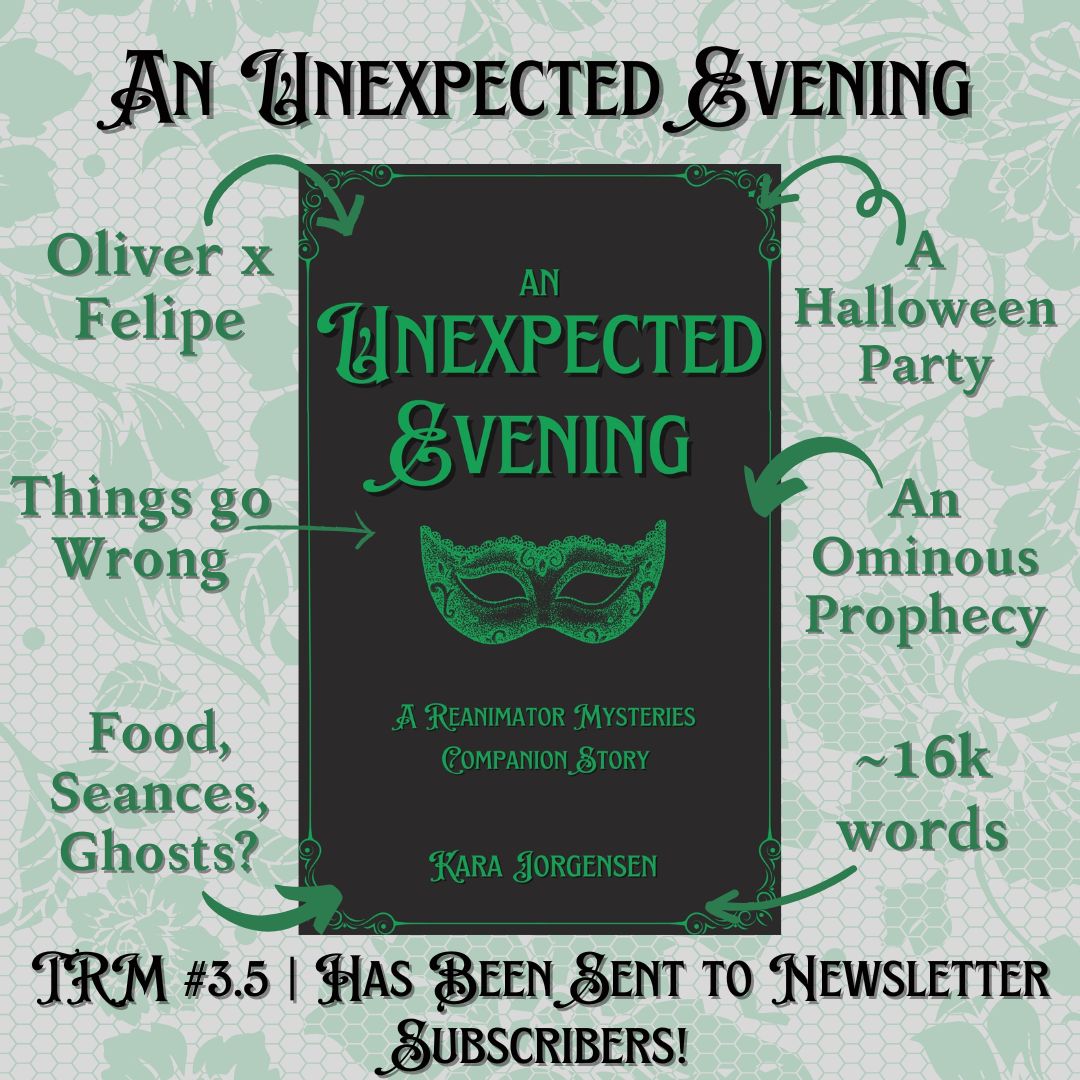
  • Write, edit, and publish “An Unexpected Evening” (about 10k, started it at the end of 2024)
  • Write, edit, and publish The Reanimator Mysteries #4 (100k+ words)
  • At least start writing Ansley and Joe’s story (80k? words)
  • Write, edit, and publish an epilogue short story for book 4
  • Write consistently throughout the year
  • Try writing two books at once (maybe)
  • Have 10 2k writing days
  • Have 3 5k writing days

Publishing Goals

  • Publish the audiobook of The Reanimator’s Remains (TRM #3) with Jack R. R. Evans as the narrator
  • Publish/send out “An Unexpected Evening” (TRM #3.5) to newsletter subscribers
  • Publish 1-2 books
    • Definitely publish TRM #4
    • Potentially publish Joe and Ansley’s book, though that may be next year
  • Make more money than I did in 2024
  • Potentially get a new cover for Kinship and Kindness (this may get pushed back to next year if Joe and Ansley’s book ends up being worked on late in the year)

Personal Goals

  • Work on my office since I stalled out on this
    • Get rid of the old furniture
    • Paint the walls
    • Set up the new furniture
  • Get healthier
    • Make more veggie-heavy dishes
    • Continue to lift weights consistently
    • Work up to 10 lb weights when I’m ready
  • Maintain my mental health
    • Be social with my friends online and in-person
    • Play games and/or refill the well
    • Be cognizant of when I’m burning out and take steps to stop it

Other Goals

  • Read 100 books
  • Play/finish 3 video games (I will consider prolonged playing of an open-world game like Stardew as “finishing”)
  • Learn a new craft
  • Learn new cooking techniques/recipes
  • Blog weekly
  • Send my newsletter out monthly

More than anything, I hope 2025 is boring. I know we’re heading into turbulent times in the US and around the world, but I want everyone to reach out to those around them and find people to support them. Change starts with us, so I hope you all turn to the trans, disabled, and marginalized people in your lives and make decisions with their best interests in mind.

Personal Life · Writing

My End of 2024 Reflection

Let me tell you, this year was SO MUCH better than last year. 2023 was horrendous, and while 2024 has not been great on a national scale, on a personal level it has been a breath of fresh air.

The word I had chosen for my word of the year for 2024 was “navigate” because I felt like I had been tossed into turbulent waters due to the fact that I was being harassed and besmirched by Freydis Moon/Taylor Barton, and I couldn’t tell anyone. They were a dark cloud looming over anything good that happened to me, and I was constantly afraid that any time I got attention, they would pounce on me. This meant every book release or awards announcement was riddled with anxiety since they did this to other authors they didn’t like in the past. In late April when they were finally exposed by Elle Porter, it felt like a massive weight had been lifted off my shoulders. The thing that had been too afraid to discuss publicly was finally out in the open, and FM/TB could no longer hurt me. I spent the rest of April and half of May vibrating with equal parts relief and anxiety, waiting for the other shoe to drop. My writing slowed to a crawl at the fear of retaliation and while processing all that had happened, but it was worth it. The only good thing to come out of FM’s assholery is that I have picked up a few new friends who experienced the same thing, and I’ve grown closer to another author I have a lot in common because of it.

On the writing front, it was actually a rather good year. Even with the wasted month, I wrote, edited, and published, “An Unexpected Question” (TRM #2.5), The Reanimator’s Remains (TRM #3), and started writing “An Unexpected Evening” (TRM #3.5). There’s always part of me that wished I wrote more, especially since that month off set me back and gave me a lot of stress in October when it was close to release day, but overall, I’m very happy with everything I published this year. The Reanimator’s Heart (TRM #1) and The Reanimator’s Soul (TRM #2) were both in the 2023 Indie Ink Awards, and TRS won for mental health representation, and book 3 is nominated in a bunch of categories for the 2024 Indie Ink Awards.

This year, I was invited to be on a few queer podcasts, I blurbed a friend’s book, and I got to work with some great people, like Jack R. R. Evans, who narrates my audiobooks, and Crowglass Design, who creates the covers for my books. I can’t thank enough my author friends for all the support they provided during all of this (and before and after). I also can’t forget my readers, who made the launch of The Reanimator’s Remains so wonderful. Without you all, there would be no books, or at least no audience for my books, and your support means so much to me. Seriously though, the reviews, shout outs about my book on social media, and the little things daily mean the world to me.

In my personal life, things have been going very well. My partner and I have both been on our own gender journeys, where we’ve been trying to figure out what brings us gender euphoria. During this process, we’ve become even closer. We both still struggle with our mental health and neurodivergence at time (are really ND if you don’t get in your own way regularly? lol), but I do feel like I’ve finally found a path toward better physical health. I have started lifting weights, and it’s been interesting to see how getting stronger has intertwined with my own version of nonbinary-ness.

I’m going to write more about my goals for 2025 in a future post, but with the way this year ended, I’m going into 2025 with far more hope than I did going into 2024. More than anything, I hope you all have a fantastic new year filled with good health, fulfilling projects, safe shores, and supportive people who love you.

Writing

What I Learned from Writing TRR

Every book is a learning experience. This is something I have been trying to drill into my college students’ heads while teaching my novel writing class this semester. No two projects are the same, and every book teaches you new things. Some more than others. The Reanimator’s Remains (TRM #3) is one of those books where I felt like I stretched myself and came out the other side a better writer. This isn’t a blog patting myself on the back. It’s more so a postmortem on what I think I did right this time.

The Reanimator’s Remains is the third book in the Reanimator Mysteries series, so I was working with characters I had already worked with twice before. This is important because I think being able to grow as a writer can be dependent upon being comfortable in other areas of the book. Knowing who Oliver, Gwen, and Felipe are and being very confident in portraying them made it much easier to step out of my comfort zone when it came to plot level intricacies. I had never really written a plot (or subplot) that relied upon flashbacks. As a creative writing teacher, I know these things can go badly fast. I was worried about how to sprinkle Felipe’s memories into the story in a way that a) feels natural b) doesn’t break up the action too much c) is useful to the story/his characterization. Felipe is a character who holds his cards close to his chest, so the chance of him spilling all of his traumatic backstory to Oliver was slim to none. Ultimately, I decided the best way to deal with this was through dreams (which can be risky in their own way), but the dreams end up tied into the overarching plot of the story, not due to Felipe’s memories per se but something else. Each dream ended with Felipe waking up in a way that scared and/or disoriented him, which helped to keep the tension from dipping after. I think the big thing about feeling like you leveled up your writing is that you’re just more aware of all the moving parts and how they link together. Instead of dropping them, I have been focused on how can one feed another.

The other thing with this book that I think made it a little better than my previous stories is that I leaned into the things my writers like or have told me I’m good at, which comes down to rich descriptions and crying men. I don’t like drama for the sake of drama in books, which is why I hate third act break-ups in romance novels. With this book, we have two established main characters who love each other very much. They are each other’s main vulnerability, and at this point we know their fears. Half of writing The Reanimator’s Remains was playing on Oliver and Felipe’s fears, especially the ones readers are already privy to. This sort of thing upped the ante when it came to the tension between the characters, and even if readers know things will end up all right, they are still feeding off the other character’s fear. My favorite thing to write is the third act mental breakdown (as opposed to a break-up) where one of the characters has to be exceedingly vulnerable and the other has to meet them where they are and accept them for the hot mess they are. It’s a level of emotional intimacy that just makes the romance so much deeper. This book also has a sex scene that isn’t a sex scene, but I won’t go too deep into that because I don’t want to go too much into spoiler land. All I will say is that sex scenes are about being naked and vulnerable, and the sex scene that isn’t a sex scene is all about letting someone else care for you when you struggle to let down your guard.

Something I feel awkward about sometimes is how I write descriptions. I love a lot of detail. My writing influences are very Victorian, which means I enjoy a useful, well-placed description rich in detail. Part of me worries my descriptions are boring or that modern audiences don’t like them, but I have to remind myself that my audience likes a beefy, evocative description. I actually had a reader tell me how much she loved the creepy cathedral in The Reanimator’s Heart, so in book 3, I was like f it, I’m writing a creepy forest, and you all are going to like it. So I went ass-deep into research about bogs, forests, etc. and let the freak fly when it came to my descriptions. I am a romantic goremonger by nature, so I leaned into it in this book with the Dysterwood, the dead people, and the [redacted] mentioned in the story.

As you become more comfortable with your style as a writer, you need to lean into the things that drew people to your work in the first place. Sometimes, you can go overboard, but for the most part, appealing to your readers by playing to your strengths is rarely a bad thing. Do what you do but better. Keep an eye on all of the spinning plates and figure out how to make your narrative work by having the pieces feed off each other rather than act as discrete, separate parts of the plot/construction. Most of all, never stop trying to get better at your craft and learning.

The Reanimator's Remains · Writing

One Day Until The Reanimator’s Remains

As of when this post goes up, it is ONE day until The Reanimator’s Remains comes out!

the cover for The Reanimator's Remains by Kara Jorgensen. It is green with a skull in the center with trees, roots, bugs, and one man reaching for the other as he walks away
Cover by Crowglass Design

The Reanimator’s Remains is the third book in the Reanimator Mysteries series and follows Oliver and Felipe as they travel to the Pine Barrens on a new case. Here is the blurb:

An autistic necromancer, his undead love, and a covenant that must be broken.

Oliver Barlow never knew what happened to his parents. With a note from his mother as his only lead, Oliver had given up hope of ever learning the truth. But when the dead start rising in the town of Aldorhaven, Oliver jumps at the chance to take the case if it means he can investigate the last place his parents were seen alive.

Felipe Galvan would like to be anywhere but Aldorhaven. Between protecting Oliver and Gwen, dealing with distrustful townsfolk, and an unexpected letter from his estranged parents, Felipe is already stretched thin. But when he is suddenly plagued by whispers from the woods and nightmares from his past, Felipe fears he is only one misstep away from becoming the monster he was meant to be.

Far more sinister things than the dead lurk in Aldorhaven’s woods. A centuries old bargain has been broken, and the only thing that can satisfy it is Oliver’s blood. Together, Oliver, Felipe, and Gwen must finish what Oliver’s parents started or they too will be ensnared by their devil’s bargain


The Reanimator’s Remains is the third book in the Reanimator Mysteries series and is my tenth full-length book (eleventh if you count Flowers and Flourishing). It takes place in the same universe as my other books and is set in the New York Paranormal Society, which is mentioned in Kinship and Kindness. You can also grab several free in-between book short stories in the freebie section of my website. The content warnings for book 3 are listed below and are also in the book are well.


CWs: suicidal ideation, self-harm, blood, gore, violence, death, descriptions of dead bodies, autopsies, on page sexual content, anxiety attack, historical period typical homophobia, remembered.mentioned child abuse, ableism, saneism, medical procedures, insects


The paperback of The Reanimator’s Remains is currently on Amazon and will move to other retailers in the coming weeks. You can still preorder the ebook at all major retailers or you can request it from your library system when it comes out October 29th, 2024. The audiobook is currently in the works and will be available spring of 2025 if all goes according to plan.

If you pick up a copy of The Reanimator’s Remains, I hope you will leave a review on Goodreads, StoryGraph, or your favorite retailer! They really help authors like me out in terms of visibility and credibility.

And if you haven’t read The Reanimator’s Heart (TRM #1), you can pick it up here. Or you can grab book 2, The Reanimator’s Soul (TRM #2), here.

The Reanimator's Remains · Writing

A Preview of The Reanimator’s Remains

The Reanimator’s Remains (TRM #3) comes out on October 29th, so about a little over a week from now! In order to whet your appetite, I thought I would share another lengthy excerpt. This time from chapter one. I hope you enjoy it.

Chapter One: Secrets and Surprises

Oliver Barlow did not keep secrets or enjoy surprises, yet he found himself eagerly doing both for Felipe. As Oliver buttoned his waistcoat, he went over the plan for that night’s outing once more. First, he would borrow one of the Paranormal Society’s steamers and take Felipe to the botanical gardens. Oliver wasn’t certain Felipe particularly cared about plants, but he enjoyed walking far more than sitting through a play. Besides, going to the greenhouses would be like visiting forests and gardens all over the world without ever leaving New York. Unlike at the theater, they could freely talk, and there was still a chance they could sneak a touch or kiss on a secluded trail. On the way back to the society, Oliver planned to stop at an Italian restaurant Louisa and Agatha had raved about. Felipe had mentioned wanting to have dinner there one day, but in the chaos of cases and meetings, they had never gotten around to it. Oliver wasn’t certain if the restaurant served dessert, so he double checked the maps in the archives to confirm there were places nearby where they could get an egg cream or some rugelach if Felipe was still peckish.

Oliver drew in a calming breath and shook out his hands to keep Felipe from feeling his anxiety on the other end of the tether. He didn’t need him running down to check on him and ruining the surprise. After listening to confirm Felipe hadn’t reached the laboratory or closet outside his basement bedroom yet, Oliver retrieved the strong box from under his bed. Tucked under papers and old photographs sat a ring box. A nervous smile crossed his lips as he turned it over in his hands. More than anything, he wanted Felipe to enjoy their outing because when they got back to the apartment, Oliver would give him a ring. Popping open the box, he marveled at the way the globe of polished amber set in gold caught the light. When he first saw the amber ring in a display case at the jeweler’s, he couldn’t get it out of his mind. Inside the fossilized resin were bits of ancient flower petals forever frozen in time, but what truly drew him to it was that the amber was nearly the exact shade of Felipe’s eyes when they caught the sunlight. He even got it inscribed with My light in the darkness to drive home to Felipe how much he meant to him. A man who reminded Oliver of all the beauty and softness in the world deserved a ring that reflected that light and life.

Oliver’s thumb drifted to the gold and black enamel band on his ring finger. Even though he wore it every day and kept it on a chain around his neck during autopsies, he still couldn’t believe it was there. He had never expected to be proposed to or to be proposing to Felipe. Men like them rarely found someone, let alone someone who wanted to stay with them forever. Oliver knew it was different at the Paranormal Society, that they could have some semblance of permanency and normalcy, but he never expected that he would find anyone who loved him like that. When Felipe had suggested they take a trip to Coney Island to relax, Oliver never thought it would end with Felipe presenting him with a ring and asking him to spend the rest of his life with him. Oliver swallowed hard at the memory. He would have given anything for that, proposal or not, but the ring with its grinning skeleton and Felipe’s message of Don’t go where I can’t follow was as much a memento mori as it was a memento vivere. If Oliver had his way, they would have so many more years together.

Shutting the ring away, Oliver shoved the strong box back under the bed with his foot. Felipe knew the proposal was eventually coming; Oliver had asked him if he could do it in return after all, but even if it couldn’t be a true surprise, he wanted Felipe to feel special and loved, the way he had made Oliver feel. At the clack of the laboratory door, Oliver stuffed the ring box into the jacket he left hanging on the desk chair and scrambled to his feet. He had just finished smoothing the wrinkles from his trousers when the bedroom door opened, and Felipe slipped inside with a tired sigh. His curly brown hair and suit were rumpled, and beneath his eyes, dark circles blotted his tan skin, but when he saw Oliver watching him, a relieved smile spread across his lips. Oliver crossed the room in two strides and caught his partner in his arms. The shorter man sagged against him in a boneless heap.

“That bad?” Oliver asked with a small smile.

Felipe grunted into Oliver’s chest. “You don’t know the half of it. You’re lucky you work down here. If it wouldn’t make a mess for both of us, I would fully retire now just to not have to deal with these meetings.”

“Why? What happened?”

“Everyone’s getting on my nerves,” Felipe replied, leaning into Oliver’s touch as he combed his fingers through his hair. “During the meeting, the head inspector let us know that a case is being transferred to us from the New Jersey Paranormal Society, so of course, everyone has to pipe up that they are too busy to take it. It couldn’t possibly go to them. Give it to someone else.”

“Do you want to take it?”

“God no, but I didn’t start griping about how we’ve been run off our feet since the Institute for the Betterment of the Soul case. Everyone is busy. Yelling at each other and fighting over whose case is bigger isn’t going to make us any less short staffed. Besides, it hasn’t even been officially transferred to our branch. None of us even know what the case is about, so why start making trouble before we even know what we’re up against?”

“I’m assuming there’s no corpse, or it would be my problem too.”

Kissing the top of Felipe’s head, Oliver inhaled the familiar scent of his aftershave mixed with coffee. When his lips traveled down Felipe’s cheek and into the hollow beneath his jaw, the other man’s hands tightened on Oliver’s back and a low moan broke from his throat. Oliver’s tongue rasped against Felipe’s stubble as his lover’s hands snaked under his waistcoat and down his backside. Halfway down the dark blue wool, Felipe’s hand stilled.

Opening his eyes, he pulled back to look over Oliver’s form. “You’re in your new suit.”

“I am,” Oliver replied with a sly smile.

Felipe stepped back to take Oliver in. His walnut brown eyes raked over Oliver’s form, pausing pointedly on his navy-clad legs and backside as he circled him. A blush rose on Oliver’s cheeks at the heat in Felipe’s gaze. Letting out an appreciative whistle, he ran his hands down Oliver’s sides before kissing him in that slow, deliberate way that made every thought scatter like billiard balls.

“And what’s the occasion for so much color? Last time I saw you, you were in work charcoal.”

“I thought we could go out this evening. I have a whole itinerary. Unless you’re too tired, of course. We could always put it off until tomorrow if you would prefer to stay in. I don’t mind waiting.”


You can read the rest of chapter one when The Reanimator’s Remains comes out October 29th. Preorder it here. Paperbacks will be available very soon.

Writing

How to Deal with Writer’s Block and Imposter Syndrome

This semester I’m teaching a class about writing a novel, and one of the things I am trying to emphasize is maintaining your mental health as a writer. I wanted my students to know all the things I had to learn the hard way or from other writers way too late, so I thought I would share my tips for dealing with writer’s block and imposter syndrome.

Writer’s Block

There is no such thing as writer’s block. Before you get mad at me, hear me out. What I mean by that is that there is no divine muse that has ripped away your ability to write and you may never write again. 99% of the time, there is a very fixable reason as to why you are blocked

How to fix writer’s block

  • Deal with your emotions– is there something bothering you? Sometimes you have a mental block. There is an emotion or thought that is clogging the pipes, and until you get rid of it, there will be no way to go forward. If you do need a good cry, embrace it, or if you think that will tank your ability to write afterward, you might consider writing about it in a journal or spending ten minutes to just dump whatever is in your head.
    • Performance anxiety-Another version of this is that you’re ruminating on something you’re worried about with your story. Whether it’s a plot hole you need to fill or imposter syndrome, freewriting for a few minutes can eliminate that block.
  • You’re burnt out– Sometimes you’re just plain tired. Being mentally, physically, or emotionally drained can cause writer’s block. You are out of spoons, and you need to take a break. You might be on a deadline or rushing to finish something, but sometimes, taking a day off can make you more productive after. If you still feel fried after taking a day off from trying to work, you may be headed toward burnout and more self-care and rest may be necessary.
    • Refill the well– This can be resting, watching tv, playing video games, going to a museum/concert, or doing crafts. Do what you need to in order to refill your creative well. In order to be creative, you need to also take things in that inspire you or stimulate your creativity.
  • Work on something else– This has the biggest caveat because if you have shiny idea syndrome, you will never complete anything, but sometimes you started working on something too early or you have another story that is loudly knocking at your brain, making it difficult to focus on your main project. You may want to give yourself a smaller amount of time to work on the other thing. Once you vent it out, you’ll probably have an easier time. If you worry you’re going to run with it and abandon your first project, then don’t do this one or only allow yourself a little side project as a treat.
  • You need to backtrack– One of the most common things for me when I get stuck is that I screwed up somewhere a few pages back, and somehow, my subconscious knows it but I don’t. Reread your story and see if you can figure out what went wrong. Sometimes it’s someone acting out of character, a missing beat/plot point, emotions that just aren’t ringing true, or an imbalance of action to introspection. Once you edit that bit and recalibrate, the words should start flowing again.
    • Most commonly, this tends to be a character issue. We’ve written ourselves into a corner or in such a way that moving in the direction we want doesn’t make any sense. Using a reverse outline can help you avoid this sort of thing, though it does still happen.

Resistance– sometimes we get ourselves so wrapped up in the anxiety of starting that we can’t get going. Some tips for this is to set a 15 or 20 min timer and tidy up your writing space (less to fiddle with or feel stressed by). Then, sit down and read your work for 10-15 min. If you feel the need to tinker or edit as you do so, do it. Then, set the timer again for 15-20 minutes and write. Sometimes all we need is to force ourselves to start in order to get over that resistance. You can also try switching it up by opening a new doc, working on paper, using a white board. Lower the stakes.

Imposter Syndrome

  • What is imposter syndrome?
    • It’s the feeling that you aren’t a real writer, artist, etc. and that if anyone looks closely, they’ll realize you’re a liar/faker. Basically, feeling you shouldn’t be given the label because you aren’t good enough. That sort of self-doubt can paralyze you or make you give up before you’ve even truly started.
  • How to deal with it:
    • Remember that this is a very normal feeling. All of the writers and artists you look up to have also had imposter syndrome, and you still look up to them. There will never be a point when this fully goes away, even if you’re famous and on the New York Times bestseller list.
    • Remember you are a writer if you write. If you have put pen to paper or finger to key while working on a story, you are a writer. People who put other writers down are insecure and projecting. If you have written, you are a writer.
    • Keep a log of your accomplishments. It’s really easy to remember all the rejections, but you need to celebrate the wins, even the small ones. You sent out your manuscript to agents- celebrate! You wrote the end on a book- celebrate! You got your first 5 star review- celebrate!
    • Talk to other writers about your feelings. Trust me when I say they will get it and will try to hype you up. Everyone has gone through it from time to time. The key is to not give in to those feelings and stop writing.
    • Remember that everyone sucks. The books you see in stores are usually like the 5th draft of a story and have been professionally edited. The first draft was a hot mess. If you think your writing is a hot mess, good. That’s part of the process, and it’s what editing and second drafts are for.
The Reanimator's Remains · Writing

One Month Until The Reanimator’s Remains

I am so excited because in a month, The Reanimator’s Remains (The Reanimator Mysteries #3) comes out in ebook and paperback. During October, I’m going to be sharing more of the story along with some fun tidbits about why this book came to be, what it’s about, etc.

Today, I want to whet your appetite by giving you some things I listened to and looked at while working on The Reanimator’s Remains.

First up, we have the YouTube playlist for The Reanimator’s Remains. I really love this playlist because the songs are so moody and fit oh so well with the creepy, woodsy ambience of this story. Compared to past playlists, it feels a bit ballad-heavy, but since this book is a slightly slower, more inwardly focused story, I think that works. Some favs:

You might have noticed there are quite a few songs from Shawn James, including “Orpheus,” “Haunted,” and “Through the Valley” among others. His deep, almost smokey voice adds such richness to his music, and of course, the subject matter of his songs is perfect for The Reanimator’s Remains. “Orpheus” is especially so.

“My Attic” which is a P!nk cover sung by Adam Lambert perfectly encapsulates Oliver and Felipe’s relationship in this book as both of them work to deal with parts of their pasts and family histories that are better hidden or left unsaid.

You might also notice songs like “The Lullaby of Woe” and “O Willow Waly,” which are meant to evoke the spookiness of the Dysterwood in book 3. If you loved the creepy cathedral in book 1, you’re going to love the Dysterwood. There’s plenty more on the “soundtrack” for this book, so I hope you enjoy it!

And I cannot give you previews without sharing the infamous Pinterest Board for The Reanimator’s Remains.

The Pinterest board has some research tidbits from this book along with my face castings for Oliver, Felipe, and Gwen. Yes, Gwen is heavily featured in this book! Gwen fans rejoice! If you’ve been wondering what The Reanimator’s Remains is about, the Pinterest board and playlist together should give you a pretty good idea of the mood and some themes. The boys are going through it.

If you haven’t preordered The Reanimator’s Remains yet, there’s still time. It comes out October 29th, 2024 at all major retailers. The Google Play preorder link will be up VERY soon (my apologies for my Google Play peeps), and paperbacks will be available closer to release day since I can’t put those on preorder ahead of time.