Writing

Success and the Awkward Authoress

For a type-A personality, success is a tricky thing to navigate and define. I thrive off getting good grades and being told that I’m at the top of the class. In writing, I’m definitely not at the top of the class. I’m not even in the middle. I’m at the bottom of the totem pole, trying to pull my way up. It’s been quite a while since I haven’t been at the top or a competitor, and it’s disconcerting to know that you’re a nobody.

I know I’m a newbie to the world of self-publishing. It’s been less than a year since I published my first book, and I’ve not only had sales every month but I’ve gotten a few loyal readers who love my books and characters. There is no reason for me to complain, but part of me wonders if I’m succeeding or failing. In this industry, I can’t rely on grades to tell me whether or not I’m doing well. You can’t rely on sales rankings because while you made a sale, you may not have added a reader. You can’t even rely on reviews because you aren’t tailoring the story to the reader as you would an assignment for a professor. Some readers will love it, others will be ambivalent, and a few will hate it. People won’t get it, and you’ll be frustrated that they didn’t see your vision. You can’t go and say anything to explain your point of view, all you can do it hope someone else gets it. It’s frustrating. It makes you question if you’re doing as well as you hoped or thought you were.

The key is to define what success is to you. It’s so much easier said than done, but when you figure out what success is to you, you can determine whether or not you’re actually failing or simply lacking confidence. Do you want to sell a lot of books each year or do you want to gain a larger readership? Do you want consistently high ratings on your books or do you want to grow with each book?

As I’ve written more and gotten deeper into the publishing process, I have found that what I care about are: gaining new readers and improving the quality of my writing with each book. Unfortunately, you need sales to get readers, but I’d rather have ten very loyal readers than a hundred ambivalent ones. In terms of quality, I know my first book is not my best work, and I’m okay with that. I’ve grown since I published it a little over a year ago, and I should have. With each successive book, I should get better. I should improve and grow and experiment. That’s what art and writing are about. The good thing is I know book two is even better than book one, so I guess in that area, I’m successful.

In this area, I find myself battling logic and emotion. Logically, I know that most writers aren’t successful in multiple areas (readership, sales, improvement, notoriety, etc.) until they have at least five books out and do a lot of marketing and connecting. Emotionally, I’m upset that I don’t feel that I’m doing as well as I should. I also realize that no matter how many sales, readers, or 5 star reviews I had, I would still probably feel insecure. This state of mind always worsens when I’m feeling stuck in my current writing project, and guess where I am currently– floundering in planning my next chapter. In order to not fall into this trap (or at least not as often), writers need to define what success is to them and work towards those goals.

What do you define as success?


If you would like news about new releases, promos, and previews of future projects, please sign-up for my newsletter.

newsletter button

Writing

March 2015 in Review

Starting in January, I decided it would be a good idea to look back at each month and see what I have accomplished in my writing and marketing as well as reflect upon what needs to be improved in the future.

While February was a transitional month as I switched from working on The Winter Garden to book three of the Ingenious Mechanical Devices, March was nearly wholly devoted to my latest project.  Beginning to work on book three has been a refreshing change even if it did take nearly half a month.  I feel much better about March than I did about February, and I hope that April will be even better. Continue reading “March 2015 in Review”

Writing

On Being a Female Writer

The other day, I was required to read Virginia Woolf’s “Professions for Women” and A Room of One’s Own for my Women and Autonomy class.  I’ve read them both several times over the course of my schooling, but after publishing, I think they resonated more.  Both pieces discuss the issues and hindrances women have in the world, particularly the writing/publishing world, and despite the works being written about eighty years ago, I think a lot of the problems still persist.

Woolf discusses the prejudice women face when writing because the literary canon is male-dominated.  The publishing world was established by men, for male works, and often the only way for women to enter that field is through subversion.  In the 19th century, the Bronte sisters wrote as the Bell brothers in order to publish their works, and today, writers like J.K. Rowling use initials when publishing in fields that are “not for women,” like science fiction and high fantasy.  If Rowling was writing romance, chick lit, or bodice-rippers, then she could have easily used Joanna Rowling, but because she was writing a story about a young boy in a magical setting, her publishers believed her book wouldn’t sell as well with a woman’s name on the front. Pfft, I mean, women don’t write fantasy well, right? She adopted the initials J.K., which relate back to her real name, but they also harken back to J.R.R. Tolkein, one of the fathers of the fantasy genre.  When Rowling decided to branch out into crime novels, she switched pseudonyms to a outright male name.  Why would she do that if her name is already famous and would draw crowds? Well, crime fiction is another genre where women are often kicked to the curb.  Unless you’re someone like P.D. James (neutral pseudonym) or Sue Grafton (whose female detective hit me as a man masquerading as a woman), you will probably not be taken seriously. To break into this genre, Rowling and/or her publishers believed she had to be a man to do so.

Sadly, I have seen this in real life.  At a book fair, we were rained out, so I was parked inside next to a huge table of female romance writers.  As people walked past my table where I sat with my boyfriend (who came as a second set of hands and a coffee-runner), they asked about my little brown book… to my boyfriend.  Quite a few people thought he was the author.  I wondered why, especially when I was the one trying to engage customers. Did they think I was some lackluster Vanna White? My hypothesis is that my little brown steampunk novel is not what one would expect from a female writer. No stock photos of women in ballgowns or half-naked couples, which is what people seem to expect from female authors.

I recently read an article saying that in the New York Times’ book review section, books by men make up sixty-something percent of the reviews.  Why would there be such a disparity?  Men’s work couldn’t possibly be that much better than women’s writing, but the explanation may lie in what the New York Times deems worthy of review, literary fiction.  The definition they are using of literary fiction is a novel that doesn’t fit any genre conventions (no wizards, no space travel, no steam-powered devices, and no straight up romance. Plot vs. character driven is irrelevant at this point). It seems men write genre fiction and women do not. This little tiff between lit and genre can be seen in Kazuo Ishiguro’s novel The Buried Giant and how he made the comment that it wasn’t fantasy and that his previous book wasn’t scifi when the book had elements of it.  Ishiguro is automatically a literary fiction writer despite the fantastical elements in his work while a writer like Ursula Le Guin openly states her books are scifi.

Why is Le Guin okay with her books being “genre” fiction while Ishiguro isn’t? Because genre fiction is the niche women have carved for themselves over the last century.  Even though men still dominate certain genres, women authors are more likely to be found in the genre categories of Amazon than men. Even though amazing authors like Le Guin, Rowling, and Rice write in this area, the canon and literati consider it lesser than “literary” fiction.

The same is emerging with self-publishing. More women are self-publishing than men.  Why? Because they can subvert the traditional publishing industry, which has not been as open to them as it has been for men, and self-publishing is the niche where they can succeed.  Strangely, Woolf self-published all those years ago.  She had the right idea, and it’s lasted until today.

Writing

February 2015 in Review

Starting in January, I decided it would be a good idea to look back at each month and see what I have accomplished in my writing and marketing as well as reflect upon what needs to be improved in the future.

February was a meh month for all of my work.  While I finished the formatting for The Winter Garden in ebook and paperback and was able to move up the release date to March 15th, I didn’t get much done in terms of book three.  I did make a little progress with all of my projects. Maybe part of the problem is that my hands and mind are in too many places at once.

What I did accomplish: Continue reading “February 2015 in Review”

Writing

The Importance of Proofing

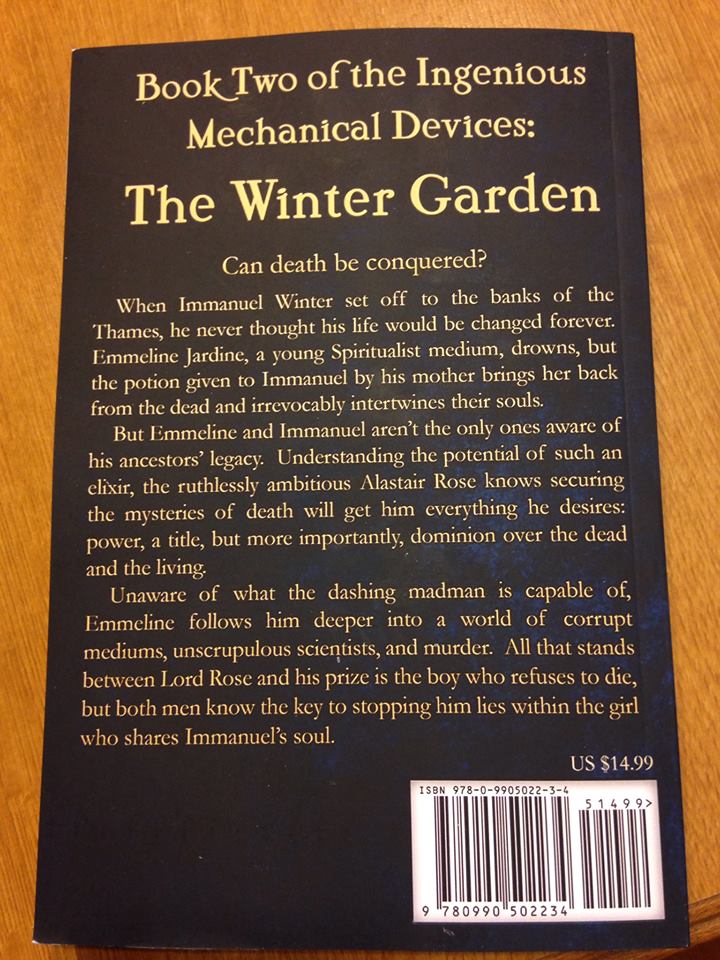
I had a minor rude awakening this weekend.  My proof copy of The Winter Garden came last weekend, so I decided I would give the book one more round of proof-reading to find some leftover typos and make sure everything was in order.  I quickly found out, it was not perfect.

Somehow italics in certain chapters magically disappeared.  No idea how it happened, but somewhere between the original file and the paperback, half the italics in the book did not translate.  Luckily, I discovered the issue Saturday night and fixed it using Word’s compare draft feature along with control-find.  At times, I wish I didn’t reference so many books or have my characters think so much, but the issue did make me very aware of what nearly skated under my quality-control radar.

This is why when you create a paperback, they send you a proof-copy to check over.  At first, I didn’t notice it because half the book had italics (sprinkled throughout), but chapter two didn’t along with many others.  Comb through your manuscript with eagle eyes.  Take your ebook or original copy and compare it to your paperback because that is how issues like this are spotted. I didn’t notice it until I was correcting typos and had my Word file for the ebook and paperback editions both open and saw that a book title wasn’t italicized.

Apart from the italics issues, I also caught quite a few typos or awkward phrasings that were easily smoothed. Proofing is a time to put the final polish on your novel and make sure everything is up to snuff. Luckily, now it is all fixed, though I’m sure I’ll find more silly errors within the coming months, but the issues have been caught and the both formats have been finalized for publication.

What am I going to do with the 35 days between now and March 31st when The Winter Garden is released? Hopefully work on book three.  More about that will come as I get further into it.

Writing

The Winter Garden Proof Came!

Please forgive the narrow camera angle. I forgot that I should have turned my iphone sideways.  Lesson learned.

Anyway, my proof copy of The Winter Garden came Saturday! It looks fantastic, and all that’s left is for me to proof-read it.  It feels fantastic to be nearly done, especially now that I seem to be getting more work at my other job and in my classes.  I will be posting more later in the week about The Winter Garden and about some of the characters within it.

If you’re interested in a copy, you can pre-order it from Amazon UK or Amazon US (check out the “Buy Links” page) for 99 cents.  The ebook and paperback will be out March 31st.

wg proof 1wg proof 2wg proof 5wg proof 4

Writing

What’s In A Number?

Numbers… so many numbers swirl around my head on a daily basis and oddly all are about my writing.  It may seem odd to think of writing in terms of numbers, but with my first book published and the second well into production, it is often what my mind diverts to when I don’t feel like writing.  The urge check and analyze this data is often overwhelming, and part of what I hope to do this year is to not obsess about the data related to publishing. Continue reading “What’s In A Number?”

Personal Life · Writing

Wrap-up and Resolutions

Wow, 2014 has been a crazy year for me.  A great year but a whirlwind of insanity at times.

This year, I began graduate school to earn my MFA in creative and professional writing, and now that a full year in the program has passed, I can say that I love it and believe I made the right decision.  I don’t think my parents were terribly pleased when I decided to change my course of study in the second half of my junior year from pre-med to English major, but I’m a lot happier reading and analyzing books and writing constantly than I ever was doing dissections and memorizing muscle groups (though biology and science still hold a special place in my heart and in my books).  In 2014, I also became a graduate assistant at the university I attend, which means I help out the professors and put together the end of semester newsletter as well as work on the department’s literary magazine. Continue reading “Wrap-up and Resolutions”

Writing

Why Buy Indie?

Department stores are to traditionally published authors as independent bookstores are to indie authors.

We are the small businesses of the writing world.  Unlike authors who have published through traditional means, we are often the editors, marketers, formatters, and creative directors of our work.  Our publishing house consists of one person.  This means every success and failure falls on our shoulders, but it also means so does every cost.  Our resources are our own, and especially in the beginning when we do not have many books or readers (remember book two always sells book one), most of our expenses come out of our pockets.  We pay for the cover artists, the editors, the box of books we lug to conferences and author events.  It can be a hard road, especially when we don’t tend to get shelf space at your local Barnes and Noble or Waterstones.  Just remember that for less than a cup of coffee at Starbucks, you are buying something someone worked on numerous hours to perfect. Continue reading “Why Buy Indie?”

Writing

Checking Those Boxes

Become-a-writer

Often my posts mention my dealings with academia, and the stark contrasts between the “normal” world and the academic domain.  These differences have sparked an interest in figuring out the psychology of not only some professors but the world they are enmeshed in.  One of the things I have noticed during my time as a graduate student in an MFA program is the difference in publishing goals and how the professors treat their writing versus how most authors deal with their work and how they market it.

To be hired as a professor, one must publish at some point, and it seems for some that the only reason they have published anything is to able to put it on their resumes.  Maybe I’m naive and idealistic, but to write a novel or short stories to check off a box seems disingenuous.  If you have a passion for writing, why would you only write one book or a handful of short stories?  Most writers have a hard time stopping or getting other work done when the writing bug bites, so how can one instruct and inspire young writers when they haven’t really done it themselves?  Can you really consider yourself a writer or author when you only write to further your career goals?  It most definitely is not my motivation for writing, but I cannot say why others do it. Continue reading “Checking Those Boxes”