Writing

The Winter Garden: Book Two of the Ingenious Mechanical Devices

first line

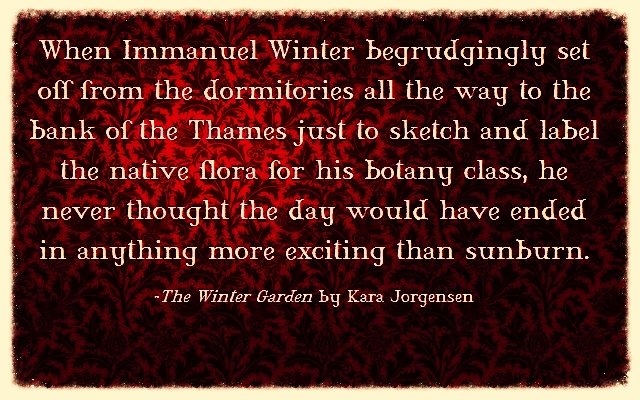
The Winter Garden: Book Two of the Ingenious Mechanical Devices is only chapters away from completion (apart from editing), so I decided it was time to post the blurb and hopefully build up some hype.  Here is it:

Emmeline Jardine and Immanuel Winter are only months away from achieving their dreams, she will enter debutant society and he will receive a degree from Oxford, but a day at the Thames transforms their lives forever, intertwining their souls and putting them into the path of a predator.

Ripped from the comfort of the world they know, Emmeline and Immanuel are thrust into a struggle for their survival. Even though they escape, Immanuel is forever altered by his time in captivity. Gradually he begins to settle into a normal life as the coroner’s assistant until he comes face to face with the man who nearly destroyed him.

Unaware of what he is capable of, Emmeline is infatuated with the dashing madman and follows him deeper into a world of corrupt mediums. When a murderer masquerading as a monster begins to hunt beautiful Spiritualists, Immanuel knows the key to stopping him lies within the girl who shares his soul.

Continue reading “The Winter Garden: Book Two of the Ingenious Mechanical Devices”

Personal Life · Uncategorized · Writing

A Woman of Principle

On my blogs and page, I try as a rule not to get too political on my author page or blog, but a recent event has refused to leave my mind, leaving me to purge it through writing.

One of the authors I know from the writing groups I am a part of on Facebook sent me a link to a blog tour service that was hosting a tour for a steampunk novel and was looking for blogs that would be willing to do the advertising posts.  Obviously, I want to support and network with other steampunk writers, so I checked it out.  The book looked okay.  I’m not a fan of advertising something I haven’t actually read, but at that point, I was willing to give the author a chance based on the blurb.  The only thing was, I couldn’t figure out how to sign up for the tour, so I went onto the their contact and information page.  As I scrolled, I came across the thing that completely soured my feelings toward that book blog tour host, No M/M, F/F, or M/F/M.

For those who are unfamiliar with the terminology, that basically means no stories involving same sex or bisexual protagonists or love interests.  I couldn’t do it.  I couldn’t bring myself to sign up for the tour and quickly clicked off the web page.  From the time I understood what being gay meant, I have been a strong supporter of LGBT rights and marriage.  Many of my friends are gay, and two of my characters in The Winter Garden comprise a gay couple who is dealing with their relationship in a world that does not approve of them.  How could I, a supporter of the LGBT community, work with a company that outright excludes them?  I couldn’t.

When we exclude certain types of fiction, what are we saying to those who choose to write about their experiences or the experiences of others?  Your story isn’t worth telling. I don’t want to hear it. No one wants to read it if it’s about that. In this day and age, diverse books are a necessity.  By writing and reading about characters who are a different ethnicity, sexuality, or religion as yourself, you are learning empathy and stepping into their shoes as you go from cover to cover.  When you say no gay or bisexual protagonists, you are telling every bisexual or gay reader or writer that comes across that site that they are unacceptable.  The anti-gay sentiment from many book blogs and reviewers follows in the vein of the prejudicial sentiments of the 1960s. Diversity in characters and novels is a necessity, and having open-minded reviewers and book programs will only further that goal.  I hope you will not ignore books solely on the sexuality or ethnicity or a characters within.  I will not state the name of the blog tour and take away their livelihood or slander them, but I will boycott them.  I will not participate in anything that excludes those who are in need of support.

Writing

The Overeager Author and Creating Buzz

I am incredibly guilty of being overeager when it comes to my writing and events I am going to do months from now (an example being posting and tweeting about the Steampunk Worlds Fair I’m speaking at next May). 

Once I began editing The Earl of Brass, I was dead-set on self-publishing it as soon as possible, so I read up on self-publishing, how to format books for ebook and paperback, and how to run your author page on Facebook.  Somehow despite all my reading, I forgot about marketing.  Of course the basics were taken care of, telling everyone I know I published and making a website, but that doesn’t bring in book sales very well.  What authors need is buzz beforehand.  To do this, there are several things authors should do:

1. Even when you finish your edits and formatting, do not publish it immediately.  This is the time when you need to create some buzz and begin a countdown.  Get readers eager to buy your book and to read it for that matter.  Two to three months may seem like an agonizing amount of time to wait even though your book is ready, but it’s worth it if you want to build a following.

2. During these two to three months of free time, send your book to reviewers.  I sent out dozens of query emails to various book bloggers and am still having reviews trickle in.  Reviewers usually take weeks to months to get to your book depending on their load, but if you tell them it is an ARC (pre-publication but perfected), they will often try to get your review out near the time your book is to be released.  Some writers get upset that they need to send free copies of their ebook to bloggers, but it’s worth it and sending an ebook doesn’t cost you anything (Smashword’s “meat grinder” feature can generate epub and mobi files for your book).  Reviews expose your work to that blogger’s audience and also build buzz. If a book is on Amazon or Goodreads and it has reviews, people are more willing to give it a chance.

3. Have a cover reveal a few months ahead of the release.  If you have a Facebook or a blog, make a big deal out of it.  You should have a cover you are proud of and be willing to show it off.  Do a countdown for the reveal.  If you have a summary read to go for that book, I would suggest putting it up on Goodreads as a to-be-released book to also build some buzz.

4. Create an author page on Goodreads as well as Amazon.  This way, people will run across your face on both sites and hopefully become interested in your books. On Goodreads, you have an audience of readers at the ready.  Join clubs and discussion boards.  Obviously, don’t just talk about your book, but if you get involved with people who have similar interests, you will become enmeshed in your target audience. If they like you and are interested in what you have to say, they will be more likely to check out your work in the future. As a side note, you may not be able to create your Amazon author page until you are ready to publish your book because you are not yet “an author” but with Goodreads, it’s much easier to join their author program.

5. A few weeks before your book is ready to be released, create event on Facebook.  Invite everyone and tell them to invite everyone they know.  If you know other authors on Facebook, Goodreads, writing groups, or in real life, invite them to have giveaways during your event (like paperbacks or ebooks of their novels or even random goodies if they are somehow related to your novel). Build relationships with other authors as well as your readers.  During the event, give away a few ebooks and maybe a paperback or two.  Have fun with it, it’s your party.

Hopefully, this is helpful.  As a first time indie author, this has been a learning curve, and I would love if my mistakes actually help others.  Just remember the importance of creating buzz and interest as well as making connections with other authors and your readers.

Writing

Don’t Ask, Don’t Tell You’re an Indie Writer

books lined up

When you are an indie or self-published writer, you come across a strange phenomena.  Should you tell people you are not traditionally published unless they ask?


For several decades, self-publishing was referred to as “vanity publishing.”  Vanity publishing was when a writer would pay to have their books printed in limited runs, and they would then try to sell them.  The vanity aspect comes from the stereotype that self-published authors were people who were not good enough to be published by a major publishing house or were hipsters who were too good for the publishing world and wanted only limited copies of their books. 


Modern self-publishing is quite different.  Self-published authors are not under contract with a publishing house, but now, this is mainly because they choose not to be.  By self-publishing authors maintain all artistic control over their work from the cover, to the formatting of the book, to the content.  There is no interference from editors or agents telling them what to write next or what to stay away from.  Some writers do fit the stereotype and self-publish because they have been rejected repeatedly by the industry, but most authors choose it for the freedom and the profit margin, which is often better than what the major publishing houses are willing to give.


Sadly the stigma of self-publishing being an act of vanity still exists mainly because most people don’t realize how common self-publishing is with sites like Amazon, Lulu, or Lightning Source.  After publishing The Earl of Brass, I have found myself holding back when someone mentions the publishing process.  I’ll skate around it by nodding and saying that it was a lot of work and took a while to get ready.  When I have mentioned it was self-published, people who were enthusiastic suddenly deflate, as if the book lost its worth because it wasn’t chosen by a major publisher to be printed.  Because I am new to this phenomena, I am still unsure how to respond to it, but I think the best way is to have people read it, hopefully enjoy it, and then say it was self-published.  That way, they realize it wasn’t self-published because the quality was poor but because I wanted to do it that way.  As I explore my experiences in this endeavor, I will create blog posts about what the process was in publishing in paperback and ebook form and how I prep my books for publication.  If there is ever a topic anyone wants me to explore, just leave a comment or message, and I will try to write a hopefully helpful post.

The Earl of Brass is on Amazon, Barnes and Noble, Smashwords, and Book Depository