Writing

What is Your Novel’s Sex?

I’m not sure many people think about the gender of their book while they are writing it, but when I began The Earl of Brass as an undergraduate, it crossed my mind.  While reading other steampunk novels, I was rather surprised by how the books seemed to either be very masculine (G.D. Falksen’s Blood in the Skies) or very feminine (Gail Carriger’s Soulless).  I wanted to write a book that was androgynous, that had no defining gender for itself or its audience.

As part of my research for writing The Earl of Brass, I read through Sir Arthur Conan Doyle’s The Lost World as well as Charlotte Perkins Gilman’s Herland in order to better understand Victorian and Edwardian adventure novels. There again, I found the gender gap.  In Conan Doyle’s novel, the men leave their women at home and go on an adventure full of dinosaurs and savages, and while Gilman infused her work with feminist ideals, it was very much an us-versus-them mentality with a muddled ending where the women and men fall in love and go back to America. Continue reading “What is Your Novel’s Sex?”

Personal Life · Writing

You Are What You Read

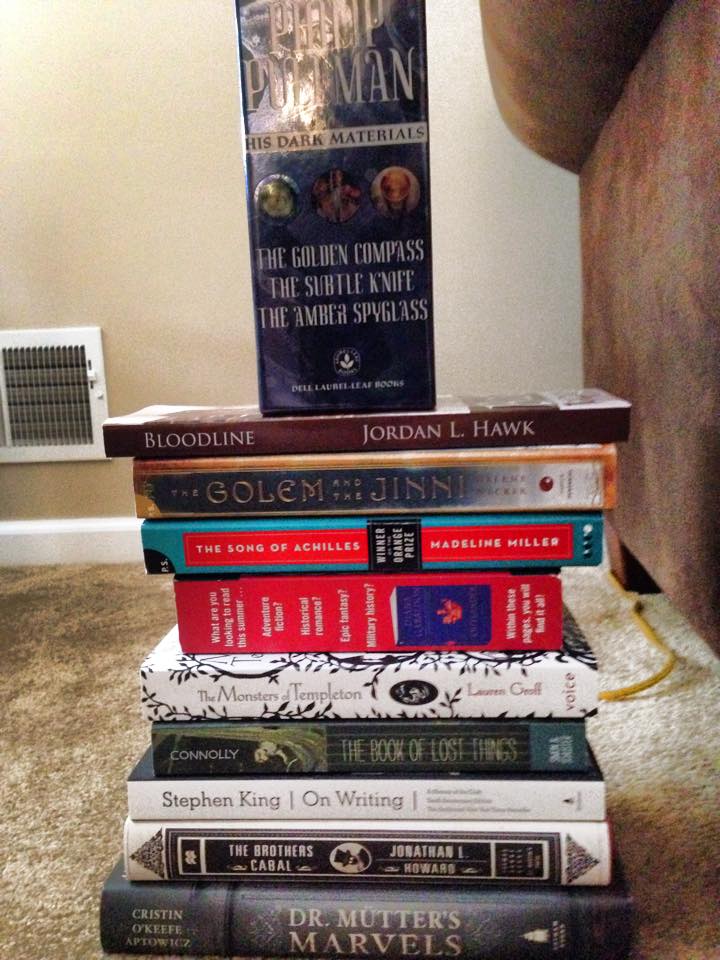
tbr pile oct 30What do your reading choices say about you?  Since beginning graduate school, I have been turning this question over in my mind as I listened to others in my classes mention who their favorite authors are.  Most of them are people I have never heard of or read but are rather famous in the contemporary lit world.  Typically, I hold my tongue and don’t mention what I read for fear of being ridiculed or looked down upon.  This led to a greater question: why do people read certain books?

Do people (especially those in academia) read for fun or do they read certain books because they feel it is expected of them?  As I continue my journey through the MFA in Creative Writing program, I find myself wondering what my professors read, especially when they are writers or poets as well.  What we read automatically becomes ingrained in our beings and eventually comes out in our writing. I can attest to the fact that when I read a book I love, I am inspired to write and often I will lean toward that genre or some theme found in that work.  If I read a book I had to drag myself through, it typically slows my writing to a crawl.  Oddly, while I didn’t love reading Virginia Woolf for the most part, her works had a huge influence in the way I deal with close narration and “head hopping” as others call it. Continue reading “You Are What You Read”

Writing

Character Preview: Immanuel Winter

im close up(Artist credit for this pic of Immanuel Winter goes to the lovely Fiammetta de Innocentis)

I put up a poll on my Facebook page asking the fans of my work what they would like to see next as a preview of The Winter Garden.  Only a few people answered (I’m not that popular and Facebook hides my posts), but it was unanimous that they wanted to see a character preview.  What I am going to reveal here will contain no spoilers and only contains information from before the events of The Winter Garden.  Down the line, I may release a few more of these along the way, but may I present to you, the leading man of The Winter Garden, Immanuel Winter.

Immanuel Winter was born February 2nd, 1870 in Berlin, Germany.  His family line can be traced back to the alchemists of Cologne, but during the time of the French Republic, his family migrated to Berlin.  This change of cities officially shifted their already changing identity from alchemists to scientists, but one remnant of their esoteric past remained in the form of a pendant: Continue reading “Character Preview: Immanuel Winter”

Writing

The Importance of Being an Earnest Reviewer

five stars

Ah, book reviews.  The all too important yet dreaded rituals all authors dread.  Will they love it?  Will they hate it?  Will the reviewer absolute eviscerate me for seemingly no reason?

The thought of reviews for any author can be daunting, but to an indie author, reviews are one of the most important aspects of marketing our writing.  Currently, I am an unknown, a bit of krill in a ocean of whales and sharks.  Reviews are what often convince readers to take a chance on a newbie author, especially if they are more in depth than “OMG! IT WAS THE BEST BOOK EVER!”  Yes, I can convince my mom and ten of my friends to write puffy five star reviews, but does that do anything for me and what does that say about me as a writer? Continue reading “The Importance of Being an Earnest Reviewer”

Writing

Straddling the Genre Line

litvgenrThe phrases “genre fiction” and “literary fiction” strike fear into my heart.  There’s a constant tug and pull in the literary world between what is of the higher art and what is considered beneath the establishment.  What should be valued more? Entertainment and enjoyment or the more “artistic”, philosophical, cerebral side of literature. Being a graduate student studying creative writing, I cringe when people ask what I write.  I am already anticipating the raised eyebrows and disapproving looks when I say, “Well, it’s technically science fiction or historical fiction.”  Instantly, it is discounted as trope-laden, cliche genre fiction. Continue reading “Straddling the Genre Line”

Writing

The Writing Process

One of the members of my Facebook author page asked if I would do a post about my writing process.  After I saw it, I sat back and scratched my head.  What was my writing process?  Like many things, when you live with it, it isn’t nearly as obvious as it is to others.


As with all writing, it begins with an idea.  Sometimes it comes as a smattering of dialogue or description while other times it comes as a topic or idea.  For The Earl of Brass, it began with the idea of a man needing automaton parts in order to survive, but this rapidly evolved into a man with a missing arm who needs a prosthesis.  In the beginning, I typically free write and put down anything that comes to mind.  Sometimes it becomes the first chapter of a novel while other times it gets completely rewritten or discarded.  Once an idea beginnings to take form, I make an idea map or an outline of what events will happen in the coming paragraphs.  For flexibility’s sake, I usually only plan five or so chapters ahead at any given time.  Typically, my characters are wayward and do what they want, so I need to alter my plans to fit them.  Forcing an agenda on my characters never goes well.  Sometimes when I have ideas but am not sure what order they should be in, I make index cards and lay them out.  I will move them around and ask my best friend/beta reader and see what she thinks to ensure it’s logical to others. Continue reading “The Writing Process”

Book Reviews · Writing

The Earl of Brass is IndieReader Approved!

IR Approved Sticker 2I awoke today to the most glorious news: The Earl of Brass was given a 4.5 star rating from The IndieReader, which means it has been given the distinction of being IndieReader Approved!  You can check out the review here.


Since 8:30 this morning, I have been doing my happy dance and texting, messaging, and bugging anyone who would listen that my novel made the list of approved books.  For an indie author, this is quite a big deal.  The IndieReader is one of the larger, more prestigious book reviewers for Indie and self-published books, and their reviews allow readers to find the gems in indie fiction as well as give indie authors the credit they deserve.  For a self-published author, marketing and getting your book recognition is an uphill battle.  Often reviews like Kirkus, are rather pricy for the average indie writer, but the IndieReader offers a moderate price with a thorough, balanced review.  Being IndieReader Approved is nothing to sneeze at.  Plenty of books they review do not reach the 4 to 5 star level, and the reviewers aren’t afraid to say the book is in need or editing or is lacking in certain areas. 


The Earl of Brass is my first literary child, and I definitely feel like a proud parent today.  Here is a sniplet of the review that made me particularly happy and I think captured the spirit of the novel:

The novel proceeds in a satisfying series of complications as Lord Sorrell and Ms. Fenice work together as archaeologists. The plot takes some unexpected turns and, while not overburdened with action, the events are well-paced and follow logical choices of the characters. The depictions of everyone, from London socialite to field laborer, showed distinct personalities which made THE EARL OF BRASS a humorous and delightful book to read.

Thank you, Claire L. Deming for reviewing my book (no, I do not know any of the reviewers, but her name is listed at the bottom).  I am honored and ecstatic that my debut novel is now on the IndieReader Approved list. 


Once again, the rest of the review can be found here.

The Earl of Brass can be purchased here:

amazon buy button

Personal Life · Uncategorized · Writing

A Woman of Principle

On my blogs and page, I try as a rule not to get too political on my author page or blog, but a recent event has refused to leave my mind, leaving me to purge it through writing.

One of the authors I know from the writing groups I am a part of on Facebook sent me a link to a blog tour service that was hosting a tour for a steampunk novel and was looking for blogs that would be willing to do the advertising posts.  Obviously, I want to support and network with other steampunk writers, so I checked it out.  The book looked okay.  I’m not a fan of advertising something I haven’t actually read, but at that point, I was willing to give the author a chance based on the blurb.  The only thing was, I couldn’t figure out how to sign up for the tour, so I went onto the their contact and information page.  As I scrolled, I came across the thing that completely soured my feelings toward that book blog tour host, No M/M, F/F, or M/F/M.

For those who are unfamiliar with the terminology, that basically means no stories involving same sex or bisexual protagonists or love interests.  I couldn’t do it.  I couldn’t bring myself to sign up for the tour and quickly clicked off the web page.  From the time I understood what being gay meant, I have been a strong supporter of LGBT rights and marriage.  Many of my friends are gay, and two of my characters in The Winter Garden comprise a gay couple who is dealing with their relationship in a world that does not approve of them.  How could I, a supporter of the LGBT community, work with a company that outright excludes them?  I couldn’t.

When we exclude certain types of fiction, what are we saying to those who choose to write about their experiences or the experiences of others?  Your story isn’t worth telling. I don’t want to hear it. No one wants to read it if it’s about that. In this day and age, diverse books are a necessity.  By writing and reading about characters who are a different ethnicity, sexuality, or religion as yourself, you are learning empathy and stepping into their shoes as you go from cover to cover.  When you say no gay or bisexual protagonists, you are telling every bisexual or gay reader or writer that comes across that site that they are unacceptable.  The anti-gay sentiment from many book blogs and reviewers follows in the vein of the prejudicial sentiments of the 1960s. Diversity in characters and novels is a necessity, and having open-minded reviewers and book programs will only further that goal.  I hope you will not ignore books solely on the sexuality or ethnicity or a characters within.  I will not state the name of the blog tour and take away their livelihood or slander them, but I will boycott them.  I will not participate in anything that excludes those who are in need of support.

Personal Life · Writing

Portrait of the Artist: From Biology Major to MFA

write quote

Last week I was gruching about a scene that was giving me trouble to my aunt, and she said, “You know, you don’t have to do this if it isn’t fun anymore.”  For a moment, I just stared at her.  Just because I’m complaining about writing being difficult doesn’t mean I want to throw in the towel.  The idea of stopping never even crossed my mind.

As with many writers, I don’t write because I want to please my fans or make money off it but because I feel compelled to.  It’s a compulsion, an itch that can only be silenced by reading and writing.  During the semester when graduate school has taken over my life, I feel the unmistakeable misery of not being able to scratch that itch and write (usually I end up foregoing reading for class and write a bit throughout the day).

From the time I was about ten years old, I have been writing stories. Over the years, the amount I write has waxed and waned depending on my circumstances, but it has been present over the last thirteen years.  When I was in high school, I had a few lousy English teachers who killed my love of writing and reading to the point that I never thought of becoming an English major in college. Creative writing was kept under the wraps since I didn’t write about teenage-appropriate topics like sports, romance, and angst.  If the guidance counselor saw my stories full of epic battles or the one about a young woman who deals with her friend’s suicide attempt, I would probably would have been sent to counseling.  Somehow I feared college would be the same.

  It wasn’t though.  I went into college as a biology major with dreams of becoming a doctor who specialized in reconstructive surgery, and honestly, I did well in my biology classes and even earned an award from the department.  In my freshman year, I met a wonderful professor who happened to be the head of the English department.  She took me under her wing and nurtured my insecure talent until finally in the second half of my sophomore year I chose to double major in English as well.  During my time as an undergraduate, I contributed to the school’s literary magazine as well as worked on it, was a writing tutor, and spoke at two literature conferences (one on scifi and fantasy and one on Medieval literature).

Much to my father’s dismay, becoming a doctor faded away the moment a Norton anthology was put in my hands.  I finished my degree in biology but immediately applied to a graduate school with an MFA program in creative writing.  While biology could have provided me with a stable income should I have pursued it, I knew I would have been miserable.  I needed to write, I needed to read. It pulled me and compelled me and was the one thing I did that felt completely natural.  Call me hedonistic, but my life has been guided by what makes me happy and so far it has worked for me.  My mom has a job that pays well, but she isn’t truly happy there.  If I see how doing what is expected can lead to misery, why should I follow the trail of money if I do not have to?

My question is, do we do what makes us happy or do we try to live up to the status quo?