Writing

The Perils of Being Creative

I want to do art.

All the time.

Those who aren’t part of the crafty-creative crowd probably hear that and think that’s great. It is not great. Well, it is, but it backfires in that I have SO MANY creative things I want to do that I often end up sort of short-circuiting and not doing anything. It’s the most frustrating part of being a creative person or at least a person with a creative-drive in the way that dachshunds have a prey-drive or border collies are driven to herd sheep.

My brain alternates between thinking of creative stuff, being anxious, and being burnt out, and there’s a lot of overlap between all three of those things on any given day. Most nights I go off to sleep thinking of book stuff or thinking about the creative projects I have started that I haven’t finished or things I want to try. As a tween and teen, I would literally go to sleep by thinking about my characters or the world I was creating in my stories, replaying scenes in my head until I drifted off. As an adult, I tend to fall asleep in bed on my laptop or holding my Kindle or fantasize about craft kits I have waiting to be completed (with an edge of guilt).

The problem with having a creative-drive is that isn’t the same thing as a drive to finish said creative projects. I just want to dabble in everything. I have a running list in my head of random artsy things I want to do that I’ve never tried: rug-making, more advanced ceramics and glaze techniques, embroidery, bookbinding, pixel art, making a game, etc. This doesn’t include all the art made by other people that I want to sample like video games, books, movies, and museums. Right now, my dining room table is littered with the detritous of a project I haven’t completed. I started working on a Valentine’s Day themed plastic canvas village right before Finn died, and for months, I couldn’t bring myself to work on it again (his unofficial birthday was Valentine’s Day and he died not long after, which double hurt). Even if the kit didn’t feel mildly blighted, there was a good chance it would have sat on the table half-completed for months while I gallivanted off to work more fully on a writing project or some other all-consuming craft.

Being creativity-driven means going where your brain blows. The process is really what pulls you. A border collie doesn’t necessarily care that the sheep end up in a certain place. It’s getting them all there that does it for their brains. Creativity is like that. I want to move the crochet hook over and over and over to build something. I want to add words to build up an image. I want to add more lines until a picture emerges. The process is what gets the good brain juices flowing. It isn’t until other people step in expecting you to finish something that the product becomes a source of stress or a slightly bigger source of dopamine.

I think a lot of us avoid finishing things for the crash that comes after finishing a project. A large part of it is that there’s the question of what comes next. You know you might aimlessly wander between projects for weeks until something clicks and the good brain state starts flowing again. The itch can be unbearable, or if the project was hard, you know you might be fried and unable to do those fun projects until your brain scabs over and heals and not picking that itchy scab is difficult. The other part is that if you release your projects to the public, then you have to face the stress of other people perceiving your work and you and having opinions about both of those things.

The problem isn’t that creatives shouldn’t monetize their work. It’s that creatives shouldn’t have to monetize everything they do or worry they are wasting time because dabbling in “unproductive” things is part of a creative-driven person’s brain and process. Turning everything into a finished product that must be put out to consumers in some way, shape, or form is demoralizing and impossible. Not everything is worthy of being finished, and not everything is meant to be consumable. Sometimes, it’s just for fun or to pass the time, the artistic equivalent of doing a puzzle. The best way to keep your favorite creative from completely frying their brains is to have basic universal income, so they could monetize certain projects and still dabble when the mood strikes.

Learning is also part of being creative-driven. Most of us want to be jacks of all trades, but society sort of beats it out of us that we don’t have time for things that aren’t making money now or aren’t seen as productive now. College, for many of us, was a liberating experience because it gave us permission to make space for those creative projects or new skills that we might have otherwise skipped for something more “productive.” Being creative-driven is being driven to do and make, yet it’s often seen as lazy or not real work or a waste of time. On a logical level, looking at these people and the bigger picture, I get why they think that way, but I also think a part of it is not understanding that for creative-driven people our minds are never quiet. We’re constantly turning ideas over even when our hands are empty and still, and I think that scares people who have to sit with the silence and blankness rattling around in their heads and wonder what could be in its place.

Writing

On Being Your Own Cheerleader

Let me tell you a little secret: no one will be as excited about your project as you are.

This might sound harsh, but ultimately, it’s true, and for newer writers, I think it’s better to learn this early than to learn it the hard way as you give up on projects because no one seems interested. Despite what others may say, writing is, generally, a solitary pursuit. You are the writer. You are the omnipotent god of your fictional world. And while others might be cheering you on, no one should be as excited about your project as you are, and expecting others to be your constant hype men is setting yourself up for failure.

I don’t want to say you can’t rely on others, but frankly, you can’t rely on other people. It isn’t your current or future readers’ responsibility to sustain your interest in a project.

When I first came across this sentiment of “No one seems interested in my work, so why bother,” I was a bit confused because I thought, “Well, the book isn’t out yet. Why would they be excited, especially if you are a new writer?” I forget that people actually show others their work while they’re writing. I tend not to. Not due to being squeamish about showing my unedited work but because I have a don’t bother anyone complex. It also slipped my mind that when people write fanfic, they tend to post things a chapter at a time and build an audience along the way. That tends not to happen with original fiction, unless you’re posting it on something like Wattpad or Ream as you write it, or you share your work in progress with an alpha-reader.

I can see how that would be a rough shift, having that built-in audience from posting your work on a piece-by-piece basis to having no one knowing what you’re working on or being excited about it until people read it and start to spread the word. No matter what though, if you abandon a project because your hypothetical audience isn’t hyped for it, you’re shooting yourself in the foot. I would definitely take a second and think if your knee-jerk reaction is self-sabotage to avoid feeling like a failure if that book isn’t popular.

I’ll let you in on another secret, first books rarely sell well. At least not until you have several other books out.

You need to find some sort of motivation to keep you going, whether it’s for the love of the story or for money, you need something that’s wholly you to keep writing when things get hard and it seems like no one cares. Above all, I care about my characters. I love them and want to see what happens to them, and my first audience member is me. If I like them, I assume others will too, but you’ll have to market the book to people like you in order to find those other readers. Look at what other people in your genre (or other writers you enjoy who are similar to you) are doing and try to emulate that when marketing your own work. Don’t go rogue with that first book. Don’t think you’re the exception. Don’t assume you’re a failure if book one is sort of a flop because that’s normal, and there’s a good chance it’ll get better.

As I write this, the thing I regret is that I can’t make you care about your work or about your characters enough to maintain that level of “screw you” needed to make art. Every artist who finishes something has a healthy (or unhealthy) amount of screw you in their system. It’s the little voice that pops up to tell off the world when someone devalues the humanities or says, “who would read that?” ME, that’s who. Over the years, I feel like my screw you voice sounds more and more like Anthony Bourdain, but I’m okay with that. When I need to summon the strength to tell my brain or the outside world to f-off because my work matters, I channel the spirit of a disgruntled, slightly world-weary chef, and it does the trick.

Whatever works to help stoke your artist ego to get your art done, do it. It may seem silly or pointless, but trust me, it isn’t. In the darker times when things aren’t going smoothly or you feel like no one gives a shit, that inner voice will get you through. In the end, you need to be your own cheerleader or disgruntled chef because no one else will.

Uncategorized

Spiting the AI

If you aren’t chronically online [like me], you may not have heard about all the issues with AI art. If you aren’t sure why it’s a bad thing, a quick synopsis is that for AI art to work, they have to steal artwork from human artists in order to mush things together to create what people are generating. It isn’t like they are taking from public domain works, and that is obscenely shitty, especially since of course corporations are cutting ties with human artists to use a machine that makes wonky ass hands and regurgitates soulless garbage made of art that was actually nice and had thought and composition behind it. It’s the art of equivalent of me writing a book by stealing good sentences from bestsellers. I mean, it’s a new book. Who cares where all the good sentences came from, especially if I changed the names, right? See how stupid it sounds when you change art to writing. We call that plagiarism. My advice for this is DO NOT FEED THE MACHINE. Don’t play with AI generators, don’t use those photo changer apps because they are AI also, and if you have Adobe or other art programs, double check that your settings are such that it isn’t stealing your data/files to feed to their AI machines.

As someone who values equity and the arts/humanities, supporting AI goes against everything I stand for, and using it, even casually, spits in the face of every artist who works hard on their craft and is trying to make a living and those who spend hours on their art as a hobbiest. Yes, I will fight people over this. Go use AI to make a machine that will do my taxes and leave the creative stuff to human beings.

Anyway, this is not meant to be a rant about how gross AI art is, though I could spend a lot of time doing so. The reason why I bring this up is because one of my goals for this year is to get back into art, drawing, and crafting. I crocheted like a machine in 2020 (though, ironically machines cannot crochet as it’s too difficult), but I sort of burnt myself out on it. Last year, I had intended to do more art, but I ended up focusing on getting back into writing and really didn’t do anything besides my bullet journal spreads/doodles. That isn’t to say that isn’t art, but it wasn’t what I had intended to do.

All through middle and high school, I took art classes, to the point that in my senior year, I was in Portfolio Art (senior year, you took all of the art classes class) and Arts and Crafts (which was like ceramics, plastic canvas, basket weaving, etc). Art has played a pivotal part in my life, and during college, I wasn’t able to take any art classes because the vast majority conflicted with my science labs. In the fourteen years since I graduated high school, I have lost that muscle memory for art that isn’t craft-focused. My hope is that I can do more little pieces, play with the supplies I have, and just enjoy art as a process. Aka, not cry over my lost muscle memory and rage quit when it doesn’t go well. At first, I know my art will look terrible, and that’s fine. The whole point of doing this is to reawaken that side of me, enjoy the process, and work toward improving in a very loose, fun way.

Something I want to put out into the universe is that I would love to sell planner stickers one day. I absolutely adore sticker sheets of cute but mundane things, and there are more niche stickers I would love to have that don’t exist in shops in the US. Maybe one day I can make some fossil stickers or ones of amphoras and Grecian urns. We’ll see.

At this point, I have Posca acrylic paint markers, needle felting kits, plastic canvas kits, and Himi gouache sitting in my basement waiting for me to use them. I don’t know how much I’ll post about my art journey this year or how far I’ll get, but I hope you will join me in recapturing the childlike glee of making art.

Personal Life

On Supportive Partners

Be forewarned that this will probably be a little gushy. Today is my 17th anniversary with my partner, so the thing that is first and foremost in my mind today is how much I love him and how much he supports me on a daily basis.

First off, let me introduce my partner a little. He is a programmer who also does cosplay and art, though his creativity really lies in 3D mediums (like cosplay armor). He is incredibly handy, a loving dog parent, and my goblin wrangler (I am the goblin in the relationship, every good relationship has one of each or that’s my theory). The Morticia to my Gomez, blah blah blah. I love him immensely and will happily gush about his many positive attributes, but I will spare you all for now.

I feel like today’s post is a no-brainer, but one of the best things that has happened to me is finding a partner who supports me and my creative endeavors. I should probably also define support in this case. I don’t think your partner needs to share all your interests. My partner and I certainly don’t. I don’t cosplay, he doesn’t write stories, but we’re both artists. We both respect the creative activities that we’re interested in. Earlier in my life, I thought my partner had to like the same things as me. I tried to get him to read my work or read books, and my poor ADHD-brained partner just couldn’t do it. At first, I was mad. How could my partner who loves me dearly not be actively involved in my projects? Was that not what support is?

Well, not really. Just as I am not hot gluing helmets made of foam, my partner doesn’t need to read my work in order to help. For one, he is the person I bounce ideas off of the most. Often, he’s just a sounding board because talking an issue out tends to speed up the process of figuring out where I’m going. He’s been helping with The Reanimator’s Heart and my other projects so much that he asked me to draw out a relationship diagram in order to keep everyone straight when we talk about them. While he isn’t likely to sit down with my book and read it cover-to-cover, he is the person who helps me the most on a daily basis, and I’m kind of glad he doesn’t because there are spicy scenes and part of me would be mortified if he read them. Don’t question the logic of it; it’s just embarrassing.

This past year or so, I’ve struggled a lot with self-worth and whether or not I can get my writing career back on track and try to rely more on that income. My partner has been the one to constantly remind me not to get down on myself and that I can eventually get to the place I want to be. It just might take some time. Whenever I mention wanting to learn some new craft or potentially trying to get back into more traditional types of art, he always agrees that I should. Trust me when I say my partner is not a yes-man. He will happily bring me back to earth when I start to spin off, but when it comes to my art or trying different things, he’s the first to tell me I should if it’s calling to me. I think part of it has to do with us both being artistic people who are also neurodivergent. We understand the siren call of a new skill or craft.

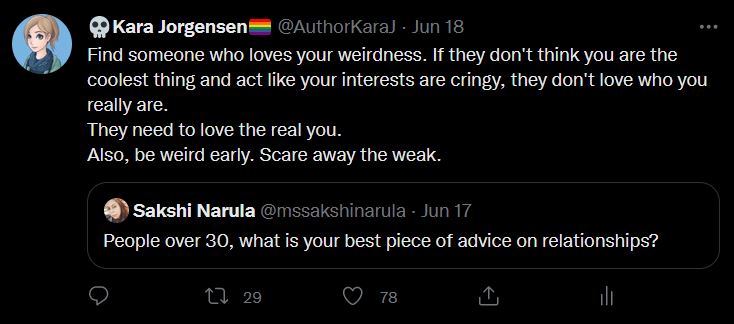
I posted this on Twitter the other day, but I think it’s very apropos for this post:

I found someone who appreciates me and all the weird shit that comes with loving me. He listens when I gush on and on about Our Flag Means Death and looks at the thousandth piece of cool pottery I’ve found on Instagram. I’ve been remodeling my office, and he’s gone along with every idea I’ve had in order to make it the perfect gothy oasis I’ve dreamed of. I don’t think there’s ever been a time when my partner acted like what I loved was cringe-worthy or weird or juvenile. I’ve seen a lot of people’s partner’s say things or roll their eyes when the other person starts gushing about their special interest or a new hobby. Or they’ve fully bought into the capitalist notion that every hobby should be profitable, and if they aren’t, they should be abandoned for more serious pursuits. Whatever those are.

It made me immensely sad to think about people who are in relationship where their partner doesn’t love them for all their weirdness and silly hobbies or their special interests. They don’t have to love that thing too, but they have to love and respect you enough to understand that you love them and that it is all a part of you as a person. While my partner doesn’t crochet or write or like arcade carpet, he would never dissuade me from my pursuit of those things. He knows the weirdness is what comes part and parcel with the things he loves, and trust me, he’s a fan of the weirdness too.

Happy anniversary, Peaches! I hope he knows how much I love and appreciate him and how he’s been the tent pole that props up my dreams when I struggle under their weight.