Personal Life · Writing

Community and Bad Author Behavior Pt. 2

Last week in part 1 of “Community and Bad Author Behavior,” I discussed what to look out for when it comes to a writing or online community that enables toxic behavior from bad actors. In this week’s post, I would like to outline what we can do on a personal level and going forward as a community to hopefully combat this behavior and keep this pattern from repeating.

Recognize Manipulation

This is easier said than done, but being aware of the signs of an abusive manipulative person helps you avoid falling for another abusive manipulative person. Keep in mind that people who are manipulative are good at what they do. If they weren’t, they wouldn’t do it. Some things to look out for are:

  • love bombing– this is when someone showers another person with praise and attention while getting closer to them. Once they have the person close, they then withhold affection. This done to keep the person craving their attention and trying to get in their good graces. Someone who runs hot and cold with their “friends” might be love bombing.
  • gaslighting– telling you something didn’t happen or didn’t happen the way you remember it in order to make you question your sanity or to make them look better. Once again, it keeps the person off balance, and the story might even be spun in such a way that it makes the person apologize to the gaslighter and try to make it up to them.
  • testing your boundaries– often they will run over your boundaries by asking you to share more, give them more time, be more emotionally intimate, trust them more. If you set a boundary, they will ignore it. At the same time, they are allowed to have boundaries, and if you run them over, they will punish you for it.
  • controlling behavior– In online communities, you’ll often see things like, you can’t interact with X person; if you do y, you’re a terrible person; you can’t be part of the group if you like so and so; and if you do any of those things, you’ll be kicked out of the group. People want to be loyal and be part of the crowd, so they comply without much push back, especially if the person is adamant.
  • using DARVO tactics– DARVO stands for deny [behavior], attack [victim], reverse victim and offender. Often someone is at the center of drama from multiple sources will try to play it off like they are the victim in all cases. Yes, someone can be bullied by multiple groups, but if someone seems to be involved in drama constantly, it warrants looking closer because DARVO tends to be involved. It’s a “get them before they get me” tactic to keep public opinion and support on their side and a way to muddy the waters when they do bad things.
  • can’t handle criticism or being told no– most of this abusive behavior comes from a fragile ego or low self-confidence, so they pretend to be an authority in order to maintain an unquestionable position. They use this to avoid accountability and deflect criticism when they do something wrong. When you approach them to tell you they hurt you, they will blow up at you or do the “I’m sorry you feel that way” type apology.

Think Critically

Manipulative and abusive people rely on the fact that you will not think too hard about what they’re telling you. Trust is key when manipulative people build communities to insulate them because, in order to get away with things for as long as they do, people need to not see what is right in front of them. It’s a slight of hand. In part one, I talked about how in these communities we often see cult-like vibes and a culture where authority isn’t questioned. Both of these mindsets require people to not think critically about what they see or experience. People who are or have been part of high control groups (like certain religions) are often more vulnerable to this sort of behavior as they were raised in a similar environment.

People who require control to keep things in their favor do not want you to think too hard about what they’re saying or push back against their behavior. Once one person defects, there’s a higher chance others will too. This is why they often boot or smear people who leave them, to keep others from believing them or doing the same. One can push back against compliance or herd mentality by having a healthy amount of skepticism. You don’t have to be an asshole and loudly question everything, but you can keep in mind that you don’t truly know people, especially online. I have online friends, and I love them dearly, but I don’t know how they behave when they aren’t talking to me. Two people can have two very different experiences with the same person.

At the same time, if something feels fishy, dig deeper. During the FM situation early on, there were red flags that popped up for me that I ignored at first because other people seemed to support them. Once they bullied one of my friends right in front of me, I realized those red flags were definitely there and dropped them like a hot potato. Being a “good friend” only goes so far. If you see them do something mean, confront them. How they react to that criticism is a good indication of whether they are trying to manipulate you or not.

Don’t Be a Yes Man

Being loyal is a good thing. Being blindly loyal is a good way to end up with a toxic friend group. Manipulative people rely on yes men to always support them out of blind loyalty or because you feel indebted to them. Community is important, but let me say this, you owe awful people nothing. Cut your losses and move on if you realize they’re toxic. There’s often a sunk-cost fallacy with friends or people higher than you in the industry where people think, “if I just wait a little longer, things will get better” or “if I wait a while longer, they’ll promote my work to their followers, and my work will take off.” People will stay in toxic situations far longer than they should because they’ve already been there so long. At the same time, it can also be a “boiled frog” situation where things slowly become worse and don’t notice.

What I think is most important is to pay attention to what is going on in front of you with this person. If you see them doing something mean or shitty, call them out on it. Normal people don’t expect their friends to always agree or support them. Most of us know we can be irrational, petty, childish, jealous, etc., and personally, I’d like to be told if I have gone off the rails and been an ass because I know I need to apologize for my behavior and do better. One of my fears is that in the age of “your valid,” people take it too far or misunderstand what it is supposed to mean. Someone feeling jealousy is a perfectly normal emotion to have. How you act on that emotion is a very different story. Having a little vent in your group chat is one thing. Spreading falsehoods about that person to undercut them is another. If a friend is doing something bad, they should be called out on it. If they can’t handle the criticism once the heavy emotions have died down, then you need to reevaluate your relationship with them.

I was debating which heading to put this under since it straddles all of them, but if you are part of a friend group or friends with someone and you are afraid to disagree with them because you think they will put you on blast or smear you as they do others, that is a mega red flag. Just think about the situation from a more objective perspective. You are afraid to leave a group for fear of being bullied. That isn’t normal, and you shouldn’t tolerate it.

Move Away from a Punitive Mindset

At the heart of many manipulator-fueled pile-ons is a sense of justice, that the people engaging in the pile-ons are helping their friend or standing up for some greater social cause. It’s commonplace for manipulative people to take a personal beef or a perceived slight and spin it with a social justice slant, couching the crime in language that isn’t truly applicable in the situation (once the evidence/situation is looked at more closely) in order to get the “good” people around them to react more strongly. “Good” people don’t engage in pile-ons unless a threshold of unacceptability is reached, and the manipulator knows that. They can’t say, “I hate so-and-so who many of you are friends with, so unfollow them,” but they can say, “So-and-so is harassing me and said something hateful about me.” That’s the kind of thing people will jump on because they believe their friend. This all should have been covered in the critical thinking section, but this mob mentality falls under punitive justice.

Punitive justice is the belief that people need to be punished for their crimes in a way that is proportional to the behavior. The problem is that people with large followings and parasocial relationships can turn those people into judge, jury, and executioner for those they don’t like. As mentioned in part one, often there is no evidence presented at all to substantiate what they’re upset about, the yes men/enablers swarm around them to console them, and then they go off to exact justice, whether that’s through harassment, review bombing, or smear campaigns. The question becomes is there actually a crime? And if there was one, is this hornet swarm proportional to what the person actually did? Acting as a white knight or savior to another person is a symptom of this sort of punitive mentality. The dragon must be slain, and the other person rescued.

In a perfect world, the mindset should be that the person is held to account but with a focus on restorative or transformative justice. If there was something done to the other person, they should make amends and do something to restore that person to how they were before the offense or to do something to atone to the community. Punitive justice leaves little room for growth or doing better, and I would even suggest that it works in the manipulator’s favor in several ways. 1. if they play the victim, the person they’re accusing will almost always be worse off than them because they end up being harmed for something they didn’t do. 2. When the manipulator is caught, they will just delete all their accounts and pop up with a new persona.

Do I think they should be punished? Yes. I think withholding support and unfollowing people is something one should do if someone is awful. At the same time, I think there should be room for growth. If we watch from afar and see that this person is trying (emphasis on is), then they should be allowed back into the community after rebuilding trust and making amends to those they hurt. Unfortunately, without all the things listed above and a severe, sustained attitude change from everyone (myself included) in the writing community, I don’t know if this is even possible.

A Note on the Victims of Manipulators

A manipulative person leaves swaths of victims in their wake. There are the people they actively wronged through smear campaigns and bullying, the people they manipulated and abused in private, and the people close to them who were used and lied to. Those closest to them need to examine how they behaved after the abuse is exposed and remember that you can be a victim and a bully.

Something that upset me after the FM incident was how the people closest to them were consoled and coddled far more readily than those who were the victims of FM’s bullying campaigns and cyberstalking. I understand why. Those people had more of a community than their victims; they had each other. It felt like they were more upset about being in the splash zone of a scandal than that they had been complicit in FM’s abuse by enabling them and/or acting as a bully by proxy for them by engaging in their pile-ons against others.

Every single person I’ve talked to who was a victim of their bullying, cyberstalking, and abusive behavior all show signs of PTSD and anxiety from the experience. Seeing their profile pic became a trigger. My blood pressure would shoot up when they appear on my timeline, and I would go into anxiety spirals when they would start harassing me with sock puppet accounts. Now that they’ve been exposed, the anxiety has lessened, but these online harassment campaigns are not victimless crimes. People who were abused privately feel deep amounts of shame, and some haven’t returned to online communities because they feel they can’t trust people anymore.

This section isn’t meant to be a complaint section on what I and others experienced. It is meant to point that real harm is done when people enable manipulators and let their behavior go on unchecked, especially after they’ve seen the red flags. My hope is that as a community, we can be better about seeing the signs of a manipulative person early, not enable their manipulation, and think critically about what we’re witnessing before acting in a punitive manner at their behest.

Writing

Community and Bad Author Behavior Pt. 1

It’s been almost five months since the FM event went down (if you know, you know), and I have had many thoughts over the last few months. If you don’t know what I’m talking about, I linked the first post above, and if you google the author, you’ll find plenty of info about what went down. This is less about them and more about how the writing community can create the [toxic] environment that led to this person doing so well and how we can recognize these sorts of conditions going forward in order to stop them before they start.

While I hate when my students do this, let me spell out my thesis for this post: Abusive and/or manipulative people cannot flourish in a community without support from those around them. No matter who is at the center of the mess, for a person to continue doing this for any length of time, those around them have to ignore bad behavior, explain it away, or join in. There are red flags to pay attention to or things we can do to avoid enabling this sort of behavior within our communities.

No Questioning Authority

Manipulative people, in order to manipulate efficiently, must hold a position of power. Grifters and other ne’er do wells often take up a niche and start posting authoritatively. It doesn’t matter if they are spouting nonsense about crystals or saying things about queer people that negate any and all nuance because if they say it in such a way where they posit themselves as an authority, people will believe them. This authority is hammered home by jumping on others who disagree. When others see them go after people with righteous indignation, they see that as confidence rather than weakness. By doing this repeatedly, they establish a hierarchy with them at the top OR they create a persecution narrative around disagreement from others in their community, which they can leverage for more attention and ultimately more authority as more people come in to support them.

From there, they rely on social compliance and herd mentality from those who surround them. Once a few people start saying they are an authority on x or y, others will agree and comply. Even if they don’t always agree, seeing many other people agree with the authority figure makes them either question their beliefs or default to what the authority said just in case or to maintain the peace. They might even create sock-puppet accounts that act as their supporters. Other people see the sock-puppet defending them and join in. Their marks are usually people who are less outwardly confident, those with less social capital (though they often end up as bullying victims later), and those who are seeking community protection. The fake authority figure appears larger than life and attracts people who want to do better or know more.

If you get involved with an authority figure who doesn’t like it when people disagree with them or they squash any discussion or dissent from people within the group, it’s a red flag. People who are secure in their authority don’t do this. They don’t worry people are going to usurp their position because they know where they stand and what they know and are confident in that. They can also handle criticism and altering their position with new information. Insecure people feel the need to put others down and make them look stupid in order to maintain their position in the hierarchy. A true “authority” or leader should be able to field questions and meaningful disagreement in order to have a discussion.

Group Think Vibes (aka it’s getting culty)

I remember being part of a queer writing Discord server once where the main person/owner of the server mentioned they hated Our Flag Means Death. Now, if you don’t know, A TON of queer people LOVE that show. This person said that in an online room full of queers, and not a single person disagreed with them. I remember sitting there like wtf is going on?? It was my first inkling that something was not right. I put the server on mute and backed away. Disagreement, discussion, and friendly arguments are normal in a business casual server like that. To see zero people disagreeing with the main person is bizarre and made me think that person must do something that makes others afraid to disagree with them, whether it’s anger, kicking people out, or using passive aggression to get them to do or say what they want.

This behavior gets worse when those in a position of power, like a beloved author, cultivate parasocial relationships with people in their Discord servers or Facebook groups, especially readers. Those readers are often following them on social media as well, and no matter what, the author is in a position of power within those groups. What begins as a mention of “drama” on a private server or Facebook group can become a swarm of readers and other writers attacking someone at the subtle behest of the person in power. The person in power has plausible deniability as they never named names or told their followers to go after them. On the contrary, they explicitly stated not to, but they wouldn’t bring it up there unless the unspoken message was to do their bidding. Bringing it up to a best friend or author friend who is also on par with you is one thing. To say it to people who look up to you is leveraging your power, especially if the group is substantially large.

The worst thing is that these readers get trained over time to become enablers by the person in power. If you do my bidding, you will get rewarded by being given attention, being treated like a white knight, or by thinking they are part of some larger social justice crusade (depending on how the disagreement is being spun). In reality, they are being used because they don’t see the larger context of the “drama,” how it started, or what role the person they like has played in instigating it. All they know is what they’ve been told, and because they trust and like this person, they don’t look deeper. People who go against the person in power or who don’t pull their weight are often booted from the group. This once again reinforces the enabler dynamic.

No Evidence or an Evidence-less Crime

I have mixed feelings about demanding proof from a victim as it can be traumatizing or impossible to prove. At the same time, I do think we need to be at least a little critical when someone starts shit with someone else on the internet, especially if they are trying to instigate a pile-on or harassment campaign. If someone is saying someone else is bullying, stalking, or harassing them, there should be proof somewhere. If someone is being accused of ableism, racism, transphobia, etc., there should be proof somewhere. People aren’t usually good at hiding that kind of stuff, and asking someone to show a post or two that prove they have done what someone said isn’t out of line.

One of the things that happened with the person mentioned at the top of the post is that they repeatedly leveled accusations against other people with zero proof. When people asked to see proof they offered to freely show, they never got it and received only excuses. The people who asked for proof weren’t part of the inner circle, so when they pointed it out, they either got hate from the in-group or were ignored. Later, it was revealed that there was no proof because those things didn’t happen. Whenever someone tried to point out they were being a bully, they would accuse the other person of something worse. Leveraging their following, they were able to quickly get public opinion on their side and silence the other person by playing the victim loudly for a crowd (it boils down to classic DARVO tactics).

It puts the other person in a very hard spot because if they react, they look angry, which can be used against them. If they don’t react, they look guilty. But how do you prove you didn’t do something? When I was dealing with *that person*, that was where I got stuck. How do I prove I didn’t harass them? How did I prove I hadn’t spoken to or about them in months? I couldn’t prove what didn’t happen, and they knew it. People who use these tactics know this and use it to their advantage. The worst part is that once it works and they see they can leverage their following and others to shut down the people who point out their bad behavior, they’ll do it over and over again.

Critical thinking? Don’t know her.

Something you may have noticed in all of the situations is people stopped thinking critically. When someone acted like an authority, they didn’t question that they might be wrong or they might be purposely ignoring nuance in a situation that needed it. When someone asked them to get involved in a fight that wasn’t their own, they did it. When someone was attacked for disagreeing, no one stepped out of line to stop them. When they accused someone else of wronging them, no one pointed out there was no evidence. As mentioned in the first section, grifters and bullies rely on herd mentality and compliance in order to get away with the bad things they do for as long as possible. People within their orbit stopped thinking for themselves and relied on someone else to tell them what to think or do, and this behavior had a social pay off for them.

The worst part is that grifters and manipulative people rely on “good people” to do their bidding. Good people want to help their friends or stand up for what is right. Good people don’t question that what they’re doing might not be the right thing because surely their friend wouldn’t do that to them. Unfortunately, good people are easy marks because they aren’t nearly as suspicious of those close to them as they should be. On top of that, they can gain social capital by participating in the harming of others. It feels good to stand up to someone they think is wronging a friend. They also often feel they will lose social capital if they don’t stand up for this person as they might throw it in their face later that they didn’t say anything in their defense, and thus they would lose standing within the group. The most loyal followers get the most social capital within the group.

Being an autistic person who tries to see the best in people, I have been burned a lot, and because of that, I have become suspicious and standoffish. I don’t wish that on others, but I do think it’s a good thing to have a healthy amount of skepticism and to remember that you don’t truly know the people you meet, online or in-person. Are they actually your friend? Is the relationship reciprocal or are you always coming to their aid? Would they drop you like a hot potato or go off on you if you disagreed with something they did? Are you afraid to distance yourself from them because you think they’ll call you out or go after you? If you answered yes to any of these, that is a major red flag, especially the last one.

Where Do We Go From Here?

I wanted to include this as one post, but it’s getting quite lengthy. Next week I’m going to discuss what can possibly be done to deal with this sort of behavior before it goes out of control. I also want to discuss the impact it has on those who the authority/bully turns against because these aren’t victimless crimes, and in online spaces, those victims are usually ignored or forgotten. Check back next week for more on community and bad author behavior.


Monthly Review

August 2024 Wrap-Up Post

Where the hell did August go?? This managed to be the shortest month ever for me, though I think that has to do with prepping for the new semester while trying to get my shit together with book 3 of the The Reanimator Mysteries. Let’s take a look at our goals for August:

  • Write 25,000 words
  • Start edits
  • Prepare for my classes
  • Make the online parts of my classes (bleck)
  • Continue to try to maintain my tenuous grip on my mental health
  • Blog weekly
  • Send out my newsletter
  • Read 8 books

Books

The goal was to read 8 books, and that is exactly how many I read.

  1. White Fragility by Robin DiAngelo- 4 stars, a nonfiction book that looks at why white people react so poorly to being told they are (or might be) racist. A good primer but not super in-depth.
  2. Shiver (#1) by Maggie Stiefvater- 4 stars, a girl is attacked by wolves as a child only to fall in love with the werewolf who saved her. This is very much a YA romance, but I loved every second of it. Sometimes we need angst teen romances.
  3. Cheese by Andrew Dalby- 4 stars, a nonfiction book about the history of cheese. Interesting, but part of me wishes it was more in-depth.
  4. Mushroom by Cynthia D. Bertlesen- 4 stars, from the same series as the book on cheese, this book looks at the history and science of mushrooms. The look at mushroom philic v. phobic countries was quite interesting.
  5. Arch-Conspirator by Veronica Roth- 4 stars, a dystopian, futuristic reimagining of Antigone. Very interesting set-up, and I like how the focus on reproductive writes and memory were handled in this version.
  6. When Among Crows by Veronica Roth- 5 stars, a fantastic fantasy book set in a monster-filled modern Chicago with an Eastern European flare. I absolutely loved the characters and the world. You know a novella is good when you wish it was longer or that there was a sequel.
  7. The Dead Cat Tail Assassins by P.Djèlí Clark- 5 stars, another fantastic short book. We have an undead assassin working for a goddess, a case that goes very wrong, wibbly wobbly time, and a really rich world.
  8. Broodmother by Vesper Doom- 4 stars, a folk horror short story featuring some incredibly scary and gross cicadas. No offense to the cicadas, but they were quite horrifying.

Admin/Behind-the-Scenes Stuff

  • Prepped all my class stuff (except the content for my new class, oops)
  • Prepared for the Naratess Indie Sale
  • Advertised my butt off for the Naratess Indie Sale
  • Edited over half of The Reanimator’s Remains
  • Continued to write The Reanimator’s Remains (nearly done, had to fix some stuff)
  • Barely maintained my grip on my sanity, but I did it
  • Listened to my body and did more creative/fun things to keep from McLosingIt
  • Joined the Plants and Petrichor Stitch-a-long, hosted by FineFrogStitching, and have been keeping up with it
  • Had a good first week of teaching my classes
  • Had to put a new battery in my car on the first day of classes because it died in the driveway .-. (it’s been a week, peeps)
  • Brainstormed how I might add to the Paranormal Society Romance series in the future
  • Blogged weekly
  • Sent out my newsletter

Blogs


Writing

I forgot to chart my writing progress this month because I’ve been writing as much as I can. Truthfully, there were weeks where I felt my brain starting to spark, so I had to slow down for a few days. I’m trying to be better about listening to my body and not running myself into the ground. This is a constant struggle for me as I will self-flagellate about not doing enough. Luckily, editing the first 60% of the book helped to get me back on track and figure out where I needed to go with the last chunk. That’s something I usually have to do during the writing process, even though I resist it every friggin time. I’m actually really proud of this book. It’s definitely different than books 1 and 2. It’s quieter and a bit more internal, even though there’s a lot going on in terms of the mystery and learning more about Oliver’s background. That’s also why I’ve been feeling a bit self-conscious about it. I worry readers won’t necessarily enjoy it as much because it isn’t as swashbuckly at the other two. Maybe it is and I’m just hung up on something that’s a non-issue. Either way, I guess I’ll find out when it comes out in October or when my ARC readers get their hands on it.


Hopes for September

  • Finish The Reanimator’s Remains completely
  • Edit the rest of The Reanimator’s Remains
  • Proofread The Reanimator’s Remains
  • Prep ARCs to go out
  • Format the paperback
  • Keep up with my class prep/grading
  • Send out my monthly newsletter
  • Blog weekly
  • Read 8 books
The Reanimator's Heart · the reanimator's soul

Get 2 Books for $2

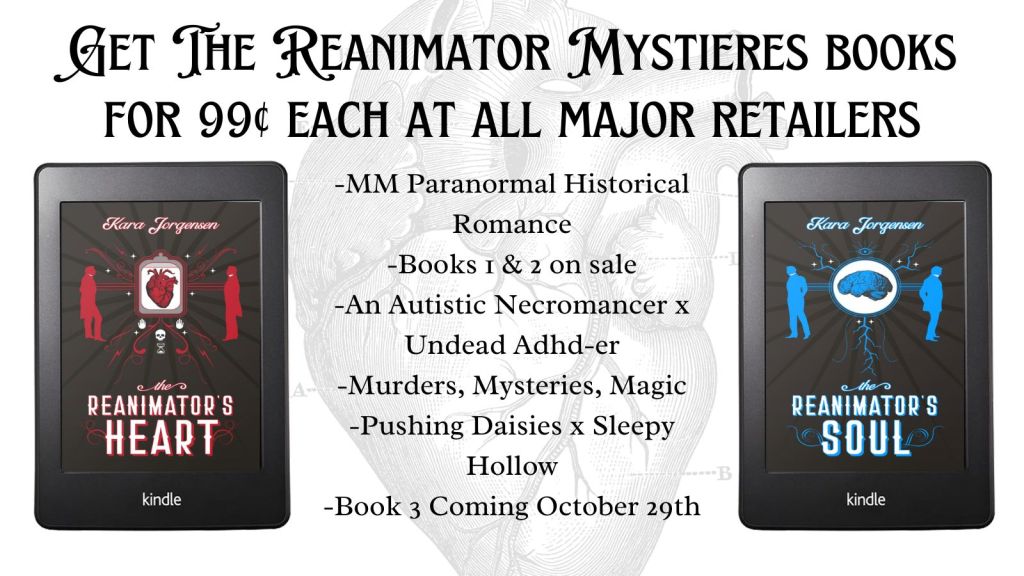
Get the Reanimator Mysteries books for 99c each at all major retailers
mm historical, paranormal romance
books 1 and 2 on sale
an autistic necromancer x undead adhd-er
pushing daisies x sleepy hollow
book 3 coming October 29th

From now until August 28th, both The Reanimator’s Heart (TRM #1) and The Reanimator’s Soul (TRM #2) are on sale for $0.99, so you can grab both books for $2. It’s the perfect time to read and catch up before The Reanimator’s Remains (TRM #3) comes out October 29th.

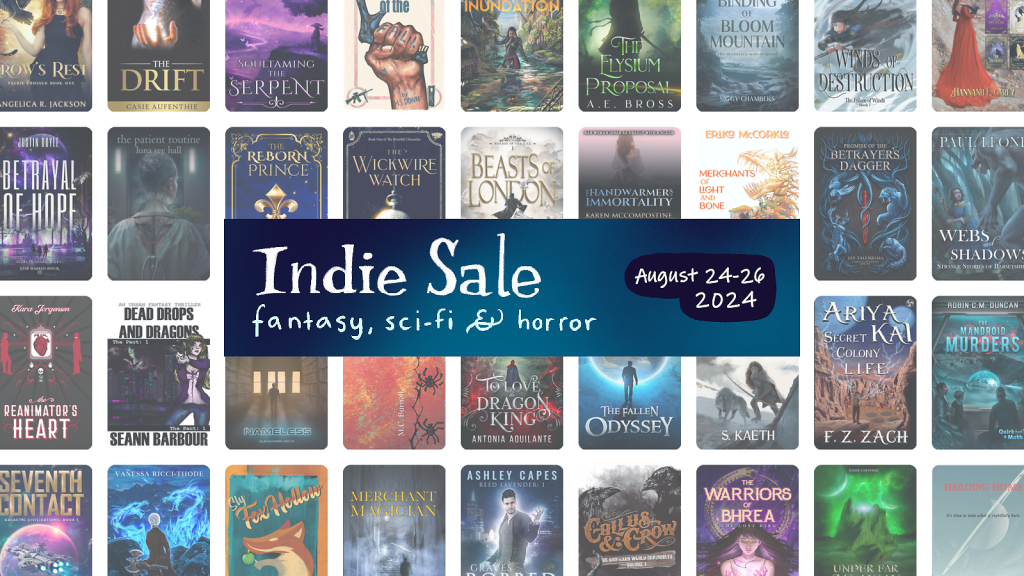
an array of covers behind a banner that says Indie Sale fantasy, science fiction, and horror, August 24 to 26, 2024

There is one day left in the Narratess Indie Sale (ends the 26th), so if you are looking to beef up your to-be-read pile for Indie August, swing over to the Narratess Sale to check out over 200 indie books that are free to $1.99. The Reanimator’s Heart is part of the sale as well as books from many of my friends’ books.

The Reanimator's Remains

10 Reasons to Read The Reanimator’s Remains

As we get closer to the release of The Reanimator’s Remains (TRM #3), I wanted to talk about some reasons I’m excited for you all to read this book.

  1. Gwen is on the case! In this book, Gwen gets to come along and be an active participant in the investigation since it’s up her alley. She may have gotten more than she bargained for.
  2. More of Felipe’s backstory. We get to see more of Felipe growing up, for better or worse. Poor Felipe is going through it in this book.
  3. ANGST. See above, lol. There’s a lot of internal angst in this book.
  4. Quilts are important. Being a crafter and coming from a family of crafters, the idea of fabrics and quilts being passed down becomes an important part of the story. I love the idea of legacy and love being stitched into blankets.
  5. A creepy forest. The Dysterwood is the star of this book, I think. If you liked the creepy cathedral in book one, you’ll love this forest. It has a lot of personality and creep factor.
  6. Scandinavian influences. I’m bringing in the Scandinavian flavor for this book. It appears in some of Oliver’s history already, but there’s definitely more of it in this book, especially in the mythos influences and environment.
  7. We learn about Oliver’s parents. They have been sort of shadowy, enigmatic figures in the series so far, so prepare to find out what happened to them. This feels sort of Hey, Arnold-ish, so prepare yourselves.
  8. A proposal. If you haven’t read the short story, “An Unexpected Question,” you might want to before reading The Reanimator’s Remains because spoilers. But yes, someone is getting proposed to in this book.
  9. Another dog. This one is named Argos, and he’s a large, brindle mutt that sort of resembles a hippo-shaped pit bull. As always, the dog will always be fine.
  10. It’s the set-up for the final book. There will be one more book after The Reanimator’s Remains, and there are some hints in this book as to what will go down in the final/fourth book.

If any of this sounds interesting to you, I hope you’ll preorder The Reanimator’s Remains, coming out on October 29th. You can get it all major retailers, and the paperback will be out in October.

Or start the series with The Reanimator’s Heart in ebook, audiobook, or paperback (and in library systems).

Writing

Trusting Your Writing Intuition

As some of you may know, my writing process is a delicate dance of two steps forward, one step back. I’m a writer who edits as they go, which I know is not how many authors or writers work. There’s a lot of advice thrown around in the writing community about when to edit. Some people overthink things and need to power through a draft to get it out before going back and fixing it. I am not one of those people. I don’t like mess. When I cook or bake, I clean pans and utensils as I go. The same applies to my writing.

Recently, I was working on The Reanimator’s Remains (TRM #3) and was finding myself slowing. Every time I tried to work, I sort of stalled out, and I couldn’t figure out why. I had an outline, I knew where I was going, I double checked the outline made sense, yet I still couldn’t convince my brain that we needed to keep moving forward. Sitting with the feeling, I realized I wanted to edit earlier parts of the book. Not a major rewrite, but I wanted to tidy things up again and reacquaint myself with the first half of the book. I kept telling myself no. No, you need to write forward, not go back and fiddle with the book, especially when I already knew act 1 was solid.

For a few days, I ignored this compulsion to edit, and guess what happened: I still didn’t write. Finally, after several days of stalling, I gave in. I had Word read the book back to me, and I edited through the entire first half of The Reanimator’s Remains. It took two days since it’s already been gone over several times, and during those days, I didn’t write anything new. At the same time, I’m kicking myself for not doing it sooner. My subconscious was begging me to edit the first half of the book and reacquaint myself with the major threads before going on, but I ignored it. My brain literally had to force me to stop writing in order for me to listen.

The worst part is that I understand why I refused to stop. I need to be productive. I need to write every day. FORWARD MOMENTUM IS KEY. But editing is a large part of my process that helps me maintain forward momentum, and somehow, I forgot that key point. Going back through that chunk of the story helped to remind me of all the threads and little details I need to pluck at in the second half of the book. I made a list as I went through the first half and went through the parts of the second half that I’ve already written to sprinkle them back in. Continuity is key, and my memory is certainly not infallible. Actually, it’s more like an internet browser with 123 tabs open, so going back through the earlier parts of the book was vitally important to not making a huge mess had I gone further into the story without checking what I needed to add in.

This whole do I or don’t I edit again debacle really comes down to trusting your intuition. If your brain is saying, hey, we need to slow down and refresh our memories and/or tidy up, we need to listen to it. Often, your subconscious knows something you don’t. Same thing with when you stall out while writing and can’t figure out why. It’s usually because you messed something up earlier, and you need to fix it before going forward.

After over a decade of writing novels, this is still something I need to remind myself: trust that inner voice when it’s telling you to stop and regroup. 99% of the time it’s worth it.

Monthly Review

July 2024 Wrap-Up Post

July was my birthday month, and luckily, it was a good one for getting writing done. Despite the heat and humidity, I enjoyed July and tried to take time to keep myself from flaming out. A reminder of our goals:

  • Write 25,000 words
  • Outline next chunk of book
  • Do a cover reveal and make graphics for them
  • Maintain my mental health better (oops)
  • Blog weekly
  • Read 8 books
  • Send out my July newsletter

Books

My goal was to read 8 books, and I read 10 books.

  1. The Christmas Chevalier (#1) by Meg Mardell- 4 stars, a historical romance with a trans masc MC who is a bit of a bohemian who falls for his ex-governess best friend and offers her the chance at a new life on her own terms. Oh, and there’s a masquerade ball.
  2. The Moon on a Rainy Night (#3) by Kuzushiro- 4 stars, a sapphic YA featuring a hard-of-hearing MC and the hearing girl who is in love with her. I love the dynamic between these two as friends and the potential for more.
  3. The Moon on a Rainy Night (#4) by Kuzushiro- 4 stars, see above
  4. The Moon on a Rainy Night (#5) by Kuzushiro- 4 stars, see above
  5. I Hear the Sunspot Four Seasons (#2) by Yuki Fumino- 4 stars, we’re starting a new arch where we find out more about the one mc’s backstory and meet some new people who may cause trouble.
  6. A Highland Hogmanay (#2) by Meg Mardell- 4 stars, an heiress runs away from London to a Scottish castle to avoid pushy, fortune hunting family and not only falls in love with the land but the woman who cares for it.
  7. Fiction Blurbs The Best Page Forward Way by Phoebe Ravencraft- 4 stars, useful for doing blurbs, but I think the original blurb book by Bryan Cohen is better, mostly because I wish it came with finished examples at the end.
  8. A Chaperoned Christmas (#3) by Meg Mardell- 4 stars, a thrupple story featuring a London lady, her ex flame, and the woman who had a crush on her years ago.
  9. A Restless Truth (#2) by Freya Marske- 4 stars, a sapphic historical fantasy on a ship where an old woman with a very valuable magical artifact is murdered, and her young traveling companion and an ex-actress must find it and survive the trip.
  10. Ennead (#3) by Mojito- 3 stars, not sure I’m going to keep reading this one if the next volume doesn’t hook me. There was some dubious consent in this one, and the writing is a bit… sparse/loose to me.

Admin/Behind-the-Scenes Stuff

  • Finished outlining the rest of TRR
  • Paid Crowglass Design for the cover of TRR
  • Did a cover reveal for TRR
  • Made so many graphics and videos for TRR’s cover reveal
  • Celebrated my birthday with my partner and had a great day
  • Edited previous chunks of TRR
  • Maintained my sanity as best I could
  • Blogged weekly
  • Sent out my newsletter
  • Signed up for the Naratess Sale in August

Blogs


Writing

So I didn’t quite hit my writing goal for July, which is fine because I wrote a lot. In June, I mentioned that I was flirting with burnout (and I still am), but days when I felt like I was overloaded or tired, I took a day off. I ended up getting a few migraines that took me out whether I wanted to write or not, which sucked immensely. The good thing is that I think the rest of the book will be fairly smooth sailing since I know where I’m going and what I’m doing to get there. I’m a plantser/gardener, so I generally have an idea of where I’m going, but it isn’t set in stone. Now, I have the vast majority of the plot solidified, so there’s less time spent waffling and staring moodily into the void.


Hopes for August

  • Write 25,000 words
  • Start edits
  • Prepare for my classes
  • Make the online parts of my classes (bleck)
  • Continue to try to maintain my tenuous grip on my mental health
  • Blog weekly
  • Send out my newsletter
  • Read 8 books
Personal Life

Emotional Whiplash

Not gonna lie, I’ve been going through it emotionally lately. It’s hard for me to talk about feeling anxious and depressed when nothing obviously horrible is happening in my life. Knock on wood, no one has died, nothing catastrophic has happened, but if I think a little too hard about my current situation juxtaposed against the state of the world, I find myself k.o-ed by a brain death spiral more often than I would care to admit.

I often think about Otto Dix and other Post-WWI artists and authors. When I was younger, I never understood how they could all be so sad and traumatized years on, even though the 1920s seemed so upbeat, especially compared to the 1910s. I get it now. The big joke about Millennials is that we’ve lived through too many historic events. A merry-go-round is fun until it won’t stop spinning, and you’re ten seconds from hurling or jumping off. That’s where we are. The only time in my life where the world was stable was from ages 0-9, which was just enough to lull me into a false sense of security that things could get better. Things have never gotten better in any meaningful, big picture way. I look back at those poor, ennui-filled people living through WWI and then a pandemic and then having to face more of life’s messiness with no real hope of things getting better, and I’m like yeah, same, bud. At the crux of that ennui is the idea that so much of this death and destruction could have been prevented.

Instead of WWI, my generation has the Palestinian Genocide. Day after day we’re confronted with horrific images of children being blown to pieces, bombs dropped on schools, on mosques, on ancient sites, libraries, universities, whole communities and families wiped out in a senseless instant. Even worse is knowing that an AI algorithm decides who lives and dies while Israeli troops post videos of them proudly rummaging through Palestinian people’s houses on Tiktok. I often think it isn’t hard to be not be a shit head, yet every day people seem to prove me wrong. Much like WWI, it’s all about land ownership. Jews, Christians, and Muslims in Palestines lived side by side for centuries, and they could again if it weren’t for people who are hellbent on turning Gaza into a seaside resort and running Palestinians out of the West Bank, once again, for the real estate.

On top of all this, there’s the pandemic, which, FYI, we’re still in. The radio silence from our leaders about Covid grates on me. Wastewater data doesn’t lie that we’re currently in another wave of covid. Each infection has a good chance of leaving you with long covid, for which there is no cure or treatment. There’s something about people willfully infecting themselves and their children with something that could give them brain or organ damage that fills me with far more dread than nearly anything else. I can ride out economic mess, I can white knuckle it through more trans- and homophobia, but I can’t stand that people won’t mask up because it “salts the vibe.” Sorry, baby, covid isn’t done with you yet, and viruses don’t care that you’re tired of their existence. Studies have proven time and time again that it isn’t milder, it isn’t a cold, and vaccines protect against severe disease only and do not prevent you from catching or spreading it. Masking would prevent so much sickness and disease, but so many well-meaning liberals just won’t anymore, no matter how much you explain how this affects chronically ill or disability people or even themselves (I mean, who wants to potentially become chronically ill or disabled?). I don’t know how to make you care or appeal to your humanity when it apparently isn’t there anymore.

“Pandemic fatigue,” “compassion fatigue,” what I’m tired of is the bullshit from people who want to pretend nothing bad is happening and that they can’t possibly be complicit. Newsflash, you are.

At the same time, I’ve been heartened by seeing others online masking, especially as the #Yallmasking went viral on Twitter. I didn’t feel so alone seeing so many people post selfies in their N95s and KN95s. Seeing the sudden renewed verve for pissing off conservatives and calling out their ridiculous bullshit has been heartening since Kamala Harris announced her run for president. Do I think she’s perfect? No. Do I think she’s spurred something akin to hope? God, I hope so. I feel like democrats are suddenly growing something at least vaguely resembling a spine, and I think Harris can be pushed further left than we’ve been in a long time. If we can gain that momentum and keep pushing left, we may actually make headway. I feel like I need to guard my heart against hope because I’ve been burned one too many times, but if there’s progress to be made, I need to feel that disenchantment, burn it off, and pick myself up again.

Since you’ve gotten this far into my soapbox rant, I hope you will

a) mask up for your own health and the health of those around you. If you can’t afford masks, see if there is a mask bloc near you

b) support the Airborne Act of 2024 by calling your congress people and asking them to support this bill, which gives tax incentives for businesses and public spaces to filter the air, which would help current and future pandemics

c) demand your congress people support a permanent ceasefire in Palestine as well as reparations for the Palestinian people, so they can rebuild. You can also leave a message for Vice President Harris.

The Reanimator's Remains

The Reanimator’s Remains Cover Reveal

Today is the day we have all been waiting for, the cover reveal for The Reanimator’s Remains (TRM #3). Crowglass Design has outdone himself with the cover for The Reanimator’s Remains! I absolutely love what he’s come up with, and I think it fits the vibe of the story so well. Plus, it’s my favorite color.

If you haven’t read book one, you can start the series in ebook, audiobook, or paperback, or you can grab book 2 in any of those formats.


The Reanimator’s Remains is the third book in the Reanimator Mysteries series and will be out October 29th, 2024. You can preorder the ebook now at all major retailers, and the paperback will be available in October closer to release day.

Check out the cover, current content warnings, blurb, and preorder link below:


An autistic necromancer, his undead love, and a covenant that must be broken.

Oliver Barlow never knew what happened to his parents. With a note from his mother as his only lead, Oliver had given up hope of ever learning the truth. But when the dead start rising in the town of Aldorhaven, Oliver jumps at the chance to take the case if it means he can investigate the last place his parents were seen alive.

Felipe Galvan would like to be anywhere but Aldorhaven. Between protecting Oliver and Gwen, dealing with distrustful townsfolk, and an unexpected letter from his estranged parents, Felipe is already stretched thin. But when he is suddenly plagued by whispers from the woods and nightmares from his past, Felipe fears he is only one misstep away from becoming the monster he was meant to be.

Far more sinister things than the dead lurk in Aldorhaven’s woods. A centuries old bargain has been broken, and the only thing that can satisfy it is Oliver’s blood. Together, Oliver, Felipe, and Gwen must finish what Oliver’s parents started, or they too will be ensnared by their devil’s bargain.


CWs include but are not limited to/are subject to change: suicidal ideation, self-harm, blood, gore, violence, death, descriptions of dead bodies, autopsies, on page sexual content, anxiety attack, mentions of


a black and grey background with green and white accents throughout. the top has Kara Jorgensen, the bottom says The Reanimator's Remains. In the center is a skull in an oval like a cameo. In the background are trees that turn into roots below. In the trees is a moth and in the roots a beetle. There's a man on either side of the trees. One is walking away while the other reaches for him

I may be a little biased, but I love this cover. I think Crowglass Design did a fantastic job. My favorite bits are… well all of it, but especially the moth and the beetle, both of which signify change. Do with that what you will.

If you haven’t preordered, The Reanimator’s Remains yet, you can use this universal link to preorder it at Amazon, Kobo, B&N, Apple Books, Smashwords, and more.

Or add it on Goodreads.

Paperbacks will be available closer to release day.

Writing

On Writer Hustle Culture

If there’s something I hate seeing online, it’s the glorification of hustle culture. For those of you who are not chronically online, hustle culture is the hyper capitalistic, you must be on 24/7, #girlboss, #productivity, work myself to death with a smile because I’m making more money than you attitude. As you can probably guess from my past screeds, I’m not a fan of capitalism for many reasons, but as an author/creator/artist, it’s particularly shitty to be expected to grind yourself to dust while supposedly doing what you love. Because if you aren’t, you’re apparently doing it wrong.

I believe artists should be able to make money from their art. I believe there should be social/governmental safety nets to allow us to do so as there are in other countries. I believe artists should be compensated fairly for their work and do it in a time frame that is aligns with their process and health. I feel like these are all very reasonable things to believe, but if you start looking at how people behave online, especially in certain online writing circles, you’ll see that is not the case.

Something I’ve noticed over the past five years of watching authortube (authors on YouTube), writertube (writers on YouTube), and writertok (writers on Tiktok) is the prevalence of hustle culture but in a way that is softer and almost more insidious because it is less obvious. I do want to preface this by saying that I see this more often with younger or less experienced writers than with people who have multiple books published, though I will touch upon some of those people later.

Beneath the aesthetic “A Day in the Life” or “Write With Me” videos is the looming threat of toxic productivity. No longer are authors writing in their pajamas gremlin style, they are out in the world writing and making content and recording B roll while doing it. The problem is that one must still write in order to have content to pump out into the world, and when your social media relies on you being a #writer, you must perform being a writer. The performance of writing is pretty clear in these videos, but the part that I find to be most toxic is the focus on large daily word counts.

Now, there are some people whose natural writing rhythm is 3k words a day or to fast draft. That’s totally fine. We all have our own pace. My problem is with the people who write for the sake of getting those large word counts, draft the same book ad nauseam, chasing their tail but never finishing anything. Or even worse, they beat themselves up over a no word or low word count day, even when the word count is perfectly normal for many writers. I’ve watched so many young or unpublished writers do this and burn themselves out. There are times when I’ve suspected a writer is burnt out and not writing, though they read off some giant word count while never talking about their project in any detail.

I’ve complained about Tiktok and the capitalist drive to produce content, but the mixing of word count and content does nothing to help writers. It gives completely unrealistic expectations to newbies, it’s fake in some cases, and in others, it drives people’s mental health into the ground when they try to maintain high levels of productivity for way too long. As much as the idea of NaNoWriMo started out as a good thing, I lay the blame for this trend at their feet. I think a lot of younger writer thought, If I can write 1666 words a day for a month, surely I can do more and for longer, without understanding that NaNo is not meant to set the pace for the entirety of their career or life. As with most things relating to hustle culture, it almost automatically excludes people without ideal circumstances, so people with lower energy levels, people with kids, with demanding jobs, etc. Those people can never be #AuthorGoals if they aren’t typing 3k a day while taking aesthetic B roll at a coffee shop.

My hope is that newer writers will understand that a lot of what they see online is not real or is heavily curated to make it look better than it truly is. There are ways to be productive and have goals without running yourself into the ground or creating a facade in order to live up to perceived expectations. The key is to focus less on content production or high daily word counts and more on what works best for you at this stage of your life. For some, it is fast drafting, but for many, a more moderate or slower approach is healthier. Don’t get caught up in what you think you should be doing because someone online tells you that you should or because you see someone successful doing it. You don’t know how much help they have or how many hours they have to work.

Going off this, be wary of people who consider themselves to be writing gurus or who churn out 10+ books a year. Many people whose sole job is writing can write 4-6 books a year, but if someone is publishing every month, be skeptical. Often, those people use ghost writers, people on Fiverr, or now, they rely on AI to do the heavy lifting with their books. They may also have assistants who run all their social media profiles or spouses who take care of all the day-to-day life stuff that you’re still doing. Don’t fall for the aesthetic hustle culture you see in online writing communities. Being a YouTube or Tiktok personality with never be a substitute for good writing or maintaining your sanity and health through good habits when it comes to a building long-term career.