Writing

Adding Texture to Your Story

This something I talk a lot about when I teach my fiction writing classes, especially when we get to world-building, but I think it might be important to discuss what I consider to be the difference between texture and description before we get too deep into this.

Photo by Pixabay on Pexels.com

Texture is description, but description is not always texture. That’s the very basic difference here. Texture goes beyond what something looks like to focus on what does it feel like.

Texture is a subset of description that ties back to the greater world-building and adds vibrancy and life to your story that basic description does not. It’s also a sustained effort throughout a scene or work. We create texture by utilizing sensory detail strategically, especially by evoking a sensory triad. A sensory triad is when you pull in three out of the five senses in short succession, so within a sentence or two. What this does if done well is to activate different parts of your reader’s brain by evoking multiple senses at once, which creates a more immersive sensory experience.

Now, you can’t just mention a smell, a texture, and something you hear without using descriptions or adjectives that are specific or it won’t be evocative enough to do much. In my classes, I refer to these specific, evocative words as gourmet words because they’re often a little fancier than your run of the mill adjectives. Some examples are things like: briny, scaly, herbaceous, plunk (onomatopoeia is incredibly evocative), marbled, peppery, honeyed, etc. These don’t necessarily need to be complex words, just evocative or specific. An example of a sensory triad being used to set a scene might be something like this:

When he first arrived at the hibachi place, James had enjoyed the soothing pluck of the zither music they piped over the speakers, but as more diners came in, he could barely think over the clatter of plates and the excited whoops from the party at the grill behind him where an onion tower roared into a tiny volcano. Rubbing his temples and squinting at the menu in the near dark, he decided not to order anything with onions; the sharp, charred smell from the other table was churning his stomach.

So I whipped up this little paragraph on the fly, but let’s take a look at the evocative bits. Hibachi is specific, and if you’ve ever been, there’s an immediate image, but if there’s not we have further description of the feel of being in the restaurant. First, we have the “soothing pluck of the zither.” Even if you’ve never heard a zither, we can assume it’s a string instrument. “Excited whoops” is a specific type of exclamation, the use of “roar” with a small onion inferno is another good noise verb. Then, we get to rubbing his temples, which is, to me, a sensory thing. It’s a self-soothing pressure. “Squinting…in the near dark” gives us the action of seeing/holding your face in a specific way and how dim the restaurant is. And finally, we add in the “sharp, charred smell” of onions churning his stomach. I’d also argue that churning works as a sensory detail because it’s very visceral, and most of us know exactly what they feels like.

Now, what you might notice is the lack of specific visuals. I could have spent time on the dark wood tables or the koi motif on the scrolls hanging from the walls. More than likely, I would have included that at some point in my description, but visuals are often the least interesting but most relied upon sense. Do we need to describe a setting? Absolutely, but when adding texture, you need to make sure that you are branching out beyond just decor. I specifically refer to it in my classes as texture because it is something you should feel, not just see. In order to establish an important setting, you have to get the sensory experiences going. The other visuals can be peppered in later or throughout the scene instead of clumping them all together. Readers are more likely to skim a paragraph delineating the decor than a sensory experience worked into action or thoughts.

The best way to create texture is to work with the idea of unity of effect. Now, this goes back to Edgar Allan Poe writing about short stories, but I’m going to co-opt the idea of unity of effect because writing a novel or longer work still requires that unity in order to create texture. This extends to a unified world in your story through cohesive world-building. This shouldn’t be mistaken for homogeneity because you can have a unified world made of many different parts. Take New York City for example. I can stand on a street and smell pizza, chicken wings, and truffle butter all from the same spot. What would hammer home the unity of New York’s texture would be things like brief mentions of taxi yellow, screens playing ads, the jostle of crowds, the smell of halal or hot dog carts. If you keep touching base with these sensory experiences, your reader remains in that moment and reconnects with descriptions you have mentioned earlier.

You don’t need to be super heavy-handed with this either. A solid sensory foundation can be reawakened by brief touches in later descriptions, or they can be complicated and even thwarted, depending on the scene. An example of this might be describing New York City at winter time when it’s super crowded, then stepping into St. Patrick’s Cathedral. The soaring space within the cathedral and the quiet of being inside a church immediately changes the tone. That sensory experience whiplash as you establish this opposing texture can be really powerful in creating interesting, visceral detail.

There are also some less obvious ways of adding texture that rely more heavily on world-building than on individual sensory descriptions, such as focusing on:

  1. Fabrics/materials- what fabrics are being used in this world. Is it silk? Barkcloth? Brocade? Denim? All of these fabrics have very different textures, histories, uses, and connotations. Integrating fabrics in clothing and building materials or decorative arts is a great way to add vibrancy, and it also speaks to the world-building. At the same time, be careful that you aren’t choosing these as window dressing and that they make sense within the world itself.
  2. Colors/pigments- I feel like I’m rehashing Victoria Finlay’s wonderful book topics, but the use of color can be a fantastic unifying force in regards to texture. We see this a lot in movies (looking at you, Wes Anderson), so think of it in a similar manner with your stories. You may also want to delve into the meanings of colors to your characters’ society, how they represent (or don’t represent) class, and even within decorations or buildings, how does paint or color create mood?
  3. Food- I love a good food description. If your writing a fantasy food or something you think readers may not be super familiar with, remember that you don’t have to spoon-feed them what it is. Give them the general feel of the food’s taste (spicy, peppery, sweet, etc.), a hint as to what it’s made of (a flaky crust, tender meat, creamy corn), and you’re good. Food is a great way to add a bit of color, smell, and texture into a scene and to ground your reader in sensory detail (and make them hungry).
  4. The weather- If the Regency and Victorian periods did one thing right, it was creating a mood with weather. Think about how the weather can add texture to your story through sensory detail. The beating sun warming a character’s back, the spray of ice stabbing their cheeks like needles, a warm spring breeze as they sway in a hammock. Combining the spring breeze with the drone of bees in the garden beside them and the gentle sway of the hammock as their food skims the grass is a great combination of detail.
  5. Gross things- I didn’t really know what to call this category, but gross things felt appropriate. Nothing is more viscerally evocative than something that is disgusting or unpleasant. The slimy grip of algae catching your foot in the water or the sulfurous punch of opening a tupperware that has been in the refrigerator too long is not something one forgets, which means it is very easy to evoke those senses.

The worst thing when creating texture is that you don’t always know what something specific smells or tastes or feels like. If it’s a fantasy setting, I would say do your best to imagine it and try to compare it to things your audience would recognize. If it’s a real world thing, then do your homework. When writing Kinship and Kindness, I googled, “What does the bayou smell like?” I had smelled swamps in NJ, we have plenty of marshes, and they’re quite pungent in summer or after a heavy rain, but it does vary. Luckily, we have the internet and most people are very willing to describe things for you. Actual in person research is best but not always feasible, so do your best with what you have and don’t be afraid to ask people if a description makes sense. Also, keep in mind that we all experience smells, tastes, and textures differently, so what smells wonderful to one person is offensive to another. That experience can often be fun to play with.

I hope this helps you integrate texture more into your work in the future. And always remember that after your first draft is a great place to go back and flesh out your settings/experiences.

Happy writing, peeps, and let me know what you think in the comments.

The Ingenious Mechanical Devices Series · Writing

The Hadley Problem

If you’ve read The Earl of Brass or The Earl and the Artificer, you know Hadley Sorrell (formerly Hadley Fenice). If not, here’s a little biographical information: Hadley is an inventor and artisan who ends up creating a new prosthetic arm for Eilian Sorrell (her future husband). She’s described as having henna red hair, blue eyes, freckles, and prefers trousers to dresses as they are far more suitable for her purposes and overall, she just likes them more.

Nothing there sounds too out of the ordinary, but the “problem” arises when Hadley dresses as a man repeatedly in the story and seems totally fine being treated as such and enjoys it. So much so that she decides to keep her hair short in future books and wears a faux bun when in the company of people who might complain (consider the story is set in the early 1890s).

Now, back in 2013 when I was writing this book, I had just figured out I was queer. It should have been blatantly obvious by how much of a rainbow covered ally I was. I already knew I was asexual, but I was beginning to realize I was biromantic as well. At the time, I had never heard of being nonbinary. My only exposure to trans people was Chaz Bono on Dancing with the Stars and a vague knowledge of Christine Jorgensen, who was a famous trans woman who happened to share my last name. Every trans person I knew of was still a man or a woman. Despite not knowing there was such a thing as being nonbinary, I was still grappling with very complicated gender feelings.

I have never felt like a woman, ever. As a teen, I rejected purses, nail polish, getting my hair done, and the idea of putting on a dress and being done up for prom made me feel ill (what I recognize now as dysphoria). I ended up skipping all the fancy, “fun” stuff at the end of high school because dressing like that felt wrong. My body and brain didn’t mesh, and I constantly felt like I didn’t fit, especially when my family tried to foist it on to me. Eventually they gave up, but during college when I was writing The Earl of Brass, I poured my feelings about gender and not fitting in into Hadley.

Hadley is physically strong from years of helping her brother and working in the shop with heavy ceramics. She has a good grasp of what we’d consider mechanical engineering today, and she can create complex mechanisms and workings as well as the artistic flourishes that come with them. She cuts her hair short, adopts the name Henry, appears to be a young man (younger than her actually age and slightly effeminate), and goes on an adventure with Eilian Sorrell.

The “problem” now is that it’s blatantly obvious to me that she should be nonbinary, agender, or genderfluid. Those words didn’t exist back in the 1890s, so part of me thinks it’s a moot point to bother getting worked up over it. There were people we could consider transgender during that time period without using our modern terminology. Even in the second book Hadley’s in, we see her struggle with expectation and get anxious about not fitting in or being another. Still, there’s nothing said explicitly about it.

I once stumbled across someone on Twitter asking if Hadley was nonbinary or if the portrayal of her going in disguise was the usual transphobic, oh they automatically pass as a man, type deal, and it was hard to sit with that because she encapsulates so much of what I was feeling before I realized I was nonbinary. She was a stepping stone in me realizing there was something outside of the binary where I fit, and in her portrayal in The Earl of Brass while disguised, she is seen as a queer man by outsiders. A character outright says she’s a young gay man who is Eilian Sorrell’s boyfriend (his affection is pretty obvious), and she uses he/him pronouns in the book when acting as Henry, switching back and forth depending on who she is with. So does she pass as a cis straight man in the story? No. She’s inherently seen as queer when living as Henry, and it makes me laugh now because back in college, I used to tell people that I felt like a gay man in a woman’s body. What I really meant (now that I can parse it out better) is that I am very queer and mildly masc leaning. I will always be slightly effeminate even if outright femininity makes me squirm, so seeing men act feminine felt more akin to how I felt internally because I didn’t feel comfortably being wholly femme or masculine. I consider myself agender/genderless, but the definition above is one that I apply to myself only.

It’s complicated.

Being queer is complicated. Gender is aggravatingly complicated, and putting those feelings into words is messy because they can be interpreted a myriad of ways, some of which are nowhere near what you feel. I have been hesitant to write this post because so much of it is laying my own feelings regarding my gender on the table for others to pick over.

Hadley is my first character that explored gender expectations, norms, and ultimately found there were pieces of each side she knew that she wanted to use. By writing this, I was sort of hoping I could figure out what I wanted to do with Hadley in the future. I would like to write another book with her and Eilian, and I’ve put off doing so because I think her feelings regarding gender should be a part of that book but wasn’t sure how people would react. Just because you consider yourself cis at 24, doesn’t mean you won’t be nonbinary by 28. I didn’t adopt that label until about the same age despite those feeling brewing for years, and I think if Hadley comes out as something like agender or genderfluid, it isn’t retconning her character. The blueprint and evidence was there, it just takes years sometimes to figure out what those feelings mean and how you want to live your life going forward.

I have nothing particularly clever to end with, just that I hope people will still cheer for a character who figures out their identity a little later in life and that we will give them the same grace we give people who don’t come out as teenagers. Hadley is a huge part of how I figured out my own identity, and in the future, I’d like to see her figure out hers too.

organization · Writing

How to Outline as a Pantser

I know the title looks like an oxymoron, but just bear with me for a moment.

Before I get into detail about what I do as a pantser, I want to talk about what I mean by a pantser, gardener, and plotter, which are terms I’m going to use throughout this post.

A pantser is someone who “flies by the seat of their pants” while they write. Meaning that they do no pre-writing or minimal pre-writing. Pantsers typically don’t use outlines, though they may have some idea of the direction of their stories when they start.

A plotter is someone who uses outlines, pre-writing, and various organizational methods to sort out the plot of their book before they start writing.

Gardeners, or plantsers as they are often known, fall somewhere between plotting and pansting, meaning that they may use some organizational techniques ahead of time but they may be scant or only used sometimes.

The problem a lot of pantsers and gardeners often run into is that they don’t like to outline because it sort of sucks the magic out of the creative process. Half the fun of writing is discovery, so when you get told everything in the outline, there’s no drive to discover. Then the next problem that arises is, if I have a beginning and end, how do I bridge those two pieces if I don’t have an outline?

What I would catch myself doing is constantly rereading what I had written in hopes that I would figure out how to get to the ending I imagined. As you can probably guess, I wasted A LOT of time rereading the same passages, and as the book got longer, I found myself skipping writing days to reread 100 pages, which then put me behind. A few times I tried to outline like a plotter when I got stuck and found myself staring into the void because I still didn’t know how to get to point B from where I was. I wasn’t a plotter and would probably never be, so this type of outlining didn’t work for me. Luckily I did find something that helped a lot: reverse outlining.

I highly doubt I am the first person to come up with reverse outlining, but I figured out this sort of retroactive outlining technique on my own after having reread the same draft every day for 3 days. What a reverse outline is, is writing out what happens in each chapter as you write them. So I make a bulleted list with Chapter # as a header, then put a bunch of bullets under it of the major things that happened. Sometimes I also include character descriptions, important objects or settings, etc. You can do this digitally on a Google/Word Doc or on Scrivener or you can make one by hand in a notebook or on index cards. Something I started to do as my story got longer is to color code the events. General main plot got one color, the romance arcs got a different color, subplots another. You could also do this if you shift point of view as well. That way, you see main points and how they work together at a glance. Here’s an example from my current project, THE REANIMATOR’S HEART:


Chapter One: Foolish Choices

  • Oliver Barlow introduction- he is the coroner at the Paranormal Society and is also a necromancer
  • He autopsies Mr. Hezekiah Henderson who was apparently killed by his own pet tigers (could talk to animals). He gets this info by reviving him briefly
  • His BFF Gwen comes in, she’s in the midst of an asthma attack. Oliver helps her, and she tells him that Felipe Galvan is looking for him. Oliver is flustered because he likes Felipe but begrudgingly agrees to go

This reverse outline can be as detailed or scant as you wish, but it should help to cut down on having to reread and reorient yourself constantly. For some chapters, these entries can be quite long, but it’s worth it. I tend to write these out after I’ve finished a chapter rather than after each writing session. This reverse outline should also help during the editing process as you can target where certain plot points/threads that need to be adjusted at a glance.

Something else you might consider after reverse outlining that helped me was micro-outlining. Half of the reason I use the reverse outline is because I’m not good at thinking too far in the future, but I often have scene ideas along the way with no means of connecting them. I tend to have a detailed reverse outline on a doc and another one of just major events written on index cards. Once I have the preexisting bits done, I make cards for future events I have in my head. As I work forward, the stepping stones to get to those events become clearer, so I start making notes (or note cards) for myself of what I need to do to get there. I think of this as micro outlining because it doesn’t take away from that discoverability aspect that I enjoy with being a pantser, but it keeps me moving forward more smoothly (as someone who forgets things, writing ideas down is key to actually using them later). It also helps me to figure out where to put things I want to include. If you’re someone who is very visual, I highly recommend using an index card based system for reverse outlining. It just makes it a lot easier to visualize what comes next. Plus, moving things around can sometimes jog ideas loose. If you are afraid of losing your index cards, Scrivener also has a digital index card feature.

If you’re a pantser or gardener who is constantly rereading your work or forgetting what you’ve done, I hope you’ll try using a reverse outline to mark out where you’ve been and figure out where you’re going.

Writing

Why Authors Need Other Hobbies

I can already hear some of you saying, “But, Kara, writing is my hobby! It’s my one passion, my true love,” etc.

And, yeah, same, but that’s also part of the problem. For those of us who would eventually like to write full-time or think of writing as more than a hobby, writing can become an all-consuming activity. We spend hours upon hours of our lives staring at the screen, working on plots or outlines, posting on social media about our work, and of course, editing said work. Often, we clock in more time with our writing than we do with our day jobs.

But what happens when the words stop flowing for a while or we write something that isn’t well received? In the past when this happened, I caught myself falling into a mental health spiral because so much of my self-worth is tied closely to my ability to write and my productivity in relation to my writing. Part of this is certainly tied to the capitalistic notion of hustle culture and productivity = self-worth. Author and writer also become part of our identity, and when that part isn’t being stoked, we lose our sense of who we are, our self-confidence, and that leads to a lot of the mental health slipping.

What I found helped me to feel less mentally chaotic when stress or life made writing difficult was learning to crochet.

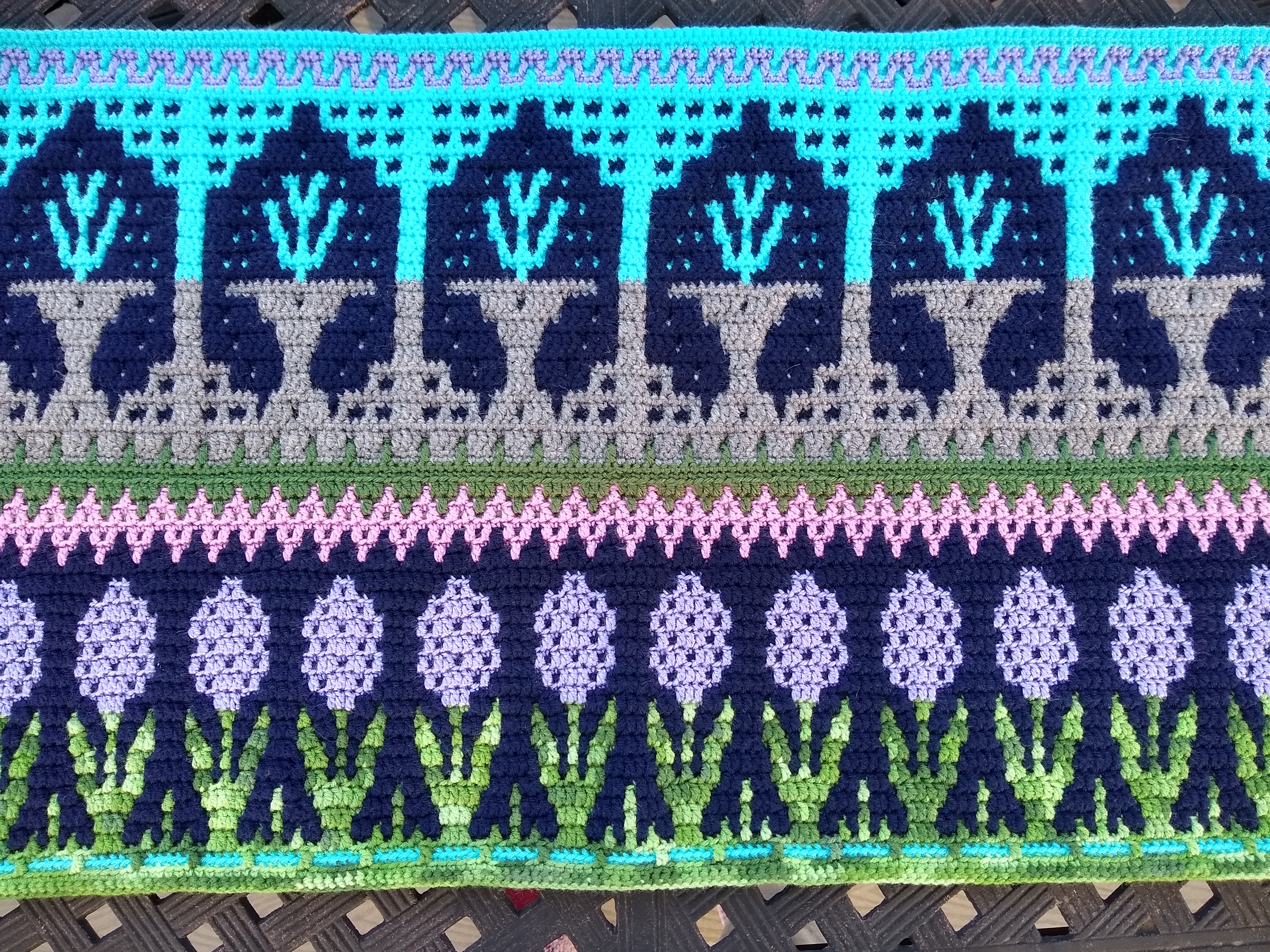
Parts 1 and 2 of the Letitia’s Garden CAL blanket I am working on for my mom. (Pattern by Rosina Plane on Ravelry)

What I love about crochet is that when I’m done with a project, there is an immediate pay off. I learn stitches, I follow a pattern, and I get a hat/scarf/blanket/produce bag/stuffed squid. Unlike writing where it takes months or years for a pay off, crocheting smaller projects can be done in an hour or two. It’s something I do to wind down if I’m feeling stressed by working on something simple or repetitive or to challenge myself by choosing something with an intricate pattern like the blanket in the picture. It helps keep me centered, especially when my writing isn’t going well.

Part of the reason this works is because I am a goal-oriented person who mentally gets off to ticking things off a to-do list, and a crochet pattern is basically a to-do list that ends in a product magically appearing. I can see the pay-off happening as I work the pattern, and that gives me the brain boost I need to counterbalance what’s going wrong with my writing. Does it help all the time? Absolutely not, and sometimes, I can’t bear the thought of picking up my crochet project and working on it.

But having a hobby that isn’t writing to give your brain that boost it needs to keep out of a downward spiral is really what is key here. If you’re athletic, maybe going to the gym and doing reps or having a pick-up game with your friends will do the trick. If you’re a crafter like me, maybe try crochet, needlepoint, knitting, plastic canvas, or even needle felting. Nothing like stabbing something a million times to get the frustration out. The good thing is, most of these hobbies don’t cost very much. You can get cheap yarn and a serviceable set of hooks/needles for $10 and there are tons of tutorials on YouTube, which is where I learned to crochet (I highly recommend HookedByRobin or JaydaInStitches).

If you are not crafty, then try video games. Much like crafts, quests give that bite size chunk pay off and seeing progression through a story or quest helps to refill the wells with serotonin. I greatly enjoy low stress games like Stardew Valley, Animal Crossing, and Ooblets, so if you aren’t a big gamer, those might be a good place to start to unwind.

The other thing I might suggest if you don’t feel like getting into a new hobby or playing a game is reading. I think most authors also tend to be readers, but I get frustrated when I hear authors say they don’t have time to read. You can probably make time for anything you truly want to do, even if it’s squeezing in a few minutes reading an ebook on your phone while in the bathroom. It still helps to refill those creative reservoirs.

Truthfully, I think doing something non-book related is the better option when you need to counterbalance writing angst. Doing something with your hands or playing video games, which helps to engage that hand-eye coordination and decision making anyway, are rife with pay-offs that might make you feel better if things are going wrong. Those small pay-offs that a hobby can bring add up and will ultimately lower your stress even if a pattern or project is frustrating in the moment. A side benefit is that I’ve often had plot epiphanies while my brain was busy chugging away a crochet project or plantings crops in Stardew Valley. It’s the repetitive, meditative nature of it that allows for your brain to run in the background and unpick the knots you’ve made.

If you’re feeling frustrated or stuck with your writing, I highly recommend trying a new hobby or picking up an old one.

Writing

All of My Books are Now Available on Google Play

The title pretty much gives it away, but yes! All of my books are available on the Google Play store. I will be uploading the short stories there soon, but for now, every novel is available in every country Google Play supports, including the box sets.

The links are active, but I’m still trickling through the system (aka they’re not showing up in searches yet). All of the content warnings and blurbs are available by clicking the books page at the top of the menu on my website.


If you’re someone who uses Google Play, you can grab your copies below:

Kinship and Kindness (Paranormal Society Romance #1, latest book)

The Earl of Brass (Ingenious Mechanical Devices #1, only 99c, oldest book)

The Gentleman Devil (Ingenious Mechanical Devices #2)

The Earl and the Artificer (Ingenious Mechanical Devices #3)

Dead Magic (Ingenious Mechanical Devices #4)

Selkie Cove (Ingenious Mechanical Devices #5)

The Wolf Witch (Ingenious Mechanical Devices #6)

Box set IMD 1-3

Box set IMD 4-6

organization · Writing

On Doing Things Wrong as an Author

Let me preface this by saying this is not a how-to on how to fix your screw ups. This is a post about things I screwed up that I didn’t realize were even a problem until I did them [repeatedly].

There is no right or wrong way to do most things as an author, especially in regards to writing. There will always be people who are really into your niche genre or dying for this very specific type of character you’re writing, but on the business end of things, there are, let’s say, less desirable ways of doing things. Things that don’t benefit you/the writer or the reader/your audience.

How I F-ed Up My Newsletter

I am incredibly guilty of doing those less desirable things because I’m either a) tired or burnout b) didn’t know better c) didn’t want to bother anyone. I bolded and italicized the last one because not wanting to bother anyone has been a lifelong mode of operation that I probably need therapy for, but we will not get into that. The problem with that mindset is that you treat everything you do as a chore for others. I only send emails to my newsletter occasionally because I don’t want to bother them. Or I don’t want to advertise my book because I don’t want to bother people. This means I am treating the books that I love and spent hours and hours of my life working on as something unworthy of attention, and in the long-run, I am setting myself up for failure because people don’t know I have books or think I’m only reaching out to sell them something, which is not a great look.

So what I’ve been working on is creating a monthly newsletter that will cover the following things:

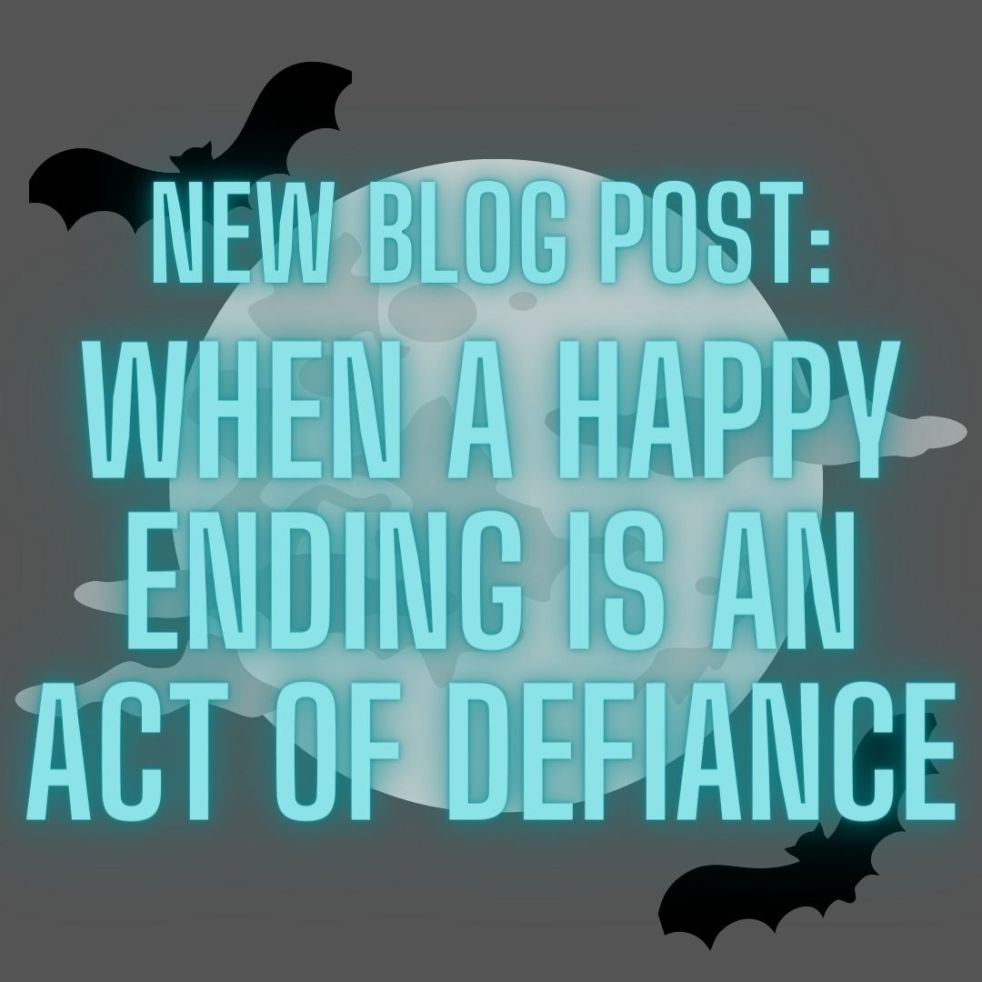
Join my monthly newsletter for: sneak peeks, freebies/deals, book recommendations, life updates, pet pics, and book research
The background is grey with teal writing and there are 2 bats flying behind the words.

If you join my monthly newsletter, I’ll share things I’m working on, some cool research (and let me tell you, writing historically set books, there is a lot and it is weird), pics of my dogs, and books that I’ve read and loved and think you’ll love, too. When you sign-up, you’ll also get a free prequel short story, and over the next few months, I plan to send out another free short to subscribers. After the initial thank you emails, you will get monthly emails, which will be sent out at the end of every month.

I decided to change this to a beefier, monthly email because I was doing a disservice to my readers/subscribers by “not bothering them” except when I had book updates, and when I thought harder about that, it felt wrong to only send messages when I published. You could just follow me on Amazon or Bookbub if you wanted that kind of bare bones update.

How I F-ed Up my Back Matter

The next giant thing I screwed up is not keeping up with fixing my back matter. Back matter is the about the author, also by the author, newsletter/social media links, etc. that are found at the back of your book. Between changing laptops several times since 2014, switching writing programs, and just being overwhelmed at the prospect of going through like 10 Word docs, I put off updating all of these things for YEARS. This means that my first book had an “also by” list that only went up to like book four of the series. I facepalmed hard when I realized I hadn’t updated my back matter since 2017.

Something I would also recommend other authors doing is going back and formatting their docs, so the chapter headers are in a heading style and the body text is one uniform style. This makes it easier for the Kindle and eReader software to convert your book to something that makes sense. Guess who went back and properly formatted all 10 documents? And I was shocked to find that once I got going, it took significantly less time than I expected. I was able to do all of them over the course of a week and reuploaded the new files to my distributors. Amazon/KDP also has a new bit of free software called Kindle Create that is a lot like Vellum or, if you’ve used D2D, their autogenerated software, which will break your book into chapters and add pretty flourishes if you’re so inclined. Once again, very easy, highly recommend to make your books look spiffy.

If you’re an author, this is your sign to fix your back matter and formatting as it won’t take you nearly as long as you think once you finish the first book.

How I Forgot to Publish an Entire Box Set

The last thing I did to get my work back into shape is to add a new box set for the Ingenious Mechanical Devices series. A while ago, I made a box set for books 1-3, which is 20% off the cost of buying the books individually, but I thought I’d wait until a year after book 6 came out before I made the next box set. Well, then I got overwhelmed with life and then enough time passed that I forgot. A couple weeks ago, I reached out to my cover designer (Lou Harper at Cover Affairs), made the file, and got it all listed, so if you’re interested in getting a box set of books 4-6 for 25% off buying the books individually, now you can. Both sets are available on all major retailers, BUT I had a little hiccup with Apple Books and Kobo. They have the set as a preorder that releases January 29th. I’ve reached out to fix it with no answer, but the 29th isn’t that far away, so if it doesn’t get fixed immediately, you will get your books by the end of the month.

TL;DR

If you’re an author, research best practices instead of assuming you’re being annoying because you could be in a totally different way than you though.

You may also want to join my monthly newsletter as it starts up in earnest this month.

If you’re an author, fix your back matter and formatting.

Check out my latest release, which is a box set of books 4-6 in the Ingenious Mechanical Devices series for 25% off the cost of the books individually.


Let me know in the comments what kinds of things you like to see in author newsletters!

Monthly Review · Writing

2022 Projects

Photo by Lisa on Pexels.com

As I mentioned in my recent post, I want 2022 to be a year of getting my shit together. I’ll talk more about this in a future post, but I have been taking a course on the HB90 method, which is a way to keep yourself organized, plan future goals, and get your life in order. The course was made by a fellow writer, so I’m hopeful it’ll help me to get back on track. While I’m doing the behind the scenes work, I wanted to give you a little preview of what I am working on and hope to publish in the coming year.

Now, a little disclaimer that I cannot control many factors, so I don’t have full release dates yet. Assume longer projects will come out in the second half of 2022.


Photo by Mitja Juraja on Pexels.com

The Reanimator’s Heart

The Reanimator’s Heart is an off-shoot of the Paranormal Society Romances, so it still takes place in the same time period as Kinship and Kindness and many scenes are at the New York Paranormal Society. The reason I chose to create a spin-off is because this will be sort of equal parts paranormal mystery and M/M romance.

The Reanimator’s Heart is like Pushing Up Daisys meets Penny Dreadful. There are definitely some darker, scarier moments in this story, so if you like Jordan L. Hawk’s Widdershins or KJ Charles’ Magpie Lord stories, this is probably up your alley.

Oliver Barlow is the Paranormal Society’s resident coroner and necromancer. Oliver does his best to keep his powers hidden, but when he finds the man he’s had a crush on for years dead, he accidentally revives the charming Felipe Galvan. But Felipe refuses to go back to being dead until they find out who murdered him. Oliver and Felipe soon find themselves entangled with a murderous cabal that wants to bring something horrid from the great beyond.


Photo by Brandon Nickerson on Pexels.com

TROUSERS AND TROUBLE (Paranormal Society Romance #2)

Trousers and Trouble is the sequel/prequel to Kinship and Kindness. This story follows Bennett from when he leaves his uncle’s home, arrives in Brooklyn, and meets his best friends, Ruth and Rory. I know the series title says, “romance,” but let’s stretch this to mean platonic friendships and self-love. This is really a story of Bennett discovering who he is and a community where he is accepted for who he is (on several levels).

As with Kinship and Kindness, there will be magic, shifters, but this story has three transgender main characters. Ruth and Rory will eventually each have their own books in the series.

Between drag balls, performances at the Stratford Theater, and days spent at the Paranormal Society, Rory and Ruth are living their best, bachelor lives in Brooklyn. That is until a teenager on the run from his old life stumbles into their path.
While parenting had never been in the cards, Ruth and Rory know what they need to do, and they soon become Bennett’s fairy godmothers as they help him become the person he was always meant to be. But sometimes the past sinks in its teeth and refuses to let go. When Bennett’s family comes knocking, Ruth and Rory will stop at nothing to keep their new friend safe.


Future WIPS

  • A short story freebie for my newsletter that will probably be in the K&K world (join my newsletter in advance and you will get another free short story, “The Errant Earl”)
  • Tempests and Temptation (PSR #3)
  • Book 2 of the unnamed necromancer series
  • More books in the Ingenious Mechanical Devices series- not sure how many, but there will be at least 2 more

Well, I think I have kept you all long enough. Let me know in the comments which of these projects you are most looking forward to!

Kinship and Kindness · Writing

Cover Reveal: Kinship and Kindness

I know I’ve been going off the grid on here, but there’s a good reason (besides work and life), I’ve been working on a new book: Kinship and Kindness.

Kinship and Kindness is a bit of a spin-off from the Ingenious Mechanical Devices series. It follows Theo Bisclavret, the name might sound familiar because he was mentioned in The Wolf Witch. He is Silas Bisclavret’s son and Wesley’s brother.

The story continues where The Wolf Witch left off, but it’s set in Louisiana and kicks off a new series about paranormal society in America. It’s a m/m romance between a cis man and a trans man, and yes, that is very possible historically (see my previous post about queer historical-romance). Here is the blurb:

Bennett Reynard needs one thing: to speak to the Rougarou about starting a union for shifters in New York City before the delegation arrives. When his dirigible finally lands in Louisiana, he finds the Rougarou is gone and in his stead is his handsome son, Theo, who seems to care for everyone but himself. Hoping he can still petition the Rougarou, Bennett stays only to find he is growing dangerously close to Theo Bisclavret.
Theo Bisclavret thought he had finally come to terms with never being able to take his father’s place as the Rougarou, but with his father stuck in England and a delegation of werewolves arriving in town, Theo’s quiet life is thrown into chaos as he and his sister take over his duties. Assuming his father’s place has salted old wounds, but when a stranger arrives offering to help, Theo knows he can’t say no, even if Mr. Reynard makes him long for things he had sworn off years ago.
As rivals arrive to challenge Theo for power and destroy the life Bennett has built, they know they must face their greatest fears or risk losing all they have fought for. With secrets threatening to topple their worlds, can Theo and Bennett let down their walls before it’s too late?

As promised, here is the cover, done by the wonderful Lou Harper.

Kinship and Kindness

If you’re interested, you can pre-order Kinship and Kindness here. I plan on setting up the pre-order to other retailers soon, but I need to work out the logistics first.

In regards to the publication date, it’s currently set on July 1st, but I’m hoping to have it ready by early May. When you set-up a pre-order you cannot push it back if things so south, so I’ve left myself wiggle room and will move the date up (and let everyone know when I do).

Stay tuned because I will be posting an excerpt as we grow closer to publication.

Writing

On Accuracy in Historical Romance

couplesketches__adam_immanuel_by_fi_di-d6x8irf
Adam and Immanuel from The Winter Garden.

Back in April, I presented a paper at Ithaca College’s feminist pop culture conference From Pippi to Ripley on the issues surrounding the perceived “inaccuracies” in historical romance, especially queer historical romance. Since this issue has reared its ugly head again, I thought I would share my paper with you.


Queer Historical Romance and the Reclamation of Identity and Power

 In recent years, as media has become more diverse, from Star Wars to romance novels, critics have claimed that portrayals of marginalized characters are historically inaccurate or done to pander to political correctness. What these critics fail to understand is that historical “accuracy” is often far from accurate. As with all wars, to the victors go the spoils and that includes the historical narrative. The narratives found in modern historical romance novels are by and large white supremacist, Christian, and upholding of colonialist values. Following the expansion of LGBT rights and the acceptance of queer characters in media, queer authors have fought to reclaim the history of those who have come before us, whose voices were lost to puritanical scholars and censors that twisted the public’s perception of the trajectory of LGBT lives. By writing historical romances to fill in the missing gaps in queer history, queer writers strengthen the modern community by asserting a history of sexual and bodily autonomy. Modern queer historical romance novels aren’t meant to be a revisionist history but a re-enlightened one that seeks to capture on the page the people and communities that had previously only lived in the margins of history.

If you’ve ever looked at the reviews of any piece of diverse media, you have come across someone spouting that the diversity present is forced or that it was impossible for a homosexual relationship to be semi-public given the time period. Questions of “realism” and “historical accuracy” have been the greatest hindrance to diverse media, but this begs one to consider what is truly historically accurate. In her essay, “Reclaiming Historical Romance,” Elizabeth Kingston posits that often what we, as readers, consider to be historical fact is actually historical fantasy that has been passed down by previous historians and repeated until it morphed into “fact” (Kingston 1). History has been overwhelmingly written by the “victors” or those who have maintained imperialist or political control. For most of the modern Western world, that has been white, Christian, heterosexual men who have espoused white supremacist views in their writings. As Bronski states in A Queer History of the United States, “The writing and reading of history is always, consciously or not, a political act of interpretation” (xiv).

Until the last few decades, queer history has been relegated to the periphery, and those queer figures who appear in the past are seen as aberrations or were viewed as deviants. The language surrounding queer stories in mass media was tainted by white supremacist political views. Despite a large portion of the queer community, especially in the seventeen to early nineteen hundreds being white, they were viewed by the community at large as going against the white supremacist view of sexual purity. This stems from Puritanical Christian views and was widely adopted after the Second Great Awakening (Bronski 89). To deviate from the heteronormative family structure was to go against the entire structure upon which evangelical and puritanical society was built (10). To many, this would mean that queer populations were nonexistent or were so afraid of persecution that they wouldn’t dare act on their feelings, but this is exactly what white supremacists want us to believe. To make a person who is not like them feel isolated or that they should be ashamed of their differences, is a way to keep them powerless. For if they hide who they are, they are less likely to find others who sympathize or understand their situation.

Developing communities of support and creating public sympathy through shared experience is how marginalized populations gain a foothold on power and social autonomy. In the mid-nineteenth century queer communities began to take root in cities and gained visibility. Due to the anonymity of city life and the ease for single people to find same-sex housing, queer relationships could blossom in relative security. Nowhere were these queer communities more visible than in the arts’ districts. Many places we think of as queer communities now, were the same over a century ago. Greenwich Village, Harlem, and Bloomsbury in London became hubs for the arts, which were often dominated by queer voices. Queer voices were consumed by the masses in vaudeville shows, plays, novels, and the visual arts, but as these voices grew stronger, political institutions stepped in to “protect” the public from what they deemed to be dangerous or deviant behavior in flouting their views of sexual purity and gender norms.

As we can see from the Oscar Wilde’s trial, art could be used as evidence against the creator if it contained homosexual or homoerotic themes, but this didn’t stop authors from publishing “scandalous literature” in America and France. While it was illegal to mail sexually explicit material through the mail, it happened and books regarding sexology and those with homosexual themes were increasingly popular well into the first half of the twentieth century (Bronski 126). History has shown that trying to stop publications is like a game of Whack-a-Mole. It was near impossible to stop people from distributing written material, especially since it was protected by the First Amendment, but the government could stop Hollywood from promoting queer or sexually progressive stories, such as Morocco, which featured the first on-screen lesbian kiss. After the US government threatened to create a censorship board, Hollywood adopted the Hays Code (or the Motion Picture Production Code) and began enforcing it in 1934. Among other things, the Hays Code stated that immorality had to be punished on screen, only “correct standards of life” could be portrayed, sexual behavior could not be shown, and “perverse” behavior could not be shown (“The Hays Code”). All of this combined to make it impossible for queer characters or relationships to be portrayed on screen without heavy coding or a tragic ending. The “bury our gays” trope sprung from this code as those who acted “immorally” according to puritanical Christian beliefs had to be punished and in many cases killed as penance for their behavior. Despite that the Hays Code stopped being enforced in 1968, the damage had been done. The general public had internalized years of anti-queer propaganda to the point that fiction became reality and the myth that queer characters could not have happy lives was solidified in Western culture.

Over the past decade, a new genre of romance has solidified itself as a rapidly expanding subset of historical fiction: queer historical romance. These stories seek to fight against the tide of historical myth that has painted queer relationships formed in the past as impossible or filled with strife. Authors such as KJ Charles, E. E. Ottoman, Joanna Chambers, and Cat Sebastian have sought to not only create works of fiction that uphold the idea that queer characters are entitled to a happy ending but have produced scholarship that upholds that what critics believe is historical fact is truly a political agenda to ignore what doesn’t fit their narrative. The question some of you may be asking is, “Why focus on romance?” Historically, romance as a genre has been treated with disdain by academia because it is portrayed as a genre filled with shirtless men and trope-laden stories about love. Bodice-rippers, as historical romances have often been called, are generally women’s fiction. They are stories written for women by women and act upon the desires and fantasies of women that have largely been ignored by society. The Western canon, despite rising scholars’ best efforts is still largely misogynistic, so the stories that are seen as feminine, such as romances, are shelved as drivel for the masses when in reality, romance strikes at the heart of what oppressed populations truly want: autonomy and power over their own destinies.

In her blog post “Historical Romance: Who Gets the HEA,” KJ Charles explores why readers get hung up on supposed historical accuracy in diverse historical romance. She writes, “And yet there is a powerful strand of opinion that holds that any m/m histrom must reflect the fear of legal persecution,…that marginalised people simply cannot have happy endings,…because history was too cruel” (Charles, “Historical Romance”). We see this on a 2 star review for Cat Sebastian’s A Ruin of a Rake. The reviewer states, “It’s extremely difficult to suspend my disbelief about the relationship between Lord Courteny and Julian Medlock as in 1817, Homosexual relationships were illegal and there were very serious consequences if they had been exposed” (Rodriguez). The reader is correct in that there were sodomy laws on the books in England, but the rate at which people were prosecuted for being in a homosexual relationship is far lower than many modern readers realize. Furthermore we must explore the idea of the legality of something being a hindrance for its occurrence. Gambling, graffiti, and jaywalking are all far more visible than the private lives of two people and are all illegal, yet they occur unpunished with alarming frequency. Readers of historical romance rarely complain that a story is lacking lice, a healthy fear of venereal disease, or the stink of chamber pots, but queer or interracial relationships occurring during earlier historical periods are remarked upon. As Kingston states, “Historical Romance is a shared, collaborative fantasy” that has shut out more people than it has let in (Kingston 4). The greater issue is that the trends within traditional historical romance send the message that “only straight white Christians deserve loving relationships” (4). No matter the amount of privilege the characters have, like Lord Courteny who is titled, rich, and already seen as a rake, it is impossible for certain readers to believe that alone could have afforded him the privacy and social standing to not be prosecuted for sodomy.

A key flaw in historical romance, as a genre, is the definition of a happily ever after disproportionately favors straight, white, cis couples. Generally a happily ever after in romance involves the couple courting, getting engaged, married, and often books end with a pregnancy or hint that a family will follow. For queer historical fiction, there are very few instances where that stereotypical happily ever after is possible. The assumption from romance writers and readers that queer love stories can’t be romances because they don’t follow that formula is inherently homophobic, but the greater question is, do we want that ending? The traditional familial model of date, marry, mate, follows a formula endorsed by the social purity movement. The forefathers of that movement, the Puritans, believed that anything outside of the family unit is forbidden and that to ensure society’s stability, partners must be monogamous and make matches in order to procreate. This “traditional” mode of living has gone relatively unquestioned for centuries, and what queer historical fiction offers is a precedent for more complex social and sexual relationships.

Inherently, the writing of romance stories is the private made public. The lives of those who came before us were often obscured for safety reasons or were written over by scholars who chose to ignore or not see what was truly before them. What romance allows us is to speculate how couples came to be and how they navigated the public and private spheres to find their own version of happily ever after. Queer historical romance deviates from the “norm” out of necessity, but it allows readers to explore how a relationship that doesn’t follow the formula of date, marry, mate was still able to thrive. Further, these stories uphold that women’s lives are not “made whole” by children or a husband to support them. Often, Sapphic historical romance involves women who are working to support themselves through a trade. For male-male couples in historical romance, we see how two individuals can live separate lives and without cohabitation still manage to be a long-term couple.

That isn’t to say that all queer historical works involve monogamy. In KJ Charles’ Band Sinister, we meet a group of friends who are for the most part queer, ranging from gay or bisexual to transgender. Three of the men in their hellfire club have had an ongoing relationship with each other for decades. When Sir Philip becomes involved with his new lover, Guy, he makes certain Guy understands how deeply he feels for his two friends. Philip states, “that may not be the kind of love about which the poets write, nor the kind I feel for you, but it’s still real and true as anything in the world” (Charles, Band Sinister 3010). Queer historical fictions allows for greater exploration of different types of love, especially those that have generally been seen as lesser in modern society. We see this blurring of queer/quasiplatonic relationships in many other queer historical works, including KJ Charles’ Society of Gentlemen series, Joanna Chambers’ Enlightenment series, and Cat Sebastian’s A Duke in Disguise.

Within queer romance, we’re given an intimate look at love that defies labels. Queer stories are “places for individual and collective explorations” that allow us to “[understand] the self through the larger fabric of culture and history and relationality” (Royster). Writing inherently requires us to pull from our own experiences and fears, and by writing within a historical setting and with characters who don’t fit our exact specifications, it allows writers to navigate the difficulties of their own world in a controlled environment and through a lens that allows enough distance and difference for exploration. In a way, we get to know “the self as other and the self as same” (Johnson 429). It is often through writing queer romance that people discover their sexuality or gender identity is more complex than originally thought, and for those who know, it allows a deeper exploration of queer identity than is often possible in real life.

Ultimately, writing is a performative act, and through the creation of images, action, and insertion of the self onto the page, the writer has self-actualized a moment in time (Rogerson 3). Much like photography, writing seeks to create and suspend moments. For queer writers, the images created are somewhat speculative since much of queer history has been erased, ignored, or purposefully left off the page for their own protection. By putting the actions and feelings of queer characters in queer relationships on paper, that missing history is being reasserted and physically actualized where there had once been a gap. Just because that moment or those people didn’t truly exist doesn’t really matter. The perception of history is itself as much fantasy as reality, but what is true is that no matter the rules, people have acted upon queer desire and others have been complicit in affording them a peaceful life. In an age of renewed fervor in the social purity movement, queer writers are digging in their heels and reasserting their sexual and bodily autonomy by reweaving the roots of history that were torn asunder decades and centuries past. By writing the past, they cement themselves in the present.

Queer historical romance aims to blow the dust off history by uncovering those who lived in the margins and reassert that history has been far less heteronormative than it has been portrayed to be. In recent years, queer historical romance has grown into a major subgenre of romance novels, and this assertion of sexual autonomy through the written word has come as a counterstrike against the white supremacist ideology dominating politics and romance novels. Despite what detractors might believe, queer relationships have always existed in America, and queer historical romance is not fiction in the way they think. Romance novels are the private made public, and queer historical romance is a reassertion of identity and sexual autonomy, a reminder that, no matter what social purists might say regarding queer relationships or non-heteronormative relationships, they have always existed and will continue to flourish.


Works Cited

Bronski, Michael. A Queer History of the United States. Beacon Press, 2011. ReVisioning American History.

Charles, KJ. Band Sinister. E-book, KJC Books, 2018.

—. “Historical Romance: Who Gets the Happy Ending.” KJ Charles, 10 Oct. 2018, kjcharleswriter.com/2018/10/10/historical-romance-who-gets-hea/?fbclid=IwAR2wHOz1DzIW2gP9IFfRcSRSXS9GQgEjjmcCFbh4cbbm8CYSTv7SDyXQ5s4.

Johnson, E. Patrick. “Queer Epistomeologies: Theorizing the Self from a Writerly Place Called Home.” Biography, vol. 34, no. 4, Summer 2011, pp. 429-46. Academic Search Premier. Accessed 20 Apr. 2019.

Kingston, Elizabeth. “Reclaiming Historical Romance.” Elizabeth Kingston, Dec. 2018. Accessed 16 Apr. 2019.

Rodriquez, Cecilia. “Masculine Pygmalion.” Review of A Ruin of a Rake. Amazon.com, 16 Mar. 2018, http://www.amazon.com/Ruin-Rake-Cat-Sebastian/product-reviews/0062642537/ref=cm_cr_dp_d_hist_2?ie=UTF8&filterByStar=two_star&reviewerType=all_reviews#reviews-filter-bar. Accessed 16 Apr. 2019.

Rogerson, Stephanie. “Without Words You Spoke: Early Snapshot Photography and Queer Representation.” Afterimage, vol. 36, no. 1, July 2008, pp. 10-13. EBSCOhost. Accessed 20 Apr. 2019.

Royster, Francesca T. “Introductory Notes: Performing Queer Lives.” Biography, vol. 34, no. 3, Summer 2011, pp. v-xii. Academic Search Premier. Accessed 20 Apr. 2019.


The Wolf Witch · Writing

The Wolf Witch is Out Today!

banner books to 6

The sixth book in the Ingenious Mechanical Device is out today! You can grab a paperback or ebook copy of THE WOLF WITCH on Amazon here.

Since returning to England from abroad, Emmeline Jardine has managed to get a place of her own, maintain a tenuous truce with her guardians, and celebrate her new found freedom by attending as many parties as she can manage. That is until a man claiming to be her father shows up.
Her father has a problem. Her half-brother, Wesley, has disappeared while investigating possible werewolf sightings, and he needs Emmeline’s help finding him. Emmeline reluctantly agrees only to find there are others interested in Wesley’s plight. When she receives a mysterious invitation to a country estate deep in the woods, Emmeline is shocked to find a familiar face there.
Nadir Talbot, Decadent, writer, and all around nuisance, infuriates her to no end, but Emmeline soon finds he is the only she can turn to as they are thrust into a world of werewolves, monsters, and secrets from her family’s past that threaten to bring the empire to its knees.

Emmeline has done a lot of growing since Dead Magic, so I hope you’ll enjoy reading her story and following her on her journey to discovering who she truly is.

If you pre-ordered a copy, it will be waiting for you on your Kindle, and if you enjoyed THE WOLF WITCH, I hope you will leave an honest review on Amazon or Goodreads. They help small time authors like me a lot in terms of visibility.

I hope you all enjoy THE WOLF WITCH, and I will have news soon on my next project, which involves characters mentioned in THE WOLF WITCH.