Book Reviews

Book Review: Write. Publish. Repeat.

wpr cover

Title: Write. Publish. Repeat.: The No-Luck-Required Guide to Self-publishing Success by Sean Platt and Johnny B. Truant with David Wright

Genre: Writing, non-fiction

Rating: ♥ ♥ ♥ ♥ ♥

TL;DR: Write. Publish. Repeat. is an indie author’s dream in terms of a straight-forward how-to book for marketing, building an audience, and creating a writing empire.


I love Sean Platt and Johnny B. Truant. This is the first of their books that I’ve read. I picked this one up on a recommendation from several other authors, and I am so glad I did.
Write. Publish. Repeat. is an extensive book, covering the self-publishing/publishing as an industry, how to look professional, what to do, what not to do, marketing, and probably every other topic under the sun that an indie author could want to know about.
The information is laid out in an easy to follow manner with each section of the book being devoted to a certain topic, and while the authors say there may be some back-tracking and double covering of topics, I didn’t notice. The tone is conversational and most importantly common-sensical. Platt and Truant pull from their own experiences as indie authors as well as those of their friends and fellow authors to illustrate how to an author can make it in the industry by achieving certain manageable goals. The book certainly isn’t a get-rich-quick scheme or a sensationalized how-to-make-millions-with-a-shitty-but-marketable-book book. Truant and Platt don’t play that way, and they remind the reader of that.
Write. Publish. Repeat. relies on an author understanding a few finer points: be adaptable, work hard, and be yourself without being an asshole because no body likes those.
People who should read this book: Indie authors of any range (new, moderately successful, successful, thinking of possibly maybe publishing) and traditionally published authors who need to learn how to market their book professionally or would like to know about more publishing options or would simply like to build their brand. I’m thinking especially of authors published by small presses.
People who shouldn’t read this book: people who want fame and fortune with one book, people who aren’t in it for the long haul, quitters, whiners, literati types, and people who can’t deal with occasional profanity.
Write. Publish. Repeat. is an indie author staple. The advice within in it is straight-forward, doable, and for the most part, painless. If you’re even thinking about going indie, read it.

Writing

Plot Bunnies and Projects

dm cover idea
A sketch for the cover concept for Dead Magic.

Hey peeps,

I thought I’d drop a post about why there’s been silence AGAIN on the blog. Well, that’s mostly because I’m actually writing. The more words dropped into MS Word, the less words I have to spare for the blog.

So I am knee-deep in Dead Magic at about 45% of the way into it. I’m still planning on having it ready to publish in the fall, so I will definitely be posting more excerpts and hints along the way.

What I’m really excited to announce is that between now and the fall, I will be writing two companion novellas for the Ingenious Mechanical Devices series.

The first story divides its time between Edo Japan where Americans and Europeans have finally barged in to “modernize” the Japanese and 1880s New York. Judith Elliott’s little sister is dead. Unable to save her and in failing health, Judith is sent to her uncle’s country home in New Jersey to recover. Resentful and dissatisfied with life, Judith fights her family’s concern and the treatments her doctors believe will get her over the devastating loss. Judith fears her life will never go on until she meets her uncle’s Japanese wife, Kiyo. Kiyo has seen more in her life than anyone Judith knows and thinks she can devise a way to repair a broken spirit. Can Kiyo help Judith move on? And is it possible to move on after fate steals the one you love?

The second will be a paranormal romance that centers around Emmeline’s mother. An old suitor has come to call. Two years after his disappearance, he’s returned to claim Madeline’s heart and hand. The only thing standing in their way is her absentee husband who has once again gone off to Africa, leaving Madeline alone at Headington Hill. Will she give in to her renewed feelings? And does her ex-lover have more to explain than just his absence?

Sound interesting? Well, the reason I decided to post the early blurbs for my forthcoming novellas is because I’ll be offering them as free ARCs (advanced reader copies) to my newsletter followers. If you would like to receive the free ARCs for my next two novellas along with updates and exclusive excerpts, sign-up for my newsletter by clicking here.

Personal Life

Graduation

As of last Wednesday, I have officially graduated from graduate school with my MFA in Creative and Professional Writing.

It seems strange to say that I’m done with school since I’ve been in it one way or another for nearly 20 years. I still may go back for a MA in literature, but for now, I’m done.

It still hasn’t sunk in yet. I feel like in the fall I should be ordering texts for class and preparing my backpack with supplies.

I guess I’ll be doing much of the same thing because in the fall I’ll be an adjunct professor at two universities, teaching freshman writing. An adjunct professor is basically a part-time professor who teaches the underclassmen. An entry level professor. It’s the bottom of ladder, but at least I’m on a rung. I’ll be one step closer to becoming a full-time English professor. It may take years to get there, but I’m willing to stick it out.

For most of my life, I had no idea what I wanted to be when I “grew up.” I went from wanting to be an archaeologist to a doctor to an English professor. What I really want to be is a writer, but I think I can balance that with working as a professor. I’ll be teaching students about writing and literature while actively engaging in that community. I’ve seen the publishing industry change over the last five years, and I’ve been self-publishing for the last two. I’m someone who loves reading and writing, and I hope I can impart that to my future students. My life was changed drastically by the influence of a few key professors, and maybe one day, I’ll be that professor for someone.

Writing

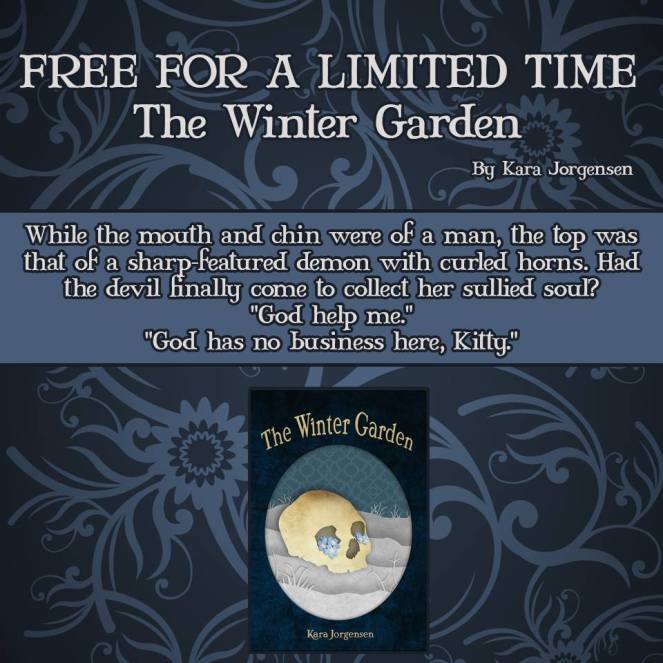
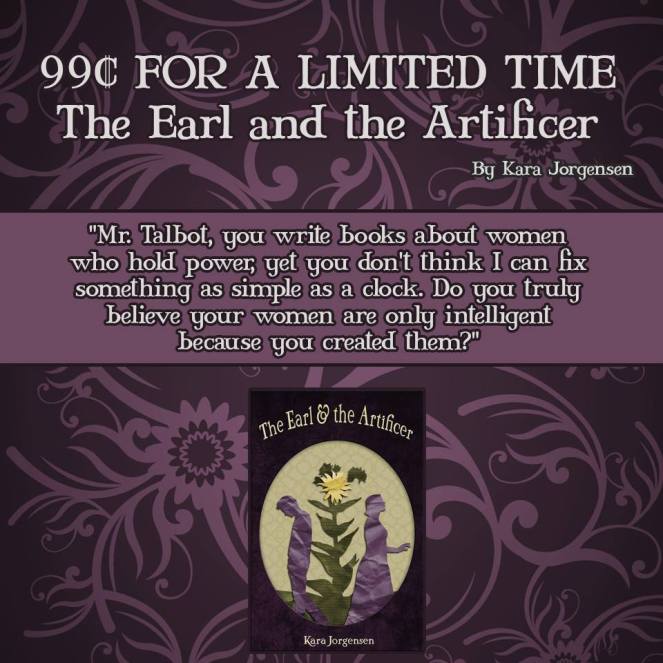
Series Mega Sale!

EoB WG free promoEatA 99 promo


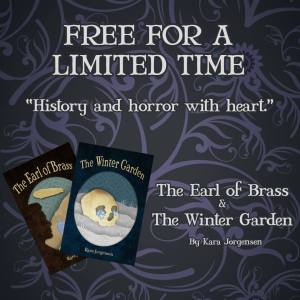
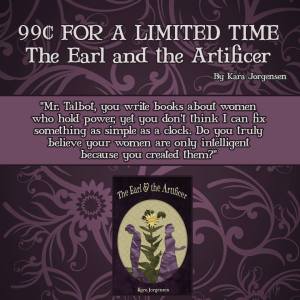
As you can see, the entire Ingenious Mechanical Devices series is on sale this week from Monday (5/16) to Thursday (5/19).

I decided to mark everything down as a little congrats to all of the college/grad students finishing up this week and the professors who are finally finished with papers. You can get the whole set for less than $2. The links are below, and if you are able or would like to help an indie author out, please share the pics under the links on your social media accounts to help spread the word.

The Earl of Brass FREE

The Winter Garden FREE

“An Oxford Holiday” 99 cents

The Earl and the Artificer 99 cents

EoB free promoWG free promoEatA 99 promoEoB WG free promo

Writing

5 Tips for Atmospheric Writing

Recently, I’ve been reading Maggie Stiefvater’s series The Raven Cycle, and what has blown me away (besides the characters, plot, and just amazing story overall) is her ability to create atmospheric settings. What I mean by that is that the settings evoke a specific feeling, and this feeling adds to the tension or heightens the mood of the piece. Atmospheric settings can sometimes be so evocative that they are characters themselves. I found this in The Raven Cycle series by Maggie Stiefvater, Jazz by Toni Morrison, and The Witching Hour by Anne Rice.

In my own writing, I’ve tried to develop this skill while building the backdrop of London in The Winter Garden and Brasshurst Hall in The Earl and the Artificer. While working on this skill, I’ve learned a few things.

  1. Write your scene first. Add your atmosphere after. I tend to write my scene in layers where I write out the dialogue and overall scene direction first. Then, I do a quick pass through where I add more detail until the scene is fleshed out. When it comes to writing, dialogue, plot, and character movement is much more important than atmosphere. My suggestion is always to work on your scenery after you’ve gotten the essentials down. This also tends to eliminate pages and pages of atmosphere/scene building because you already know what you need in your scene instead of tossing in everything and the kitchen sink just in case your character needs it.
  2. Know what you’re trying to evoke. It makes infinitely easier to build tension or heighten the mood if you know what you’re trying to accomplish. Ask yourself a questions. Is your story paranormal or a western? How does your genre affect the atmosphere of your piece? What’s the overall emotion in this scene? Suspense, mystery, anger, romance, sadness, etc. Does the feeling fit the genre or scene? Does it fit the characters? Sometimes the feelings will conflict with characters to create tension, but if it stands out in a bad way against the rest of your story, you may want to rethink what you’re trying to create.
  3. Figure out what your scenery looks like before you start adding it in. I don’t mean that you need to break out the Sims and start building an entire house, but you should know the major features or the features you hope to highlight. My suggestions is to jot down the defining characteristics of the character the scene relates to. For example, when I was creating Dr. Hawthorne’s home office, I knew he he was a busy doctor who was progressive for his day. This comes out in his bookshelf, which is filled with medical texts from scholars throughout history, and between books there are rather disgusting anatomical specimens in jars. Because he’s busy, his desk is covered in notes that need typing and random bits of paper for his own research. Personal spaces should reflect the characters who live in them. As always, knowing where you’re going makes it infinitely easier to avoid writer’s block.
  4. Focus on the senses. And not just sight. Pretend that you’re where your characters are. What would you smell? Could you taste or hear anything? The more sensory details you include, the more evocative your scene will be. When I get stuck in this area, I go onto Pinterest to look for photos or Youtube for videos of scenery or thunderstorms, depending on the scene. If need be, look up words to describe smells or tastes. I know I’ve looked up how to describe the smell of rain.
  5. When you’re all done, go back and prune. You don’t want pages and pages of atmosphere, so go back after you’ve written your scene and see if you can get rid of anything. Pay careful attention to word choice as you’re editing. Are your descriptions succinct and do they make sense? Show them to someone else and see what their feelings are about your descriptions. Sometimes what’s in our heads doesn’t come out on paper. Atmospheric writing should add to the scene, so if it’s doing nothing but adding to your word count, cut it.

If you’re trying to boost your writing skills and learn how to create atmosphere in your story, my best suggestion is to read and take notes on what other authors do. The best way to learn to write is to learn to read as a writer.

Do you have any examples of writers who rock at creating evocative scenery?

dead magic · Writing

Dead Magic Sniplet #2

dead magic

Dead Magic, the fourth book in the Ingenious Mechanical Devices series, won’t be out until the fall, so I thought I’d share another clip from my WIP with you. Miss Emmeline Jardine has pilfered a package from the Spiritualist Society.


The Dorothy Restaurant hummed with chatter only broken by the occasional sharp laugh. Emmeline resisted the urge to shift in her seat. She had been to the Dorothy several times with Cassandra Ashwood, but she never failed to feel odd there. There had never been a public place she frequented where men were not allowed. The room was overly bright even in the dreary weather with its cream and red walls and gaudy array of colorful Japanese fans and parasols artfully tacked to the walls and ceiling. Around them all manner of women ate the same meal at the same white tablecloth and vase of flowers. During previous visits they had spotted Constance Wilde and the Countess of Dorset not far from a table of shopgirls. In a space free of men, the women seemed to change before her eyes into some strange perversion of the womanhood she knew. Cigarettes were lit and overheard table conversation often involved politics, women’s rights, and even colonialism. Of course, there was gossip, but mixed in were stories of tête–à–têtes that bored on elicit. At the Dorothy, they all seemed so free, yet surrounded by a complete lack of restriction, Emmeline faltered.

“You’re very quiet today, Em,” Cassandra said, looking up from her roast chicken and potatoes.

Her eyes flickered over the window where rain pattered against the pane and through the drivel, she inadvertently caught the gaze of a man peeking inside. What he expected them to be doing, she couldn’t imagine, but gawkers, she was quickly learning, were common at the Dorothy.

“Ignore him.”

“Why are they always staring in? It’s rude. It’s a restaurant, not a sideshow.”

“They don’t like that we finally have some privacy. You know, you could have left your book in the coatroom. I’m pretty sure no one would steal it, especially when Miss Barker knows us.”

“That’s not what I was worried about.” She paused. What was she worried about? “I didn’t want anyone to see the title.”

Cassandra shook her head. “Maybe I don’t want to borrow it if you’re that nervous about other people seeing it.”

Emmeline gave her a weak smile. Her eyes traced the outline of the book beneath the crinkled paper. She had placed it on the table facedown with her reticule and gloves on top of it to keep Cassandra from turning it over. Her heart pulsed in her throat, ruining the taste of the meat in her mouth. She was itching to open it. Every time she looked away, she felt its glare upon her, as if the book was watching her—beckoning to her—the moment she turned her gaze. For a moment, she wondered if she should just confess to Cassandra what she had done and open the bloody book.

Before she could act on her thought, Cassandra straightened with a squeak. She wiped her mouth and took a long sip of tea before she asked, “Did I tell you about the gala?”

“What gala? The season is over.”

“Well, it isn’t a society party. It’s a gala to celebrate a new ancient botanical collection at the British Museum. I’m sure you heard.”

When Emmeline raised a dark brow, Cassandra continued, “Your aunt’s cousin, the Countess of Dorset, and her husband donated the main specimen, the silphium plant. Please tell me you know what I’m talking about. I’m sure your aunt mentioned it.”

Thinking back to dinner conversations, she could vaguely recall some mention of a party at the museum. She hadn’t paid much attention. “I don’t think I was invited, but it doesn’t matter. I don’t want to go.”

Cassandra’s chestnut eyes widened and sagged.

“You actually want to go? But why? It will be so boring. All those old stuffy scholars and their pinch-faced wives.”

“My friends will be there. I don’t think you have met her, but Judith Elliott is my best friend—”

Emmeline stiffened.

One of my best friends, and I’m certain you will love her as much as I do.”

“Of course,” she replied tartly as she stabbed a piece of boiled potato and brought it to her lips.

She could feel Cassandra’s gaze upon her, eyes torn between anger and guilt. Somehow, Emmeline had never imagined that she could have friends besides her, that she had a life outside the spiritualist society. That and the Dorothy was the only place she ever saw her, and she didn’t appear to have a beau or that she was even looking. Modern woman, Emmeline scoffed. No wonder Aunt Eliza loved when Miss Ashwood came for tea. Watching Cassandra go back to her meal, Emmeline’s stomach knotted. She knew so little about her even though they spent nearly every weekend together and most nights at the spiritualist society. She knew Cassandra worked as a secretary somewhere, though Emmeline couldn’t remember where, and that she lived in a flat not far from the society along with another woman.

From the edge of her vision, Emmeline studied Cassandra’s features. She envied her prominent cheekbones and her expressive lips. When she smiled, it made Emmeline’s face join in her joy, but it was her bearing that caught her attention when they first met. She had thought of quitting the spiritualist society for good until she spotted Cassandra waiting at the front door. She stood tall despite her short stature, with her walking suit smartly cut to accentuate her curves and the color rich enough to bring out the flecks of gold and green in her eyes. There was a self-assuredness about her that didn’t require words to enforce. Maybe that was what five years of relative independence did to a woman. Still, it was troubling to know she had no suitors to fall back on or tear her attention away from the gloom and tedium of the spiritualist society.

“I shouldn’t be telling you this since you have decided to be peevish, but Mr. Talbot’s cousin just walked in,” Cassandra whispered, her eyes darting toward the front door as a rush of warm, damp air washed in.

“How do you know who she is?”

“Because I just saw him drop her off.”

Whipping around, Emmeline turned in time to see a dark-haired woman enter and a charcoal grey steamer pull away from the curb. “I can’t believe I missed—”

The words died in her throat. Cassandra was holding the book, her book, regarding her with pursed lips. Emmeline reached to snatch it from her grasp but pulled back. It wouldn’t do to make a scene. Shaking her head, Cassandra handed the paper-wrapped book back to her.

“I knew something was wrong when you wouldn’t give it up. You never wait to open a book. Nostra is a fool, but this is hers. You can’t steal her property, Emmeline,” she replied in a harsh whisper.

Groaning, Emmeline placed the package in her lap and covered it with her napkin. “But she isn’t even the head of the society, not yet anyway. Besides, it probably isn’t even hers.”

“If it isn’t hers, then whose is it?”

Emmeline opened her mouth, but his name refused to leave her throat.

Sensing what she wouldn’t say, Cassandra shook her head. “But it’s been over five months. Do you really suspect it was meant for him?”

“I don’t know. I know taking it was wrong, but you didn’t know him, Cass. He was evil.”

“You think it’s something malicious?”

She shrugged. “It could be. Would you want Nostra getting a book on soul-stealing or God knows what?”

Cassandra sighed, her gaze traveling to the book in Emmeline’s lap before coming to rest on her concerned eyes and drawn mouth. “Maybe you should open it and see what it is. If it’s just a book, we could rewrap it and bring it back tomorrow, and if it’s something bad—”

“We can get figure out what to do once we know what it is. Good idea.”

Using her untouched bread knife, Emmeline carefully slipped it between the paper. With a crack, the must of centuries old paper and ink rushed out. Emmeline locked eyes with Cassandra as she tipped the package and let the book slide into her hand. Laying across the front cover was a letter. Setting the book and torn wrapper on the table, she turned her attention to the missive. The sole page was stained with ink and flecks of brown, but the lines of the long, looped writing had been written with such force that it had been incised into the page. As she lifted it closer, minute beams of light broke through the parchment.


September 14th, 1892

To the person the grimoire chooses,

I hope whoever is reading this letter can forgive that I know not to whom I am writing. I don’t have much time left. The duke is ailing and has entrusted the book to my care, but I fear my time will be as short as his. They have discovered me, and the grimoire is no longer safe in my care. This book has passed through many hands before reaching you. Others like us will have received this package, and in turn, sent it to another to keep the book out of the hands of those who would pervert the knowledge within. If you are reading this note, you are the end of the line. It is my hope that the book has fallen into worthy hands.

You must know dark forces are in Berlin and are moving north to London. They move against all of our kind. Those who would seek to keep the balance of death and life are being cut down by practioners wanting to tip the scale. They need what the grimoire possesses.

Protect it or send it to someone who can.


There was no signature. Flipping the paper over, she found the same note written in Latin. Emmeline’s heart thundered in her throat. Dark forces were coming to London. What had she taken?


Stay tuned for more updates for Dead Magic. If you would like news about releases, ARCs, and special deals, please sign up for my newsletter.

Book Reviews

Book Review: Writing Short Stories to Promote Your Novels

raynehallshortstories

Title: Writing Short Stories to Promote Your Novel by Rayne Hall

Genre: Writing, non-fiction

Rating: ♥ ♥ ♥ ♥

TL;DR: A good resource for how short stories can boost sales that comes with exercises for idea generation.


As with most of Rayne Hall’s works on Amazon, Writing Short Stories to Promote Your Novel is meant to help authors who already know how to write and are just trying to hone their skills and learn some new techniques.

Writing Short Stories provides the reader with an exercise where they can generate ideas for short stories that can tie into their existing series or books. Following Hall’s method, the reader can figure out how to tie short stories into their existing works by creating works of a similar flavor using side characters. I don’t want to go too in depth because the book is short and the exercises in it are much more useful than my paraphrasing.

In the future, I’m hoping to apply this to my teaching (if I ever get to teach creative writing), and I’m planning on writing some short stories over the summer using Hall’s method. It’s simple, straight-forward and uses something similar to the pomodoro method, which I’m all for. Hall also provides ways to publish these short stories in a way than can benefit the author and give them the most exposure.

The only thing I didn’t like about Writing Short Stories to Promote Your Novels was that she included a lot of her short stories in the back of the book. It seemed more like free publicity than a way to help the reader. Also, Hall suggests the stories generated should be about 2,000 words long, but I don’t think word count is really an issue in the long-run.

If you’re interested in purchasing Writing Short Stories to Promote Your Novels, it’s on sale this week for 99 cents on Amazon.

Monthly Review

April 2016 in Review

spring

Last year, I decided that I would post my accomplishments for the month and what goals I hope to achieve in the following month.

Spring has arrived, and while April didn’t look like it would turn out to be a productive month at first due to health issues, it seems to have turned around nicely.

What I accomplished in April:

  1. Read 3 books and 1 short story:
    1. The Raven Boys by Maggie Stiefvater
    2. Brothers and Keepers by John Edgar Wideman
    3. “The 13th Hex” by Jordan L. Hawk
    4. Writing Short Stories to Promote Your Novels by Rayne Hall
  2. Wrote 12,000 words in Dead Magic (IMD #4)
  3. Finished proofing the audiobook for The Winter Garden
  4. Found a narrator for The Earl and the Artificer audiobook
  5. Finished all of my classwork for grad school

What I hope to achieve in May:

  1. Read 3 books
  2. Write 8 blog posts
  3. Write 15,000 words
  4. Finish the syllabus for the class I’m teaching in the fall
  5. Make covers for the translations of The Earl of Brass
  6. Participate in the #writewemay challenge
  7. Brainstorm a few short stories to write that are set in the Ingenious Mechanical Devices universe

I really thought April was going to be an absolute disaster. Beginning a month with a sinus infection that renders you barely functional isn’t a sign of good things to come, but I pulled it together after a few days where I wrote nothing at all.

That last sentence was hard to admit. In my bullet journal (my slightly artsy to-do list/organizer), I write down how much I’ve written every day. Seeing all those zeroes in a row during my sinus infection made me want to vomit. Originally, I had hoped to write 15,000 words in April, but 12,000 is respectable and what matters is that Dead Magic is cruising along nicely. I promise that later in the month I’ll post another excerpt from the novel. It’s one of my favorites to write thus far, and I think that’s because I love the characters.

After reading Rayne Hall’s book on writing short stories to promote your novels, I really want to write a few short stories revolving around the side-characters in the Ingenious Mechanical Devices series. There will probably be one with James and Eliza and maybe one of Eilian’s adventures in the Far East before he met Hadley.

Besides my author stuff, I will also be teaching two freshman English classes at the university next semester, so I need to create the syllabus for those classes. I’m excited and terrified to be teaching as an adjunct professor. Worst case scenario, I could totally ruin them and make them even worse writers than when they came in, but I’m hoping to teach them the fundamentals of writing and at least instill in them that writing is necessary for life and can be a very cathartic tool.

Well, onward to May, and I hope it’s a good one for you!

Book Reviews

Book Review: “The 13th Hex” by Jordan L. Hawk

13th hex jlh

Title: “The 13th Hex” (Hexworld 0.5) by Jordan L. Hawk

Genre: Paranormal/arcane fantasy

Rating: ♥ ♥ ♥ ♥

TL;DR: A great short story that introduces a new world featuring witches, familiars, hexes, and of course, Teddy Roosevelt.

The official blurb:

Romance. Magic.
Murder.

Dominic Kopecky dreamed of becoming a member of New York’s Metropolitan Witch Police—a dream dashed when he failed the test for magical aptitude. Now he spends his days drawing the hexes the MWP relies on for their investigations.

But when a murder by patent hex brings crow familiar Rook to his desk, Dominic can’t resist the chance to experience magic. And as the heat grows between Dominic and Rook, so does the danger. Because the case has been declared closed—and someone is willing to kill to keep it that way.

The 13th Hex is the prequel short story to the all-new Hexworld series. If you like shifters, magic, and romance, you’ll love Jordan L. Hawk’s world of witch policemen and the familiars they bond with.


I’m a total glutton for Jordan L. Hawk’s work, and when I saw that she was creating a new series centering around 19th century New York City, I was beyond excited. If “The 13th Hex” is any indication of the rest of the series, I’ll pre-order every single installment.

The story centers around Dominic Kopecky, a hexman working at the New York Metropolitan Witch Police. His job is a tedious one, copying, analyzing, and perfecting hexes that the police use, but Dominic is the best in the business, which brings Rook into his world. Rook is a familiar without a witch, investigating murders caused by a faulty hex. While the police have closed the case, Rook suspects there’s something more. What ensues is a very enjoyable short mystery with a hint of steam.

Jordan L. Hawk instantly makes me fall in love with her characters. Dominic is the typical quiet office worker with his nose to the grindstone. While this wasn’t the job he wanted, he does it to the best of his ability, and the brief moments of hope in Dominic’s thoughts totally endeared him to me. Rook is all sensuality and action, but what I loved about her familiars is that they have characteristics of their animal forms without shoving it down the reader’s throat. Rook’s laugh is described as cawing while Cicero, the cat familiar, has a languid air to him while reverting to cat-like disdain at the sight of water.

“The 13th Hex” is a short story, so I’ll keep the review brief. The world Hawk is setting up is steeped in history and wrapped in sigils, magical creatures, and murder mysteries. The downside to “The 13th Hex” is that it’s so short. I really wanted a longer work because I loved Rook and Dominic’s dynamic and it made the pace incredibly fast. A few thousand more words may have satisfied me more.

Overall, “The 13th Hex” is a fantastic short story to introduce a new series, and I can’t wait for Hexbreaker.

You can buy “The 13th Hex” here for $0.99.

Book Reviews

Book Review: The Raven Boys by Maggie Stiefvater

ravenboys

Title: The Raven Boys (The Raven Cycle Book #1) by Maggie Stiefvater

Genre: Paranormal adventure

Rating: ♥ ♥ ♥ ♥ ♥

**Spoilers in this review should be minimal**

TL;DR: I LOVED this book. If you like well-rounded characters, an atmospheric setting, and a paranormal streak that crosses the globe, this book is for you.

Oh my god. I devoured the second half of this book, and immediately, dug out the second book, The Dream Thieves.

The Raven Boys centers around four boys in Henrietta, Virginia, who attend the local private school, Aglionby Academy, and their new friend, Blue, who is the daughter of a psych. Gansey, Adam, Ronan, Noah, and Blue become entangled with Henrietta’s local history and paranormal legacy as they search for ley lines, lines of energy that crisscross the globe, connecting sites of historical and magical importance. Gansey is searching for one thing, the resting place of the legendary Welsh king Glendower. Legend says that if you wake the kind, he will grant you favor, and Gansey knows a few people who could use some favor. Blue has always been mildly envious of her mother and her friends’ psychic abilities, but Blue has an ability of her own, amplifying energy, and she may be the key to helping the Raven Boys find Glendower.

What I loved about The Raven Boys was the characterizations, not just of the characters but of the setting as a whole. Everything, from the Virginia landscape to Gansey’s dilapidated car, has a soul, and these characterizations add a whole new level of detail and beauty to Stiefvater’s story. The settings are atmospheric and lend themselves to firmly integrating yourself within the book. Even the magical elements later in the book fall perfectly into the realm of reality because they are so believable and so in tune with the rest of the world.

Maggie Stiefvater’s characters shine brightly in a novel where they could easily be lost or flattened beneath the heavy mythos and mystery of the story. Each of the Raven Boys is very distinct, each with their own flaws, complexities, and reasons to love them. We have Gansey the driven adventure-seeker who wants nothing more than to search the earth to find Glendower. His life is complicated by trying to manage his wayward friends, Ronan and Adam, and not insult people by simply being Richard Gansey III (can you smell the old money?). Adam is a scholarship boy from a bad home. He tries to be all things, a research companion to Gansey, an independent man, an A student, but he flounders under the weight of his violent home life in the local trailer park. Ronan is the opposite of Adam, a fighter, a trouble-maker, a boy with all the money in the world and nearly nothing that makes him happy. Noah, is… well, he’s Noah. Then, there’s Blue. She’s a sensible free-spirit who wears homemade clothes and was born with the ability to amplify the energy of those around her, which is infinitely useful when you live with a bunch of psychics.

The story itself is a wonderfully complex paranormal mystery that spans four books. We begin the story at a graveyard that sits on a ley line on the one night of the year when psychics can see those who will die that year march toward the otherworld. From there, we discover how the ley lines connect with the mysterious Welsh king, Glendower, and the mysteries surrounding Henrietta. Despite all of the pieces that make up the mystery, Stiefvater makes it easy to digest and quickly draws the reader in to make them as obsessed with discovering Glendower as Gansey. It’s as intricate as The DaVinci Code but with a hundred times better characterization and atmosphere.

Am I looking forward to the second book? Hell, yes. The book may be labeled as young adult but the only thing juvenile about it is the age of the main characters. The Raven Boys is a story rich with history and texture with characters as complex as any book taught in a college classroom.