Writing

Dear Young Authors

For the past two weeks, I have spent more hours than I would care to admit watching videos about the Audra Winter situation. If you don’t know, Audra Winter is a 22 year old queer, autistic author who girl bossed to close to the sun, and through hubris and a lack of experience, she went from being a Tiktok marketing sensation who got 6,000 preorders on a sight unseen book to someone people are begging to listen and drop her ego because she doesn’t have the skill to back it up. BookLoverLaura‘s videos do a good job of capturing the whole situation. As a fellow queer autistic who made writing their whole personality in my younger years, I see a lot of my younger self in Audra, so I wanted to talk about some lessons I learned that might help other young authors along the way and things I wish I realized sooner.

  1. Don’t make your book/writing your whole personality– This often comes from a place of passion, which is great, but you are more than your book or your love of writing. Making your book or writing your whole personality becomes a problem when you start viewing any criticism of your book or process as a direct attack against you. Learn to separate your identity from your book or writing productivity. A secondary issue with this arises when you need to take a break or want to do something besides writing. If your entire identity is tied to one thing and you stop doing that thing, you are going to spiral. Staking your identity and self-worth on other people’s validation or one activity is a good way to set yourself up for mental health problems and an identity crisis in the future. As an aside, you are also probably insufferable to others if this is the only thing you do or talk about. Variety of interests is always a good thing. Be colorful.
  2. Younger isn’t always better.– Something I regret is publishing my first book at 23. The years between 23 and 25 provided a lot of growth for me as a writer and as a person. I think if I had waited a little longer, I could have made my first book even stronger structurally and emotionally. As much as I like it and am proud of 23 year old me, it makes me cringe to read now, which is to be expected as I have grown as an author. At the time I was writing it, I definitely had a chip on my shoulder and had plenty of things to work through as a person that hindered my writing in ways I didn’t understand at the time. Society pushes that younger is better and that “prodigies” are special, but authorship is a marathon, not a sprint. You want to create a sustainable writing career, and the younger you are, the more foolish you are and the more likely you are to tank your career over something you would never do as a more mature adult.
  3. Listen to other people!- One of the biggest frustration points with the Audra Winter situation is that she refuses to listen to anyone. You are not the first author to do something, and if everyone is doing something differently than you, there may be a reason for it. When you’re young, there’s often a feeling that you are special and doing things no one has ever done before, but in reality, you just have no idea what you’re talking about and don’t know enough to know what you don’t know. Inexperience breeds hubris. There are TONS of resources online for new authors to help them with writing, publishing, managing money, etc. Use those resources and ask authors who are more experienced than you rather than reinventing the wheel. Most authors are more than willing to point a newbie in the right direction, but if you come off as an arrogant tool, no one will want to help you. In regards to editors, you may not agree with everything they say, but if multiple people (betas, editors, readers, etc.) say the same thing, you need to tamp down your knee-jerk reaction to the feedback and see if they are right. Editors are trying to make your book better, and you will get called out if you ignore obvious issues in your books.
  4. You are not entitled to an audience or career.– I really hate pity marketing, which is when people post things like, hinting that people not buying your books makes you want to off yourself, “The tiktok algorithm keeps hiding my posts. Like and share to help me become a six figure author,” or even, “Support me because here are things the haters are saying about me.” It’s also those videos where it shows someone sitting at a table at Barnes and Noble with no one buying a book in order to guilt-trip people into supporting them. Tonally, there is a difference between this and talking about the realities of being an author. The latter doesn’t ask the viewer to buy anything or follow them. There will be times where a convention doesn’t work out or you sell zero books in a month, but you are not entitled to a following or an audience. Cultivating an audience is a two way street. The author has to create something of value for their audience and earn the audience’s trust by putting out repeated books that are of good quality, don’t feel scammy, and meet their readers’ expectations. If you don’t do those things, no one will want to read your work. Often, authors aren’t attracting the audience that fits with their books due to bad marketing, so you need to do things that will attract those people. Ultimately, whether you get an audience is partly due to algorithms and luck online and partly due to how you present yourself and your books to the world. You are not entitled to anyone’s time, money, or attention.
  5. Don’t expect your income to continually grow every month.- There’s an expectation that businesses will grow in an upward diagonal line, but that isn’t how it works, especially as an author. Your income will yo-yo. There are slow points during the year where sales dip and times where they boom, and if you do sales or bundles, you will often see hills and valleys. There are times when releases don’t make as much money off the bat as you expect or the algorithms change and you see a dip in sales. These things are going to happen. You need to brace yourself for really low income months and spend your money assuming the highs are not going to last. Audra Winter made a ton of money on preorders, and she immediately incorporated into an LLC on the assumption that the money would continue to roll in. There’s a 99% chance it will not continue at that magnitude, so don’t put the cart before the horse and assume you are suddenly going to be successful forever. Virality doesn’t equal long-term success. Building a sustainable author career is key to avoiding burnout and expanding your readership, so focus on the long-term success, not short-term hills and valleys.

If you takeaway nothing else from this post, I hope my younger author friends remember that your author career is a marathon, not a sprint. Build a solid foundation rather than trying to do all the things or trying to go viral, and early success does not guarantee future success. Listen to others, and above all, be yourself/be a person with hobbies beyond writing.

Writing

On Writing For Your Best Reader

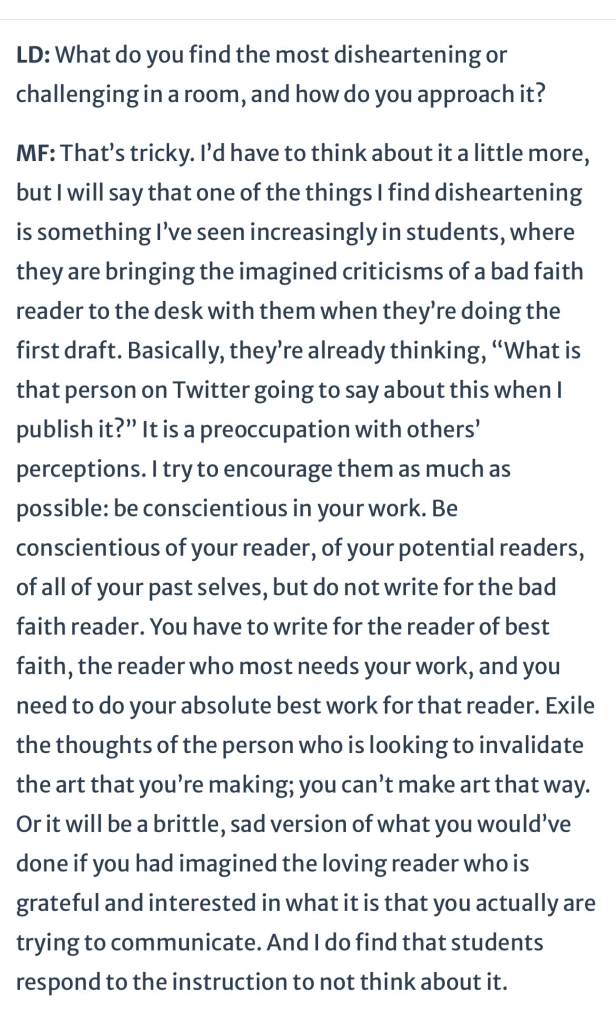
So I saw this screenshot on Twitter from an interview with Melissa Febos and it made me think a lot about what a lot of writers grapple with, especially writers that haven’t been publishing for very long. You can read it below.

There is a fundamental difference between not wanting to accidentally include something that is racist or -phobic (aka being a conscientious writer) and constantly worrying about what someone might say about your work. The former is being responsible. The latter is setting yourself up for failure.

Someone will always interpret your work in the worst way possible. Someone who doesn’t like you or started off your work on a bad foot will read it wrong. They will purposefully skew things and misinterpret them, just as they would something you said online or in real life. It is an inevitability. I’ve had reviews of my books where the reader thought I was referencing something I had never heard of or media I’ve never actually interacted with/watched. It’s going to happen, but the best thing to do is say, “This book isn’t for you.”

My book isn’t for that reader. My writing, my characters, my genres, my inner voice isn’t meant for that reader.

There’s a push online for universality of work. That things should be sanitized for everyone’s palates. Don’t rock the boat. Don’t be “offensive.” Offensive doesn’t even mean racist or -phobic in this sense. It’s just don’t upset other people, which is, frankly, ridiculous. My mere existence as a nonbinary, queer, neurodivergent person upsets some people. Should I stop? Should I sanitize myself to placate others?

In the same vein, we can’t neutralize fiction to avoid things that could upset people simply because you don’t want to see a bad review or have someone be rude to you on Twitter. We put up trigger or content warnings as a heads-up to keep from ruining someone’s day. That’s enough. You’ve given people warning. They have time to opt out before they get too deep or brace themselves knowing it’s coming. If they continue on or don’t read the warning, that is on them.

I used to get upset when I would get homophobic reviews on my books. I still do when I see my second book get returned on Amazon. That means someone read book 1, totally missed the heavy pro-queer message and got upset when book 2 focused on a gay couple. Those people aren’t my readers. A part of me relishes that they were offended. Good. Be mad. I did my job.

After eight books, I know who I write for. I write for other queer people who want to see themselves in stories set in the past, to know that they could have had a happy ending. That the world can be messy and cruel but there will be people who love and support you. You just have to find them or carve a place for yourself regardless of what others think. I write for the people who want that, and I market my books while highlighting those things.

New/young writers, I am begging you to write for yourself first and write for the people who would love your books second. Do not be under the illusion that everyone will love your books or that you need to write for the largest swathe of people possible. Yes, that will help with marketability, but is it fulfilling? Are you happy writing stories for people who wouldn’t appreciate you as a person? People who would read your book and enjoy it but not support you as a person are not your audience, or at least, I don’t think they are. I will happily take money from cis straight people who enjoy my work, but I’m not writing for them.

Being an author or creative in general means making yourself vulnerable. You’re flaying yourself open in your art for people to see the bits of you beneath the surface: the dreamer, the darkness, the sadness, the hope, the traumas we’ve maybe not spoken of aloud but permeate our work. Locking those things away to avoid scrutiny will leave your work flat. You can’t present yourself as the perfect person or your work as the paragon of goodness and still make something worth reading. People are messy. Characters are messy and should be. As creatives, I think we often need to have a long hard look at purity culture and remember that it upholds white supremacy and its values. Would you rather have someone misinterpret your characters in bad faith or uphold white supremacist values by sanitizing yourself and your work?

The answer feels pretty clear cut to me. Any time someone tells you to take things that aren’t truly offensive (aka not ableist, racist, -phobic) out of your book/work, ask yourself why? What standard is this upholding? If it has anything to do with goodness or purity, I’d think long and hard before changing it.