Writing

What to Do When You Get Stuck

Getting stuck while writing is the worst. Nothing is more frustrating than those days where you actually want to write, you have time, you have energy, but the ideas or words won’t come no matter how hard you try. So what do you do?

Cry.

Sometimes… if you think it’s going to help, but truthfully, this advice isn’t that far off. Sometimes you have a mental block. There is an emotion or thought that is clogging the pipes, and until you get rid of it, there will be no way to go forward. If you do need a good cry, embrace it, or if you think that will tank your ability to write afterward, you might consider writing about it in a journal or spending ten minutes to just dump whatever is in your head. Another version of this is that you’re ruminating on something you’re worried about with your story. Whether it’s a plot hole you need to fill or imposter syndrome, freewriting for a few minutes can eliminate that block.

Backtrack.

One of the most common things for me when I get stuck is that I screwed up somewhere a few pages back, and somehow, my subconscious knows it but I don’t. Reread your story and see if you can figure out what went wrong. Sometimes it’s someone acting out of character, a missing beat/plot point, emotions that just aren’t ringing true, or an imbalance of action to introspection. Once you edit that bit and recalibrate, the words should start flowing again. Most commonly, this tends to be a character issue. We’ve written ourselves into a corner or in such a way that moving in the direction we want doesn’t make any sense. Using a reverse outline can help you avoid this sort of thing, though it does still happen.

Rest.

I can already hear my past self hissing at this suggestion, but sometimes it’s because you are fried and need a rest. Yes, I know you’re on deadline. Yes, I know you’re behind. Yes, I know you need to write like that song from Hamilton, but if the words aren’t flowing and you’re just getting more and more stressed, sometimes you need a mental timeout. Therefore, it is time to refill the well. Play some video games, go for a walk, watch a movie or favorite show, do some crafts (my personal favorite/go-to). Do something that recharges you and makes you feel more inspired without draining you.

Work on something else.

This has the biggest caveat because if you have shiny idea syndrome, you will never complete anything, but sometimes you started working on something too early or you have another story that is loudly knocking at your brain, making it difficult to focus on your main project. I had this happen with The Reanimator’s Soul. I had a Valentine’s Day short story that sprung fully formed in my head, so I told myself that I get a week to write that, and then I must go back to my main project. I did it, got it out of my system, and when I went back to my main project, things flowed more smoothly. You may want to give yourself a smaller amount of time to work on the other thing. Once you vent it out, you’ll probably have an easier time. If you worry you’re going to run with it and abandon your first project, then don’t do that.


Hopefully, these ideas will help you get unstuck and be able to work on your project. Above all, remember to be kind to yourself and don’t beat yourself up for needing to rest or having to go back and rework something.

Personal Life

Prioritizing My Dreams

I have quietly come to the decision that I want to work toward becoming a full-time writer or creative. I’ve been thinking about this for a long-time and have been prioritizing my goals over the past few quarters to reflect this. At first, I wasn’t sure if this was even a tenable goal since my author income was pretty low after I derailed my marketing and such during the great burnout of 2018-2019. After reorienting myself to market my backlist better and publishing The Reanimator’s Heart, I’ve seen my income increase. It’s nowhere near what anyone would consider full-time, but it’s beyond what I ever expected to make this past year.

What I would like to do is incrementally move toward this goal of being a full-time creative, and I am taking that first step. I’m only working at one university in the fall. I won’t rag on my past employer, but I find working at this particular university is more stress than its worth. The class sizes are very large, the parking is miserable, and they have a tendency to cut my class like two days before the semester starts, which means I get left in the lurch and unable to make up that income anyway. By only working at one university, I will have more room to focus on my writing while, typically, dealing with smaller class sizes and a more predictable schedule. This university is better for me as I know and am friends with most of the full-time faculty in my department, the vibe of the students is different, and generally, I leave work feeling good rather than frustrated. This is the school where I teach creative writing classes, so I feel like my skills are valued there.

The hope is that I can write more while only teaching at one school. For my writer friends, this part is obvious, but more writing means I can publish more books, which, hopefully, means an increase in author income. Right now, I have decent momentum going with The Reanimator’s Heart and its sequels. I’d like to continue that, but if I’m bogged down by 3-4 classes, I can’t do that.

I know there are some of you out there who are like, “Kara, are you out of your mind? You are willing to trade guaranteed income for hypothetical income.” Yes, I am, but working in academia is never truly guaranteed income. Sadly, this is something I’ve learned a lot over the past few years. Classes get cancelled last minute, you get ghosted by universities, or suddenly a school decides to swap class times and your commute is now 2 hours longer than it needs to be. This costs me gas money, tolls, and my time. The last one is really what has been bothering me. I waste so much time driving between multiple schools or dawdling between classes where the schedules don’t line up perfectly. And I don’t want to do it anymore.

I’m still keeping an eye on the scant academic job listings, but more and more being an indie author feels like a realistic option. I don’t need to make a million dollars. I just want to make enough to pay my bills and occasionally go out to eat or buy myself something nice. That bar feels doable, though I hate that I need to figure out quarterly taxes. On top of all of this, I’m neurodivergent, and I think working for myself, eventually, would be a good option for me. I’m self-disciplined, driven, and willing to work hard to become a full-time creative in the future. Something I would love to do now that I’m dabbling with art again is make planner stickers. I absolutely love using them, and I love drawing objects. The intersection of two of my passions would be a great thing to explore, and this is why I initially wrote in this post that I’d like to be a full-time creative. A writer who also draws and has a little sticker store would be something I would certainly be interested in pursuing.

For now, I’m definitely still working at the small university as long as they’ll have me, but ultimately, being an author is the star I’m steering toward.

Writing

Why My Books Aren’t in KU

Because someone on the internet will willfully misinterpret this, this isn’t bashing authors who use Kindle Unlimited, but with everything, it is a business decision. I’m writing this post because I feel bad for my friends who have gone all in on Amazon and feel like their world has been upended. It especially sucks because having been publishing since 2014, this has happened before.

Full disclosure: once upon a time, I had my books enrolled in Kindle Unlimited. I’ve been publishing since 2014, so I think my books were in KU from 2014 to 2018 or 2019 (I honestly cannot remember). There were times I made really good money off KU, like more money than I make now because I paired KU with a Bookbub ad and my profits/exposure exploded.

I still took my books out, and the reason being is that I have been through the KU song and dance before. This rollercoaster of profit and loss is nothing new to authors who have been around a while and why you don’t see many authors have been around a while on Kindle Unlimited. KU had a different payout system for a while, then they changed that, and our royalties tanked, then more people started indie publishing and enrolling in KU, and profits tanked again. Lather, rinse, repeat for different yet very similar reasons.

At some point, I got sick of it. I liked the perk of easily being able to run a sale, but ultimately, it wasn’t worth it. I had friends who told me they wanted to read my books, but they didn’t use a Kindle. Looking at other indie or hybrid authors I looked up to, I noticed most of them had their books at stores besides Amazon. That sort of solidified my decision to go wide with my books and pull them out of Kindle Unlimited. It makes me sad that a lot of the indies I knew back in 2014 have disappeared or don’t talk much about publishing because I think a lot of newer authors could have expected this to happen and been prepared for it.

I’m not going to lie, removing my books from KU was an ordeal, and I think they do that on purpose. My books had been published at different times, so I had to pull them out individually and wait until the next one was about to clock out of its 90 day KU cycle. I’m not going to lie, laziness almost got me there. I was frustrated and ready to just let them rot in KU, but eventually I got my shit together and removed all my books. They still remained on Amazon, but I looked into Draft2Digital, and it seemed easy enough to get my books on there.

To all the authors who were not around back in the day, you’re very lucky not to have to deal with Smashwords’s “meatgrinder,” which also stalled my publication process. Now though, it is so easy to post your work to D2D and use their formatting tools to make your ebook look attractive. I, then, took that file from D2D and uploaded it to Google Play in order to have even more reach. If you’ve never published your books wide before, there are tons of resources online, especially on Youtube that can walk you through the process of uploading your books onto other platforms.

At this point, besides fear of lost royalties, I can’t understand why anyone would stay in Kindle Unlimited. I understand that I am looking at this from someone who has watched KU for a long time and been burned before, but between the shittier payouts, people getting their accounts banned because some asshole put their books on pirating cites, and Amazon bots taking people out for no reason, it seems like a terrible decision to keep your eggs in one basket. For those who hang on hoping to ride out the storm, it may happen. KU is publishing chutes and ladders, but at some point, you may feel like you’re still not making money on KU and that money could be made elsewhere.

What I like about having my books on many platforms is that I get readers from all over the world (especially on Google Play, which seems to reach everywhere but China), I get to have my books in library systems, and readers who don’t use a Kindle, can still access my books. The worst part about going wide is that you do need to revamp your marketing a little bit and actually advertise that you’re wide now. You will probably have a few slow months until people realize your books are there, and there will always be platforms where your book does better than others. Series do really well on Google Play, but outside of Amazon, most of my books sell best on Apple Books.

I have to admit that I roll my eyes when people act like having their books on Kindle Unlimited is some moral good because they’re “accessible” and cheap. Having your books in library systems is less sexy than KU, but your book is equally accessible and even cheaper. It isn’t like KU is available in all countries (same with libraries, to be fair). Still, I like the fact that I can make my books as available as I possible can make them without relying solely on Amazon. At the end of the day, this is a business decision that I made for myself and my book. I don’t like leaving money on the table, and after almost ten years of being an indie author, you will see history repeat itself and watch others not heed the warnings from established authors because some hustle-master on Youtube or Tiktok said it was a great way to make money. With what’s going on, you need to ask yourself if it’s worth it to be at Amazon’s mercy. There are other options, but you need to do your due diligence and decide what’s right for you, but please, don’t think KU is the only way to make money because I can promise you that it isn’t.

Monthly Review

March 2023 Wrap-Up Post

I’d love to know why March felt like the longest and shortest month. Oddly, this month was busy, yet I spent a lot of the time resting and re-calibrating as I worked on The Reanimator’s Soul. It was sort of a weird month. Not good or bad, just a transitional month between projects and parts of the semester. Anywho, let’s see what my goals were and what I got up to during the month.

  • Read 8 books
  • Write The Reanimator’s Soul
    • Minimum goal 15k words
    • Real goal 20k words
    • Stretch goal 25k words
  • Enjoy spring break and actually relax (as opposed to using it to catch up)
  • Blog weekly
  • Send out my monthly newsletter
  • Do some digital art
  • Plan my goals for Q2

Books

My goal this month was to read 8 books, and I read 10.

  1. The River of Silver (#4) by S. A. Chakraborty- 4 stars, a great book of additional stories in a universe I was very sad to leave. Also, yay for some closure.
  2. The Two Towers (#2) by J. R. R. Tolkien- 4 stars, once again loving Andy Serkis being a one-man cast.
  3. Tithe (#1) by Holly Black- 3 stars, it was okay. I know this is one of her earlier books, and it definitely reads like my middle/high school experience. It was weird reading a book that takes place so close to where I live.
  4. Highly Suspicious and Unfairly Cute by Talia Hibbert- 4 stars, loved this one. The neurodivergent and mentally ill rep was great, as always with Hibbert’s books.
  5. The Ancient Magus’s Bride (#17) by Kore Yamazaki- 4 stars, we’re still mid-arc, but I am enjoying it and hoping the conclusion of this arc will be satisfying.
  6. The Magus of the Library (#6) by Mitsu Izumi- 4 stars, I love seeing a mystery deepen and characters come into their own. This is a complex yet low stress manga.
  7. A Black Women’s History of the United States (#5) by Daina Ramey Berry and Kali Nicole Gross- 5 stars, a great primer for further research.
  8. Circe by Madeline Miller- 4 stars, if Aragorn and Arwen in The Lord of the Rings was your jam but you wished there as extra baggage, this one is for you.
  9. She Loves to Cook & She Loves to Eat (#2) by Sakaomi Yuzaki- 5 stars, so sweet, so tender, so sapphic, and so much good food.
  10. Valiant (#2) by Holly Black- 4 stars, I’m not sure how this one ended up with more stars than book 1. The end sort of saved it for me because I really like Ravus and the whole Beauty and the Beast dynamic we had going.

Admin/Behind-the-Scenes Stuff

  • Finished the major compiling for the university literary magazine my class was working on (low key stressful since this was the first one since 2018)
  • Sent the university literary magazine to the printers
  • Wrote the preliminary blurb for The Reanimator’s Soul
  • Setup the preorder for The Reanimator’s Soul at all major retailers (except Google Play, which I will do soon)
  • Started doing crafts again, yay! I started working on a Halloween village plastic canvas kit from Herrschner’s, which I’m really enjoying doing since I haven’t done plastic canvas since high school. It’s very centering.
  • Made my quarter 2 goals and setup my Kanban board
  • Enjoyed spring break with only a bit of freaking out (my brain has been on fire all month)
  • Retail therapy for a case of the stressful sads, which means buying washi tape and planner stickers

Blogs Posted


Writing

If you saw my false starts blog post, you’ll know that I ended up basically rewriting the whole beginning of The Reanimator’s Soul. I’m not going to lie, I was very annoyed at first. I felt like I fell behind as soon as the month started, but ultimately, my writing word count goals take a backseat to story quality and starting over was necessary. I have to keep reminding myself of this when I internally freak out over being behind. Behind is better than words that are lukewarm and don’t make sense in the larger context of the work. It took me about a week to figure out what I needed to fix and how to make it better. In the end, I wrote 12,000 words this month, which I’m pretty happy with since all of these words make sense and have sent the story in the proper direction. I’m feeling much more confident at this point, so fingers crossed no major rewrites will be needed at the 25-33% mark.


Hopes for April

  • Writing (we’re feeling ambitious this month)
    • 23,000 words is the goal (770 words a day)
    • Because of this goal, everything else is sort of scant, which I’m fine with since this is also a heavy grading month
  • Read 8 books
  • Refill the well each week (aka do art, crafting, or game)
  • Blog weekly
  • Send a newsletter each month
  • Doctor’s appointment/taxes BOO
  • Start watching Sarra Cannon’s Publish and Thrive updated lessons
Writing

On False Starts

This is part of the process, this is part of the process, I remind myself every time I start a new book.

Without fail, I have a false start. I know why I have false starts; I just don’t like that I do. Typically, this happens because I am excited about the book and want to dive into it, but I haven’t actually gotten to the point where I know where I’m going or what the larger point is of something I mention early in the story. Or I have an idea of what I want to say and where I’m going, but I mess up what point of view it’s from. Usually, I realize this halfway through writing the scene when things feel off.

I am neither a pantser nor a plotter but some secret third thing. I like to think of my writing process as gardening. I start out with a basic idea of what I want to accomplish, what the end goal is, and sort of let things happen as they may while pruning and prodding the plot to make it cohesive. Plots and plants need shaping and scaffolding sometimes. While writing, I do have a very basic act by act outline where I plan the main points of the plot (or the key beats) and I also keep a stack of note cards with a bunch of scenes on them that I know I want to use in my story. Sometimes I pull them out to move stuff around or figure out where I need to go next.

The problem is that I need the beginning to be solid before I move on. I know there are plenty of writers on the internet who will be like, “No, you must move forward! You must keep going no matter how messy it is because progress is progress.” Yes, that’s great, but that doesn’t work for me. If the foundation isn’t solid and the beginning doesn’t feel at least somewhat tidy and logical, I can’t move forward. This means I spend a lot of time futzing with the opening chapters of my books until I hit about 10,000 words. From there, everything seems to flow better. I would much rather mess with the opening chapters and get the book on a decent foundation because everything flows from those opening scenes. They set the stage for everything else, so they need to make sense. I also do another editing session at the 25-33% mark for added cohesion.

The false starts have become a part of the process as I’ve grown as a writer, but I’m still coming to terms with “wasting words.” It’s hard for me to give in and say, “Okay, this isn’t working. Let’s restart.” My brain would like to push through and keep going, but sometimes rewriting a chapter is easier than fixing it piece by piece. That’s what happened with The Reanimator’s Soul. I got a chapter and a half in and was not happy with it. At first, I wasn’t 100% sure where things had gone wrong, so I put it aside to write “An Unexpected Valentine.” Sometimes a palate cleanser is necessary for clarity. Once I finished that short story and reread what I had written of The Reanimator’s Soul, the issues were glaringly obvious. The prologue needed beefing up, and the first chapter was in the wrong point of view. I went back and rewrote the prologue chunk by chunk and totally restarted chapter two. Between finishing “An Unexpected Valentine” and doing the rewrites, I had also worked a bit more on my outline and note cards, so things were clearer.

The question I had for myself was, “Would I have figured this out if I had just waited a week or two to start The Reanimator’s Soul instead of diving in headfirst and making a mess?” and the best answer I can give is no.

For me, those false starts are part of the process. They help me tidy up the ideas I have and sort of troubleshoot things that don’t work in a way I probably wouldn’t have figured out through thinking or outlining alone. Some things sound great on paper but just don’t work in the actual story. Other times, you think you could do A or B, so you just pick one and pick the wrong one. Oops. So far, false starts have happened for the past four books I’ve written, and I’ve probably done the same for more, but I just don’t remember them.

At some point, you have to figure out where optimization ends and the process begins. You can’t eliminate all the mess in the writing process, so sometimes we have to acknowledge that we need to write through a little chaos to find the gold that comes after. Knowing this also helps you better estimate how long certain parts of the process will take. For me, I always know act one will always take twice as long as any other part of the writing process, and I can live with that.

Monthly Review

February 2023 Wrap-Up Post

Not going to lie, I tend to hate February because it’s a short month, which totally throws me off in terms of planning. Every deadline in early March causes panic mode for me because I somehow forget February ends abruptly. Either way, this was a far less eventful month than January, and I’m not sure how I feel about that. My goals for February were to

  • Learn more about writing mysteries specifically (research!)
  • Outline Act I of The Reanimator’s Soul
  • Write 500 words a day (14k total) <— hahahahaha
  • Grade a shit ton of papers with my brain in tact
  • Manage stress
  • Do more art
  • Read 8 books
  • Blog weekly
  • Send out my monthly newsletter

Books

My reading goal for February was to read 8 books, and I read 10 books.

  1. The Empire of Gold (#2) by S. A. Chakraborty- 5 stars, a phenomenal ending to this series. I loved how it wrapped up, everyone got what they deserved, and the redemption arc was actually good.
  2. The Fellowship of the Ring (#1) by J. R. R. Tolkein, read by Andy Serkis- 4 stars for the book, 5 stars for the reading. Andy Serkis is a fantastic voice actor. He voices every character uniquely, and the acting is fantastic. This sort of audiobook reading is really the only kind I enjoy.
  3. Sword Dance (#1) by A. J. Demas- 4 stars, I greatly enjoyed this re-imagined ancient Mediterranean world. It was full of queer characters, espionage, and action.
  4. The Busy Writer’s Tips on Writing Mystery, Crime, and Suspense by M. R. McAlister- 3 stars, while there were some useful things in this book, I think if you’re more than a newbie writer, a lot of it is already known/obvious.
  5. Out of the Mirror, Darkness (#7) by Garth Nix- 3 stars, this series is linked by tone and time periods but different authors. So far, this one feels the most underdeveloped. I don’t know if Nix borrowed characters known to his usual readers, but the main characters in this short story felt very flimsy.
  6. American Cheese by Joe Berkowitz- 4 stars, an interesting nonfiction deep-dive into US cheese culture. A lot of this is hipster-y, but there was a whole cheese subculture I had no idea existed.
  7. Self-Defense for Gentlemen and Ladies by Colonel Thomas Hoyer Monstery- 4 stars, a collection of Monstery’s articles on self-defense with added biographical and supplemental text. Very fascinating and will come in handy for my research.
  8. A Very Merry Bachelor’s Valet (#2.5) by Arden Powell- 4 stars, a short story featuring the characters from The Bachelor’s Valet. It was a lot of fun to visit them and see the chaos they can get into.
  9. A Novel Arrangement (#5) by Arden Powell- 5 stars, I absolutely loved the dynamic between these three characters. At first, I wasn’t sure how their relationship was going to work out, but throughout the story, Powell did a great job getting them to move to friends, then lovers.
  10. Last Gender (#2) by Rei Taki- 4 stars, this one doesn’t flinch from complicated, adult queer relationships. I have a love-hate relationship with the vignette format because there are some characters where I would love to see more. It also does quite a bit of explaining/spoon-feeding of info, but I can deal with that.

Admin/Behind-the-Scenes Stuff

  • Wrote “An Unexpected Valentine”
  • Edited and proofed “AUV”
  • Made the cover and blurb for “AUV”
  • Published “AUV” and sent it out to newsletter subscribers
  • Researched writing mysteries
  • Researched plot twists
  • Researched many more book things I won’t give away
  • Outlined Act I of The Reanimator’s Soul
  • Did more planning for The Reanimator’s Soul
  • Played more of Bear and Breakfast
  • Got REALLY far ahead with blogging
  • Graded so many papers

Blogs Posted


Writing

I’m not going to lie, I was really ready to be very down on myself about how much I didn’t write in February on The Reanimator’s Soul. What ended up happening, as with all my new stories, is a false start. I often feel like I am 100% ready to write a story, then I start writing it and quickly realize I have no idea what I’m doing or where I’m going. Basically, it’s still underbaked, even if I have the framework of the story ready to go. That’s what happened in February. I started writing it, realized it was not fully gelling, went into the wrong point of view initially, and I froze. I didn’t want to delete what I wrote already because that would have been painful, but rewriting it was also sort of a painful process because it needed a lot of beefing up and fine tuning. The good thing is that while I stalled doing that, I picked up my pack of blank notecards and managed to figure out the major emotional beats for the story and made quite a few scene cards for act one. Are they words on the page? No. Are they very useful to eventually getting words on the page? Yes. I need to trust the process. So much of art is staring at something that looks like absolute garbage until suddenly it doesn’t. Art is messy and frustrating and often ugly, and that’s something my perfectionist(ish) brain tends to forget. We get an (ish) on perfectionist because it’s less about perfection and more about “why can’t it look like I know what I’m doing?!” before I actually know what I’m doing.

The other big writing thing I did was nothing to sneeze at either. I wrote a whole freaking short story, edited it, proofed it, and published it to my newsletter (which you can grab if you sign up for it). Even though “An Unexpected Valentine” is only 5k words, I put a lot of effort into it and deeply love it. I needed a palate cleanser when the story wasn’t flowing well, and I think working on it is ultimately what jogged loose the important things I needed to figure out. It’s like when you get ideas in the shower or while doing a semi mindless task. I needed to write that to let the bigger story gel in the background. Books are basically jello. They need time to set before you can start messing with them.


Hopes for March

  • Read 8 books
  • Write The Reanimator’s Soul
    • Minimum goal 15k words
    • Real goal 20k words
    • Stretch goal 25k words
  • Enjoy spring break and actually relax (as opposed to using it to catch up)
  • Blog weekly
  • Send out my monthly newsletter
  • Do some digital art
  • Plan my goals for Q2
The Reanimator's Heart · Writing

“An Unexpected Valentine” is Coming!

If you follow me on Twitter or Instagram, you may have seen it, but I was moved by the spirit of procrastination and chaos to write a Valentine’s Day short story for Oliver and Felipe. Typically, I don’t run with the plot bunnies and get distracted, but this short story sort of sprung fully formed in my head and came together in a few days.

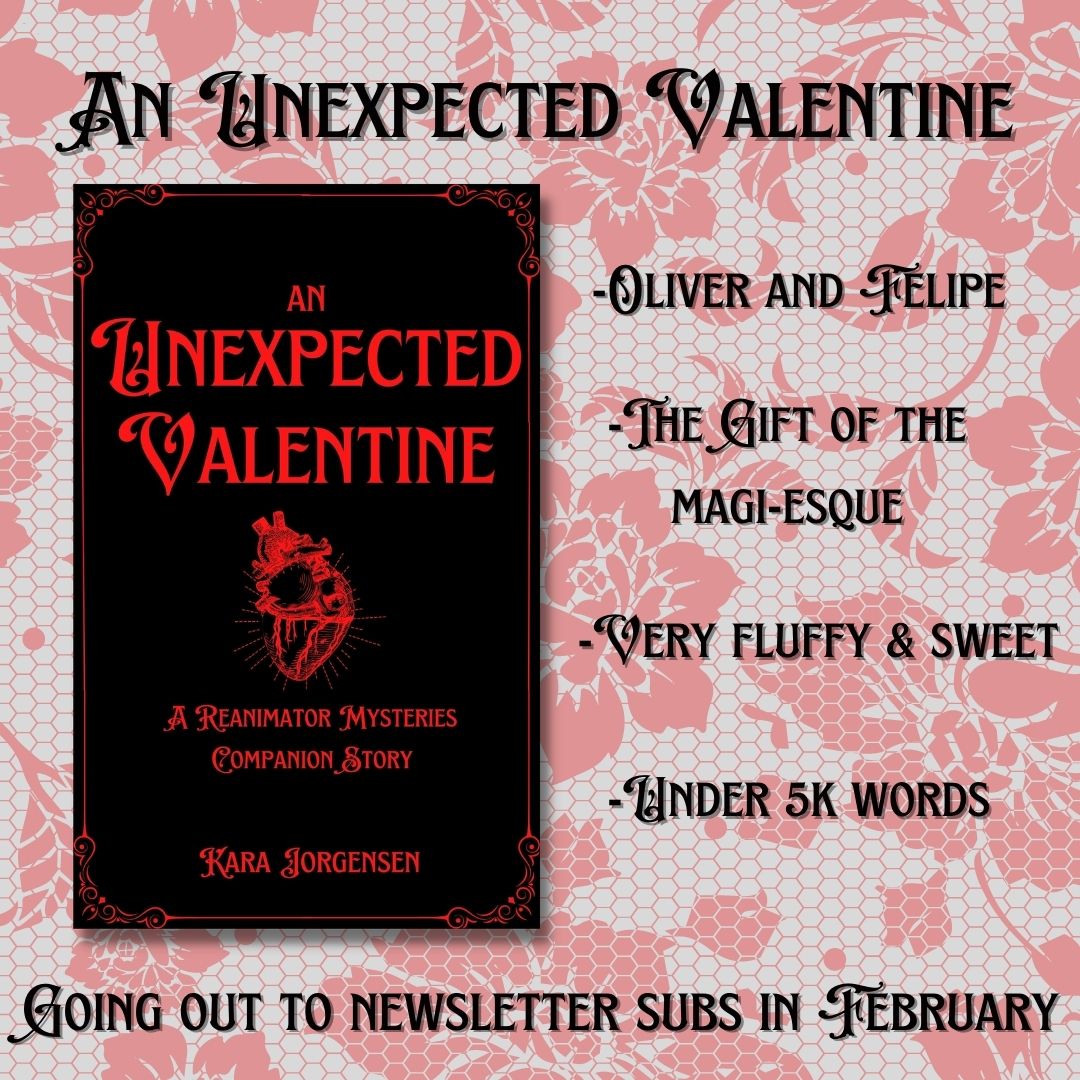
An Unexpected Valentine by Kara Jorgensen, a Reanimator Mysteries Companion Story
Oliver and Felipe, The Gift of the Magi-esque, very fluffy and sweet, under 5k words, going out to newsletter subs in February

Oliver and Felipe’s first Valentine’s Day together was supposed to be perfect. That is, until Felipe’s idea falls through at the last minute and Oliver realizes he never ordered Felipe’s gift. Now, nothing is going according to plan.
But with a little ingenuity and help from their friends, Oliver and Felipe may not have such a bad Valentine’s Day after all.

“An Unexpected Valentine” is a <5,000 word short story that comes after the events of The Reanimator’s Heart. Please read book 1 before reading this story if you don’t want any spoilers.

You can add “An Unexpected Valentine” on Goodreads.

Because this story takes place 3 weeks after the events of The Reanimator’s Heart, I think you have to have read it to read this short story. Otherwise it is spoilers galore.

Once again, this will be a freebie for my newsletter subscribers and will go out with February’s newsletter in the next few days. I will not be sending out a short story a month. There is no way I could keep that pace, so please enjoy these random short stories/novellas because there probably won’t be another one for a while. You can join my newsletter by clicking the link in the top menu that says “newsletter” or by clicking here.

Writing

How I Develop Characters

As I mentioned a few blog posts back, I asked around on Twitter if there was anything anyone wanted me to write about on my blog (PS- hit me up in the comments if you have ideas), and one of my Twitter peeps asked if I ever use character sheets and if so, how detailed are they. Today’s post will be about how I develop my main characters.

To answer the question very succinctly before I run headlong into segue-ville, no, I do not use character sheets.

The reason being is that I find them overwhelming. Back when I was in college and writing The Earl of Brass, I downloaded a bunch of DnD and roleplay-based character sheets because they were super detailed, which is great until detailed becomes overwhelming. The problem I found with most character sheets is that I found the most of the details to be inconsequential. Does it matter what my character’s favorite food is or when their birthday is exactly? Usually, no. Yes, favorite color can be symbolic or be used as a signature color (like Emmeline and purple in my books), but more often than not, the vast majority of the favorite x type questions did not actually inform who my characters are. I remember a Youtuber I watch mentioning character sheets and how if you put real people into them, the details don’t make sense. Her example was that her very prim and proper grandma loved a very macho movie. Just listing that didn’t explain anything; it was just sort of a weird quirk on an otherwise normal sheet. First and foremost, I think of my characters as real people and treat them as such throughout the generation process. They are not tropes, they are not cardboard cutouts, they are people with wants, needs, idiosyncrasies, anxieties, and a past that informs their present. A character sheet doesn’t get to the heart of who they are, so the question then is, how do we figure that out?

What comes first: the plot or the characters?

For me, often the characters do, which I think informs this process more than you would think. I’m not shoehorning characters into a situation but building the situation from the characters. I have a necromancer and his undead love (Oliver and Felipe from The Reanimator’s Heart). How did they end up here? Were they partnered up before the story takes place or during? I ask a lot of questions early on to figure out how we got to the point where the story will theoretically start (or the first point of no return/doorway in plot terms). This allows an organic plot to form out of who these people are. What happens for me when I work the opposite way with plot first, characters second is that I end up fudging who the characters are to fit into the idea I had. This leads to stiff, 2D characters who are trying to be something they’re not because they are hemmed in by the plot. I think this is often why detective fiction requires sort of flat, stagnant characters. They need to fit into the litany of mysteries they need to solve rather than having their stories fit/inform them. And that’s fine for that genre, but that isn’t what I write. When dealing with stories that are very emotion heavy, psychology driven, and character oriented, the characters need to come before the plot.

Kara’s #1 important character element for creating realistic characters

Okay, that is a bit of hyperbole, but there is one thing I tend to think about more than anything else when building my main characters and that is their background. The character’s history/background informs who they are when the story takes place. Years of life have left their marks on this character, for good or for bad, and these things show through in what they do daily, their internal monologue, their wounds, their goals, etc. Their world view is tainted by their past, and the clearer I can see that past, the easier it is to figure out how they would react to the current circumstances (especially in a way that makes sense to them). If all your characters seem to react the same way to everything, that’s probably because you aren’t paying attention to their psychology and you might be relying more on your experiences.

Some of you out there are like, “Kara, these aren’t real people. I shouldn’t apply psychology to them.” Well, we want our characters to be realistic, we want them to feel like real people, and real people are informed by their past history. People aren’t a blank slate on any given day, and your characters don’t spring forth on page one as a blank slate either.

I will say that I don’t sit down and outline everything in their lives so far. I like to leave room in case I need to add something as a book or series goes on. KJ Charles talked about this on her blog once, that for your own sanity as a writer, leave blanks and don’t tell readers everything to keep from repeatedly boxing yourself into a corner. You can know all these things, but your readers don’t have to until it’s absolutely necessary. When I build my characters, I usually play around with them a bit to get their general personality, then I start to think about how we got here. Here’s an example using Oliver from The Reanimator’s Heart:

Things that inform Oliver’s identity most from his life/past: orphaned fairly young and was raised by his grandma, the many misunderstandings in his life due to him being neurodivergent, break-ups due to ND traits, being gay in the 1800s, having to leave his job as a doctor due to *REDACTED SPOILER* reasons

Notice that I don’t have a whole laundry list of key events, just the few things that would impart some complexes/wounds on a person. Once we have those wounds, we can figure out the natural trajectory for complications and reactions. Social interactions go wrong a lot, so he avoids them. When he does have them, he tends to over-explain during or over-think after. Note the logical progression from past to wound to behavior. These wounds are things that can heal during the story, but they will still inform the character’s behavior. There will still be days when doubt or low self-esteem come creeping back to cause problems, just like in real people.

Now that we have the biggest chunk of who the character is, what else do we need?

The hierarchy of character building

This is less about what you should do first and more about what informs the things below it.

  1. Psychology/backstory- see previous chunk for that
  2. What do they want/need?- these are the things that drive this character in your story toward their internal and external goals. The internal goal is also usually informed by their psychology. Whether he knows it or not, Oliver really needs acceptance, which is caused by his past bad experiences.
  3. Their personality- how this character behaves is informed by everything above. A character’s personality and likes/dislikes are obviously important because it differentiates them from everyone else, but it has to make sense with their psychology/backstory and what they want/need. This is also something that is easier to change based on those other two things.
  4. Their appearance- typically, this is the least important aspect of a character’s being UNLESS it plays into the plot/conflict. Generally though, whether a character has brown v. black hair or curly v. wavy hair really doesn’t make a difference in the big scheme of things. The good thing is if you have all of the above aspects fleshed out, you can tailor your main character to fit even better into the story you’re creating. For example, Oliver is awkward and a necromancer, so to make him even more of a weird character, I gave him very stark coloring (very pale, very dark hair, very grey eyes) which highlights those dead and otherworldly ties.

Now that you’ve learned how I develop my characters, I hope you can take at least some of what you learned here and use it within your own work. As always, writing is a very individual process, and what works for me may not work for you. If you have any questions or would like to know more about a certain aspect, hit me up in the comments or on social media.

Writing

Writerly Tools of the Trade

What I thought I would do this week is share some of the tools/random things I use while writing or planning that have helped me in hopes that it might also help some of you. I have not been paid to endorse any of these things. I just like them and would like to share.

Spreadsheets

I hate making spreadsheets. Some of you are very talented and patient. I am not, so I like to outsource my spreadsheet needs.

  • WorkingWriterBiz spreadsheets– I bought these last year when I started to get my author shit together. This Etsy seller has so many fantastic spreadsheets. I use them to track my sales, social media numbers, and word count trackers. You can even make your own 3 book bundle, which is awesome. They work on Excel and Google Sheets, and you can save them as blanks and use them year after year.
  • Svenja’s word count spreadsheets– I love Svenja’s spreadsheets so much. If you only write like one project a year or don’t want to separate word count data by project, these spreadsheets are fantastic. They are pay what you want and have beautiful background art from Lord of the Rings, Once Upon a Time, and much more.

YouTube

  • Sarra Cannon’s Heart Breathings Youtube channel/newsletter/resource library– You have to sign up, but it is worth it. Her Youtube Channel, which will be mentioned below has been so helpful to me (she will pop up a few times here). She has sprint trackers, a plot outline sheet, and so much more. Besides being a great teacher, she also takes into consideration chronic health problems, mental illnesses, etc. when discussing being an author. There’s positivity, but none of it is toxic or of the hustle variety. You can find the link to her newsletter on her website/YT channel. Personally, her resource library is *chef kiss*
  • The Courtney Project on Youtube– Courtney is one half of the romance writing duo Kennedy Fox, and she has some really good info on being a full-time author, how to up your game, etc. She’s a bit more down to business than Sarra Cannon, but sometimes that is necessary.
  • Music to Write By playlist– This is something I whipped up for myself and for my students. There’s a lot of fantastic ambient music and long tracks to help you focus while you work. Tinnitus scrubbers or colored noise has been a godsend for my ability to focus.
  • As a side note, while I have not watched it, I know Brandon Sanderson (aka the fantasy author I have also not read) has his entire course on writing scifi/fantasy for free on Youtube if you are interested.
  • A word of caution- There are tons of resources on Youtube, but there’s a difference between enjoying someone’s authortube content and coming to them for advice on writing/publishing. Obviously vet who is posting because learning from someone who is below you in skill or are not ahead/in line with you career-wise isn’t particularly useful. People who haven’t finished and/or edited a book might not be the best people to get writing advice from if you are trying to publish your work.

Books

  • Writing and Selling Your Mystery Novel by Hallie Ephron- pretty self-explanatory. If you’re at the intermediate/advanced stage of mystery writing, this is below your level but useful for someone like me who strays into suspense instead of mystery
  • Structuring Your Novel by K. M. Weiland- truthfully, all of K. M. Weiland’s books are phenomenal
  • Save the Cat Writes a Novel by Jessica Brody- another book on structure that is incredibly helpful
  • Romancing the Beat by Gwen Hayes- for the romance writers who also need structural help
  • I Give You My Body by Diana Gabaldon– the author of Outlander also has a short book on writing sex scenes, which I found helpful from a sensory/choreography level
  • Newsletter Ninja by Tammi L. Labrecque- this book and its sequel helped me increase my newsletter subscriber list significantly. I haven’t used all the advice, but the vast majority of it (in both books) were very useful.

Sundries

I’m not including buy links to these because they’re sort of open-ended, but these are things I use all the time when I’m working on my books.

  • Blue light blocking glasses- to save your eyes from computer screen glare. Plus, I think the yellow helps me focus, even if I panic that my dogs have jaundice (FYI it’s the glasses, not them)
  • A notebook to write ideas in or to write on the go- I use a 5 Star grid paper notebook most of the time. It’s the perfect size for my normal handwriting, fits a lot on the page, has a spiral, etc.
  • A bullet journal- if you like staying organized, I highly recommend having one or a planner to keep track of your publishing/writing to-do list
  • Kanban Board- same thing as above, though this is paired with the HB90 method (see Sarra Cannon’s channel or my past blog posts for more on this)
  • Washi tape, markers, stickers, highlighters, etc.
  • Your choice of pen that is conducive to writing- for me, this is Pilot G2 pens (of various colors, sometimes I use the one color only for one book) or Sharpie S-Gel pens. If the pen doesn’t write well for you, use something else. Yes, I do get hung up on pens and the color sometimes.
  • Reverse outlining– I write very vague outlines on an act-by-act basis, but you can find more about reverse outlining in a past blog.
  • Forest app– this is an app on my phone that I use to time sprints all while growing cute little plants. I also use it for grading papers and doing any other thing I don’t feel like doing. Will do work for cute trees.
  • Miro– this is a very flexible app where you can make mind maps or just organize notes in a nonlinear way. I use it for chapter or timeline planning.
  • As an aside, a lot of people like Scrivener to write on. I find it difficult to use and fiddly. If you’re thinking about it but aren’t sure, I highly recommend getting the free trial and then seeing if it clicks with you or not. For me, it did not, but I prefer Word.

Courses

  • Skillshare- I do not have a Skillshare subscription currently, but in the past, I had a 2 week freebie period and I was able to watch a lot of videos on writing, marketing, etc. You can find these free trial codes pretty easily online, so I highly recommend grabbing one (and setting a reminder to cancel it). They also have courses like learning ASL, various art media, etc.
  • HB90- this is Sarra Cannon’s course on planning, getting your shit together, realistic goal-setting, etc. It’s not being offered currently but will be in March, I believe. I highly recommend it if you’re trying to organize your life a bit better and actually make progress toward your goals. Once again, it isn’t about hustle culture. Her mindset is inclusive of those who are chronically ill or neurodivergent, which I appreciated.
  • Publish and Thrive– this course was pivotal to me getting my shit together and doing so well with my launch of The Reanimator’s Heart. It is a 6 week course on indie publishing that is stuffed with fantastic information that you can watch at your own pace and have lifetime access to. When I took it, I ended up with over forty pages of notes and a plan for how to market my books better and set myself up for success. It’s great for those who are new to indie publishing, those getting back into it, and those who feel like they’re career is stalling. Sarra is only offering this course once this year, and it is currently open for enrollment. It starts February 4th, 2023, and while it is pricey, it was worth it and she offers payment plans. As a past student, I have an affiliate link if you would like to sign-up. Feel free to reach out to me if you are thinking about it but have questions!
Writing

Why I Write What I Write

On Twitter a few weeks ago, I asked if anyone had anything they wanted me to blog about, and my friend Char was kind enough to toss out a whole list of potential topics that were really intriguing regarding my writing process, why I write certain things, how I write, etc., but the one that caught my eye first was “What draws you to M/M romance and what do you specifically find delightful in writing the male gaze from the male gaze?”

At first, I sort of stared at the prompt because I’m currently editing an f/f or sapphic romance, which will go out to my newsletter subscribers at the end of the month (which you can join by clicking here). My immediate answer is that I don’t write M/M romance so much as that I write queer romance. I think a lot of newer readers might assume I write M/M only because Kinship and Kindness and The Reanimator’s Heart, my last two releases are both M/M, but if you look at my previous series, The Ingenious Mechanical Devices, you’ll see that there’s an ace-allo M/F(but would be enby in 2023) couple, a gay couple, and a pan-bi M/F couple with various other queer side characters. And subsequent books in the Paranormal Romance series will have a lesbian F/enby couple as well.

It’s mildly annoying that M/M romance tends to get the most attention and sales, which on one hand I am grateful for, but I like to write about all sort of queer characters. Within the queer community, there are those (like myself) who will read about anyone and just enjoys queer couples in general. Other readers tend to be more insular and only read MM or FF, which is fine, but that really isn’t the audience I write for.

My choice of genre/romantic couples stems from my own gender and sexuality. I tend to just say I’m nonbinary and queer for simplicity’s sake, but if we’re getting more granular about it, I’m agender nonbinary (slightly masc leaning, slightly) asexual omniromantic. Aka, gender is *giant shrug* but basically Anne Hathaway in Twelfth Night and my sexuality is that I like people of all sorts but don’t feel sexual attraction.

Because of my gender and sexuality, I am attracted to different genders and my identity in relation to those genders is complicated at times since we don’t really have commonly used words for nonbinary attraction to men or women or other enbies. Because I am slightly masculine leaning, M/M romance made sense in my head. Before I knew what being nonbinary was, I used to say I felt like a gay man trapped in a woman’s body. I felt queer, I felt like that feminine masculinity that I often saw with queer men (highly related to Nathan Lane in The Birdcage as a tween/teen because being a woman was a parody of who was I, but I couldn’t put that into words. Besides that, Anne Rice’s books, which were highly influential in my tween/teen years for realizing queer people even existed, were mostly M/M or focused on queer men. Gay men of the late 80s/early 90s were a major touchstone in figuring out my gender identity and that what I was feeling was queer attraction, so M/M tends to be the attraction I relate to most.

Complicating this was that I dealt with dysphoria, which made it difficult to write cis F/F romance. I often joked there are too many layers of Victorian Era clothing and that’s why I avoided F/F romance, but no, it was that trying made my dysphoria kick up horrifically. For a long time, I had a very hard time reading or writing cis F/F romance, but once I realized I was nonbinary, that lessened greatly. It was strange, but somehow realizing I wasn’t a woman despite the body I came prepackaged in gave me distance enough that I could enjoy those books without my brain rebelling. This is why I’ve actually been able to think more about Ruth’s book (Tempests and Temptation) and write Flowers and Flourishing (though one MC is a trans woman).

Sexuality and gender are complicated, writing is complicated, and dysphoria bleeds into the creative side of your work whether you like it or not. For a while, I was ashamed that I couldn’t write F/F romance. I wanted to, and I am attracted to women. I couldn’t understand the mental block, but once it fell away, it was like, “Oh, yeah, that revelation seemed to clear a lot up.”

The crux of this long digression is that I don’t write for the M/M gaze. I write for the queer gaze because I write queer characters of all genders and sexualities. If you’re looking for exclusively M/M content, that certainly isn’t me, but if you want series with trans characters, nonbinary characters, gay/lesbian characters, asexual characters, and bi/pan characters who get happy endings, then I’m the writer for you.


As a side note, Sarra Cannon’s Publish and Thrive course is going to be running soon. This 6 week class is what helped me restart my career last year, and it was certainly worth the money. If you’re new to indie publishing or want to get back into the swing of it by refreshing your knowledge on best practices or marketing, I would take a look. I wrote out 40+ pages of notes when I took it, and now that she has expanded it, I will be taking it again since I have lifetime access to the course. She also has payment plans set up if you want to join but can’t pay in full upfront. If you use this link to sign-up, I get a commission as a former student.

If you would like to know more or have questions about the course, I would be happy to answer them!