Writing

On Writer Hustle Culture

If there’s something I hate seeing online, it’s the glorification of hustle culture. For those of you who are not chronically online, hustle culture is the hyper capitalistic, you must be on 24/7, #girlboss, #productivity, work myself to death with a smile because I’m making more money than you attitude. As you can probably guess from my past screeds, I’m not a fan of capitalism for many reasons, but as an author/creator/artist, it’s particularly shitty to be expected to grind yourself to dust while supposedly doing what you love. Because if you aren’t, you’re apparently doing it wrong.

I believe artists should be able to make money from their art. I believe there should be social/governmental safety nets to allow us to do so as there are in other countries. I believe artists should be compensated fairly for their work and do it in a time frame that is aligns with their process and health. I feel like these are all very reasonable things to believe, but if you start looking at how people behave online, especially in certain online writing circles, you’ll see that is not the case.

Something I’ve noticed over the past five years of watching authortube (authors on YouTube), writertube (writers on YouTube), and writertok (writers on Tiktok) is the prevalence of hustle culture but in a way that is softer and almost more insidious because it is less obvious. I do want to preface this by saying that I see this more often with younger or less experienced writers than with people who have multiple books published, though I will touch upon some of those people later.

Beneath the aesthetic “A Day in the Life” or “Write With Me” videos is the looming threat of toxic productivity. No longer are authors writing in their pajamas gremlin style, they are out in the world writing and making content and recording B roll while doing it. The problem is that one must still write in order to have content to pump out into the world, and when your social media relies on you being a #writer, you must perform being a writer. The performance of writing is pretty clear in these videos, but the part that I find to be most toxic is the focus on large daily word counts.

Now, there are some people whose natural writing rhythm is 3k words a day or to fast draft. That’s totally fine. We all have our own pace. My problem is with the people who write for the sake of getting those large word counts, draft the same book ad nauseam, chasing their tail but never finishing anything. Or even worse, they beat themselves up over a no word or low word count day, even when the word count is perfectly normal for many writers. I’ve watched so many young or unpublished writers do this and burn themselves out. There are times when I’ve suspected a writer is burnt out and not writing, though they read off some giant word count while never talking about their project in any detail.

I’ve complained about Tiktok and the capitalist drive to produce content, but the mixing of word count and content does nothing to help writers. It gives completely unrealistic expectations to newbies, it’s fake in some cases, and in others, it drives people’s mental health into the ground when they try to maintain high levels of productivity for way too long. As much as the idea of NaNoWriMo started out as a good thing, I lay the blame for this trend at their feet. I think a lot of younger writer thought, If I can write 1666 words a day for a month, surely I can do more and for longer, without understanding that NaNo is not meant to set the pace for the entirety of their career or life. As with most things relating to hustle culture, it almost automatically excludes people without ideal circumstances, so people with lower energy levels, people with kids, with demanding jobs, etc. Those people can never be #AuthorGoals if they aren’t typing 3k a day while taking aesthetic B roll at a coffee shop.

My hope is that newer writers will understand that a lot of what they see online is not real or is heavily curated to make it look better than it truly is. There are ways to be productive and have goals without running yourself into the ground or creating a facade in order to live up to perceived expectations. The key is to focus less on content production or high daily word counts and more on what works best for you at this stage of your life. For some, it is fast drafting, but for many, a more moderate or slower approach is healthier. Don’t get caught up in what you think you should be doing because someone online tells you that you should or because you see someone successful doing it. You don’t know how much help they have or how many hours they have to work.

Going off this, be wary of people who consider themselves to be writing gurus or who churn out 10+ books a year. Many people whose sole job is writing can write 4-6 books a year, but if someone is publishing every month, be skeptical. Often, those people use ghost writers, people on Fiverr, or now, they rely on AI to do the heavy lifting with their books. They may also have assistants who run all their social media profiles or spouses who take care of all the day-to-day life stuff that you’re still doing. Don’t fall for the aesthetic hustle culture you see in online writing communities. Being a YouTube or Tiktok personality with never be a substitute for good writing or maintaining your sanity and health through good habits when it comes to a building long-term career.

Writing

The New Book Blues

I have a confession: I hate starting a new book.

This probably sounds weird from someone who loves writing, their characters, stories, etc., but the actual starting part is the absolute worst for me. I’m not one of those writers who gets an idea and immediately dives headfirst to bang out 10,000 words in a few days before hitting the wall when they get to the middle. No matter how hard the spirit of inspiration strikes, I never get that sort of burst at the beginning of a story. The beginning is always the slowest part of the writing process for me. I’m constantly having false starts, stalling, reworking or clarifying things. The beginning of a book is about feeling things out and trying to get the shape of it in my mind before I get too far. My process is probably closest to a sculptor using a piece of a marble. They have to inspect the veins and natural curves and weaknesses of the rock before they get too far, lest they ruin it.

I’ve said it previously in other posts about my writing process, but I hate mess. I’m not the kind of person who can speed-run through a draft and deal with the problems later. If I have a super messy draft, there’s a 90% chance I will just chuck it in the bin and move on instead of dealing with it. Because I am mess averse, I tend to be a slower writer but a quick editor. My writing has been gone over so many times by the time I reach the editing stage that the draft is fairly clean. At the same time, I don’t have hyper-productive days with astronomical word counts because that would mean cleaning up a lot of mess later. Occasionally, I do have these days, but they’re often toward the very end of the story when I know exactly where I’m going and what needs to happen.

The beginning of a book is like standing at an eight-way intersection. I have too many choices and I haven’t puzzled out where they all lead yet, so I get decision paralysis. Some people will say just pick something and deal with the consequences. Yeah, no, I’d rather take a few hours or days to figure out what won’t work before charging down a certain path and making a mess for myself. I’m a careful writer, and the fact that the slow start is part of my process is something I need to remind myself each time I start a new project.

I often scare myself when I start a project because I am so slow at first. There’s a little, panicked voice inside of me that’s like, “At the rate you’re going, it’ll take two years to finish this book!” and then, I freak out more and freeze up. This time, I’m trying to remind myself that the speed at which I write exponentially goes up the further along I am in the book. The first five to ten thousand words are the slowest because my brain is still grappling with all the setup and moving pieces that need to be nailed down early on. This is part of the process, even if I don’t like how it feels, and at some point, I need to make peace with that.

The beginning of a book is like a road with nearly limitless paths, and the further I get into that draft, the more side streets are closed to me. The path becomes clearer, and the chance of getting lose diminishes. For now, I will keep going, albeit slowly, and try not to get lost.

Writing

Setting Writing Goals: The Numbers Game

I’m having one of those moments in my writing where I feel like I have discovered the secret to writing consistently. Well, for myself. Since everyone is different, what works well for me probably won’t work well for 80% of writers out there. At least, that’s how I always feel when I read writing advice. I’m still on the look out for good ways to plot/outline a novel ahead of time, but here it is what I have found that works for me in terms of actually getting the writing done.

Word count goals. Daily ones. Monthly ones. Several monthly ones.

I know that it sounds odd, but at least for me, I found that when I set lofty monthly goals that I missed, my confidence came crashing down to earth (*cough* NaNoWriMo *cough*). After being somewhat stumped with my current project, I joined Camp NaNoWriMo to boost my word count. I hoped to write 15,000 words in 31 days to double my word count. The Camp NaNoWriMo website had a little bar graph that grew as you entered in your daily word count. Watching the bar grow and exceed the projected word count was a pay-off. Each day I strove to exceed that projected word count more and more. By the end of the month, I had written 20,000 words instead of 15,000 words.

This was what worked. It held me accountable to a projected word count while giving me the pay-off of a visual graph that showed me exceeding my goal. Currently, I’m using one of these word count charts. They’re great because they have the same graph visual at the top along with a yearly goal, monthly goal, and projected daily goals. The sheet also tells you if you are on target to finish on time. It’s everything the numbers girl in me needs to stay on track: instant feedback, a visual pay-off, and something that is changeable.

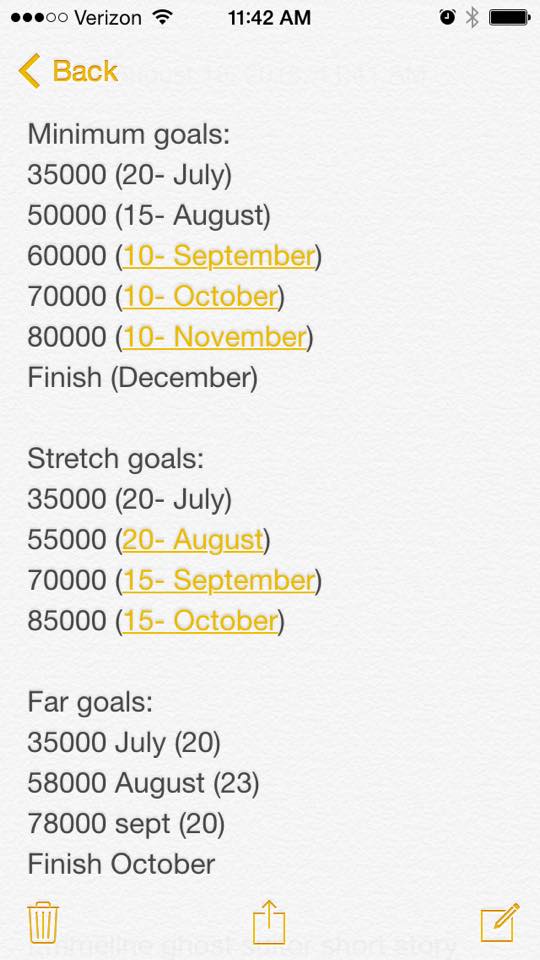
The second part of my numbers game is that I have been setting multiple goals per month. Here is a note I made for myself on my iPhone to track my writing goals for the next few months until I finish The Earl and the Artificer:

word count goals (In case you’re wondering, July’s goals are all the same because I completed it, and the word count determines what other months will look like). As you can see, there are three goals for August: a minimum, a stretch, and a far goal. The reason I set a minimum goal is because I know things come up. For September, my minimum goal is so small because the semester starts up again, and I’m not sure what I will face and how much my writing will be affected by stress, fatigue, and assignments. My only rule for my goals is that the minimum goal cannot get smaller. I will not reduce it. It’s low for a reason, but I will hit it no matter what. I ended up creating a stretch goal and a far goal because I didn’t want to say that I had a maximum goal. If I write 40,000 words instead of 20,000, that’s a far goal but never a maximum. There is only greater than, not a less than for my writing goals. If asked, my real goal is probably the stretch goal. I would really like to hit at least that one every month without fail, but I wanted to have a fail-safe in the minimum goal. Plus it feels good to hit the milestones. That minor pay-off helps to boost you to the major pay-off.

Right now, I’m projected to hitting my minimum goal for August on the 19th. That means, I’ll have about twelve days to add 5,000 more words, which is more than doable. Then, I have the far goal, which I’m pretty sure I will meet as well.

One thing I have also noticed while charting my progress is that my daily word count has also gone up. For both July and August, I have had the same monthly goal, 15,000 words, which means a daily word count goal of 484 words. In July my daily word count average was 645 words per day, and in August, it has jumped to 782 words per day. Right now I don’t know whether to attribute that to wanting to succeed and pushing myself or if it has gotten easier to write book three now that I’m over the hump. The second halves of books tend to write themselves or at least go easier than the first half.

For the tl;dr version: set realistic goals each month, then set one that will make you push yourself, and if you want to really challenge yourself, set another milestone. Chart your daily progress and see if you improve.


If you would like news about new books, sales, or updates, please subscribe to my periodic newsletter by pressing the button below:

newsletter button
