Writing

What is Your Novel’s Sex?

I’m not sure many people think about the gender of their book while they are writing it, but when I began The Earl of Brass as an undergraduate, it crossed my mind.  While reading other steampunk novels, I was rather surprised by how the books seemed to either be very masculine (G.D. Falksen’s Blood in the Skies) or very feminine (Gail Carriger’s Soulless).  I wanted to write a book that was androgynous, that had no defining gender for itself or its audience.

As part of my research for writing The Earl of Brass, I read through Sir Arthur Conan Doyle’s The Lost World as well as Charlotte Perkins Gilman’s Herland in order to better understand Victorian and Edwardian adventure novels. There again, I found the gender gap.  In Conan Doyle’s novel, the men leave their women at home and go on an adventure full of dinosaurs and savages, and while Gilman infused her work with feminist ideals, it was very much an us-versus-them mentality with a muddled ending where the women and men fall in love and go back to America. Continue reading “What is Your Novel’s Sex?”

Book Reviews · Writing

The Earl of Brass is IndieReader Approved!

IR Approved Sticker 2I awoke today to the most glorious news: The Earl of Brass was given a 4.5 star rating from The IndieReader, which means it has been given the distinction of being IndieReader Approved!  You can check out the review here.


Since 8:30 this morning, I have been doing my happy dance and texting, messaging, and bugging anyone who would listen that my novel made the list of approved books.  For an indie author, this is quite a big deal.  The IndieReader is one of the larger, more prestigious book reviewers for Indie and self-published books, and their reviews allow readers to find the gems in indie fiction as well as give indie authors the credit they deserve.  For a self-published author, marketing and getting your book recognition is an uphill battle.  Often reviews like Kirkus, are rather pricy for the average indie writer, but the IndieReader offers a moderate price with a thorough, balanced review.  Being IndieReader Approved is nothing to sneeze at.  Plenty of books they review do not reach the 4 to 5 star level, and the reviewers aren’t afraid to say the book is in need or editing or is lacking in certain areas. 


The Earl of Brass is my first literary child, and I definitely feel like a proud parent today.  Here is a sniplet of the review that made me particularly happy and I think captured the spirit of the novel:

The novel proceeds in a satisfying series of complications as Lord Sorrell and Ms. Fenice work together as archaeologists. The plot takes some unexpected turns and, while not overburdened with action, the events are well-paced and follow logical choices of the characters. The depictions of everyone, from London socialite to field laborer, showed distinct personalities which made THE EARL OF BRASS a humorous and delightful book to read.

Thank you, Claire L. Deming for reviewing my book (no, I do not know any of the reviewers, but her name is listed at the bottom).  I am honored and ecstatic that my debut novel is now on the IndieReader Approved list. 


Once again, the rest of the review can be found here.

The Earl of Brass can be purchased here:

amazon buy button

Writing

Flawed Characters or Human Characters?

Amy-Bloom-You-are-imperfect-permanently-and-inevitably-flawed.-And-you-are-beautiful

As a writer who in recent months has received several reviews, I have noticed that there was mention of “flawed” characters.  Is a character flawed enough?  If a character is not irreparably flawed, are they then perfect?


The definition of a character flaw is: “a limitation, imperfection, problem, phobia, or deficiency present in a character who may be otherwise very functional. The flaw can be a problem that directly affects the character’s actions and abilities, such as a violent temper. Alternatively, it can be a simple foible or personality defect, which affects the character’s motives and social interactions, but little else.”


These flaws can then be broken down into minor, major, or tragic.  Minor flaws include things like scars, nervous habits, quirks, baldness, Major flaws are more encumbering on the character’s lives but are not always absolutely negative things.  A strict moral or ethical code that inhibits their freedom or life can be a major flaw, and of course, the typical notion of major flaws, such as anger issues, mental problems, blindness, deafness, etc. are all possibilities.  Protagonists or antagonists can often be brought down by these flaws and succumb to them, or they can struggle against them throughout the plot.  Tragic flaws, which are commonly seen in Greek tragedies and epics (such as Achilles’ pride or Oedipus’s anger and suspicion), bring the character from a place of prominence to ruin when they ultimately fall victim to these flaws.


When most readers discuss flaws, they automatically think of major and tragic flaws, but in real life, how many of us are plagued with life-shattering personality traits?  This leads a writer to consider whether they want their characters to be realistic or whether they want to check off the box marked “flawed”.  If they choose to be realistic, one must grapple with whether everyone considers the same thing to be a flaw.  The answer of course is no. For a character study, I will use my own character Eilian Sorrell, who ultimately lacks major or tragic flaws.


In terms of minor flaws, Eilian is at times irresponsible, laid back, is handsome but has burn scars across his chest, neck and arm, is missing his right arm, lacks confidence (especially around his family and formal social situations), is easily hurt and crushed by others’ comments, and is overly trusting.  One might not consider being laid back or trusting to be a flaw, but in the context of the work, does it backfire on them?  If the answer is yes, it is a flaw.


When working on characters, I believe that creating a realistic portrait of a human being is preferable over a character that checks off the correct boxes: neatly fits archetype, has flaws, is a “good guy” or “bad guy”, fits reader expectations.  Are humans flawed? Very much so, but is everyone so horrifically flawed that they cannot function and constantly get in their own way, no.  Create characters who are real and balanced, who could walk off the pages and into life, and who logically navigate through life with all their traits, good and bad.

Writing

Don’t Ask, Don’t Tell You’re an Indie Writer

books lined up

When you are an indie or self-published writer, you come across a strange phenomena.  Should you tell people you are not traditionally published unless they ask?


For several decades, self-publishing was referred to as “vanity publishing.”  Vanity publishing was when a writer would pay to have their books printed in limited runs, and they would then try to sell them.  The vanity aspect comes from the stereotype that self-published authors were people who were not good enough to be published by a major publishing house or were hipsters who were too good for the publishing world and wanted only limited copies of their books. 


Modern self-publishing is quite different.  Self-published authors are not under contract with a publishing house, but now, this is mainly because they choose not to be.  By self-publishing authors maintain all artistic control over their work from the cover, to the formatting of the book, to the content.  There is no interference from editors or agents telling them what to write next or what to stay away from.  Some writers do fit the stereotype and self-publish because they have been rejected repeatedly by the industry, but most authors choose it for the freedom and the profit margin, which is often better than what the major publishing houses are willing to give.


Sadly the stigma of self-publishing being an act of vanity still exists mainly because most people don’t realize how common self-publishing is with sites like Amazon, Lulu, or Lightning Source.  After publishing The Earl of Brass, I have found myself holding back when someone mentions the publishing process.  I’ll skate around it by nodding and saying that it was a lot of work and took a while to get ready.  When I have mentioned it was self-published, people who were enthusiastic suddenly deflate, as if the book lost its worth because it wasn’t chosen by a major publisher to be printed.  Because I am new to this phenomena, I am still unsure how to respond to it, but I think the best way is to have people read it, hopefully enjoy it, and then say it was self-published.  That way, they realize it wasn’t self-published because the quality was poor but because I wanted to do it that way.  As I explore my experiences in this endeavor, I will create blog posts about what the process was in publishing in paperback and ebook form and how I prep my books for publication.  If there is ever a topic anyone wants me to explore, just leave a comment or message, and I will try to write a hopefully helpful post.

The Earl of Brass is on Amazon, Barnes and Noble, Smashwords, and Book Depository

Writing

What I Have Been Up To Recently

I have not been a very good blogger recently. Keeping up with posts is never easy for me, but I have a grand announcement, I published a novel.

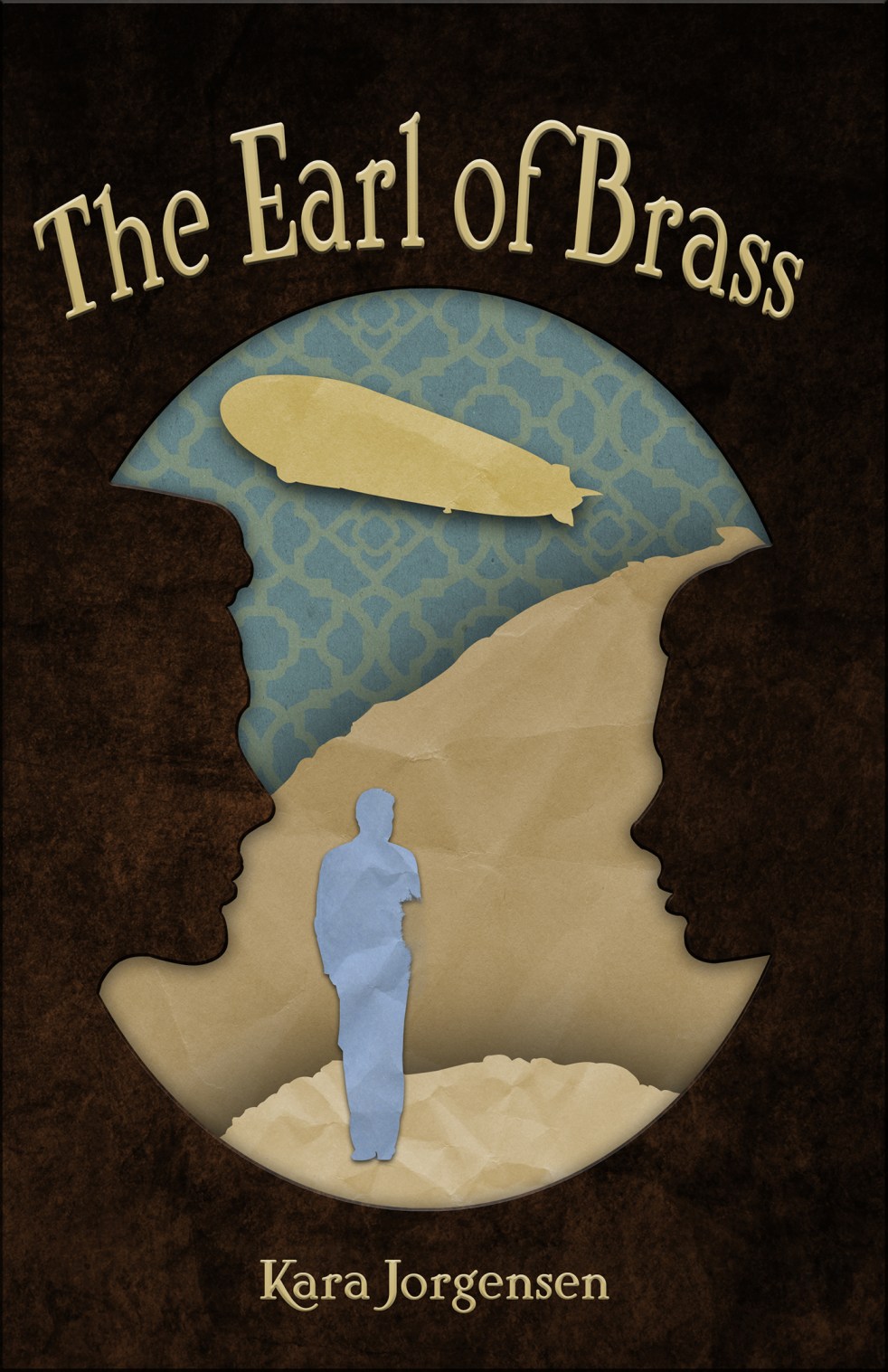
The Earl of Brass began as a project for my undergraduate classes, and it is finally out in the world for all to read. The story involves adventure, a little swashbuckling, traveling to distant lands, Victorian England, and a hint of romance. The synopsis is as follows:

When Eilian Sorrell, a promising archaeologist and the eldest son of the Earl of Dorset, loses his arm in a dirigible crash, he fears he will face a bleak future among London’s aristocracy. On a quest for normalcy, Lord Sorrell commissions a prosthetic arm but finds the craftsman is not what he seems. After the death of her brother, Hadley Fenice takes over his prosthesis business but knows it will be an uphill battle as women are discouraged from doing man’s work. In return for building Lord Sorrell an automaton arm, he offers her a chance at freedom by following him to the Negev Desert under the guise of a man. But what lies beneath the desert is more precious than potshards or bones. As they venture deeper, they discover a society where the path of life is not governed by gain but by passion. When imperialistic invaders come in search of a new colony to pillage, Eilian and Hadley are forced to defend their fleeting glimpse of paradise.

The story is available on Amazon in paperback or ebook, Smashwords , and Barnes and Noble

In the coming weeks, I will be writing on self-publishing, my current and future work, and how it is to be a somewhat struggling writer looking for an audience.