Writing

Do You Need a MFA to Write?

Many writers hear this from teachers or other writing professionals: if you want to be a writer, you need an MFA in creative writing. As someone with an MFA in Creative and Professional Writing, I am here to say you absolutely do not need one with some caveats and things to consider.

My first question to you is, do you want to teach creative writing? One of the most useful things to me that I got out of my MFA program was the pedagogy aspect. I think I took 2 or 3 classes on teaching as a discipline and had at least one creative writing class where creating lesson plans was a larger component of the class. Teaching writing and literature classes was a major thing I wanted to do, so getting an MFA in creative writing gives me more legitimacy in academia. I would also say if you started a Youtube channel or wanted to teach a course or do book doctoring/coaching, having an MFA does add a layer of authority. If you don’t plan to teach writing in some form, you don’t need it. Everything else can be learned through other avenues, many of which are free.

My next question would be do you want to write literary fiction? The reason I ask this is because a lot of programs only focus on literary fiction or delineate that they don’t accept genre fiction. I was in a rather lit fic-focused program, but I was lucky enough to have a professor who writes crime fiction as my first teacher at this program who was incredibly affirming and loved my work. If I had gotten a different professor first, I may not have had as solid of an ego foundation as I did, and being forced to write only lit fic would have upset me as would the patronizing tone of some of the teachers when discussing genre fiction elements. If you are thinking about going into an MFA program as a genre fiction writer, you need to take a long, hard look at the programs you’re applying to and if you can handle people wrongly ragging on your genre of choice. It can shake your confidence and derail the progress you have made.

My experience with my MFA program was a mixed bag. I had a handful of professors who were absolutely fantastic (one was a poet and the other a crime fiction writer especially were amazing) while a few others were horrible (a different poet and the head of the program who was supposedly a fiction writer). The things I really didn’t enjoy about it and that are fairly common with these programs is that there is a heavy emphasis on literary fiction and traditional publishing. This can shut out genre fiction writers or self-publishing writers who don’t feel like they are part of this world or that no matter what they do, it isn’t enough. Truthfully, I don’t like to send my shorter works to literary magazines because there’s little eyeball traffic and no money, and I need to feed my dogs. A lot of what MFA programs promote are prestige-based, so writing for the love of it rather than being paid fairly. Privilege is rife in these programs, and unless you can get into a fully paid program, I don’t recommend dropping tens of thousands of dollars to learn things you could easily find on the internet or in craft books. Also, keep in mind that many MFA programs are also literature focused, so you may be required to take master’s degree level literature classes. If you aren’t an English major or have a literature background, you might struggle. At the same time, there are a few things MFA programs do well that you can replicate on your own with a group.

The two strong suits that I found with my program (besides the teaching portion) were editing and critique groups. These sort of feed off of each other. As a writer, I highly recommend finding a structured critique group to help you get good feedback on your work. I have a blog about this already, which will help you know what to look for with a critique group. These groups should be of people who are at your level or slightly above to help you learn what works and what doesn’t with your work, and it should be consistent in order for you to get the most out of it. Because you get so much feedback in an MFA program as most classes have workshop portions, you end up focusing a lot on editing. The biggest takeaway from these programs is that writing is a process. The process, not the end product, is important. You need to learn your craft, write, edit, write more, edit more, etc. That is something I 100% stand by and agree with. After getting feedback from your workshop group, you need to learn to filter out feedback and figure out what works best for you, what fits with your story, and when you are being oversensitive when it comes to feedback. I haven’t necessarily found a good resource for this online, but I think you need to have thick skin but, more importantly, a clear picture of what you want your story to look like in the end. If you don’t have a vision, you will get led around by the feedback others give you, and they may not be your intended audience.

Once you’ve gotten some feedback from others, I highly recommend doing craft work in the areas that you struggle with, like dialogue, grammar, making things sound natural, writing descriptions, creating mood, etc. There are a lot of great thesaurus style books online that you can buy that help you with conflict, setting, emotional threads, etc. that I highly recommend if you need a reference book to aid you in developing those aspects. I would also suggest checking out Sarra Cannon’s Youtube channel HeartBreathings as she talks a lot about writing as a business and as a writer. She makes some fantastic worksheets and videos to aid in structuring your book and writing your characters’ journeys. These are actually things my MFA program didn’t cover at all, so I ended up relying on Sarra’s videos during my time in grad school. I also have a Pinterest board that has a ton of helpful goodies about writing.

The most important thing I would like you to focus on is figuring out what works best for you and your process. Becoming a writer is a marathon, not a sprint, so finding sustainable habits is key to not burning out. I want you all to succeed and go on to having fulfilling writing careers, no matter what that looks like, and to do that, you need to care for your body and mind first. Take care of your hands (stretch, think ergonomics, don’t keep writing if they hurt). Don’t shrimp (get an ergonomic chair or sit in a comfortable position, straight and stretch once in a while or get a walking desk). And most importantly, you can push back a deadline far easier than you can push off burnout. The key to a long career isn’t an MFA, it’s figuring out the best path for you, whether it’s traditional or self-publishing, being true to your vision, taking feedback, and continually growing as an author while still making sure to care for your body and mind.
Writing

Writer Tips: The Beginning Pt. 1

This week I thought I would talk about writing the beginnings of books since I am working on the fourth Reanimator Mysteries book. Opening chapters are often the hardest to write and the thing we spend the most time fixing/fiddling with. Part of this is because we put so much emphasis on attracting readers and keeping them hooked from the beginning. They are the first impression of the book that our reader has, so we need to make sure we use that chapter to set expectations and capture the general mood of the piece to avoid disappointing readers later. As a side note before we start, I think first chapters/openings are often something to worry about in the second draft rather than the first. Things often become clearer once we’re farther along. Remember, don’t get hung up on the opening when you start. You can always fix it in a later draft if you realize there is a better place to start the story. That’s what editing is for.

The Pieces

I really like the way Sarra Cannon lays out the structure of a novel (you can check her out at Heartbreathings.com). Let’s take a look at her Act 1 outline to remind ourselves what we need in Act 1/our opening

  • An interesting image/hook

  • Introducing our characters

  • Introducing the setting

  • Introducing conflict/mystery

The Hook

When you open a book, we want to put something interesting at the very beginning to keep the reader intrigued or entertained. We want to create this opening image in a way that sneakily introduces the character and the setting. What we do not want to do is put too much information into the opening because our reader won’t remember it’s important later. The opening is meant to be a brief image that gets us intrigued before diving in, and your reader will remember more of the feel of the scene than the information you give or the words you say, which is why we want to nail the vibe but not info dump.

A prologue can be used instead of an opening scene in order to introduce a mystery- like showing someone getting murdered or a god dying, but we have to be careful with prologues because they can become info-dumpy rather than intriguing. Save info/specific world-building for when you have the world more established and the reader can appreciate it. You also want to be careful with starting with dialogue as the reader doesn’t know who these people are, the context of their relationship, etc. It may be better to save it for half a page in when the reader has been grounded by the mood or setting.

Introducing Our Characters

During your opening chapter, we should be introduced to at least one of the main characters. If you have multiple POV characters, obviously that will be spread over multiple chapters or we will only get them from one person’s POV (aka don’t split the chapter in two with different POVs). You want to ground your reader, so e should get the character’s “normal” before the conflict really kicks in. This is important because we need to establish where your character is before they change over the course of the book. You can do this by showing us the character’s world, which also helps to incorporate the setting, and showing them interacting with others while giving us their thoughts and feelings.

At the same time, there should still be a hint of something being amiss during the opening scenes. Some examples:

  • If the MC is a workaholic, show them missing a holiday due to a work trip.
  • If a character has a gambling problem, show them checking their bank account and seeing all of the micro transactions.
  • If a character is lonely, hint at it by having them be alone or mentally commenting on the silence.

Your reader will connect with your main character first and foremost, so spend time fleshing them out by giving them thoughts, feelings, ideas, opinions, clothes, rooms, things, etc. By the end of the opening, the reader should understand what this character is going through, where they live, who they are, etc. Once again, is is often something that is strengthened in the second draft once you understand them better. The bigger point is that at the beginning of the story, these characters are wounded and/or missing something that they need. We need a hint of that wound/issue early on because it will drive the internal and potentially the external conflicts.

Introducing the Setting

Apart from your character, you also need to establish the setting, mood, and genre of your story. I lump these together because you’re doing all of the above at the same time. As you are writing, keep in mind that not every genre cares as much about setting as others do. Small town romances require you to create a realistic town while fantasy and scifi require a much greater level of world-building, so you will need to do this proportionately to the genre you are working in. At the same time, even if setting isn’t as prominent, like in contemporary romance, it is still important to ground your reader in a place by describing what the character is experiencing from a sensory perspective.

In this opening chapter, you are giving us hints of the world, the foundation and first glimpses of it. Only give us lore if it’s absolutely necessary, as in, we need to know this right now or we will be totally confused. Even then, I suggest doing so with caution and consider in your next draft if it is necessary. In your opening, we should be moving through the world via your main character’s eyes. Only give us things they would see or know. They take lore for granted since they exist in this world, so your opening should reflect that. You can also hint at fantastical things without being overt, like showing us bits of magic by offhandedly mentioning someone stirring a cup with telekinesis or a magical animal talking with the main character. You don’t need to give the reader explanations. They can suspend a little disbelief early on.

Having your character physically move through a space is a really good way to pepper in that world-building naturally. That way we follow their eyes over doors and paintings where you can add in little bits of detail that characterize the setting. During this time, we still need to set up the mood as well, and this should be baked into the setting and thoughts of the characters. Keep in mind that your genre can dictate the mood based on reader expectations. While a paranormal romance can be silly or serious, subgenres of mysteries or romances have more distinct moods. A cozy mystery can’t be too heavy, and a noir detective story has to air on the side of dark. Your world-building, thoughts, feelings, sensory words will all imbue the world with a mood. You need to establish that mood during your opening paragraphs, so you don’t pull a bait and switch on your reader.

The Conflict

As mentioned in the character section, your reader should get a hint of what the internal conflict is early in your book. Chapter one or the prologue can’t be aimless, so by having the internal conflict rearing its head, we give the book a bit of direction. There can be hints of the external conflict, mentions of money troubles, a bad guy looming, newspaper headlines, etc., but the external conflict shouldn’t quite appear in the opening. That should be saved for the inciting incident, which is at the very end of act 1 and pushes the main character into the meat of the story. This is sometimes called the call to adventure. The main reason we don’t want to do this is that we want to build up the world and the characters before shoving them into the main part of the story in order to build up the stakes or what the character could lose if things don’t work out for them. Without that build-up, the story can feel very flimsy or your reader isn’t engaged because they haven’t connected to the main character yet. This doesn’t mean there can’t be a murder or something intriguing, it just means that the thing that really forces the character to move hasn’t happened yet. If we don’t establish the internal conflict, the stakes, and the characters, the story will feel rushed, and we don’t want that.


I hope this break down on the opening of your book helped you! I would consider the opening to be the first 10-15% of the story with the inciting incident happening at the 25% mark. Next week’s post will talk about potential pitfalls in the opening of your story and how to avoid them.

Personal Life

Graduation

As of last Wednesday, I have officially graduated from graduate school with my MFA in Creative and Professional Writing.

It seems strange to say that I’m done with school since I’ve been in it one way or another for nearly 20 years. I still may go back for a MA in literature, but for now, I’m done.

It still hasn’t sunk in yet. I feel like in the fall I should be ordering texts for class and preparing my backpack with supplies.

I guess I’ll be doing much of the same thing because in the fall I’ll be an adjunct professor at two universities, teaching freshman writing. An adjunct professor is basically a part-time professor who teaches the underclassmen. An entry level professor. It’s the bottom of ladder, but at least I’m on a rung. I’ll be one step closer to becoming a full-time English professor. It may take years to get there, but I’m willing to stick it out.

For most of my life, I had no idea what I wanted to be when I “grew up.” I went from wanting to be an archaeologist to a doctor to an English professor. What I really want to be is a writer, but I think I can balance that with working as a professor. I’ll be teaching students about writing and literature while actively engaging in that community. I’ve seen the publishing industry change over the last five years, and I’ve been self-publishing for the last two. I’m someone who loves reading and writing, and I hope I can impart that to my future students. My life was changed drastically by the influence of a few key professors, and maybe one day, I’ll be that professor for someone.

Monthly Review

February 2016 in Review

Last year, I decided that I would post my accomplishments for the month and what goals I hope to achieve in the following month.

February has not been a great month for me. My mom spent part of the month in the hospital, which completely derailed anything I planned to do, but the good thing is that my mom is better now and home. March will be better.

What I accomplished in February:

  1. Read 3 books, 2 of which were for class, and dealt with my schoolwork (Confessions by Jean Jacques Rousseau, The Curious Tale of Gabrielle by Zachary Chopchinski, and The Story of My Life by Helen Keller)
  2. Worked on the university’s English Department newsletter (it’s about 60% done and is one of my major tasks for the semester)
  3. Scheduled a promo for later in the month
  4. Wrote a bit of Dead Magic (IMD #4)
  5. Started offering editing services

What I hope to achieve in March:

  1. Write more of Dead Magic
  2. Find the balance between work and writing
  3. Read at least 3 books
  4. Blog more
  5. Begin offering formatting services in edition to editing

February Book Haul
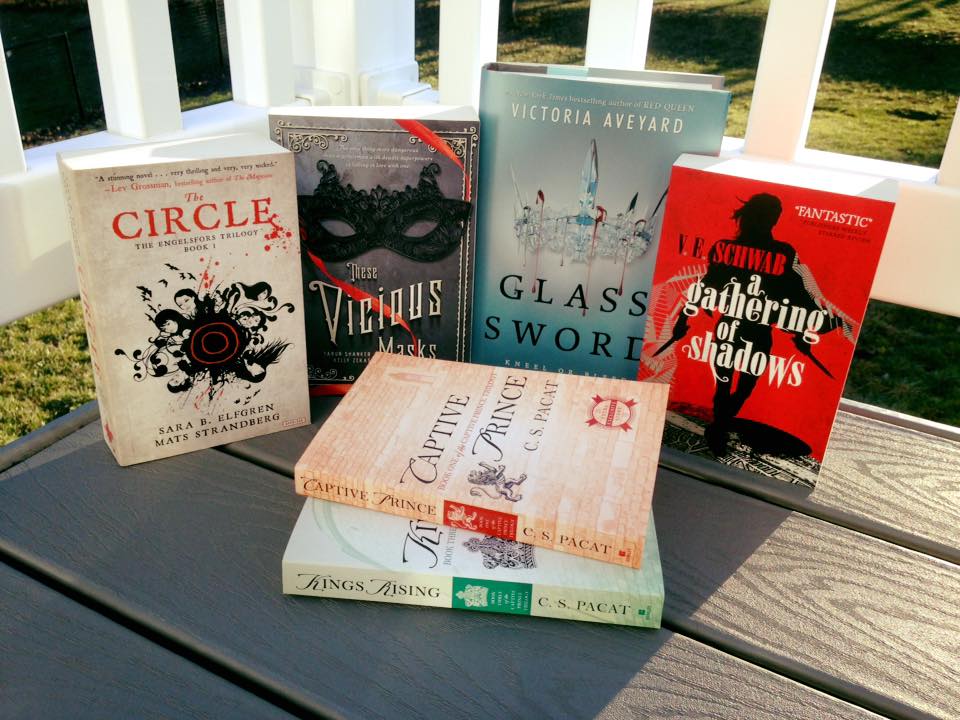
February book haul.

February was a strange month for me. I began working on one project only to abandon it for book 4 of the Ingenious Mechanical Devices, which will be titled Dead Magic. I’m going to refer to February as a transitional month. It’s been a lot of getting accustomed to grad school starting again, which totally throws off my groove, and at the same time, I’ve been switching projects (twice technically since I went from book 3 to random project to book 4). Later in the month, my mom was sick and in the hospital for nearly a week. Luckily she got there in time, and they were able to properly treat the issue. Now, she’s home and back to work. My mom is my best friend, so having her in the hospital meant being in a constant state of anxiety until her procedures were done. All is well now, and March will be a better month.

As you can see at the top of the page, I am now offering editing services. I’ve done developmental editing for the whole of my time as an MFA student, and through my own work and working with other authors, I’ve done some editing for them as well (I will make a post about this later). This month, I plan to look into offering ebook and paperback formatting services. I do it for my own books, so I could easily do layouts for others.

So Dead Magic is coming along slowly. I haven’t written much yet because I’m still figuring out the path the story will take, but as I figure that out, I’ll post more about it. At this point, I’m not making any writing goals for March because I’m still in the planning stage. I don’t know how long that will take, but trying to crank out 10,000 words that won’t work isn’t worth the effort at the moment. I am looking forward to writing Dead Magic, especially since some of my fav characters are back.

Well, that’s probably all I have to say about February and March, but onward to better things! What are your plans for March?

Writing

The Absent Awkward Authoress

The Awkward Authoress has not been posting nearly as often as she really should, and for that, she must apologize. I have unconsciously decided to take a little hiatus from blogging this month to throw myself wholly into my writing. For nearly all of May and most of June, I struggled through The Earl and the Artificer, adding only a hundred words or so here or there, taking several weeks to muddle through a chapter. In one of my recent posts, I mentioned that I was participating in Camp Nanowrimo and that my goal is 15,000 words by the end of July, which would bring my manuscript’s word count up to 30,000 words if I met my goal.

Well, it’s going swimmingly, and I am trying very hard to keep up the pace with my novel. The downside is that to keep productivity up, I have had to take a step back from blogging for a little while. In August, I hope to figure out how to balance writing and blogging better, but for now, I will be only posting once or twice a week until the end of the month. Most will probably be progress updates and info posts about my current WIP. I do feel guilty about neglecting my blog and its readers, yet I hope you will understand that my novel is more pressing. It will be my thesis project for my MFA, and I need to get as much of it done over the summer as possible because once the school year starts, I know my productivity will drop dramatically.

When you get the chance, I hope you will check the Progress and Projects page at the top of the website to see how The Earl and the Artificer is coming along. I should be updating it every few days.

Once again, I apologize for disappearing this month, but it’s for a good cause.

Writing

Checking Those Boxes

Become-a-writer

Often my posts mention my dealings with academia, and the stark contrasts between the “normal” world and the academic domain.  These differences have sparked an interest in figuring out the psychology of not only some professors but the world they are enmeshed in.  One of the things I have noticed during my time as a graduate student in an MFA program is the difference in publishing goals and how the professors treat their writing versus how most authors deal with their work and how they market it.

To be hired as a professor, one must publish at some point, and it seems for some that the only reason they have published anything is to able to put it on their resumes.  Maybe I’m naive and idealistic, but to write a novel or short stories to check off a box seems disingenuous.  If you have a passion for writing, why would you only write one book or a handful of short stories?  Most writers have a hard time stopping or getting other work done when the writing bug bites, so how can one instruct and inspire young writers when they haven’t really done it themselves?  Can you really consider yourself a writer or author when you only write to further your career goals?  It most definitely is not my motivation for writing, but I cannot say why others do it. Continue reading “Checking Those Boxes”