Writing

Giving Myself a Pep Talk

I had a rough week. It was one of those weeks where nothing objectively terrible happened, but a bunch of small things conspired to absolutely wring the life out of you. I was exhausted from the semester starting again, I had a butt ton of papers to give feedback on, I had to go to the DMV to get my car inspected and have my partner get a new ID, my body decided to kick my butt in terms of fatigue and pain, and my partner’s mom ended up in the hospital for a moderately scary issue. Ultimately, mom-in-law is okay and on the mend, the papers got graded, and everything went well, but I barely got any writing done this past week.

On Thursday, I got home from work and thought I would finally be able to write now that everything had settled down, only to have the words bounce off my brain. I could feel myself ready to beat myself up over it, but instead, I stepped back and listened to an audiobook for a few hours before bed. Normally, I would try to just push through or punish myself by refusing to let myself read or decompress with anything fun because I didn’t “deserve” to have dessert if I didn’t eat my vegetables (aka writing). I’ve been trying to be better about recognizing when I’m mentally fried and need to do things to help me refill the well. Void staring as punishment does not help, and I’m glad that I trusted my body and allowed myself to decompress because, even though I didn’t write much on Friday, I was able to reread what I wrote the previous week to reacquainted myself with the text and edit a decent chunk of it.

Even if it was tiny, it was progress. Saturday was a bit better. I hit the point where I realized I needed to major edits on a scene and spent most of the day untangling that mess. Once again, it was a semi-low words day, but I still wrote and still worked on my book. Editing is time consuming and uses up a lot of brain power, which is why it’s sometimes hard to write afterwards. I resisted the urge to beat myself up again on Saturday because I did not hit my minimum goal or catch up. This was all made worse by this being the first week of September– first week, start strong, fresh start, blah blah blah. You get the mentality.

By Sunday, I had hit the realization that it’s just another week in the year. It is one week out of fifty-two, and falling short of your goals because you had a week from hell isn’t a going to ruin The Reanimator’s Fate or set me so far back I can never catch up. It’s fine. I’m fine. The book is fine. Ever since I realized I had to push back the release date for The Reanimator’s Fate, I have felt very guilty about it, even if my readers have been lovely about it. Releasing the book in early 2026 isn’t going to ruin anything or let down my readers who are eagerly waiting for the final book. No one is mad at me. No one hates me. The only one who is beating me up over it is me.

That’s really the crux of the matter: the only one punishing me for not being perfect is me. It’s still hard for me to grapple with the fact that giving 100% does not mean being at peak performance 24/7. I always feel like I should be writing 1k or more a day without fail, but that is unrealistic. 100% sometimes means just rereading what I wrote. Other days, it means just editing, and on bad days, 100% is refilling the well and watching Deadliest Catch while I passively think about what I want to write tomorrow.

My writing career is a marathon, not a sprint, so sustainability is key. Listening to my brain and body is a major part of that, and I’m trying to get better about not beating myself up when I need to take a short break to recharge. Sometimes, a month starts out rough, and that’s okay. A new week is a new week, no matter where in the month it falls. All that matters is that you start again and keep going.

Monthly Review

January 2025 Wrap-Up Post

How have these past two weeks been so, so long. Also, to everyone in Canada, Mexico, and China, yes, this is the stupidest timeline and the US deserves all the hate it gets globally. ANYWAY, let’s remind ourselves what I was supposed to get done this month.

  • Finish writing “AUE”
  • Edit and format “AUE”
  • Pay Q4 2024 taxes (bleck)
  • Set up my syllabi and Blackboards for my courses
  • Send out my newsletter (with “An Unexpected Evening”)
  • Start planning out TRM #4
  • Blog weekly
  • Read 8 books

Books

My goal was to read 8 books this month, and I read 10. All links below are affiliate links that give me a little kickback.

  1. The Reckless Decade by H. W. Brand- 4 stars, a nonfiction book about the 1890s. This was WAY too timely for what’s going on. If you want a hint as to how we might get out of this, I think this book might be helpful to a point.
  2. Calling the Spirits by Lisa Morton- 4 stars, a nonfiction book about seances throughout the ages. It starts with necromancy and goes all the way to modern ghost hunting shows. It was quite interesting and research for a potential book.
  3. Toad Words & Other Stories by T. Kingfisher- 4 stars, I read books 3-5 in rapid succession, so I’m not sure which was which. Overall, I really enjoyed T. Kingfisher’s commentary on fairytales and her retellings.
  4. The Halcyon Fairy Book by T. Kingfisher- 4 stars, see #3.
  5. Jackalope Wives and Other Stories by T. Kingfisher- 4 stars, see #3.
  6. Adrift in Currents Clean and Clear (#10) by Seanan McGuire- 5 stars,
  7. Bryony and Roses by T. Kingfisher- 4 stars, a beauty and the beast retelling with a beast who has been stuck in a time loop for centuries and a gardening beauty named Bryony. This was a really interesting mechanism for BatB as it reminded me a bit more of Eros and Psyche, but I wish there was more emotional intimacy built between the MCs as that is my jam.
  8. Fever by Jordan L. Hawk- 4 stars, a horror story set during the Canadian gold rush featuring a cabin in the woods, queer characters, and plenty of spookiness. This is good horror for people who are big babies… like myself.
  9. Boyfriend Material (#1) by Alexis Hall- 4 stars, a disaster gay needs a fake boyfriend for a fundraiser and winds up fake dating a fussy lawyer. Soon, fake dating turns to real dating turns too real turns to much more. On one hand, I wanted to shake Luc, but both MCs deserve each other as they are both annoying.
  10. She Loves to Cook & She Loves to Eat (#5) by Sakaomi Yuzaki, 5 stars, the two MCs finally move into together, so we get house hunting, LGBT+ struggles in Japan, and a hint at their new life together. This series is so sweet and cute, and the food always looks impeccable. I love how mental health and the characters’ sexualities are handled.

Admin/Behind-the-Scenes Stuff

  • Postponed the release of “An Unexpected Evening” because my brain broke somewhere around January 20th and didn’t recover in time to finish writing the story
  • Wrote some of “An Unexpected Evening”
  • Started zapping my partner’s face 3x a week because we must achieve gender euphoria, even in hellish times
  • Started working on a writing notebook to keep track of all my writing stuff for the next year (we’ll see how this goes)
  • The Reanimator’s Remains (TRM #3) made it to the next round of the Indie Ink Awards in several categories (a huge thank you to all who voted!)
  • Had several mental breakdowns due to the state of the US
  • Called my reps nearly daily about various issues
    • Democracy.io can be very helpful if you want to email all your reps at once
    • You can also call the Capitol switchboard and ask for your rep by name- (202) 224-3121
  • Paid my 2024 Q4 taxes (bleck)
  • Set up my syllabi and online stuff for my classes
  • Started teaching my classes
  • Kept up with my arm/shoulder workout

Blog Posts


Writing

When I tell you this month has been hard, I mean it. At the beginning of the month, I was struggling to get back into writing because I took a month and a half off after the release of The Reanimator’s Remains to avoid burnout. I needed the break, but the problem with a break is getting back into the routine of writing. I also ended up rewriting and restructuring “An Unexpected Evening,” which made it significantly better but threw me off my game. My confidence was mildly shaken by having to fix it, so when January 20th rolled around and all hell broke loose, my brain just noped out of writing completely. I kept hoping I could wrangle it, but if you have been following politics in the US, you can understand why this was nearly impossible (and made worse by my classes starting). I think I’ve finally regained equilibrium and am hopeful that I’m finally back on track for real this time. The good thing is that I think you will enjoy this silly story… novella? Not sure, it’s grown a bit according to my guestimated word count. I seriously appreciate all of you so much for your kind words when I announced that I had to push the short story’s release back.


Hopes for February

  • Finish writing “AUE”
  • Edit “AUE”
  • Send it out to my newsletter peeps first (everyone else gets it a month later)
  • Reread The Reanimator Mysteries books 1-3
  • Start proofing the audiobook for The Reanimator’s Remains
  • Read 8 books
  • Blog weekly
  • Send out my monthly newsletter
  • Maintain my fragile sanity
  • Perpetually bug my congress people
Writing

How to Deal with Writer’s Block and Imposter Syndrome

This semester I’m teaching a class about writing a novel, and one of the things I am trying to emphasize is maintaining your mental health as a writer. I wanted my students to know all the things I had to learn the hard way or from other writers way too late, so I thought I would share my tips for dealing with writer’s block and imposter syndrome.

Writer’s Block

There is no such thing as writer’s block. Before you get mad at me, hear me out. What I mean by that is that there is no divine muse that has ripped away your ability to write and you may never write again. 99% of the time, there is a very fixable reason as to why you are blocked

How to fix writer’s block

  • Deal with your emotions– is there something bothering you? Sometimes you have a mental block. There is an emotion or thought that is clogging the pipes, and until you get rid of it, there will be no way to go forward. If you do need a good cry, embrace it, or if you think that will tank your ability to write afterward, you might consider writing about it in a journal or spending ten minutes to just dump whatever is in your head.
    • Performance anxiety-Another version of this is that you’re ruminating on something you’re worried about with your story. Whether it’s a plot hole you need to fill or imposter syndrome, freewriting for a few minutes can eliminate that block.
  • You’re burnt out– Sometimes you’re just plain tired. Being mentally, physically, or emotionally drained can cause writer’s block. You are out of spoons, and you need to take a break. You might be on a deadline or rushing to finish something, but sometimes, taking a day off can make you more productive after. If you still feel fried after taking a day off from trying to work, you may be headed toward burnout and more self-care and rest may be necessary.
    • Refill the well– This can be resting, watching tv, playing video games, going to a museum/concert, or doing crafts. Do what you need to in order to refill your creative well. In order to be creative, you need to also take things in that inspire you or stimulate your creativity.
  • Work on something else– This has the biggest caveat because if you have shiny idea syndrome, you will never complete anything, but sometimes you started working on something too early or you have another story that is loudly knocking at your brain, making it difficult to focus on your main project. You may want to give yourself a smaller amount of time to work on the other thing. Once you vent it out, you’ll probably have an easier time. If you worry you’re going to run with it and abandon your first project, then don’t do this one or only allow yourself a little side project as a treat.
  • You need to backtrack– One of the most common things for me when I get stuck is that I screwed up somewhere a few pages back, and somehow, my subconscious knows it but I don’t. Reread your story and see if you can figure out what went wrong. Sometimes it’s someone acting out of character, a missing beat/plot point, emotions that just aren’t ringing true, or an imbalance of action to introspection. Once you edit that bit and recalibrate, the words should start flowing again.
    • Most commonly, this tends to be a character issue. We’ve written ourselves into a corner or in such a way that moving in the direction we want doesn’t make any sense. Using a reverse outline can help you avoid this sort of thing, though it does still happen.

Resistance– sometimes we get ourselves so wrapped up in the anxiety of starting that we can’t get going. Some tips for this is to set a 15 or 20 min timer and tidy up your writing space (less to fiddle with or feel stressed by). Then, sit down and read your work for 10-15 min. If you feel the need to tinker or edit as you do so, do it. Then, set the timer again for 15-20 minutes and write. Sometimes all we need is to force ourselves to start in order to get over that resistance. You can also try switching it up by opening a new doc, working on paper, using a white board. Lower the stakes.

Imposter Syndrome

  • What is imposter syndrome?
    • It’s the feeling that you aren’t a real writer, artist, etc. and that if anyone looks closely, they’ll realize you’re a liar/faker. Basically, feeling you shouldn’t be given the label because you aren’t good enough. That sort of self-doubt can paralyze you or make you give up before you’ve even truly started.
  • How to deal with it:
    • Remember that this is a very normal feeling. All of the writers and artists you look up to have also had imposter syndrome, and you still look up to them. There will never be a point when this fully goes away, even if you’re famous and on the New York Times bestseller list.
    • Remember you are a writer if you write. If you have put pen to paper or finger to key while working on a story, you are a writer. People who put other writers down are insecure and projecting. If you have written, you are a writer.
    • Keep a log of your accomplishments. It’s really easy to remember all the rejections, but you need to celebrate the wins, even the small ones. You sent out your manuscript to agents- celebrate! You wrote the end on a book- celebrate! You got your first 5 star review- celebrate!
    • Talk to other writers about your feelings. Trust me when I say they will get it and will try to hype you up. Everyone has gone through it from time to time. The key is to not give in to those feelings and stop writing.
    • Remember that everyone sucks. The books you see in stores are usually like the 5th draft of a story and have been professionally edited. The first draft was a hot mess. If you think your writing is a hot mess, good. That’s part of the process, and it’s what editing and second drafts are for.
Monthly Review

September 2024 Wrap-Up Post

September did not exactly go to plan, but that’s all right because I can and will get everything together. I underestimated how rough the beginning of the semester would be on my brain and body, especially when I didn’t get my medications for several weeks (laugh sob). Things are back on track (mostly), so let’s take a look at September’s goals before we go on:

  • Finish The Reanimator’s Remains completely
  • Edit the rest of The Reanimator’s Remains
  • Proofread The Reanimator’s Remains
  • Prep ARCs to go out
  • Format the paperback
  • Keep up with my class prep/grading
  • Send out my monthly newsletter
  • Blog weekly
  • Read 8 books

Books

My goal was to read 8 books, and I read 9 this month.

  1. Paladin’s Grace (#1) by T. Kingfisher- 5 stars, a Paladin with a dead god hesitantly falls in love with a perfumer who is dragged into international espionage and nearly ends up losing her life.
  2. The Heroine’s Journey by Gail Carriger- 4 stars, a nonfiction book taking a look at the hero and heroine’s journey. I highly recommend this if you are a writer or academic with a background in literature.
  3. Linger (#2) by Maggie Stiefvater- 4 stars, Sam is now a human but Grace is slowly losing her hold on her humanity as the werewolves beckon. Her parents nearly made me throw this book through a window because of how they treat Sam.
  4. Paladin’s Strength (#2) by T. Kingfisher- 4 stars, a bear shifter and a paladin collide as she looks to get back her missing sisters from the monastery after they are kidnapped.
  5. The Invisible Man & His Soon-to-be-Wife (#4) by Iwatobineko- 4 stars, a really cute volume involving a spa and ghosts. I love when stories like this take a field trip.
  6. The Pairing by Casey McQuiston- 4 stars, a second chance romance between two rather pretentious characters as they eat and screw their way across Europe. It reminds me of how Regency and Victorian gentlemen took hedonistic European tours.
  7. Paladin’s Hope (#3) by T. Kingfisher- 4 stars, an MM romance between a paladin trying to help his Gnole friend find a killer as he falls in love with the city medical examiner who happens to have necromancer-adjacent powers.
  8. The Carnelian King and Other Stories by Arden Powell- 5 stars, a really fantastic anthology of fantasy stories spanning genres, time periods, etc.
  9. Paladin’s Faith (#4) by T. Kingfisher- 4 stars, a spy falls for her paladin bodyguard as they infiltrate a party, end up trapped in a cave during a snowstorm, and figure out who they might be in the future.

Admin/Behind-the-Scenes Stuff

  • The Reanimator’s Soul won in the mental health representation category in the Indie Ink Awards
  • Wrote my butt off but didn’t finish TRR (it was done in October, oops)
  • Started editing the latter half of TRR… repeatedly
  • Wrote class notes for my new class and got ahead finally
  • Tried to maintain my mental health, so I don’t burn out
  • Played a lot of Love, Ghostie (highly recommend, it’s a very cute game)
  • Went to my doctor and got my meds problem dealt with (laugh sob)
  • Bugged my state reps about not supporting a mask ban (please call your state reps to tell them preemptively not to support a mask ban)
  • Blogged weekly
  • Sent out my newsletter

Blogs


Writing

My first mistake was underestimating the size of this book. It’s been kicking my butt because it is LONG. It isn’t horrendously long, but it’s long for me. It’s close to 110k right now, and while editing, it may end up even longer. Most of my books are around 90k, hence how I ended up woefully behind. I also made the mistake of thinking teaching wouldn’t kick my butt at the beginning of the semester. After like eight years of teaching, those first few weeks still make me feel like I’ve been dragged behind a bus no matter how much I like my students. With the added pressure of creating weeks of notes for a new class, things did not go well in the productivity department. BUT I do think this book is one of my best. I feel like I’ve grown as far as juggling things in the narrative and fleshing out my characters’ trauma in new and interesting ways. I hate feeling behind, but I build in a cushion for a reason.


Hopes for October

  • Finish editing TRR
  • Send out ARCs/Review copies
  • Format the paperback
  • Have a great publication day
  • Read 8 books
  • Blog weekly
  • Send out my monthly newsletter
  • Not implode along the way
  • Stay on top of my class stuff
Personal Life

Ambition v. Spoons

I hate making banana bread. And it isn’t because I hate bananas or banana bread or even baking. It’s because somehow, no matter what I do or how I plan the bananas and I are never ready at the same time.

This has been a theme throughout my life, especially as an adult as my inflammatory issues have taken a toll on my energy levels. If I have the energy, I don’t have the inspiration. If I have the inspiration, I don’t have the energy to work on my creative projects.

If you’ve heard of spoon theory, should sound familiar to you. In short, spoon theory is the idea that we all have a certain allotment of energy (spoons), and certain activities cost more spoons that others. The problem with being neurodivergent and chronically ill is that there is no such thing as a work-life balance. There isn’t a single activity that doesn’t cost me spoons, whether they’re physical or mental.

Spending time with people outside my partner, costs me even if I greatly enjoy our time together. Washing my hair will ultimately feel better, but it will cost me energy to do, which means I end up putting it off until I have to because I have work or I put it off so long that it starts to bother me from a sensory perspective.

What people don’t seem to grasp with spoon theory and autism is that things cost you spoons that don’t always make sense to others or they cost a disproportionate amount. Going to the grocery store isn’t physically taxing for me, but the lights, the noise, trying not to get clipped in the parking lot, the people, remembering to get everything on my list (I need a list because I have gone totally blank at the store), acting “normal” at the checkout, etc. is a lot that most neurotypical people take for granted. For me, this mental stress converts into physical stress, so once I get home from the grocery store and unpack everything, I wind up in a heap of fatigue for a few hours decompressing. It’s the same thing with my job(s) and why I avoid going to conferences or conventions. Even if covid wasn’t a thing, they still suck the life out of me and require a multi-day recovery period. Part of the reason I diligently mask and try to reduce my chances of catching covid is because if I got long-covid/a post viral illness, I would have even less spoons to go around, and I can’t imagine limiting my life more.

I’ve tried to organize my life in such a way that I’m expending as few extra spoons as I possibly can, so I can still do my writing and creative stuff and not be an overstimulated misery to deal with. It sucks though because I don’t think most people who casually know me would think of me as disabled or even autistic, and people with invisible disabilities or neurodivergence will always be held to impossible standards. They might be attainable for a time, but they aren’t something most of us can manage long-term without burning ourselves out. There is no way for me to have a standard neurotypical work-life balance without losing something, whether it be hobbies, socializing, chores, or my actual job. Something will always be falling to the wayside, and in neurotypical society’s eyes, I will always be failing.

For people where most of these things are near effortless or the effort is only required in short bursts, they will probably never understand how much I struggle and how little of a safety net there is. There are many reasons I support Universal Basic Income (UBI), but one of the main reasons is for when people who are ND or disabled burn out or need time to recover from a flare, they won’t be left destitute or having to keep working at seemingly 100% while actively hurting themselves. We live in a society that is very much all or nothing. If you aren’t disabled enough, you get zero benefits/support. If you are able bodied enough, there is no safety net. The best way to support your neurodivergent or chronically ill friends is to help them out when they need it (after asking, of course) and pressuring your government and politicians to expand things that actually help our society and those who need that extra help or safety net. Being able bodied is a temporary state for most people. Shaping our society to support rather than penalize a state most of us will end up in will benefit everyone.

Writing

My Books are in the Indie Ink Awards!

This is a semi unscheduled/unplanned post because I just found out that my books The Reanimator’s Heart and The Reanimator’s Soul are both in the Indie Ink Awards and voting has officially opened!

The Reanimator’s Heart was nominated for

  • Best audio narration
  • Best friendship
  • Best setting
  • Wittiest character
  • Writing the Future We Need: LGBTQ+ Representation
  • Writing the Future We Need: Neurodivergent Representation by a Neurodivergent author

The Reanimator’s Soul was nominated for

  • Best friendship
  • Best use of tropes
  • Writing the Future We Need: LGBTQ+ Representation
  • Writing the Future We Need: Mental Health Representation
  • Writing the Future We Need: Neurodivergent Representation by a Neurodivergent author

I am so grateful for everyone who nominated my books. If you’re willing, I would greatly appreciate it if you could visit the site and vote for my books, especially The Reanimator’s Heart in the “Neurodivergent Rep by a Neurodivergent Author” category as the autism rep in my books is very important to me.

To vote, you need to make an account on their site (this is done to avoid cheating/multiple votes or vote spamming). Then you would click into the categories, click the book cover, then scroll to the bottom and hit save. If you don’t hit save, the vote won’t count.

Once again, thank you all so much for nominating my books, and I hope you will vote for The Reanimator’s Heart, especially in the ND category and The Reanimator’s Soul in the mental health rep category! Voting is only open until the end of December

Book Reviews · Monthly Review · the reanimator's soul

September 2023 Wrap-Up Blog

In September, I finally feel like I found my footing again. With all my major book launch/release prep out of the way, I am looking forward to The Reanimator’s Soul coming out October 24th, in time for spooky season. As a recap, here were my goals for September:

  • blog weekly
  • monthly newsletter
  • read 8 books
  • maintain mental health by gaming, reading, or crafting when necessary
  • stay on top of grading
  • Edit The Reanimator’s Soul

Books

My goal was to read 8 book this month, and I read 8 total.

  1. The Dragon’s Betrothed (#1) by Meguru Hinohara- 4 stars, a blocked up writer returns to his family home only to find out he is supposed to be a dragon’s bride. Hi-jinks ensue as the dragon tries to persuade him to give him a shot and it eventually becomes steamy.
  2. The Dragon’s Betrothed (#2) by Meguru Hinohara- 4 stars, see above.
  3. Night Spinner (#1) by Addie Thorley- 3 stars, an ex-soldier finds her loyalties cannot so easily lie with her old troops after falling in with a band of Robin Hood-like deserters. I found the world-building to be… meh, and while the tone is YA, the ages feel very off for the story.
  4. Akata Woman (#3) by Nnedi Okorafor- 3 stars, a young woman finds she is far more than she appeared and must steal back a mystical book to appease a spider god that threatens to destroy her world. While I enjoyed this, I found the world-building to be all over the place compared to previous books.
  5. Fangs by Sarah Anderson- 4 stars, cute vignettes between a vampire and a werewolf, very fluffy.
  6. Mammoths at the Gate (#4) by Nghi Vo- 4 stars, Chih returns to their monastery to find their home a mess as the head monk has died and the relatives want more than the monastery can give. A wonderful look at grief and the transformative power of love and devotion.
  7. Princess Floralinda and the Forty-Flight Tower by Tamsyn Muir- 5 stars, Princess Bride meets Adventure Time as a princess saves herself with the help of a sassy pixie. Hilarious and weird.
  8. The Candles are Burning (#6) by Veronica G. Henry- 4 stars, a horror short story set in the South, featuring a recent widow who must trick the devil to save her soul. Very atmospheric.

Admin/Behind-the-Scenes Stuff

  • The Reanimator’s Heart made it to the final round of BBNYA 2023!
  • The Reanimator’s Heart was the queer romance book club pick at Meet Cute Bookshop
  • I ran a sale on The Reanimator’s Heart and a Bookbub ad
  • Finished playing Venba and Assemble With Care (both are available on Steam)
  • Finished writing the last little bit of The Reanimator’s Soul
  • Edited The Reanimator’s Soul twice/two rounds
  • Proofread The Reanimator’s Soul
  • Prepared and sent out ARCs for The Reanimator’s Soul
  • Formatted the paperback interior for The Reanimator’s Soul
  • Contacted my cover designer for the paperback cover for The Reanimator’s Soul
  • Got my covid booster
  • Did a bunch of event admin stuff for work
  • Beta read someone else’s book

Blogs Posted


Writing

Writing and editing went really well, which always scares me a bit. In my defense, The Reanimator’s Soul was a book that I spent a lot of time on, so the “done” draft ended up being fairly clean. When I keep going back and fiddling, I make less of a mess for myself at the end of the process. Another thing that I think worked in my favor for the editing process was that a) I enjoy editing, especially since I edit as I go. b) I made of list of things I needed to add/tweak as I finishing the book up, which made it far easier to go back and run through.

I’m not going to lie, I really like this book. The emotional arcs for Felipe and Oliver are as important as the mystery. There’s a bit less action than the last book, but I feel like that’s to be expected and is ultimately good for balance since I don’t want the feel of the books to be too homogenous/identical. It’s about coming to terms with being chronically ill/disabled, realizing you can be loved as an autistic person without changing who you are, setting boundaries, and how medicine can uphold white supremacy. Sadly, these things don’t look sexy on a marketing picture, so I rarely get to talk about them, but those are the core things the book is about.


Hopes for October

  • Post/market consistently before The Reanimator’s Soul releases October 24th
  • Do all the paperback setup for The Reanimator’s Soul once I have the final cover
  • Have a great launch for The Reanimator’s Soul
  • Write side/follow-up story for my newsletter subscribers (TRM #2.5)
  • Get ball rolling on the audiobook of The Reanimator’s Soul
  • Read 8 books
  • Send out my October newsletter
  • Finish putting together my Halloween plastic canvas village sets (I have one building left and need to hot glue others together)
  • Decide if I want to do anything NaNoWriMo related in November, despite it being a month from hell for me usually (aka is Kara feeling masochistic)
Personal Life

Kara Struggles with OCD

I’ve known for a while that I have OCD. It’s a very common comorbidity with autism, and they feed off each other in the worst way by tapping into that obsessive, hyperfocused piece of autism and strapping an anxiety rocket to the back of it. Once it starts, it’s very hard to stop.

To me, anxiety feels like I’m overwhelmed; the world is too much. OCD feels like my brain is hurtling through my thoughts at 100 mph in a hyperfocused yet constantly shifting feedback loop. It makes it nearly impossible to focus on one thing for long, so I just hop from thing to thing until my brain exhausts itself, gets anxious again, and the process repeats because checking/obsessing gives it a dopamine pay-off to cancel out the anxiety. The worst part is that when it’s bad, I’m not always cognizant that’s what this is, especially if there is an active source of stress. The incident that has kicked off this post was caused by someone and a perceived (real or imagined) threat, so it wasn’t illogical to believe I needed to do something to stay safe. The problem was anxiety about feeling unsafe because it seemed like someone I had blocked was creeping on my social media quickly snowballed into an obsessive downward spiral (whether that was true or not doesn’t change the anxiety over it).

I don’t like who I become when I’m obsessed like this. You know in movies/TV shows where the detective is tracking someone through storms and ridiculous situations no matter what danger appears, that is how being OCD driven feels. My brain would happily sacrifice actual safety to get what it wants, and that is terrifying in hindsight. It makes me an unsafe person when I’m in that hypervigilant state. The minutiae I would typically be anxiety-ridden over go out the window if I can feed the thought engine to go faster. Somehow my brain thinks hurtling toward danger is how I can make myself safe, as if I can think myself into safety because the solution has to be there somewhere. I just need to think fast and hard enough to do it.

Part of the problem is that I have trained myself to do this by accident. When I was in high school and college, I could ascend to a higher test-taking plane by working myself into that frenzied hyperfocused state. If you’ve ever seen Michael Phelps getting pumped before a meet, that’s basically what it looks like but internal. I could fly through a final exam in less than fifteen minutes and walk out with an A because I worked my brain into a state it was never meant to be in. After finals week, I would collapse into a pool of exhaustion and mild anxiety until my synapses cooled. The same thing happens now with OCD.

I feel the rug pulled out from under me when the source of stress is removed or I snap out of it for whatever reason. OCD brain v. normal brain is a shocking contrast, but when it’s been slowly building for weeks, you don’t notice you’re in trouble until you’re in the thick of it, which is the scariest part for me. My OCD doesn’t manifest as external rituals, it’s just internal cycling, obsessive chaos, which makes it harder to pinpoint and harder for others to notice and intervene. Plus, despite all the rest, I try to hide it if I think my partner is getting concerned about me. I shouldn’t, but unfortunately, it’s hard to admit to ourselves and others that we need help. I’m open about having anxiety and being autistic, but OCD is always seen so stereotypically that it’s hard to discuss it when it presents as a whirlpool of brain chaos and refreshing internet tabs.

Truthfully, I thought I could will it away. If I tried hard enough, I could magically beat back the OCD or pull myself out without external help, but it’s obvious I can’t. The problem with treating OCD and autism together is multifaceted. The most obvious issue is the cost and availability of mental health services. A lot of places have wait lists for evaluations, and no matter where you go, it’s going to cost you unless you have good insurance (even then, it isn’t cheap). The other major problem is that a lot of psychiatrists are not equipped to work with neurodivergent/autistic patients, so they end up either being ableist and patronizing or totally useless because your brain doesn’t work the same way as a neurotypical person’s brain. When you have a combo plan brain and one without external ritualized behaviors, OCD gets a little tricky to treat.

My hope is that in the near future I can get anti-anxiety/OCD medication that will hopefully help to tamp down these feelings or make it easier to disengage. It will probably be a bit as I research psychiatrists and figure out what my insurance will and won’t cover. In the meantime, I’m going to try to limit my time on social media and active Discords because, now that I’m less chaotic, I know those are part of the under-over stimulated feedback loop that sucks me into a checking OCD spiral.

I got off balance this year back in July when I had the jury duty panel week, and it wasn’t my smartest move to throw an intensive summer class on top of it, knowing I was working on my book and that other things could come up, which they did. I need to figure out the balance between making enough to live and not putting my brain into stressed out, OCD hell. In the meantime, I’m going to work on finding some coping strategies and supplements that might muffle the anxiety until I can make an appointment with someone.

Personal Life

Maintaining My Sanity

I have recently learned a valuable lesson: you cannot mandate relaxation.

My tendency is to be a bit of a workaholic when it comes to grading, writing, etc. to the point that I burn myself out. I rarely get to the point of actual burnout, but I definitely end up giving myself a time out or not being able to work for a few days due to my brain just being fried.

Of course, because I’m a workaholic, I got annoyed at the fact that I sometimes required a few days off every now and again, so what did I do? I added mandated relaxation to my to-do list. If you’re face-palming at this, you aren’t wrong.

What does mandated relaxation look like? At first, I put on my weekly to-do list that I had to play video games. At the time, certain games were doing it for me and helping me relax. The first few weeks of this, allowing myself to play games did help. Having it on my to-do list eliminated the guilt associated with playing games while fried instead of doing something “productive.” The problem came when I started to feel better, and gaming went from relaxing to another thing on my list that I didn’t feel like doing. Soon, I switched it from gaming to doing crafts.

Once again, it worked at first, and then quickly became a chore. I sat there being like how do I phrase this to allow myself to relax or force myself to break without feeling bad?

It feels like a very obvious answer now, but I need to unpack my own productivity issues and allow myself to enjoy myself, rest, do relaxing things instead of void staring until I’m productive again. Fixating on productivity and what I can do or get done isn’t healthy, and it’s ultimately what’s holding me back from maintaining a more realistic healthy schedule. Sometimes I also like to forget that I have chronic conditions that make it so I’m not 100% on or at the same level all the time. I would never beat someone else up over having to take it easy when they don’t feel good, but with myself? I take no quarter and am very mean to myself.

Listening to my body isn’t easy, but I’m trying. I’m trying to pay attention to when it needs rest or to do something creative because creativity is as nurturing to me as food. When I say creative here, I mean something besides writing. I like to do art, crafts, puzzle games. Anything intellectually stimulating that isn’t my writing or grading. I tend to think I’m at peace with having chronic conditions since I’ve had them in some form for the vast majority of my life, but when the condition becomes more internal (versus being very outwardly obvious as it used to be), it’s harder to face the expectations people put on you when they assume you’re running at normal/full steam all the time. That’s the part I need to work on: advocating for myself with others while listening to my body and brain rather than punishing it for its needs.

Writing

Why Authors Need Other Hobbies

I can already hear some of you saying, “But, Kara, writing is my hobby! It’s my one passion, my true love,” etc.

And, yeah, same, but that’s also part of the problem. For those of us who would eventually like to write full-time or think of writing as more than a hobby, writing can become an all-consuming activity. We spend hours upon hours of our lives staring at the screen, working on plots or outlines, posting on social media about our work, and of course, editing said work. Often, we clock in more time with our writing than we do with our day jobs.

But what happens when the words stop flowing for a while or we write something that isn’t well received? In the past when this happened, I caught myself falling into a mental health spiral because so much of my self-worth is tied closely to my ability to write and my productivity in relation to my writing. Part of this is certainly tied to the capitalistic notion of hustle culture and productivity = self-worth. Author and writer also become part of our identity, and when that part isn’t being stoked, we lose our sense of who we are, our self-confidence, and that leads to a lot of the mental health slipping.

What I found helped me to feel less mentally chaotic when stress or life made writing difficult was learning to crochet.

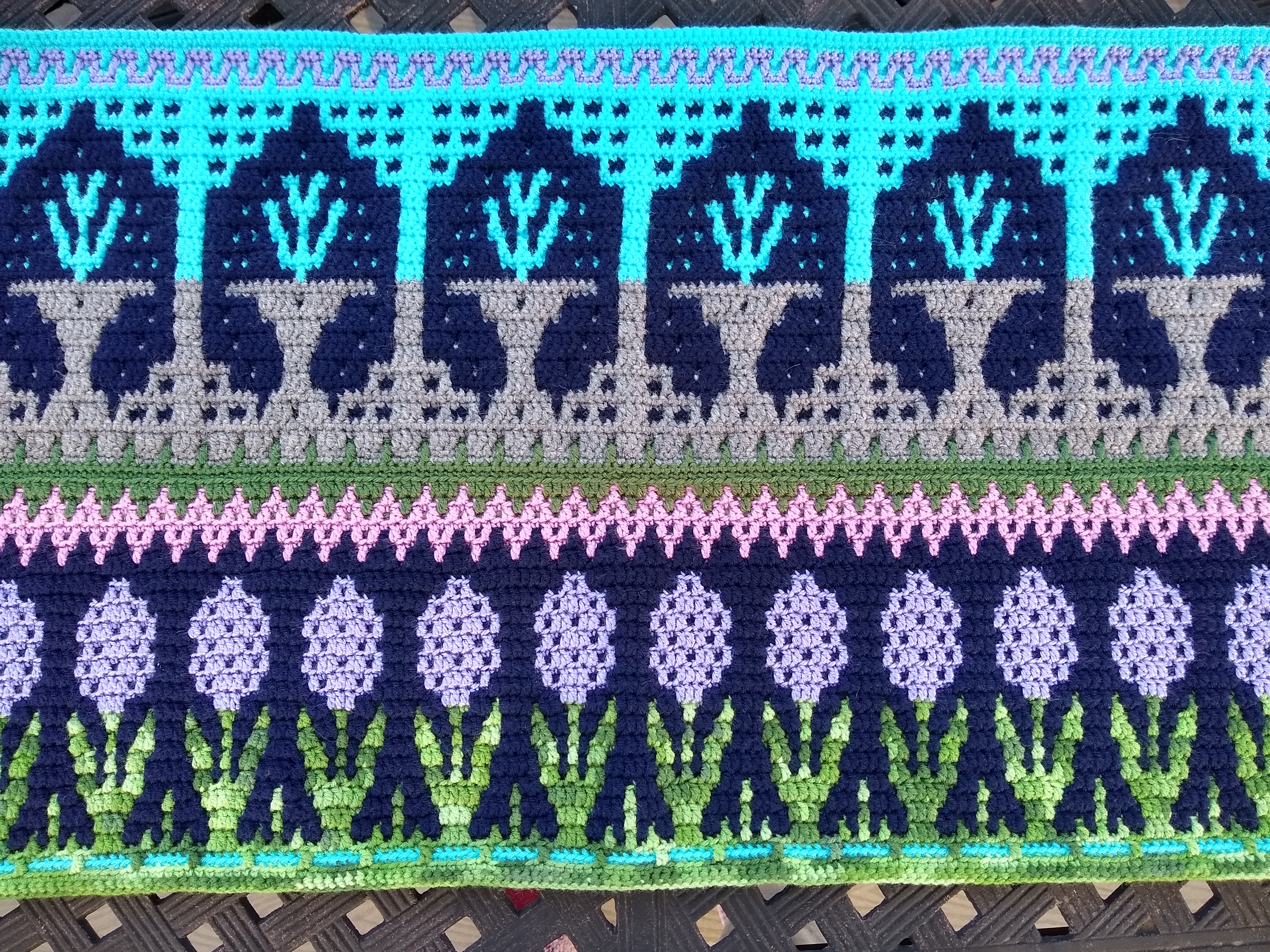
Parts 1 and 2 of the Letitia’s Garden CAL blanket I am working on for my mom. (Pattern by Rosina Plane on Ravelry)

What I love about crochet is that when I’m done with a project, there is an immediate pay off. I learn stitches, I follow a pattern, and I get a hat/scarf/blanket/produce bag/stuffed squid. Unlike writing where it takes months or years for a pay off, crocheting smaller projects can be done in an hour or two. It’s something I do to wind down if I’m feeling stressed by working on something simple or repetitive or to challenge myself by choosing something with an intricate pattern like the blanket in the picture. It helps keep me centered, especially when my writing isn’t going well.

Part of the reason this works is because I am a goal-oriented person who mentally gets off to ticking things off a to-do list, and a crochet pattern is basically a to-do list that ends in a product magically appearing. I can see the pay-off happening as I work the pattern, and that gives me the brain boost I need to counterbalance what’s going wrong with my writing. Does it help all the time? Absolutely not, and sometimes, I can’t bear the thought of picking up my crochet project and working on it.

But having a hobby that isn’t writing to give your brain that boost it needs to keep out of a downward spiral is really what is key here. If you’re athletic, maybe going to the gym and doing reps or having a pick-up game with your friends will do the trick. If you’re a crafter like me, maybe try crochet, needlepoint, knitting, plastic canvas, or even needle felting. Nothing like stabbing something a million times to get the frustration out. The good thing is, most of these hobbies don’t cost very much. You can get cheap yarn and a serviceable set of hooks/needles for $10 and there are tons of tutorials on YouTube, which is where I learned to crochet (I highly recommend HookedByRobin or JaydaInStitches).

If you are not crafty, then try video games. Much like crafts, quests give that bite size chunk pay off and seeing progression through a story or quest helps to refill the wells with serotonin. I greatly enjoy low stress games like Stardew Valley, Animal Crossing, and Ooblets, so if you aren’t a big gamer, those might be a good place to start to unwind.

The other thing I might suggest if you don’t feel like getting into a new hobby or playing a game is reading. I think most authors also tend to be readers, but I get frustrated when I hear authors say they don’t have time to read. You can probably make time for anything you truly want to do, even if it’s squeezing in a few minutes reading an ebook on your phone while in the bathroom. It still helps to refill those creative reservoirs.

Truthfully, I think doing something non-book related is the better option when you need to counterbalance writing angst. Doing something with your hands or playing video games, which helps to engage that hand-eye coordination and decision making anyway, are rife with pay-offs that might make you feel better if things are going wrong. Those small pay-offs that a hobby can bring add up and will ultimately lower your stress even if a pattern or project is frustrating in the moment. A side benefit is that I’ve often had plot epiphanies while my brain was busy chugging away a crochet project or plantings crops in Stardew Valley. It’s the repetitive, meditative nature of it that allows for your brain to run in the background and unpick the knots you’ve made.

If you’re feeling frustrated or stuck with your writing, I highly recommend trying a new hobby or picking up an old one.