Writing

Chasing the Market

Recently, I was watching a video from LauraRaeSpeaks on Youtube about this author who was using AI. Now, you all know I hate AI and am staunchly against it, but this is less about AI and more about something the AI-reliant author said, which was that once you get further along in your author career and get serious, writing what you want takes a backseat to writing to market. I’ve heard a lot of authors say this, and as an author who has been publishing since 2014, I vehemently disagree with this position.

What I think gets lost in this discussion is that there are two markets:

  1. the general market of readers- who are the people who read and spend the most money and what genres do they buy?
  2. the market of your readers- who are the people who love your work and what do they like about your work in particular?

I am very against chasing market #1. The reason is that you quickly become homogenized and lost you when you chase the market. Keep in mind that the market is always changing based on people’s whims. If romantasy is popular, then you’re a romantasy author. If contemporary sports romance is popular, then you’re a contemporary sports romance writer. You have no identity outside of whatever genre you’re chasing. It’s very easy to become homogenized by writing what you think readers want, which quickly becomes the same tropes, archetypes, and stories everyone else in that genre is putting out. The result is an identity-less, middling body of work with no soul or passion behind it.

And unless you can write ridiculously fast and to trend, you aren’t going to be able to keep up. If you’re hellbent on putting out 3-5 books a year in an uber popular genre because some rando on the internet says that is the only way to make money, you are going to burn yourself out. Creativity cannot be sustained on money and profit-driven drive alone, so unless there is something in those genres that spark joy, you will flame out and crash your career at some point.

Authors who chase trends can absolutely make money, but my question to you is, do you want a quantity of readers or quality readers? The problem with constantly shifting with trends is that the second that genre becomes passe, you are identity-less and will lose readers the second you hard shift your genre into whatever is now popular. Those readers are into that specific genre, so if your book is one of a hundred sports romances they read that month, they aren’t going to follow you or recommend you as much as someone who loves your work because you wrote it.

This is why I believe you should focus more on market #2- your readers and why they like your work in particular. I’m not going to lie, I write mostly for myself. I write the books I want to read because I’m also my ideal reader, but I also will shift things around or give certain characters more page time because I know my readers like them. Readers who like your work for the special something that is unique to you will follow you through genres, time periods, and even age levels because they like your work.

When I think about my readers and what they like about my books, it’s pretty easy to figure out. They like my work because it’s queer, character-driven, has high emotional intimacy, a bit of heat, angst, lots of historical research, and is a tad morbid or dark while still having a happy ending. No matter what genre, you know what you’re getting with a Kara Jorgensen book. I know that if I decided to write scifi or a different historical period, my readers would stick around because the things that are unique to me will persist. My selling feature isn’t a genre but my style or flavor.

What makes some authors avoid this is because the pool for market 2 is going to be smaller at first because you are less universal, and it will take time for your idea readers to find you. If you’re decent at marketing and can hone in on pre-existing media that fits well with your work, then comps can be a great way to bring in readers who will like your work. With the Reanimator Mysteries, I always say the series is Sleepy Hollow meets Pushing Daisies but queer. Put the romance in necromancer with a dark, mysterious edge and queer characters. A snappy one line summary of the book that fits the book well also works (an autistic necromancer and his accidentally reanimated crush have to solve his murder in 1890s NYC is a snappy summary). You have to do more marketing to find your people, but once you do, they’re more likely to recommend your book loudly and often if they enjoyed it versus people who read 50 books in the same genre every month or two.

The most important thing about writing to your market is that you get to retain the special something that makes you you. That uniqueness can carry authors through different genres and series while still meeting reader expectations every time. One of the reasons I love KJ Charles’s books is because I know I’m getting some morally grey messes solving mysteries or doing crimes. Cat Sebastian’s books always have such emotional depth and complexity while still feeling like a warm hug. Neither author writes in the same subgenre consistently, but that special something is present in every single book, which is why they have become auto-buy authors for me and so many others.

I won’t knock anyone who writes strictly for money. You have to do what’s best for you, but I’m writing all this to let younger authors (and struggling preexisting authors) know that you don’t have to homogenize or sacrifice your style or passions for the market. You just have to find your market and have those people love your work. Now, part of this is also working on your craft, so the other half of the battle is writing a good book, but that’s for another post. Just keep in mind that the authors who write full-time are often the ones who wholly embrace who they are rather than chasing trends.
Writing

On Being a Female Writer

The other day, I was required to read Virginia Woolf’s “Professions for Women” and A Room of One’s Own for my Women and Autonomy class.  I’ve read them both several times over the course of my schooling, but after publishing, I think they resonated more.  Both pieces discuss the issues and hindrances women have in the world, particularly the writing/publishing world, and despite the works being written about eighty years ago, I think a lot of the problems still persist.

Woolf discusses the prejudice women face when writing because the literary canon is male-dominated.  The publishing world was established by men, for male works, and often the only way for women to enter that field is through subversion.  In the 19th century, the Bronte sisters wrote as the Bell brothers in order to publish their works, and today, writers like J.K. Rowling use initials when publishing in fields that are “not for women,” like science fiction and high fantasy.  If Rowling was writing romance, chick lit, or bodice-rippers, then she could have easily used Joanna Rowling, but because she was writing a story about a young boy in a magical setting, her publishers believed her book wouldn’t sell as well with a woman’s name on the front. Pfft, I mean, women don’t write fantasy well, right? She adopted the initials J.K., which relate back to her real name, but they also harken back to J.R.R. Tolkein, one of the fathers of the fantasy genre.  When Rowling decided to branch out into crime novels, she switched pseudonyms to a outright male name.  Why would she do that if her name is already famous and would draw crowds? Well, crime fiction is another genre where women are often kicked to the curb.  Unless you’re someone like P.D. James (neutral pseudonym) or Sue Grafton (whose female detective hit me as a man masquerading as a woman), you will probably not be taken seriously. To break into this genre, Rowling and/or her publishers believed she had to be a man to do so.

Sadly, I have seen this in real life.  At a book fair, we were rained out, so I was parked inside next to a huge table of female romance writers.  As people walked past my table where I sat with my boyfriend (who came as a second set of hands and a coffee-runner), they asked about my little brown book… to my boyfriend.  Quite a few people thought he was the author.  I wondered why, especially when I was the one trying to engage customers. Did they think I was some lackluster Vanna White? My hypothesis is that my little brown steampunk novel is not what one would expect from a female writer. No stock photos of women in ballgowns or half-naked couples, which is what people seem to expect from female authors.

I recently read an article saying that in the New York Times’ book review section, books by men make up sixty-something percent of the reviews.  Why would there be such a disparity?  Men’s work couldn’t possibly be that much better than women’s writing, but the explanation may lie in what the New York Times deems worthy of review, literary fiction.  The definition they are using of literary fiction is a novel that doesn’t fit any genre conventions (no wizards, no space travel, no steam-powered devices, and no straight up romance. Plot vs. character driven is irrelevant at this point). It seems men write genre fiction and women do not. This little tiff between lit and genre can be seen in Kazuo Ishiguro’s novel The Buried Giant and how he made the comment that it wasn’t fantasy and that his previous book wasn’t scifi when the book had elements of it.  Ishiguro is automatically a literary fiction writer despite the fantastical elements in his work while a writer like Ursula Le Guin openly states her books are scifi.

Why is Le Guin okay with her books being “genre” fiction while Ishiguro isn’t? Because genre fiction is the niche women have carved for themselves over the last century.  Even though men still dominate certain genres, women authors are more likely to be found in the genre categories of Amazon than men. Even though amazing authors like Le Guin, Rowling, and Rice write in this area, the canon and literati consider it lesser than “literary” fiction.

The same is emerging with self-publishing. More women are self-publishing than men.  Why? Because they can subvert the traditional publishing industry, which has not been as open to them as it has been for men, and self-publishing is the niche where they can succeed.  Strangely, Woolf self-published all those years ago.  She had the right idea, and it’s lasted until today.

Writing

What I’ve Learned From My Thesis Proposal

I don’t really read much steampunk.

When I submitted a draft to my professor, he sent back revision suggestions with a note along the lines of “What steampunk books can you cite in your bibliography?”  I stared at the page for a few minutes before sitting back and sighing. Shit, I needed to add steampunk books.  Somehow, I didn’t think I would need to reference any.  Continue reading “What I’ve Learned From My Thesis Proposal”

Writing

“Is it Literary Fiction?”

**To preface, I am saying literary fiction not in a plot v. character driven way since many books have both now regardless of genre, but I mean realism (lit fic) versus a story with a genre aesthetic (genre fic)**

I was sitting in my grad school class, Women and Autonomy, discussing how women are often expected to write certain genres or certain stories and suddenly my work was brought into the conversation.  I mentioned how at a book fair, quite a few people assumed by boyfriend was the author because The Earl of Brass is not only scifi but has a brown cover and is told partially from the point of view of a man. My professor remembered that I write steampunk and mentioned how that genre often gives women a greater prominence and strength than many other scifi or fantasy subgenres.  As she spoke, a voice piped up from the end of the conference table. Continue reading ““Is it Literary Fiction?””

Personal Life · Writing

You Are What You Read

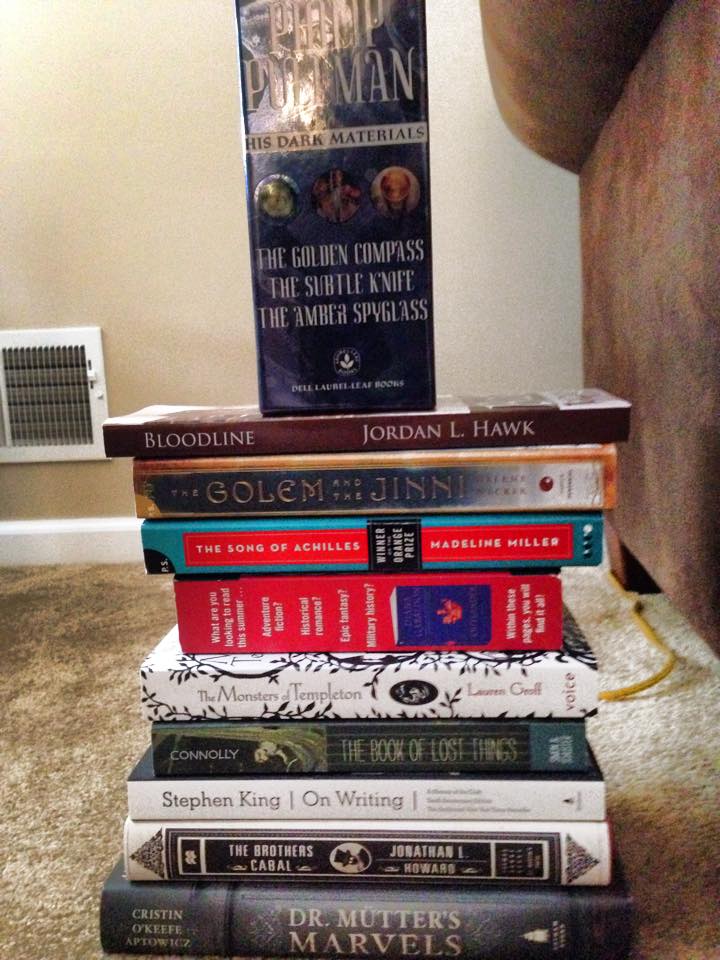
tbr pile oct 30What do your reading choices say about you?  Since beginning graduate school, I have been turning this question over in my mind as I listened to others in my classes mention who their favorite authors are.  Most of them are people I have never heard of or read but are rather famous in the contemporary lit world.  Typically, I hold my tongue and don’t mention what I read for fear of being ridiculed or looked down upon.  This led to a greater question: why do people read certain books?

Do people (especially those in academia) read for fun or do they read certain books because they feel it is expected of them?  As I continue my journey through the MFA in Creative Writing program, I find myself wondering what my professors read, especially when they are writers or poets as well.  What we read automatically becomes ingrained in our beings and eventually comes out in our writing. I can attest to the fact that when I read a book I love, I am inspired to write and often I will lean toward that genre or some theme found in that work.  If I read a book I had to drag myself through, it typically slows my writing to a crawl.  Oddly, while I didn’t love reading Virginia Woolf for the most part, her works had a huge influence in the way I deal with close narration and “head hopping” as others call it. Continue reading “You Are What You Read”