Writing

AI Writers, Please Quit

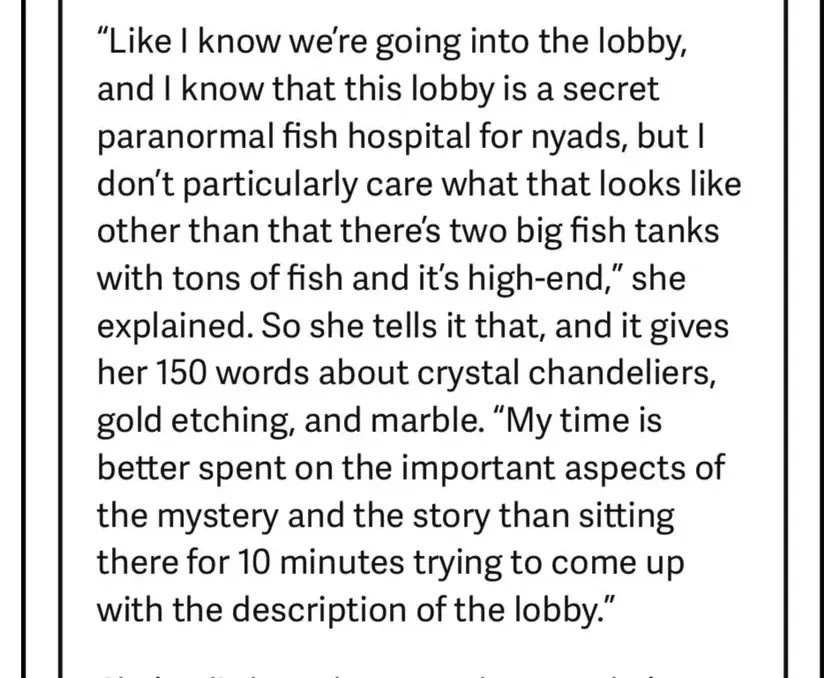
I came across this excerpt from a writer talking about using generative AI during her writing process, and all I have to say is, if you use generative AI to help you write your book, please quit writing.
That isn’t hyperbole or snark; I mean every word. Here’s the thing about writing, it isn’t glamorous, but people think being an author is. People who use AI to write some or all of their books want the aesthetic of being a writer. They want the fans or readers, they want the pretty covers, the money (lol), the minor amount of fame and prestige it bestows upon someone who has published, but ultimately, they don’t want to do the work to get there. And writing is work. It is incredibly unglamorous work. It’s long days staring at a screen, figuring things out, murmuring to yourself, getting stuck, and getting stuck, and getting stuck. It’s weeks of fiddling with descriptions or rewriting things that don’t quite make sense or need a bit more life breathed into them.

For the writers who use AI, they look at the work part and think about how to eliminate it. Who wants to deal with the ugly, un-fun bits of the process? Let the machine do the things I find hard or unenjoyable.

But once you outsource your process to the plagiarism slot machine, is it even yours? See, the thing about AI is that it doesn’t magically come up with new stuff for you. It’s essentially the predictive text feature on your phone, so it pulls up the most likely thing it can from a combination of words. Not the most correct or the most interesting, the most likely. Whatever description or idea it is spitting out is the lowest common denominator. It’s always going to give you a homogeneous, verbal statistical average. If you generate a bunch of statistical averages, your book is also going to be statistically average and have the same voice as other writers using AI. For some writers, at least the ones who use AI, that’s fine. As long as they can make a little more money or churn out work a little more quickly, who cares if the quality suffers? Their readers won’t even notice.

The fact that they think their readers are so indiscriminate that they won’t even notice their is statistically average is sad. Either they don’t value their readers and don’t think they’re intelligent or they have cultivated a following of people who will shell out for average slop and be happy about it. Personally, if an author I read did that, I would stop reading them, unfollow them, and never give them a dime because they don’t respect me as a reader, and I know a lot of other readers and writers who would do the same.

The thing about art is that the process is the important part. We make money off the final product, but we better our skills through the process and ultimately that is what gets us the best product. Going back to the original quote above, writing that off-handed description of the lobby in the paranormal fish hospital is part of the process. It is the process of getting better at writing descriptions; adding more depth, realism, and interest to your setting; adding theme or mood into your story through the use of setting. No description in your book should be pointless enough that you can hand it off to a computer to write. If it serves no purpose, don’t write it.

The fundamental issue with writers using AI is that they choose to outsource their creativity instead of bettering their craft. Learning your craft comes from doing mundane bits repeatedly or by dissecting what writers you like do and figuring out how to work it into your writing. It’s like playing a sport. Having a robot shoot baskets for you won’t make you better at basketball, only you doing lay-ups and practicing can do that. Writing, art, crafts, etc. are skills that can only be increased with practice. Every writer using AI has lost the plot in that regard. Outsourcing the mundane bits will ultimately make you a worse writer because the muscle you have for writing those bits will atrophy over time, and you will have to rely on it more and more. Same for using it for research, coming up with ideas, outlining, editing, etc. Those are skills you need to learn and strengthen through practice and getting feedback from other people. The machine cannot give you feedback as it does not have a brain that can analyze and be critical. It can only regurgitate what it thinks you want to hear. It’s also not a search engine, so any research it brings up is not necessarily accurate, just the thing that appears the most in relation to the terms you gave it. It’s a median machine.

At its core, authors utilizing AI leans heavily on the idea that talent for art or writing is either innate or store-bought with no between. Those who think they don’t have innate talent go for store-bought (the AI) when in reality the writers they think are innately good have just practiced for years and the store-bought isn’t talent, it’s basically a box of saw dust mislabeled as cake mix. Adding your characters’ names to it won’t make it any better, but people will still buy it if you put a shiny enough wrapper on it.
Writing

Why I Will Never Be a “Brand”

I’ve been thinking about brands, online personalities, and sincerity a lot lately. Without harping on past posts, let’s summarize the reason for this rumination as recent-past online trauma (if you know, you know).

Something you hear a lot as a new author is figuring out your “brand.” What’s your author brand? Build your author brand in 5 easy steps! Build your brand!

What building your brand should be is targeting your product to your ideal reader. Note: I said product. Your book is a product; you are not a product. I do have an author brand. I call it being a romantic goremonger. I write books with some gory, highly descriptive gross bits (usually medical in nature or having to do with a cadaver) while balancing that with lots of emotional intimacy between the two main characters. My ideal reader also enjoys historicals and is probably queer (or enjoys queer books) since those are basically all that I write. If you like Anne Rice, KJ Charles, Jordan L. Hawk, Cat Sebastian, Allie Therin, and Arden Powell, you’ll probably like my books.

What I don’t like and have come to actively distrust is creatives who treat their social media as an extension of their brand. There’s a big difference between throwing your audience a bone by posting a smutty snippet or sharing some cool research from your latest project and treating everything you post like it’s a direct reflection on you. When the latter happens, often people start posting less about things they actually care about and more about things that will reflect well on them as a brand. It’s the same reason corporations only post rainbow stuff in June or Black history infographics in February. It’s not that they care about any of these groups or want to foster equity of any sort. It’s that if they don’t, it’ll reflect poorly on their public image.

Years ago, I saw this mostly when authors completely refused to post anything “political” on their pages by abstaining from every mentioning a problem a person of color might face or that LGBT people exist. This was mostly due to the fear that people wouldn’t want to buy from them due to their lack of a stance (or conservative stance) on an issue. Unfortunately, we’re also starting to see it happen in the other direction where people make token posts about Palestine or trans rights because they feel they have to, not because they actually give a shit about either group. The idea is once again a preservation of their audience rather than a sincere post about something they care about. I’m totally fine with someone saying, “Hey, I’m not going to post about X because I don’t know enough about it.” I’d rather someone step back and educate themselves than make a knee-jerk post because they feel they have to. You should be supporting people of color, queer people, disabled people, etc. because you want to, not because you feel social pressure to do so. The social pressure on social media can absolutely drive this sort of insincerity, and I hate it immensely. The worst part is how many people seem very happy to tick off the boxes that make someone acceptable before supporting them when in reality it’s all for show and they don’t actually care.

Kara, how do you tell if someone cares? Well, at a glance, you really can’t.

This is the internet where everything is online for all to see, yet nothing is truly real. I think the only way you can truly judge is by looking at patterns of behavior. Do they continue support after X month is over? Do they seem to genuinely care about this topic/group? Do they retweet people who aren’t themselves posting about X thing? At the same time, some people only use their social media accounts for updates about their own stuff, so you have to take that into consideration. At a time where many people want a black and white litmus test for goodness or good rep, I’m here to remind you that nothing is that straightforward.

Going off of this, I will say the one rule of thumb that hasn’t proven me wrong yet is anyone who gets online and touts themself as an authority on anything is probably full of shit. Anyone who acts like they are the most queer, the most trans, the most Latinx, the most whatever because it makes them an absolute, unquestionable authority is probably pulling a Wizard of Oz act and hoping you can’t look behind the curtain to see who they really are. Authority should always be questioned, no matter if it’s in the community or outside of it. I feel like most people who know anything about something know that there is still a lot left to learn, and they are open to criticism or open to new information or outside perspectives. If someone’s online brand is that they are trying to cultivate a following that looks only to them or sees them as the ultimate authority on a marginalization or topic (like publishing), I would be very cautious as those people are usually grifters.

Has the idea of an author brand gone too far? I do kind of think so. The problem truly begins once a person gets a large enough following online. It seems around 3k-5k followers on most platforms is enough for fans/followers to start treating them less as a person and more of some random avatar that they can say whatever they want to as if they don’t have feelings. It’s weird, but I’ve seen it many times where people will suddenly say things to a person with a larger account that they would never say to someone they’re friends with who has 500 followers. The size of the account means the intimacy disappears and with it the humanity of the person holding the account. When we do that, we reduce a real person to only their posts, which makes it easier for grifters to turn themselves into an authority or “brand” that posts only to appease rather than sharing things they actually care about. Ultimately, it’s a problem that lies with the fans/followers as much as the creators. People don’t magically attain a different status when they reach a certain number of followers, and they are never going to appease everyone. Expecting them to do so will only lead to heartbreak, so keep your expectations in moderation and check yourself for parasocial relationships.

Writing

Bookish Favorites

We all know what we hate to see in book, but what makes us giddy with anticipation? As a follow-up to my Bookish Bitching post, I will now list 20 things I love to see in books.

  1. Leather-bound, embossed, gilded books
  2. Artistic book covers
  3. A series that matches yet each cover is unique
  4. Vibrantly colored book covers
  5. Old book smell
  6. Box sets for series, especially with pretty/illustrated sleeves
  7. Complex characters
  8. Maps at the front or back
  9. Characters who are romantically involved yet their relationship isn’t based solely on sexual attraction
  10. Books with diverse casts, especially main characters
  11. Antagonists who are morally ambiguous
  12. Atmospheric settings and genres
  13. Male and female characters who are just friends
  14. Authors who write a finite series in a timely manner
  15. Books that cross genres in a unique and surprising way
  16. Books with illustrations to match the text
  17. Characters who are human (have strengths, flaws, dreams, moments of weakness)
  18. Authors who enjoy interacting with their readers
  19. Goodreads/Amazon/Barnes and Noble recommendations that lead to new favorites
  20. Books that hit the spot and make it so you can barely put them down

What are some bookish things you love?

Writing

Bookish Bitching

As readers, we all have things we see in a book that make us roll our eyes or want to immediately put it down. This week, I was inspired by Nate Philbrick’s 20 Bookish Pet Peeves to write my own list. It’s Monday, so why not bitch about it?

  1. Covers that change mid-series
  2. When paperbacks are released six months after the hard cover
  3. Ebooks that cost as much (or more) than a paperback
  4. Highly sexual book covers
  5. Poorly done photo-manipulated covers
  6. Publishers who give authors super short print-runs
  7. Love triangles
  8. Characters will oddly apt names, like a werewolf named Luna Woolf
  9. When side characters are more interesting than the main characters yet get very little screen time
  10. The “tragic queer” trope
  11. Invisible people of color (when characters are only revealed to be PoC by the author AFTER the book has been published and widely read, yet there’s no textual evidence in the book)
  12. Mary-Sues/Gary-Stus
  13. Complex female characters being called Mary-Sues because they can think and act like a capable human being
  14. Books that flat-line in the middle in terms of pacing
  15. Unlikable characters only being “bad guys”
  16. Lack of diversity in many genres (in terms of race, sexuality, gender-identity)
  17. Books with no back blurb, just “reviews” by big name papers or authors.
  18. Authors who put out one really great book and never write again
  19. Certain genres being seen as lesser or more important than others
  20. When the dust jacket won’t stay on your hard cover

What bookish things do you bitch about?

Writing

“Is it Literary Fiction?”

**To preface, I am saying literary fiction not in a plot v. character driven way since many books have both now regardless of genre, but I mean realism (lit fic) versus a story with a genre aesthetic (genre fic)**

I was sitting in my grad school class, Women and Autonomy, discussing how women are often expected to write certain genres or certain stories and suddenly my work was brought into the conversation.  I mentioned how at a book fair, quite a few people assumed by boyfriend was the author because The Earl of Brass is not only scifi but has a brown cover and is told partially from the point of view of a man. My professor remembered that I write steampunk and mentioned how that genre often gives women a greater prominence and strength than many other scifi or fantasy subgenres.  As she spoke, a voice piped up from the end of the conference table. Continue reading ““Is it Literary Fiction?””