the reanimator's fate · Writing

10 Reasons to Read The Reanimator’s Fate

Now that we are less than two months away from the release of The Reanimator’s Fate (TRM #4), I wanted to give you a few reasons why you should read it (or look forward to it):

  1. Community– this book has a lot of focus on community, the importance of it, the different ways we are in community with each other in small spaces and the world at large.
  2. Cursed objects– while there aren’t any haunted dolls or cursed gems stolen during colonization, there is some new magic in the way of curses, an antiquated method of magic that packs a punch.
  3. Books, libraries, words– last book was very textile heavy, and this book is definitely more focused on the impact of books and words and the way we contain and share knowledge.
  4. The origins of the Paranormal Society– we finally get some more background about how the Paranormal Society came to be and how it functions as a supernatural entity. It’s a little weird.
  5. A look to the future– this story is very much about how we impact the world around us on a micro and macro level, so with fate being involved, there’s a lot of talk about Oliver, Felipe, and Gwen’s futures.
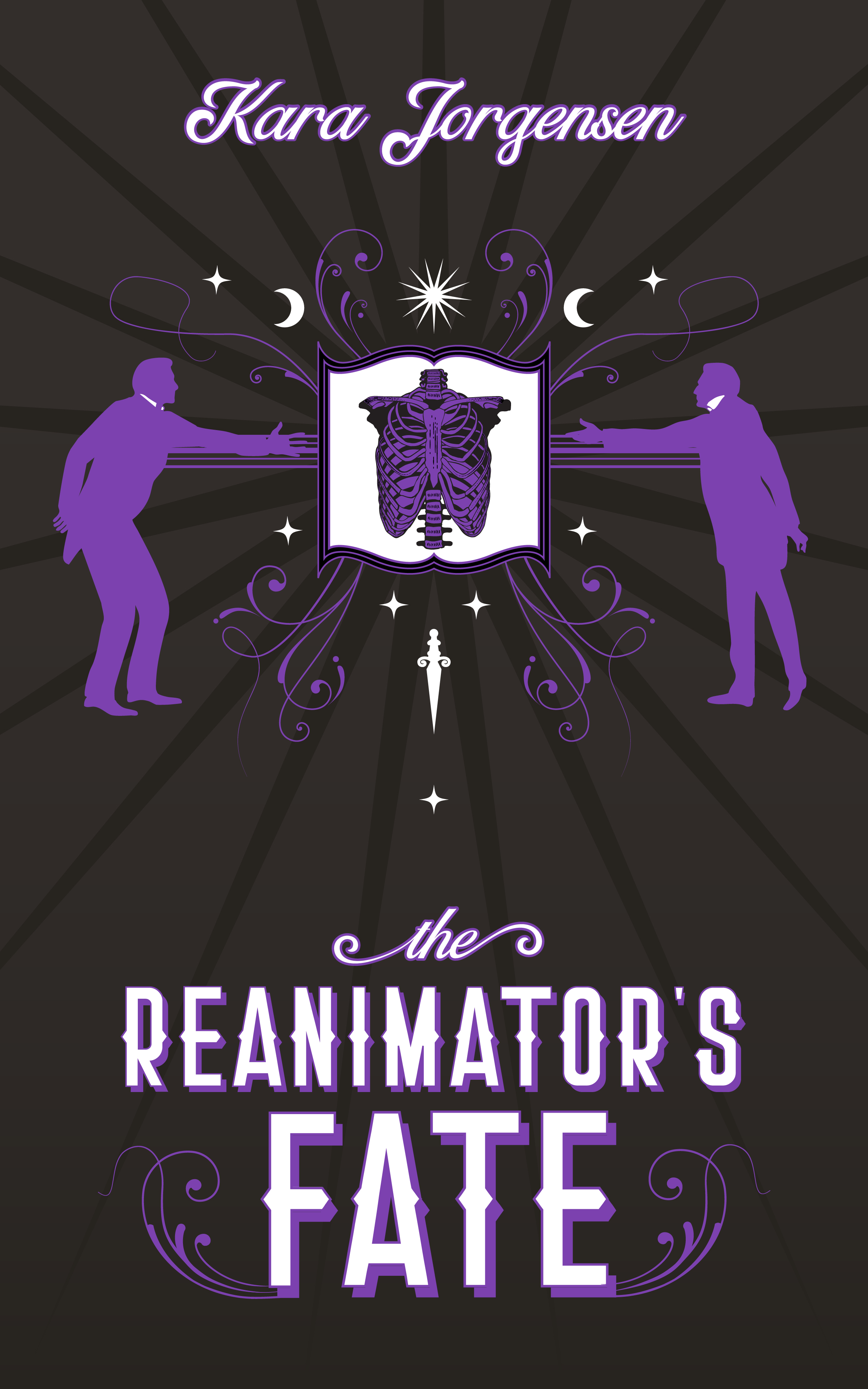
  6. Growing some spines– as the cover may suggest, Oliver and Felipe both grow a spine and stand up to some people, real or imagined, in order to become someone new.
  7. Felipe confronts some inner demons– this was definitely hinted at in book 3, but Felipe is facing down more of his inner demons and finally taking them on.
  8. Prophecies– the prophecy from “An Unexpected Evening” rears its head. If you haven’t read that short story yet, I highly recommend doing so, especially since it’s free!
  9. Oliver gets to tell people off– I don’t know about everyone else, but I really enjoy when Oliver finally snaps and goes off on people who deserve it. In this book, we have more than Oliver pops-off incident. Conversely, he also does a lot of heavy lifting for Felipe emotionally in this book, which feels like a good balance.
  10. This is the final novel in the Reanimator Mysteries series– while there will be a short story collection with all of the in-between stories and several brand new ones, The Reanimator’s Fate is the last big story I have planned for Oliver and Felipe, so I hope you will come and see them off.

If any of this sounds interesting to you, I hope you’ll preorder The Reanimator’s Fate, coming out on January 29th. You can get it all major retailers, and the paperback will be out in January.

Or start the series with The Reanimator’s Heart in ebook, audiobook, or paperback (and in library systems).

the reanimator's fate · Writing

The Reanimator’s Fate Cover Reveal

Today is the day we have all been waiting for, the cover reveal for The Reanimator’s Fate (TRM #4). Crowglass Design has outdone himself with the cover for The Reanimator’s Fate! The cover is *chef kiss* and captured the strain the boys are under in the final installment of the Reanimator Mysteries series.

If you haven’t read book one, you can start the series in ebook, audiobook, or paperback, or you can grab book 2 or book 3 in any of those formats. I also have a sale going exclusively on Itch.io where you can get each ebook for $1.99 until the end of November.


The Reanimator’s Fate is the fourth book in the Reanimator Mysteries series and will be out January 29th, 2026. You can preorder the ebook now at all major retailers, and the paperback will be available in January closer to release day.

Check out the cover, current content warnings, blurb, and preorder link below:


An autistic necromancer, his undead love, and a future in peril

The Paranormal Society has been Oliver’s home for over a decade, yet he still isn’t sure where he fits. At Gwen’s suggestion, Oliver joins the mutual aid committee, but between misunderstandings, sabotage, and a life-changing proposition, Oliver once again fears he is out of his depth. At least there’s one thing he can count on: Felipe and the cases they solve together.

Felipe has always been the one everyone can depend on, but after years of bloodshed, fighting, and death, the cracks are beginning to show. The gruesome cases that once sustained him, now fill him with dread to the point that he questions how long he can keep going before he breaks. But if he isn’t a weapon, then what good is he to anyone?

A sinister plot against magical folks is unfolding, one that threatens to destroy the Paranormal Society from the inside. Can Oliver and Felipe grow into the men they were always meant to be, or will their doubt spell their doom?


CWs include but are not limited to: Murder, descriptions of corpses/autopsies, on page sexual content, ableism against autistics, suicidal ideation, violence, blood, gore, anxiety attack, medical peril


the cover for The Reanimator's Fate by Kara Jorgensen. The background is black with purple and white accents. In the center is a book with a ribcage and spine that lines up with the book spine. Around it are suns, moons, and a dagger. On either side of the book is a man reaching desperately for the man on the other side. A tether of lines joins their chests

As much as I hate to write the last novel for Oliver and Felipe, I absolutely love the cover Crowglass Design has come up with. I think he has knocked it out of the park, and I hope you all love the book as much as I do. You can preorder it at all major retailers or add it on Goodreads. The preorder link is a universal link that will take you to Amazon, B&N, Kobo, and more.

Paperbacks will be available in January closer to release day, and the audiobook will be out in spring or early summer of 2026.

There will be a book of collected short stories for Oliver, Felipe, Gwen, and several other reader favorites coming out in late 2026 as well, so stay tuned for that!

Writer Rambles · Writing

Writer Rambles #2

You ever get mad at yourself because something that should work actually does work, so you’re mad at yourself that you put off doing it for so long. That was me this month with using sprints and giving myself concrete writing goals. I used to do this religiously, but recently, I fell off the wagon due to life, work, stress, etc. I told myself that I didn’t need to have goals because I can just write and that’s fine.

*Narrator voice* It was indeed not fine.

I started to get very down about myself because I was struggling to write consistently above a small(ish) amount per day with plenty of work days where I did nothing at all. This led to me feeling bad about myself and internally beating myself up. As you can imagine, this is counterproductive and only makes it harder to write. Not writing makes my mental health slip and my mental health slipping makes me not want to write. It can be a vicious cycle at times. Part of what was making it hard to write and stay on track was I was focusing on a minimum while trying to shoot for a maximum that was unattainable because in my head I was always playing catch-up. “My goal is x, but as long as I shoot for y, I’m okay.” This led to me hitting the smaller goal and feeling bad that I didn’t hit the bigger one. Playing catch-up constantly is stressful as hell, and when you can’t catch up because the goal was unrealistic, it makes everything worse.

In November, I vowed to not do that. I took out my blank word count tracker, set up a monthly goal that was reasonable enough for daily writing where if I missed a day, fully or partially, I could catch up in a day or two. So far, it has been working, and I’m mad at myself for not doing it sooner last month. I wish I had taken a second, regrouped, and restarted my word count goal midway through. My absolute refusal to recalibrate was my downfall, and I’m trying to be better about it because my autistic brain does not like to change or deviate from a plan once I have it in place.

If you’re curious as to what I am using right now to track all of this, I would like to warn you that I have redundancies because I’m still figuring out what my brain prefers at this point. I have a monthly sprints tracker from Sarra Cannon’s Heartbreathing resource library that I’m using to specifically track sprints each day as well as my word count. To track my overall writing goal until I finish, I’m using Pacemaker (which lowkey stresses me out a little, so I haven’t been using it as consistently), but for my monthly goal, I’m trying out TrackBear because a friend was recommending it. It’s similar to Nanowrimo’s graphs, which I think a lot of people will like. I find it less stressful to look at than Pacemaker right now. I have no idea why, but if it works, it works.

Sprinting has also helped a lot when I’m feeling resistance about writing because it is a concise amount of time that I need to work, and after that, I can be done. Often by the time I finish, I’m less stressed and can easily keep writing. I bought a timer cube to help with this as well because I had a bad habit of pausing internet-based timers. I really hate the fact that I need to work around my brain so much, but I’m trying to be kind to myself because the outside world in the US is very stressful and feeling out of control makes my anxiety so much worse.

The lesson I would like you to take away from this that took me too long to figure out is that if something isn’t working, stop and take a step back. Figure out what you need to do to regroup, be realistic with what you are capable of, and start over. You can get back on track. You just need to be flexible and allow yourself to do so.

the reanimator's fate · Writing

The Reanimator’s Fate (TRM #4) is on Preorder

The Reanimator’s Fate (TRM #4) is officially on preorder and will be out January 29th, 2026! You can now preorder it at all major retailers, including Amazon, Barnes and Noble, Kobo, Apple Books, and more. The paperback version will be available closer to release day, but unfortunately, I cannot put those on preorder ahead of time. I also plan to put out the audiobook, but that usually lags a few months behind the ebook/paperback release.

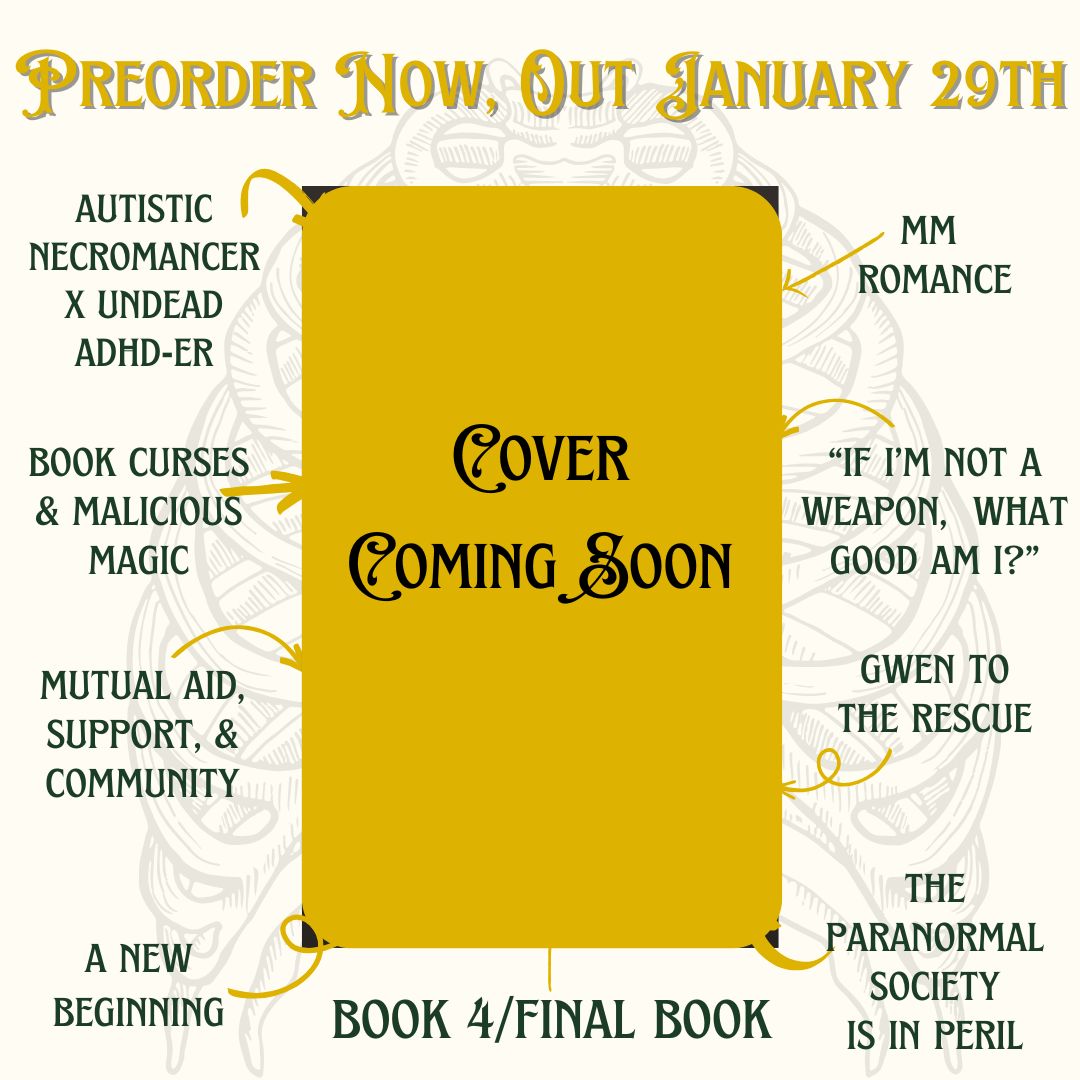
cover reveal soon. preorder now, out January 29th.
autistic necromancer x undead ADHDer, mm romance, book curses and malicious magic, mutual aid, support, community, a new beginning, if im not a weapon, what good am i?, gwen to the rescue, the paranormal society is in peril, book 4 final book

Here is the new blurb for The Reanimator’s Fate:


An autistic necromancer, his undead love, and a future in peril.

The Paranormal Society has been Oliver’s home for over a decade, yet he still isn’t sure where he fits. At Gwen’s suggestion, Oliver joins the mutual aid committee, but between misunderstandings, sabotage, and a life-changing proposition, Oliver once again fears he is out of his depth. At least there’s one thing he can count Felipe and the cases they solve together.

Felipe has always been the one everyone can depend on, but after years of bloodshed, fighting, and death, the cracks are beginning to show. The gruesome cases that once sustained him, now fill him with dread to the point that he questions how long he can keep going before he breaks. But if he isn’t a weapon, then what good is he to anyone?

A sinister plot against magical folks is unfolding, one that threatens to destroy the Paranormal Society from the inside. Can Oliver and Felipe grow into the men they were always meant to be, or will their doubt spell their doom?


In the next month or two, I will have a cover reveal (I am eagerly awaiting to see what Crowglass Designs comes up with), and of course, I will release more snippets, tidbits, playlists, and more. Stay tuned for that!

If you haven’t read The Reanimator’s Heart, the first book in the series, you can find it at all major retailers and library systems in ebook, paperback, or audiobook.

Writing

Giving Myself a Pep Talk

I had a rough week. It was one of those weeks where nothing objectively terrible happened, but a bunch of small things conspired to absolutely wring the life out of you. I was exhausted from the semester starting again, I had a butt ton of papers to give feedback on, I had to go to the DMV to get my car inspected and have my partner get a new ID, my body decided to kick my butt in terms of fatigue and pain, and my partner’s mom ended up in the hospital for a moderately scary issue. Ultimately, mom-in-law is okay and on the mend, the papers got graded, and everything went well, but I barely got any writing done this past week.

On Thursday, I got home from work and thought I would finally be able to write now that everything had settled down, only to have the words bounce off my brain. I could feel myself ready to beat myself up over it, but instead, I stepped back and listened to an audiobook for a few hours before bed. Normally, I would try to just push through or punish myself by refusing to let myself read or decompress with anything fun because I didn’t “deserve” to have dessert if I didn’t eat my vegetables (aka writing). I’ve been trying to be better about recognizing when I’m mentally fried and need to do things to help me refill the well. Void staring as punishment does not help, and I’m glad that I trusted my body and allowed myself to decompress because, even though I didn’t write much on Friday, I was able to reread what I wrote the previous week to reacquainted myself with the text and edit a decent chunk of it.

Even if it was tiny, it was progress. Saturday was a bit better. I hit the point where I realized I needed to major edits on a scene and spent most of the day untangling that mess. Once again, it was a semi-low words day, but I still wrote and still worked on my book. Editing is time consuming and uses up a lot of brain power, which is why it’s sometimes hard to write afterwards. I resisted the urge to beat myself up again on Saturday because I did not hit my minimum goal or catch up. This was all made worse by this being the first week of September– first week, start strong, fresh start, blah blah blah. You get the mentality.

By Sunday, I had hit the realization that it’s just another week in the year. It is one week out of fifty-two, and falling short of your goals because you had a week from hell isn’t a going to ruin The Reanimator’s Fate or set me so far back I can never catch up. It’s fine. I’m fine. The book is fine. Ever since I realized I had to push back the release date for The Reanimator’s Fate, I have felt very guilty about it, even if my readers have been lovely about it. Releasing the book in early 2026 isn’t going to ruin anything or let down my readers who are eagerly waiting for the final book. No one is mad at me. No one hates me. The only one who is beating me up over it is me.

That’s really the crux of the matter: the only one punishing me for not being perfect is me. It’s still hard for me to grapple with the fact that giving 100% does not mean being at peak performance 24/7. I always feel like I should be writing 1k or more a day without fail, but that is unrealistic. 100% sometimes means just rereading what I wrote. Other days, it means just editing, and on bad days, 100% is refilling the well and watching Deadliest Catch while I passively think about what I want to write tomorrow.

My writing career is a marathon, not a sprint, so sustainability is key. Listening to my brain and body is a major part of that, and I’m trying to get better about not beating myself up when I need to take a short break to recharge. Sometimes, a month starts out rough, and that’s okay. A new week is a new week, no matter where in the month it falls. All that matters is that you start again and keep going.

Writing

Dear Young Authors

For the past two weeks, I have spent more hours than I would care to admit watching videos about the Audra Winter situation. If you don’t know, Audra Winter is a 22 year old queer, autistic author who girl bossed to close to the sun, and through hubris and a lack of experience, she went from being a Tiktok marketing sensation who got 6,000 preorders on a sight unseen book to someone people are begging to listen and drop her ego because she doesn’t have the skill to back it up. BookLoverLaura‘s videos do a good job of capturing the whole situation. As a fellow queer autistic who made writing their whole personality in my younger years, I see a lot of my younger self in Audra, so I wanted to talk about some lessons I learned that might help other young authors along the way and things I wish I realized sooner.

  1. Don’t make your book/writing your whole personality– This often comes from a place of passion, which is great, but you are more than your book or your love of writing. Making your book or writing your whole personality becomes a problem when you start viewing any criticism of your book or process as a direct attack against you. Learn to separate your identity from your book or writing productivity. A secondary issue with this arises when you need to take a break or want to do something besides writing. If your entire identity is tied to one thing and you stop doing that thing, you are going to spiral. Staking your identity and self-worth on other people’s validation or one activity is a good way to set yourself up for mental health problems and an identity crisis in the future. As an aside, you are also probably insufferable to others if this is the only thing you do or talk about. Variety of interests is always a good thing. Be colorful.
  2. Younger isn’t always better.– Something I regret is publishing my first book at 23. The years between 23 and 25 provided a lot of growth for me as a writer and as a person. I think if I had waited a little longer, I could have made my first book even stronger structurally and emotionally. As much as I like it and am proud of 23 year old me, it makes me cringe to read now, which is to be expected as I have grown as an author. At the time I was writing it, I definitely had a chip on my shoulder and had plenty of things to work through as a person that hindered my writing in ways I didn’t understand at the time. Society pushes that younger is better and that “prodigies” are special, but authorship is a marathon, not a sprint. You want to create a sustainable writing career, and the younger you are, the more foolish you are and the more likely you are to tank your career over something you would never do as a more mature adult.
  3. Listen to other people!- One of the biggest frustration points with the Audra Winter situation is that she refuses to listen to anyone. You are not the first author to do something, and if everyone is doing something differently than you, there may be a reason for it. When you’re young, there’s often a feeling that you are special and doing things no one has ever done before, but in reality, you just have no idea what you’re talking about and don’t know enough to know what you don’t know. Inexperience breeds hubris. There are TONS of resources online for new authors to help them with writing, publishing, managing money, etc. Use those resources and ask authors who are more experienced than you rather than reinventing the wheel. Most authors are more than willing to point a newbie in the right direction, but if you come off as an arrogant tool, no one will want to help you. In regards to editors, you may not agree with everything they say, but if multiple people (betas, editors, readers, etc.) say the same thing, you need to tamp down your knee-jerk reaction to the feedback and see if they are right. Editors are trying to make your book better, and you will get called out if you ignore obvious issues in your books.
  4. You are not entitled to an audience or career.– I really hate pity marketing, which is when people post things like, hinting that people not buying your books makes you want to off yourself, “The tiktok algorithm keeps hiding my posts. Like and share to help me become a six figure author,” or even, “Support me because here are things the haters are saying about me.” It’s also those videos where it shows someone sitting at a table at Barnes and Noble with no one buying a book in order to guilt-trip people into supporting them. Tonally, there is a difference between this and talking about the realities of being an author. The latter doesn’t ask the viewer to buy anything or follow them. There will be times where a convention doesn’t work out or you sell zero books in a month, but you are not entitled to a following or an audience. Cultivating an audience is a two way street. The author has to create something of value for their audience and earn the audience’s trust by putting out repeated books that are of good quality, don’t feel scammy, and meet their readers’ expectations. If you don’t do those things, no one will want to read your work. Often, authors aren’t attracting the audience that fits with their books due to bad marketing, so you need to do things that will attract those people. Ultimately, whether you get an audience is partly due to algorithms and luck online and partly due to how you present yourself and your books to the world. You are not entitled to anyone’s time, money, or attention.
  5. Don’t expect your income to continually grow every month.- There’s an expectation that businesses will grow in an upward diagonal line, but that isn’t how it works, especially as an author. Your income will yo-yo. There are slow points during the year where sales dip and times where they boom, and if you do sales or bundles, you will often see hills and valleys. There are times when releases don’t make as much money off the bat as you expect or the algorithms change and you see a dip in sales. These things are going to happen. You need to brace yourself for really low income months and spend your money assuming the highs are not going to last. Audra Winter made a ton of money on preorders, and she immediately incorporated into an LLC on the assumption that the money would continue to roll in. There’s a 99% chance it will not continue at that magnitude, so don’t put the cart before the horse and assume you are suddenly going to be successful forever. Virality doesn’t equal long-term success. Building a sustainable author career is key to avoiding burnout and expanding your readership, so focus on the long-term success, not short-term hills and valleys.

If you takeaway nothing else from this post, I hope my younger author friends remember that your author career is a marathon, not a sprint. Build a solid foundation rather than trying to do all the things or trying to go viral, and early success does not guarantee future success. Listen to others, and above all, be yourself/be a person with hobbies beyond writing.

Writing

Join Me on the Trope-ology Podcast

This week I had the pleasure of chatting with Chris (@themythofChris) on their podcast, The Trope-ology Podcast, to discuss my favorite trope, hurt-comfort. I had an absolute blast, and instead of a blog post this week, I hope you will check out this episode where we discuss the psychological pay-off of hurt-comfort, how it relates to disability and chronic illness, the intimacy of being seen, why having needs (big and small met) matters of much in this trope, and of course, a TON of great book recs.

After my conversation with Chris, I think I added like 10 books to my tbr. I have embedded the episode below or you can check it out through the link above, and I hope you will follow Chris and her podcast as well because it’s a lot of fun and features some fabulous authors.

Writing

Do You Need a MFA to Write?

Many writers hear this from teachers or other writing professionals: if you want to be a writer, you need an MFA in creative writing. As someone with an MFA in Creative and Professional Writing, I am here to say you absolutely do not need one with some caveats and things to consider.

My first question to you is, do you want to teach creative writing? One of the most useful things to me that I got out of my MFA program was the pedagogy aspect. I think I took 2 or 3 classes on teaching as a discipline and had at least one creative writing class where creating lesson plans was a larger component of the class. Teaching writing and literature classes was a major thing I wanted to do, so getting an MFA in creative writing gives me more legitimacy in academia. I would also say if you started a Youtube channel or wanted to teach a course or do book doctoring/coaching, having an MFA does add a layer of authority. If you don’t plan to teach writing in some form, you don’t need it. Everything else can be learned through other avenues, many of which are free.

My next question would be do you want to write literary fiction? The reason I ask this is because a lot of programs only focus on literary fiction or delineate that they don’t accept genre fiction. I was in a rather lit fic-focused program, but I was lucky enough to have a professor who writes crime fiction as my first teacher at this program who was incredibly affirming and loved my work. If I had gotten a different professor first, I may not have had as solid of an ego foundation as I did, and being forced to write only lit fic would have upset me as would the patronizing tone of some of the teachers when discussing genre fiction elements. If you are thinking about going into an MFA program as a genre fiction writer, you need to take a long, hard look at the programs you’re applying to and if you can handle people wrongly ragging on your genre of choice. It can shake your confidence and derail the progress you have made.

My experience with my MFA program was a mixed bag. I had a handful of professors who were absolutely fantastic (one was a poet and the other a crime fiction writer especially were amazing) while a few others were horrible (a different poet and the head of the program who was supposedly a fiction writer). The things I really didn’t enjoy about it and that are fairly common with these programs is that there is a heavy emphasis on literary fiction and traditional publishing. This can shut out genre fiction writers or self-publishing writers who don’t feel like they are part of this world or that no matter what they do, it isn’t enough. Truthfully, I don’t like to send my shorter works to literary magazines because there’s little eyeball traffic and no money, and I need to feed my dogs. A lot of what MFA programs promote are prestige-based, so writing for the love of it rather than being paid fairly. Privilege is rife in these programs, and unless you can get into a fully paid program, I don’t recommend dropping tens of thousands of dollars to learn things you could easily find on the internet or in craft books. Also, keep in mind that many MFA programs are also literature focused, so you may be required to take master’s degree level literature classes. If you aren’t an English major or have a literature background, you might struggle. At the same time, there are a few things MFA programs do well that you can replicate on your own with a group.

The two strong suits that I found with my program (besides the teaching portion) were editing and critique groups. These sort of feed off of each other. As a writer, I highly recommend finding a structured critique group to help you get good feedback on your work. I have a blog about this already, which will help you know what to look for with a critique group. These groups should be of people who are at your level or slightly above to help you learn what works and what doesn’t with your work, and it should be consistent in order for you to get the most out of it. Because you get so much feedback in an MFA program as most classes have workshop portions, you end up focusing a lot on editing. The biggest takeaway from these programs is that writing is a process. The process, not the end product, is important. You need to learn your craft, write, edit, write more, edit more, etc. That is something I 100% stand by and agree with. After getting feedback from your workshop group, you need to learn to filter out feedback and figure out what works best for you, what fits with your story, and when you are being oversensitive when it comes to feedback. I haven’t necessarily found a good resource for this online, but I think you need to have thick skin but, more importantly, a clear picture of what you want your story to look like in the end. If you don’t have a vision, you will get led around by the feedback others give you, and they may not be your intended audience.

Once you’ve gotten some feedback from others, I highly recommend doing craft work in the areas that you struggle with, like dialogue, grammar, making things sound natural, writing descriptions, creating mood, etc. There are a lot of great thesaurus style books online that you can buy that help you with conflict, setting, emotional threads, etc. that I highly recommend if you need a reference book to aid you in developing those aspects. I would also suggest checking out Sarra Cannon’s Youtube channel HeartBreathings as she talks a lot about writing as a business and as a writer. She makes some fantastic worksheets and videos to aid in structuring your book and writing your characters’ journeys. These are actually things my MFA program didn’t cover at all, so I ended up relying on Sarra’s videos during my time in grad school. I also have a Pinterest board that has a ton of helpful goodies about writing.

The most important thing I would like you to focus on is figuring out what works best for you and your process. Becoming a writer is a marathon, not a sprint, so finding sustainable habits is key to not burning out. I want you all to succeed and go on to having fulfilling writing careers, no matter what that looks like, and to do that, you need to care for your body and mind first. Take care of your hands (stretch, think ergonomics, don’t keep writing if they hurt). Don’t shrimp (get an ergonomic chair or sit in a comfortable position, straight and stretch once in a while or get a walking desk). And most importantly, you can push back a deadline far easier than you can push off burnout. The key to a long career isn’t an MFA, it’s figuring out the best path for you, whether it’s traditional or self-publishing, being true to your vision, taking feedback, and continually growing as an author while still making sure to care for your body and mind.

Writing

No, You Shouldn’t Use AI, Even on the Small Stuff

If you’ve followed me on social media for longer than a few days, you know I hate AI. I am morally opposed on every level to AI because it not only destroys the environment but is a tool of fascism. As much as I would like to word vomit about that, instead, I would like to speak about why writers shouldn’t use AI, even for seemingly minor details as so many AI-using authors claim to do.

Here’s the thing, there are no truly minor details or unimportant parts of a book as everything needs to further the characterization and mood of the story.

I can already feel some writers rolling their eyes at that. Feel free to do so at your own peril. Writers who are willing to hand over parts of their project to AI to “free up their time” to do other things should instead look at their relationship to hustle culture and why they have chosen quantity over quality. Hustle culture is rife in the writing world with many author groups pushing a churn and burn mentality where authors need to publish every 3 months or be lost to irrelevancy. If you go onto Amazon’s top 100 category boards for books on writing, you’ll find books about writing more or writing faster. While those can be useful, writing more isn’t the same as writing good or better books. The hustle side of the writing world stresses that readers don’t care about the books themselves. They’ll read anything as long as it checks off a few boxes for them, and that once you have hooked them, readers will come back every 90 days to choke down whatever book you throw at them.

I despise this mentality. For one, it is patronizing to readers. Readers won’t stick around if your book sucks or if the quality goes down over time. We’ve seen this with readers noticing an author with a massive backlist has turned to AI, and they abandon them when the writing becomes nonsensical or the quality change becomes noticeably bad. I don’t like when authors treat their readers like shit or take advantage of them by assuming they will always be there no matter how they treat them or how crappy their books are. If you’re a writer, I believe you should write for yourself first, but anything you sell to readers should be the best it could possibly be for them since they’re the ones supporting you monetarily.

What I hate even more about the hustle culture mentality is the way corporate speak has made its way into creative fields. Creativity can and should make you money. Artists should be paid fairly for their work and be able to make a stable living off of it. At the same time, I don’t think creativity should be treated like a business in the way that corporations expect exponential growth at all times. It is unsustainable. We cannot write more books every single year and increase our yearly word counts exponentially. It is impossible and will quickly lead to burn out and quality loss. In order to meet these unsustainable quotas, authors turn to AI because others have convinced them that if they outsource the tedious parts of writing to the machine, they will free up time to write more of the things they enjoy or just write faster. The problem is that those tedious parts aren’t useless; everything in your book should serve a purpose.

What many of these “write more in less time” gurus purposely ignore is writing as a craft. There is almost no discussion of how to make your writing better, only how to do it faster. If they did care about craft, none of them would be suggesting using AI. As someone who teaches young writers how to better their work, every piece of writing I have seen from AI is far worse and emptier than anything brand new writers in my classes have come up with. AI writing is confusing, devoid of charm or character, and just flat-out bad. 0/10 do not recommend using it because it will take way more time to edit than just writing something yourself. A study with people who code showed that while they thought they were taking less time using AI, they were actually taking longer because they had to review it, fix it, etc (source). This is on top of the environmental harm, the fact that it is a tool of fascism, and a plagiarism machine.

The thing that a lot of writers using AI for the “boring parts” don’t seem to understand is that the minor details are incredibly important to your story. One of my most hated posts online is the whole, “Only English teachers care that the drapes are blue. They’re just blue. The author just gave it a random color. It isn’t that deep.” Sure, that can be true occasionally, but 99% of your descriptions and details should be purposeful. When you are creating a world, even if a story takes place in the real world, you are building a microcosm specific to your characters and the story you are telling. Therefore, there is an added level of cohesion and purpose in those details that might not appear in our material reality. When you are setting the scene, you need to think about how you want the reader to feel while interacting with this part of the world, how the structure fits the function of this setting, and how the point of view character effects the way the world is interpreted or experienced. For example, a character with a phobia of dentists is going to view, experience, and describe a dental office differently than someone who doesn’t think getting their teeth cleaned is a traumatic experience. If you just let AI fill in the description of the dental office, you are losing that context. Even if the character isn’t scared of it, they will still notice details other characters won’t, and while you’re writing your story, that should be something you focus on.

The other place I’ve heard people using AI for “busy work” in books is dialogue. This really makes no sense to me because dialogue is one of the best ways to insert characterization, motivation, and movement into a story. Even if you feed a chat bot relevant information about your character, it isn’t going to understand the context of your work and anything about the character below a surface level. Any dialogue it spits out will be generic, boring, and probably ill-fitting for the moment. This is one of those situations where editing extensively will be necessary and will probably take longer than just writing it yourself.

But what if I’m stuck? Why can’t I just use AI to fill in the gap for me?

Because that’s cheating! It’s cheating yourself out of using your brain to puzzle out what should go next. It’s like saying, “I find this exercise hard, so I’m going to use a motor to move the dumbbell for me.” It isn’t going to help you, and at some point, your writing muscles are going to shrink and atrophy until you can’t write anything without constantly circling back to AI. Using AI long-term causes cognitive problems (source). If you continually use it to help write your books, you will become more dependent on it and eventually get worse at writing. The best way to combat this is to face the things that challenge you head-on. Why are you stuck on this dialogue? Why do you struggle with description? Do you not know when you need to add it, or do you simply need some resources to help you name things?

There are a ton of writing resources online made by authors for authors, many of which are free. Instead of using AI, slow down and invest time and effort into getting better at your craft. I know hustle culture says write more, write faster, publish quicker, but the best way to get ahead as a writer is to take time for yourself and do things to be a better writer. Sometimes, that looks like taking a break to read good books, watch shows that stoke that creative fire, do other crafts to refill your well. Other times, it’s dissecting how other authors write well and figuring out how to do that in your own way. Writing takes work, and work means effort on your part. Using AI to write the things that you struggle with or find boring means that you are cheating yourself out of the opportunity to learn, grow, and become a better writer. Before you run to ChatGPT for help when you get stuck, look up a resource on Google that can help you with this particular thing. If you are struggling, others have too, and there’s a 90% chance that someone has made something to help you figure it out on your own.

Writing

AI Writers, Please Quit

I came across this excerpt from a writer talking about using generative AI during her writing process, and all I have to say is, if you use generative AI to help you write your book, please quit writing.

That isn’t hyperbole or snark; I mean every word. Here’s the thing about writing, it isn’t glamorous, but people think being an author is. People who use AI to write some or all of their books want the aesthetic of being a writer. They want the fans or readers, they want the pretty covers, the money (lol), the minor amount of fame and prestige it bestows upon someone who has published, but ultimately, they don’t want to do the work to get there. And writing is work. It is incredibly unglamorous work. It’s long days staring at a screen, figuring things out, murmuring to yourself, getting stuck, and getting stuck, and getting stuck. It’s weeks of fiddling with descriptions or rewriting things that don’t quite make sense or need a bit more life breathed into them.

For the writers who use AI, they look at the work part and think about how to eliminate it. Who wants to deal with the ugly, un-fun bits of the process? Let the machine do the things I find hard or unenjoyable.

But once you outsource your process to the plagiarism slot machine, is it even yours? See, the thing about AI is that it doesn’t magically come up with new stuff for you. It’s essentially the predictive text feature on your phone, so it pulls up the most likely thing it can from a combination of words. Not the most correct or the most interesting, the most likely. Whatever description or idea it is spitting out is the lowest common denominator. It’s always going to give you a homogeneous, verbal statistical average. If you generate a bunch of statistical averages, your book is also going to be statistically average and have the same voice as other writers using AI. For some writers, at least the ones who use AI, that’s fine. As long as they can make a little more money or churn out work a little more quickly, who cares if the quality suffers? Their readers won’t even notice.

The fact that they think their readers are so indiscriminate that they won’t even notice their is statistically average is sad. Either they don’t value their readers and don’t think they’re intelligent or they have cultivated a following of people who will shell out for average slop and be happy about it. Personally, if an author I read did that, I would stop reading them, unfollow them, and never give them a dime because they don’t respect me as a reader, and I know a lot of other readers and writers who would do the same.

The thing about art is that the process is the important part. We make money off the final product, but we better our skills through the process and ultimately that is what gets us the best product. Going back to the original quote above, writing that off-handed description of the lobby in the paranormal fish hospital is part of the process. It is the process of getting better at writing descriptions; adding more depth, realism, and interest to your setting; adding theme or mood into your story through the use of setting. No description in your book should be pointless enough that you can hand it off to a computer to write. If it serves no purpose, don’t write it.

The fundamental issue with writers using AI is that they choose to outsource their creativity instead of bettering their craft. Learning your craft comes from doing mundane bits repeatedly or by dissecting what writers you like do and figuring out how to work it into your writing. It’s like playing a sport. Having a robot shoot baskets for you won’t make you better at basketball, only you doing lay-ups and practicing can do that. Writing, art, crafts, etc. are skills that can only be increased with practice. Every writer using AI has lost the plot in that regard. Outsourcing the mundane bits will ultimately make you a worse writer because the muscle you have for writing those bits will atrophy over time, and you will have to rely on it more and more. Same for using it for research, coming up with ideas, outlining, editing, etc. Those are skills you need to learn and strengthen through practice and getting feedback from other people. The machine cannot give you feedback as it does not have a brain that can analyze and be critical. It can only regurgitate what it thinks you want to hear. It’s also not a search engine, so any research it brings up is not necessarily accurate, just the thing that appears the most in relation to the terms you gave it. It’s a median machine.

At its core, authors utilizing AI leans heavily on the idea that talent for art or writing is either innate or store-bought with no between. Those who think they don’t have innate talent go for store-bought (the AI) when in reality the writers they think are innately good have just practiced for years and the store-bought isn’t talent, it’s basically a box of saw dust mislabeled as cake mix. Adding your characters’ names to it won’t make it any better, but people will still buy it if you put a shiny enough wrapper on it.